I’m Either Sleepy or Angry

This is an honest dilemma.  We’ll talk about what a lemma is in just a moment.  It may not be a dilemma for this particular child, whom Bette says is about 8 months old.  And even if it were a dilemma for this child, I have no intention to attribute this particular phrasing of the dilemma to this particular child.  The phrasing is clearly inappropriate to this child, which is why someone thought it was funny and put it on the web.  I thought it was hilarious, which is why I downloaded it.

Nap 1

A lemma is a proposition.  The fact that is comes from the Greek lambanein, “to take,” will help us phrase “proposition” as “taken for granted.”  But having two lemmas doesn’t really bring us to di-lemma.  To be a di-lemma both of the courses of action must be unsatisfactory and/or uncertain.  If you have to go one way or the other and can’t tell which way you should go, you have a dilemma.  Door #1 or Door #2 is not a dilemma.  “The Lady and the Tiger” is a dilemma.

Now, is the situation this child faces, a dilemma?  There is absolutely no way to tell whether a child that age could construe alternatives of this kind.  I, however, face that choice very nearly every day and I don’t always resolve it in the same way.  And neither do you.

Yesterday, I watched the Seattle Seahawks manhandle the San Francisco 49ers.  Looking back on the game, one of the commentators lined up a series of plays in which a very good Seahawk cornerback completely covered a 49er wide receiver.  Lots of physical play, all legal, but intensely frustrating.  Toward the end of the series, there were several plays when the wide receiver didn’t even run his route.  He just ran up the the cornerback and started pushing him.  He had decided to cry about being tired.  He had lost all interest in his nap.

Here’s a clip from a piece I wrote in anticipation of giving up university teaching.

Now let’s consider the player whose job it is to make the free throws.  This is the character in the drama with whom Clarence Thomas identifies.  This player’s  job, as Thomas sees it, is to focus on the rim and ignore the distractions.  But now imagine that he begins to think that the behavior of this unruly mob behind the backboard is intolerable. He, the player who is trying to make the shot, is doing what must and should be done.  They, who come to the game with entirely malevolent intentions, are doing what should not be done.  Justice Thomas has just been changed from a player—focus on the rim, make the shot, win the game—to a critic.  As a critic, he will not be as good a player.

I think that is where I am as an educator; I am becoming a critic.  I am having more and more trouble remembering how much more important it is to make the shot than it is to disapprove of the mob behind the basket.

I found myself right on the edge of crying about being tired—right on the edge of passing up a really restorative nap.  So I decided to give it up the crying and take a nap instead.  That is what I am doing now.

This child feels bad.  Look at his face.  He doesn’t know why he feels bad, but even he has the choice of calling the kind of bad he is feeling “sleepy,” and falling asleep or calling it “uncomfortable” and being angry about it.  And so do we all.

The choice to “cry about being tired”—and all of the analogs that make up adult life– is a moral choice; it is a protest.  It expresses our unhappiness.  It holds someone “accountable”—although it might just be the person who is nearest.  At that point, we don’t really care.

The choice to “take a nap”—and all the adult analogs– is not a moral choice.  It is an instrumental choice.  We feel uncomfortable and we are not sure the means of dealing with that discomfort are available to us, but Dilemma 2some means are available, and we incline toward those.  If “taking a nap” doesn’t work, there will always be time later to “cry about being tired.”

I really don’t approve much of people who think that “crying about being tired” is “the wrong approach” and consequently don’t do it.  They are stoic.  I think that’s too much.  The people I like are the people who try the solutions that are within their power (“napping”) first but who are willing to express their displeasure (“crying”) effectively should the occasion call for it.

All this to say that this kid’s face illustrates a dilemma that seems very familiar to me.  I wonder if it seems familiar to you as well.

Posted in Living My Life, ways of knowing | Tagged , , | Leave a comment

Why I Became a Political Psychologist

I didn’t know it at the time, but I became a political psychologist so I could study stories like this from all different angles.  The top of this story is how the City of Portland (Oregon) is handling the question of parked cars with blue “Handicapped” tags hanging from the rearview mirrors.  That’s the story as it appeared in the Oregonian, which you can see here.

It’s a perfectly legitimate story, but it can be approached from so many other ways.  When I was it grad school at the University of Oregon (Go Ducks!), I began to say that I was interested in the commitment of psychosociopolitical resources.  Even in grad school, that sounded pretentious so I gave it up.  Not right away, of course.  It does suggest, however, that I was looking for a way to look simultaneously at the way individuals formulate problems, the several ways societies try to respond to (or preempt) those problems and the way governments use the scarce resource of authority to define the issues and the outcomes.  That’s still what I am interested in.

Let’s start this story at the political level.  The government does, after all, set the conditions for Novick 2parking and has an interest in how this scarce resource is offered.  Here is Steve Novick, one of the five commissioners who run the city of Portland, Oregon.

“The idea that more than half of the people with business in the core area of downtown Portland have disabilities that preclude them from using parking meters or other forms of transportation frankly strains credulity.”

Novick has never been known for his subtlety of expression.  Then again, Lynne, in the next scene, isn’t all that subtle either.

On Tuesday, an IRS employee named Lynne smoked a cigarette next to her Volvo parked outside the downtown Portland federal building. It was one of five parked cars displaying disabled placards on the street. “I have multiple issues,” she said, without going into details. “But honestly, I just couldn’t afford the $150 a month for parking. I’m not the only one doing it.”

A conversation between Novick and Lynne would go like this.

Novick:           So…you don’t actually have a disability.  You’re just ripping off the system.

Lynne:             I have no intention of ripping off the system.  I just can’t afford to pay the going rate for parking and a lot of us feel that way.

We could start thinking about personal values like integrity.  Lynne needs to lie to her doctor about her condition, then accept a parking pass she doesn’t deserve, and then deprive the city of the income the parking meters should generate and deprive honestly disabled people the parking spaces they need.

It is a commonplace of political theory that a society of law-abiding citizens can get by with a remarkably modest government.  This government does not intrude unduly on the lives of its citizens and, partly for that reason, it is a very inexpensive government.  This small decorous government requires people not to act the way Lynne did.  But if you look at the reasons Lynne gave, you see right away that her behavior is not the only problem she is carrying around.  In my line of work, we call these reasons “causal attributions.”  Here are two.

Novick 1The first is that she would not otherwise be able to afford this particular amenity.  Here is a block of cars enjoying this particular privilege.  The list of things Lynne could steal using that reason is staggering.  These clothes.  This BMW.  The restaurants from which I steal meals by using bogus credit cards.  The fact is that all these are covered quite nicely by the excuse that she could not, otherwise, have afforded them.  It is a very broad rationale and why should she limit it to disabled parking tags?

The second is that she is not the only one doing this.  The idea that it needs to be unique to be illegal is staggering.  Every drug lord can point legitimately to the existence of other drug lords; every embezzler to the actions of other embezzlers, and so on.  “What I am doing is not wrong because it is not unique” is the standard she is using.

Still, you don’t buy these parking tags from a vending machine.  They are like prescriptions from your doctor.  Your condition is assessed and a pill or a rehabilitative program or a special permit are issued.  It is your doctor’s status as a trusted professional that assures us that he or she will not simply sell these parking tags.[1]  And what if there is a Portland Association of Physicians?  Would they guarantee that their members would simply not sell these parking tags and would they use fines, censures, and loss of license as tools?  They might.  But they will certainly not discipline a physician who is simply worn down by the persistence of a patient who wants cheap parking and who knows that wearing down her physician is the only way to get it.

Novick 4You might want to rely on the community of professionals to prevent abuses of this kind, but I don’t think that is going to be effective.  Or, to start from the other side, you might want to rely on the community where Lynne lives.  Let’s imagine that Lynne lives in an old, stable, neighborhood which has norms of conduct that are so well agreed upon that they are never discussed among the adults.  They are much discussed with the children, however, because that is one of the ways social norms are clarified and enforced and “Don’t do what our neighbor Lynne did” would certainly be one of the cautionary tales.

There could be, in other words, a community of professionals that prevents its members from abusing their control of parking tags and/or a community of neighbors capable of saying to one of their own who has offended the neighborhood’s character by using a pass everyone knows she is not entitled to, “We wish you would stop using that pass.  It’s embarrassing.”

A society of solid, morally engaged communities—both professional and neighborhood, in this instance—will prevent the problem we have been looking at.  And they are very inexpensive, compared with the legal solutions which government will apply if necessary.  And in Portland, one of the Commissioners is concluding that something has got to be done.  He is a city commissioner.  He will not propose that we develop more moral citizens or more controlling communities.  He will propose stricter enforcement and punitive fines.  Maybe he has already.

 We come, finally, to the politics part of my psychosociopolitical schema.  There are lots of places the government can step in.  Doctors, for instance, are regulated very lightly by governments because they have professional associations and they can “police themselves,” as the saying goes.  If they don’t police themselves, there is no reason government cannot step in and charge the offending physicians.  It’s a terrible solution in nearly every way, but if the choice is between this solution and just holding your nose at this persistent parking fraud, it might seem like the lesser evil to a majority of commissioners.

On-the-street surveillance is not only possible, but, as costs go today, it is relatively cheap.  With very little tweaking, we can appropriate the threat made by gangsters in gangster movies, “We know who you are and we know where you park.”  We did all that with surveillance cameras.  And the fraud division found out that the doctor you got this pass from gave passes easily to three undercover cops posing as new patients, so he’s got some legal problems as well.  Oh, and did we mention that the fine for the kind of parking you’ve been doing has just tripled?  And that the next time, your driver’s license goes away, too?

Programs like these are all possible and they are all legal.   They are cures that are worse than the disease, as political solutions often are.  They burn up the presumptive good will of citizens as if it were an easily renewable resource.  It is not.  It extends surveillance from national security warrants to parking abuses and we are watched, in my judgment, way too much already.  And these programs are expensive.  The cameras aren’t, because of the plummeting costs of all kinds of technological solutions, but everything after the camera is much more expensive and the enhanced budget requests of all the winning departments will make sure it stays more expensive.

I called these “levels” of activity and analysis.  It isn’t that an issue like this is “psychological” and therefore not “political” or “social.”  The problem itself can be looked at profitably from all three—and there are more than three—perspectives.  Each of these perspectives gives a different understanding of the issue and new ways to address it.  And that’s what I’ve been doing since 1974, when I stopped talking about “psychosociopolitical resources.”


[1] As Rod Blagojevich, former governor of Illinois, said about his control of a U. S. Senate seat, “This is a fucking valuable thing, I’m not just going to give it away for fuckin’ nothin’.”  I apologize for the language in my consistently vanilla blog, but I think it helps convey Blagojevich’s disdain for the law a little more clearly.

Posted in Political Psychology, Politics | Tagged , , , , , | Leave a comment

The Putin Critique

Every time I taught P.S. 102 at Portland State University, we studied the effect of the electronic media on American politics.  And every time we studied that, we discovered that “bias” was everywhere.  Everyone who cared enough about an issue to write about it or lobby for it or to fund campaigns favorable to it turned out to be “biased.”

Very shortly after we reached that point, someone would ask me where to go to get unbiased news.  I always said there wasn’t any such thing, and proposed my own solution to the dilemma.  Round up a substantial array of biased sources, read them all, take them all seriously, and draw a conclusion rooted in your own values.

It’s a pretty expensive solution to the problem and I suspect very few students actually followed it, Putinbut if they had, and if they had run across President Putin’s op ed piece in the New York Times, (which you can see here) and had brought it to me to see, I would have said, “See.  It works.”  This is a really marvelous speech.  Having written my share of speeches, I can tell you I would have been proud to have written this one.  It does exactly what Putin wanted to do and it paints his opponents into a corner.

Just look at these few elements.

No one wants the United Nations to suffer the fate of the League of Nations, which collapsed because it lacked real leverage. This is possible if influential countries bypass the United Nations and take military action without Security Council authorization.

The U. S. is invited to bring significant international conflicts to the Security Council of the United Nations, where they can be vetoed.  The alternative—THE alternative—is unilateral action, which will ruin the U. N.

Or how about this one?

No matter how targeted the strikes or how sophisticated the weapons, civilian casualties are inevitable, including the elderly and children, whom the strikes are meant to protect.

The most powerful part of President Obama’s speech was that we need to do whatever is necessary to prevent the death of so many children.  President Putin points out that dead is dead.  The children who die of poison gas and those who die as collateral damage to drone strikes are laid out on the ground side by side.

Or this one?

No one doubts that poison gas was used in Syria. But there is every reason to believe it was used not by the Syrian Army, but by opposition forces, to provoke intervention by their powerful foreign patrons, who would be siding with the fundamentalists. Reports that militants are preparing another attack — this time against Israel — cannot be ignored.

Here Putin’s argument is more subtle.  There is the factual question: who actually used the Sarin gas?  Then there is the danger to Israel—that is not a name plucked out of the hat—which we exacerbate by falling for the ploy the rebels used to get us to intervene.

But, to my mind, the most interesting by far, was his final point.

My working and personal relationship with President Obama is marked by growing trust. I appreciate this. I carefully studied his address to the nation on Tuesday. And I would rather disagree with a case he made on American exceptionalism, stating that the United States’ policy is “what makes America different. It’s what makes us exceptional.” It is extremely dangerous to encourage people to see themselves as exceptional, whatever the motivation. There are big countries and small countries, rich and poor, those with long democratic traditions and those still finding their way to democracy. Their policies differ, too. We are all different, but when we ask for the Lord’s blessings, we must not forget that God created us equal.

He is saying that the nations of the world differ in many ways—size, wealth, form of government, policy commitments—but all are morally equal.[1]  Let’s imagine a caricature political universe where there is a “free world,” a Communist world, and an unaffiliated and mostly poor, “third world.”  In Putin’s proposal, all the nations that make up these three worlds are equal.  We are all equal because God created us all equal.  The United States as a leader of “the free world” is precisely like the Soviet Union, which dominates the police states that make up their empire.  Don’t let the starkness of this cartoon view distract you.  If there were such a world, the U. S. and the Soviet Union would be morally equivalent.  Furthermore, the Soviet Union and Latvia, which was not even allowed to speak its own language under Soviet occupation, would be moral equals as well.

There is, in short, no moral basis for distinguishing one nation from another.  I think that is preposterous.

Here is what Obama actually said.

America is not the world’s policeman.  Terrible things happen across the globe, and it is beyond our means to right every wrong.  But when, with modest effort and risk, we can stop children from being gassed to death, and thereby make our own children safer over the long run, I believe we should act.  That’s what makes America different.  That’s what makes us exceptional.  With humility, but with resolve, let us never lose sight of that essential truth. 

So “doing the right thing” is what makes America different; it is why we are not just any old nation.[2]  We are willing to do these things—with modest effort and risk—and we are able to do these things, so we should.  “We” in all these instances is the U. S.  In other world, unilateral action or a coalition cobbled together by the U. S. are “we.”  The United Nations is not “we” and nations that are committed to intervening through the agency of the U. N. are simply not extraordinary.

I think that is preposterous as well.

As is often the case, I hesitate between two courses of action.  Very often, even the short-term effects of these actions cannot be foreseen and the long-term effects cannot even be guessed at.  On the other hand, it is also important that we pay attention to how we justify our proposed actions and inactions and I think that the accounts offered by Presidents Putin and Obama are not adequate.


[1] Putin’s phrasing is religious, rather than merely moral, but he just wanted to throw Thomas Jefferson back at us.  It is interesting that he interpreted “equality” as Jefferson did in the Declaration of Independence, and not as Lincoln did in the Gettysburg Address.

[2] I know that phrasing is offensive, but ask yourself if it is different from “exceptional.”  I don’t think so.  I think the view of the Americans Obama is pandering to in this reference is precisely that the world is full of ordinary nations and then there is us.  I don’t think Obama actually believes that himself, but he is not acting as a self while he is in office.

Posted in Political Psychology, Politics | Tagged , , , | 2 Comments

With Your Eyes So Blue (not Green, but Blue)

Today, I want to think a little about one of the densest and most debated texts I know.  It is the Prologue to the Gospel of John, found in Chapter 1, verses 1—18.  These verses have made and ruined academic reputations, split churches, and very likely have made or ended pastoral careers.  I should say before I begin that this post is going to have to be longer than usual.  I’m sorry.  The next one is going to be about Vladimir Putin’s New York Times editorial and if you want to wait for that one, I understand.  This one will require a little huffing and puffing.

I’m not going to do anything that belongs in that league, but I’ve been thinking about some comments made by Raymond E. Brown in his lectures on the gospel of John and in his commentary on John as well.  As I read the Prologue, the question of “rather than what” keeps coming to my mind.  From a rhetorical perspective, it is obvious that when you say that an object is something, you are saying that it is not something else.  A hand, as St. Paul says, is not a foot. 

Very often, however, either “what it is not” is not explicit or “why the distinction is important” is not clear.  So in addition to my “rather than what” question, I must as “why does it matter?”

1 In the beginning was the Word, and the Word was with God, and the Word was God. He was with God in the beginning. Through him all things were made; without him nothing was made that has been made. In him was life, and that life was the light of all mankind. The light shines in the darkness, and the darkness has not overcome[a] it.

There was a man sent from God whose name was John. He came as a witness to testify concerning that light, so that through him all might believe. He himself was not the light; he came only as a witness to the light.

The true light that gives light to everyone was coming into the world. 10 He was in the world, and though the world was made through him, the world did not recognize him. 11 He came to that which was his own, but his own did not receive him. 12 Yet to all who did receive him, to those who believed in his name, he gave the right to become children of God— 13 children born not of natural descent, nor of human decision or a husband’s will, but born of God.

14 The Word became flesh and made his dwelling among us. We have seen his glory, the glory of the one and only Son, who came from the Father, full of grace and truth.

15 (John testified concerning him. He cried out, saying, “This is the one I spoke about when I said, ‘He who comes after me has surpassed me because he was before me.’”) 16 Out of his fullness we have all received grace in place of grace already given. 17 For the law was given through Moses; grace and truth came through Jesus Christ. 18 No one has ever seen God, but the one and only Son, who is himself God and[b] is in closest relationship with the Father, has made him known.

I have read that straight through, all my life, without asking the two questions with which I began this post.  There are two reasons for reading it the way I always did and the way everyone I knew always did.  The first is that reading it with the alternatives in mind is a lot of work.  The second is that it isn’t always work that leaves you feeling clear and committed.  Sometimes it makes you feel unclear and hesitant.

Let’s postpone the Prologue for just another moment to consider the “what is not there” question.  For that purpose, I propose, “Down by the Old Mill Stream,” the beginning of it anyway.John 2

Down by the old mill stream

Where I first met you

With your eyes so blue

Dressed in gingham, too

Sometime in my unremarkable past, I learned another version.  This is the version that pretends to care a good deal about our first question, which, you will recall, is “Rather than what?”

Down by the old (not the new but the old) Mill stream (not the river but the stream), Where I first (not the last but the first) Met you. (Not me but you.) With your eyes (not your ears, but your eyes) Of blue (not green, but blue). Dressed in ging- (not silk but ging-) -ham too. (Not one but two.)

I say it “pretends to care” because some of the appositions are nonsensical and the ones that aren’t are trivial.  Is there really a new mill stream?  Are streams different from rivers in any important way?  Would anyone celebrating the beginning of a romance distinguish when I last met you from when I first met you?  Does “when I first met me” make any sense at all?

John 4However, when we get down to eye color, we begin to have something.  Let’s make it brown instead of green.  I remember a song that has the line, “Beautiful beautiful brown eyes; I’ll never love blue eyes again.”  Not blue but brown.  If there were rival clans, one of which had blue eyes and the other brown eyes, what would a romance between a brown-eyed boy and a blue-eyed girl mean?  It would mean what Capulet and Montague mean; what Hatfield and McCoy mean.  It would mean war.

So of all the nonsense accompanying that old mill stream, we come up with one distinction that points us in the right direction.  When I say “blue eyes,” is there an alternative that matters?

So—finally—let’s look at the Prologue and start with the last verse.  For working purposes, I am going to use my New Jerusalem Bible, which reads, “No one has seen God; it is the only Son, who is close to the Father’s heart, who has made him known.”  We know now that someone has seen God and has made Him[1] known.  Who is it?  Jesus Christ.  Who is it not?  Moses.

“The LORD would speak to Moses face to face, as one speaks to a friend,” says Exodus 33:11.  Prologue 1Here we have a tradition saying that Moses has seen God and a tradition saying that he has not.  These two communities are the leaders of the synagogues around 100 A.D. and the believers in Jesus who were being thrown out of the synagogues around 100 A.D.  In the bluntest and least conciliatory phrasing, we have the author of the Prologue saying “You say your guy saw God face to face, but you are lying because no one has ever seen God.  Except, of course, for our guy who is close to the Father’s heart (v. 18) and who was “with God in the beginning” (v. 2)”

Honestly, I don’t want to enter into this dispute.  My contribution to it is a) to note that there is a dispute and b) to show that only one side—the side making the claim in this text—is represented.  This text says “blue eyes,” but it does not say “not green eyes.”  It takes some study to come up with the green eyes.

Let’s try another.  Take a look at verses 12 and 13.  Here it is in the New Jerusalem Bible.

But to those who did accept him, he gave power to become children of God, to those who believed in his name—who were born not from human stock or human desire or human will, but from God Himself.”[2]

In all honesty, I will have to say that in verse 11, just before this passage, it says that the Word came to his own people—Israel—and his own people did not accept him.  That’s why I underlined did accept him.  Some did (Jews who believed in the claims Jesus was making) and some didn’t (Jews who found those claims the rankest blasphemy).  The people who accepted Jesus were begotten of God and Jesus gave these people the power to become the children of God.

There’s the positive reading.  Who can possibly object to God choosing some to be his children?  Well, remembering that the Prologue is a monument in the ongoing altercation between two parties, you become a Jew by having a Jewish mother.  The priests are descended from the tribe of Levi.  We are ourselves descended from Abraham (Chapter 8, verse 33) and we are disciples of Moses [because] we know God spoke to Moses (Chapter 9, verse 29).  Those are substantial claims and they had allowed Israel to hang together for centuries.

Here is the negative—that is, the version where the pejorative comparison is featured—version.  All those are wadded together into “human will” and contrasted to the creative gift of God.  What your guy (Moses, Abraham) has and so what you as their followers have, is “merely human.”  What our guy (Jesus) has and the gift of God which he has given us is divine and not human at all.

Let’s do one more.  This is harder because you have to stretch a little to see what is not there.  It is the Torah that is missing.  Here is the positive reading.  God created the world good.  He sent life and light into the world, but mankind chose the darkness.  That’s the story of Adam and Eve and their descendants who must live in the darkness their ancestors chose.  Then God send light into the world again (the Word) and even now, those who accept him may choose the light of God’s presence.  God is trying really hard here.  He offered light and life once and got His hand slapped.  So he offered them again.  You want positive?  That’s positive.  But as you now know, I am seeing every positive as paired to the exclusion of a (lesser) alternative.

No Jew—ever—would skip from the creation of the world to the incarnation of the Word as Jesus John 5of Nazareth.[3]  You start with creation, then move to the call of Abraham and the Exodus and the incomparable divine gift of the Torah.  This is where God says, “You will be my people and I will be your God” (Exodus 6:7 and many other places).  Why on earth would anyone go from creation to incarnation without citing the fundamental agreement God made with His people?

Why?  Well, remember that we have dipped into the middle of a ferocious conflict between those who believed in Jesus and those who did not.  The Torah is what they had shared.  No one is in a sharing mood anymore.  Why should we emphasize the Old Covenant when God is in the process of offering a New Covenant?

For the people who were engaged in this conflict, careful judgment and peaceful fellowship were not options.[4]  Those aren’t the options facing Christians today—at least they aren’t the options this post is about.  Our options are to read these texts naively—noting only the positive case and ignoring what is excluded—or with a sensitive awareness of how the argument is actually built.  As I Christian, I don’t pretend to be a neutral observer, but for most of my life, I have not been an observer at all.  I have read about the wonderful gift of God without ever seeing the “Our guy is better than your guy” connotations.

Now that I see them, I can’t not see them anymore.  For me, “blue eyes” are always going to mean “not brown eyes.”


[1] I still capitalize the word when I am not quoting someone else.  I’m a monotheist and it just makes sense to me.

[2] I put the dash after name, and capitalized the personal pronoun.  The rest is just what you would find in any New Jerusalem Bible.

[3] And if he did and if he was an Israeli citizen, his passport would get massively more complicated.

[4] Brown says there are some characters in John’s gospel who wanted to stay in both worlds and for whom John has nothing but contempt.


Posted in Biblical Studies | Tagged , , , | Leave a comment

The President Should Be Free to Choose a Response to the Use of Chemical Weapons in Syria

That title is my thesis.  I’m going to make the best case for it I can, then I’m going to read that case several times and see if I am still willing to go along with it.  I will say, up front, that I am trying as hard as I can to make a positive case—this is what we ought to do.  Most of the emotion I have is anger against several negative cases—things we have done already and done in the wrong way—and I know that rejecting the bad actions is no way to choose a good action.  This is a “better angels of our nature” sort of problem.

I’d like to take the time to clarify a few things before I begin.  You noticed that the title of this post Syria 1is ridiculously long.  That is because it contains all the references I now have to clarify.[1]  Note that I specify that it is “the use of chemical weapons in Syria” that requires a choice.  It is not “civil war in Syria” or “Syria’s dictator, Bashir al Assad, is a bad man.” [2]  The “red line” the President drew had to do with chemical weapons, not with who is going to govern Syria.

Second, note that I am trying to preserve for the President the freedom to choose “a response.”  I did not say “our response.”  I did not say, nor did I mean to imply, that the President should be free not to respond at all.  The President might choose diplomatic or military responses or, as is commonly the case, both in varying proportions.  The President might choose a direct military action, like bombing something, or an indirect military action, like arming whichever side has not yet used chemical weapons.  The President might choose a coordinated action by all the major powers—including, as George H. W. Bush did, the Arab League—or he might choose a unilateral U. S. action.  I am not choosing any of those.  I am saying that I want him to be free to choose the one he thinks is best.

Syria 3Finally, by “free to choose” I mean free from congressional acceptance or rejection.  By “Congress,” I do not mean the chairs of the armed services committees and the foreign intelligence committees of the House and the Senate.  They will have to be consulted.  I mean Congress as a whole.

Here is my case.  If the goal is to stop each and every instance of the use of chemical weapons, then the U. S. cannot, alone, be the guarantor of that ban.[3]  That means that a substantial array of nations and international bodies will have to agree to the ban and agreeing to the ban means agreeing to prompt and adequate punishment of whoever violates it.[4]  If President Obama is going to coordinate that scale of agreement, he is going to be collecting, “yes,” “yes, but,” and “yes, if” commitments from an extraordinary array of leaders.  The work he will need to do cannot be done in public.  That’s not how deals like that are made, particularly if our side of the deal requires extensive payments of one kind or another.

Syria 2If there is to be anything like George H. W. Bush’s “New World Order,” the unprecedentedly large collection of nations and organizations that allied to condemn Saddam Hussein’s invasion of Kuwait, it is going to be assembled in private.  That’s the way Bush did it and that’s the only way it can be done.  An international response, in other words, requires that the President be free to cut the best deals he can and not all of them are going to pass the sniff test.

If the President is going to treat the Assad regime’s use of chemical weapons as a U. S. problem—something that will require a U. S. (not an international) response—then he is going to have to deal with the Congress.  I’m talking about House and Senate hearings, not just quiet conversations with the Gang of Eight.[5]  It will be treated to the full partisan attention of Democratic and Republican Senators and Representatives who are thinking about being reelected.  It will be thought about carefully by anyone who wants to be elected President in 2016 and who does not want what happened to Hillary Clinton in 2008 to happen to him or to her.[6]

If the question of whether the use of chemical weapons is going to become a serious international norm, defined and enforced by all the relevant nations and organizations, then it needs to be negotiated and acted on at that level.  Leaving the President free to pursue that goal requires that he be freed from the Congressional Carnival Tent so he can do the job that only he can do.

He doesn’t have to be reelected.  He cannot be reelected.  But he could actually earn the Nobel Prize he got for free just be being elected.  And he should.


[1] It is still better than “bomb, bomb, bomb/ bomb bomb Iran.”

[2] It is also not that the world would be a better place if we turned Syria into a regional model for democracy by invading them and installing a pro-Western puppet government.

[3] I would, by the way, include Agent Orange as a chemical weapon, not because it is an antipersonnel weapon by design, but because it is an antipersonnel weapon in effect.

[4] I am not opposed to involving the International Criminal Court, but they fail on the “prompt” criterion.

[5] “Specifically, the Gang of Eight includes the leaders of each of the two parties from both the Senate and House of Representatives, and the chairs and ranking minority members of both the Senate Committee and House Committee for intelligence as set forth by 50 U.S.C. § 413(c).”  That’s from Wikipedia: I got it by googling “Congress Gang of Eight.”

[6] The early Obama v. Clinton contest was very tight and one of Obama’s very large early advantages over Clinton was that George W. Bush had forced her to vote for the war in Iraq, while State Senator Barack Obama was out giving speeches against it.

Posted in Politics | Tagged , , , , | Leave a comment

Vengeance is His

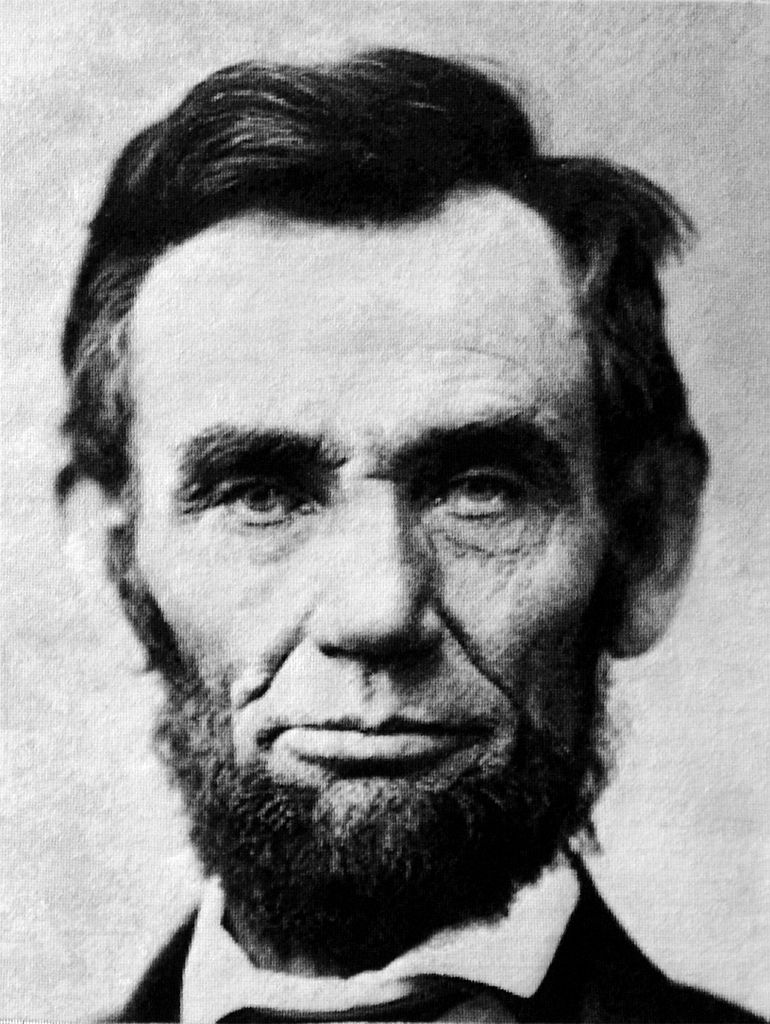
Lincoln 1I have long thought that Lincoln’s second inaugural address was one of the most powerful pieces of English prose ever written.  I still think that.  But I am beginning to wonder whether I have misunderstood his message.  Here is the passage I want to think about today.  I would be happy to have whatever help you can give me.

Yet, if God wills that it continue until all the wealth piled by the bondsman’s two hundred and fifty years of unrequited toil shall be sunk, and until every drop of blood drawn with the lash shall be paid by another drawn with the sword, as was said three thousand years ago, so still it must be said “the judgments of the Lord are true and righteous altogether.”

It is always wise, when considering a passage beginning with the word “yet,” to look at what came before it.  Here it is: “Fondly do we hope, fervently do we pray, that this mighty scourge of war may speedily pass away.”  We want this war to end quickly, says Lincoln.

But “the judgments of the Lord are true and righteous altogether,” so even if it costs the Confederacy unmeasureable blood and unmeasureable treasure, that would be only fair.  That is what it looks like to me.  Here is my argument, such as it is.  Two very nearly rhetorical questions.

Who received the wealth piled up by the slave’s labor over the 250 years of servitude?  As a factualLincoln 2 matter, it wasn’t the slaves.  As a matter of political sensitivity, it also wasn’t those Northerners who made a lot of money on the slave trade.  Lincoln doesn’t mean either of those two groups.  He means Southern slave holders.  If the war continues, says Lincoln according to this interpretation, until the Southern slave owners have lost as much money as their slaves made for them in two and a half centuries, we see God’s justice in that outcome.

Whose blood is going to be spilled if this war continues?  The correct answer is that all the soldiers are going to have to pay.  At this very late state of the war, the Union was losing three men for every two the Confederacy lost.  That was a winning margin for the Union.  But the question of God’s justice calls into question only the blood of Southerners, as I see it.  Who drew blood with the lash?  Owners of slaves.  Whose blood will be spilled, if God’s true and just judgments are to prevail?  Owners of slaves and those armies that defend the practice.

So Lincoln is saying, as I read it, “No matter how much it costs you, God says you deserve it.”

The passage I quoted isn’t the most familiar part of the Second Inaugural and it has never been my favorite part.  Here is my favorite part.

With malice toward none, with charity for all, with firmness in the right as God gives us to see the right, let us strive on to finish the work we are in, to bind up the nation’s wounds, to care for him who shall have borne the battle and for his widow and his orphan, to do all which may achieve and cherish a just and lasting peace among ourselves and with all nations.

I don’t see “malice toward none” and “charity for all” in the passage we considered first.  What I see in that passage is, “You are getting what God says you deserve.”  That’s why I titled this post “Vengeance is His.”  So what does this second paragraph mean?

Looking at it in the light of my (brand new) understanding of the first paragraph, I’d say that this is Lincoln’s Union paragraph.  “Let us strive on to finish the work we are in” would be directed at General Grant.  “Malice toward none” and “…bind up the nation’s wounds” are directed at the Radical Republicans, who weren’t sure that the Lord’s vengeance would really be enough.  Similarly, “all which may achieve and cherish a just and lasting peace among ourselves” is Lincoln’s program for the post-war years.

So this last paragraph of the speech sets out Lincoln’s standards for the post war years.  The earlier paragraph sets out God’s standards of justice as it applies to the South.  It is of such havoc as General Sherman wreaked on the south that Lincoln says, “…still it must be said that the judgments of the Lord are true and righteous altogether.”

Now…I confess that I have never heard anyone say this and I haven’t done a lick of research to see if any of the avalanche of Lincoln books touches this question. I don’t know if it is a startling new insight or something every Lincoln scholar has known for years.

And I don’t care.  I’m a dilettante.

Posted in Living My Life, Politics | Tagged , , , | 4 Comments

What Steven Pinker Should Have Said

On August 6, The New Republic published “Science Is Not Your Enemy: An impassioned plea to neglected novelists, embattled professors, and tenure-less historians,” an essay by Steven Pinker.  It was an attempt to claim the word “scientism” for scientists and by claiming it, take it away from science’s enemies. This is a much-used strategy.  It’s what gays and lesbians did with “queer” and what the Society of Friends did with “Quaker.”

I thought Pinker’s article was pretty aggressive.  It was a name-calling, finger-pointing article. Pinker 5 Note that calling it that doesn’t establish anything at all about whether his accusations were true.  The finger-pointing did produce a lot of responses, though, and the New York Times printed seven of them on August 15. (You can see Pinker pointing one of the fingers here.)

From the seven, I’ve picked these four as the most fun.  None of them responds to what Pinker actually said.  Some talk about a topic they wish Pinker had written on rather than the one he did write on.  Some issue massive rebuttals of positions Pinker did not take.  Many of them have written books on “related topics” and the titles of the books go right below the name and the institutional affiliation.

Mine would look like this.  “Why is Steven Pinker So Scared of Steven Gould?”  Dale E. Hess is Adjunct Emeritus[1] at Portland State University in Portland, Oregon.  He is the author of Steven Pinker and His Critics and a number of films, interviews, VHS tapes and filmstrips on the same subject.  These comments on Pinker, in other words, serve as blurbs for the book.

Pinker 1The first respondent was Karl W. Giberson, a physicist who teaches science and religion at Stonehill College, in Easton, Massachusetts.  Here is his resounding beginning.

We are hard-wired to want creationism to be true. A strong belief in a creation story like that told in the Bible validates the powerful human desire to believe that our lives have meaning and purpose, that what we do matters…

Notice “hard-wired.”  Very scientific.  “Hard-wired to want…”  Not quite as scientific.  “A strong belief (like that told in the Bible) validates our desire.”  Validates?  I could go as far as “illustrates,” but I don’t think our belief actually “validates” anything at all. 

Giberson’s next step is this: “The brouhaha about “biblical creation” is really a proxy war about the reality of meaning in the world.”  Pinker is the war-maker, I’m guessing.  He doesn’t want a war about the creation story (stories) in Genesis, so he is fighting a war, instead, to establish that life doesn’t actually mean anything!  Really?

Actually, Pinker does think that life means something.  He does not believe that its meaning is given to us from “beyond.”  And there is nothing, absolutely nothing, Pinker would like more than a war about “biblical creationism.”

Nevertheless, the problem that shows up clearly in Pinker’s article, according to Giberson, is that he asks “either/or questions” and he should not.  One of the many reasons he should not is that Giberson has written a book.

I laid out just such a “bipartisan” story in my book “Seven Glorious Days,” but the warring camps are just too far apart in this conversation to appreciate any mediation..

Pinker 2My second choice is Kevin Wax, managing editor of The Gospel Project.  The Gospel Project thinks that Pinker went too far.  Of the respondents the Times chose, Wax comes closest to Pinker’s finger-pointing style and is furthest from Pinker’s actual views.  Wax wants to talk about whether people who accept that science is the only path to knowledge really live as if their lives had no meaning or purpose.  They should live that way, Wax thinks, once they have renounced “meaning” as the organizing principle of life, but they don’t.  They live as if their lives mean something.  Furthermore, “science,” is as impressive as religion is in handling data, because science is based on unprovable assumptions and is therefore “based on faith,” just as religion is.  So there.

Pinker didn’t actually raise the question of how scientists are to live, given that they “believe in” meaninglessness.  Wax thinks Pinker should have raised it.  Pinker also believes that scientific assumptions—which must, as Wax says, be taken on faith—are justified by their utility in accounting for data that cannot otherwise be accounted for.  Pinker’s standard is “Trust, but verify.”  Wax thinks that one or the other should be enough.

Wil Gafney is our next respondent.  She is an associate professor of Hebrew and Old Testament at Pinker 3The Lutheran Theological Seminary in Philadelphia and she wants to talk about why the creation account(s) given in Genesis should not be taken literally.  Pinker doesn’t actually raise the question of literal readings of the Bible, but you can tell he knows about them and that he is not happy.

Gaffney spends her days teaching students not to fall for literalism.

Literal readings of nonliteral texts can also lead to fraudulent readings, dogmatic tenacity to ahistorical or unscientific claims, and the loss of credibility for those who insist on nonsensical interpretations.

The dangers of literalism is what Gaffney would rather talk about.  Pinker, we would hope, wishes her well, but I am sure he would wonder why her students are reading sacred texts at all.  Pinker’s view sounds more like this and it is a much broader charge than Gaffney is responding to.

Most of the traditional causes of belief—faith, revelation, dogma, authority, charisma, conventional wisdom, the invigorating glow of subjective certainty—are generators of error and should be dismissed as sources of knowledge.

Pinker 4Finally, my favorite respondent.  Salam Al-Marayati is executive director of the Muslim Public Affairs Council.  He has no interest in Pinker at all.  He has a soft spot in his heart for the fundamentalist position on creationism, but he also thinks that the creationists are pansies.  “You think it’s bad when you want to talk about creationism at dinner parties,” he tells them.  “You should try talking about Shariah law.”

Americans should all be able to discuss topics like Shariah and creationism without intimidation and browbeating. Freedom of speech applies to those who want to follow religion as well as those who want to flee religion.

Al-Marayati has found that people don’t know much about Shariah, but they know they hate it.  He seems to believe that if creationists got treated better, there would be a chance that advocates of Shariah  would be treated better.  I’m sure he would appreciate that and I don’t blame him.  Besides, Shariah is what he wants to talk about and Pinker’s pitch on the virtues of “scientism” is of no more interest to him than Shariah is to Pinker.

I titled this post “Responding to Steven Pinker.”   You know now that I consider that a heavily ironic title.  No one did actually respond to Pinker.  Everyone responded to something that Pinker’s article made them think of.  In many cases, it made they think of the jobs they have or the books they have written.

Of course, I have not responded to Steven Pinker’s argument either.  But I might.


[1] That is my actual title since my retirement.  An adjunct professor is like a substitute teachers in an elementary school except that you get the phone call earlier.  “Adjunct Emeritus” means that I am a substitute teacher based on my merit, which you could take either way, really.

Posted in Political Psychology, ways of knowing | Tagged , , , , | Leave a comment

Grants Pass (rhymes with Alas), Oregon

For some time, I have been pitching a schema that relates society, economy, and polity.  The goal of this device is to explore ways of keeping issues away from the polity, as small government advocates have been proposing.

In Grants Pass, Oregon, I may have found the limiting case.  To the embarrassment of Oregonians who live up north in the Willamette Valley, this piece was published in the New York Times.  I’d like to reflect on it a little.  My plan is to look at the way it is being characterized by several participants, who are quoted in the story.  Then, I would like to put it on the small government grid and see how it looks.

The story, in brief, is that Josephine County, Oregon has not taxed itself to provide what are often called “law and order services.”  For our purposes, that’s a sheriff’s department, enough deputies to do the work, and a jail to put people who need to be put there.  The recent levy would have raised Josephine County’s property taxes from $0.59 per $1000 of property value, Oregon’s lowest, to $1.48 per thousand for the next three years.   It failed.

This brings the manpower of the Sheriff’s office to a total of one (1) and makes the jail unusable for most of the usual purposes.  Some of the residents of the county like that just fine.  Some others are troubled by it.  It does sharply raise the question of what government is for and what the alternatives are.

Let’s start with Sam Nichols and Glenn Woodbury.  They serve on “citizen crime patrols.” PATROL-1-articleLarge These are vigilante groups, I imagine, since they have no authority.  The group they represent,  Citizens Against Crime, says that the county’s financial troubles are having two distinct and beneficial effects.  The first is that they are strengthening the community.  I’d guess that means that the armed citizens who patrol the community feel very good about each other and it may mean that the people they protect feel good about them as well.  The second is that this do it yourself law enforcement shows that, in fact, the job can get done without any increase in property taxes.

Except for the uneasiness I feel which led me to use the word vigilante, I’d have to say that these two claims sound good.  Let’s look at some other perspectives.

Keith O. Heck, a county commissioner, said he fears that the county could break apart into balkanized camps of self-government, each on its own lookout, if a fix to the problem is not found soon.

This fear is completely compatible with the satisfaction of Citizens Against Crime.  A county is an official unit of government.  Within the county, the “balkanized camps” Heck is worried about are exactly the same as the “communities” Sam Nichols and Glenn Woodbury are serving.  In this vision, every “community” arms some of its members and protects those members against other groups.  By that means, the county is balkanized into groups that are not only self-governing, but fully armed.

The question arises, however, of what to do with people you catch in the middle of an attempted burglary.  Do you shoot them?  Do you wait until they try to escape and then shoot them?  You can’t put them in jail because the jail is closed.  And that’s just burglary.  How about public order?

“We have homeless people sitting in the alleyway — they drink, urinate, defecate, fornicate — whatever they can get away with,” he said. And a ticket or citation from a police officer? They laugh and stay put. “They don’t care — they know there’s nowhere to put them,” he said.

That’s from Jack Ingvaldson, the owner of the Grants Pass Liquor Store.  Presumably these activities are violations of public order.  In Portland, they would be warned a couple of times and if it continued, they would wind up in jail.  But then, we still have a jail in Portland

“I hold my breath, every day, for everything,” said Sheriff Gil Gilbertson in an interview in his office, where images of John Wayne lined the walls.

At grocery stores in Grants Pass, stopping and citing shoplifters — sometimes with whole carts of beer or food in tow — have become part of the daily law enforcement routine.

The one Sheriff’s deputy available for general calls in Josephine County might not be at every grocery store that is being robbed.  They will not likely continue to watch as “whole carts of beer or food” leave their stores without having made the customary stop at the cash register.  What’s next?  Armed guards at the groceries?  Shooting shoplifters?  Remember that you can’t arrest them, because there’s no place to put them.

What to do?  I have been using a model in which the social arrangements we make (the society is the blue oval), the economic arrangements we make (the economy is the green oval) and the political arrangements we make (the polity is the red rectangle) are shown together.  The goal of small government fans is to keep issues successfully in the society and the economy.  You keep them there by preventing anyone from appealing to “outside forces,” i.e., the polity.three ring circus

As applied to the Grants Pass situation, it means that people who want these crime issues to remain in the non-governmental areas—that’s the society and the economy in this chart—need to find a way to prevent appeals to Sheriff’s Office.  That means that people will need to prevent violations of community norms.  No one will be hanging around the liquor store getting drunk, urinating, defecating, and fornicating because doing that would violate community standards of behavior.  In every strong community, those internalized standards are the first line of defense.  That hasn’t worked in Grants Pass according to Mr. Ingvaldson, so he just might appeal to the government to deal with the issue, particularly if potential customers are afraid to come to his store.  So this problem is not contained within the society; it is appealed to the polity where there are laws and the necessary funding to enforce them.

No one will deny, I suppose that, the sale of groceries is a part of the economy.  Economic problems like watered stock, noncompliance with contract demands and, of course, theft, could be dealt with by the merchants themselves.  This is precisely how the saloons were run in ten thousand western dramas of which the Virgil Cole series by James Patterson are my current favorite.  Virgil is hired by the owner of the saloon to keep order.  When threats don’t work, Virgil shoots someone and they throw the body out into the street.  And it doesn’t require any tax dollars.  The saloon owner provides the means to protect his own space and his own profits.

If they can’t do that in Grants Pass, they will have to appeal to government to do it.  This is, again, a loss for the small government proponents because the issue escapes from the economic sphere and gravitates to the polity, where authority resides and where tax dollars are spent.

Even a small government enthusiast might conclude that Josephine County has gone too far.  While it is true, as these theorists always say, that things are better when they are handled closer to home—meaning the society, where standards of decency prevail, and the economy, where contracts are honored—even they will have to say that things are not being handled at all and the time for bigger government has arrived.

The idea is that people who want issues to remain in the non-governmental areas—that’s the society and the economy in this chart—need to find a way to prevent appeals to government.  That means that people will need to prevent violations of community norms.  No one will be hanging around the liquor store getting drunk, urinating, defecating, and fornicating because doing that would violate community standards of behavior.  In every strong community, those internalized standards are the first line of defense.  That hasn’t worked in Grants Pass according to Mr. Ingvaldson, so he just might appeal to the government to deal with the issue, particularly if potential customers are afraid to come to his store.  So this problem is not contained within the society; it is appealed to the polity where there are laws and the necessary funding to enforce them.


Posted in Political Psychology, Politics, Sustainability | Tagged , , , | Leave a comment

Secularism 2

It came to my mind, as I was reflecting on “secularism”—my son, Doug, remarked in passing that he was a “secularist” and I got to thinking about how good a term that is—that it was an “extent of time” word, like “day” or “hour” or “age” or “era.”  In Secularism-1, I said the crucial question was whether there was only one age—ours—or whether there is also another one.  I called Doug and me both “secular” because both of us think “this age” is the only one there is.

Nothing I have noted so far has a religious connotation to it, but we have come to the trap door.  If “this age” means “an era bounded by time” and is to be opposed to the notion of “eternity,” then we will have to ask what “eternity” means and that is going to get religious really fast.  (I’m going to come back to touch on one good way to pose the “eternity” question at the end of this note, but only lightly.)  If, on the other hand, “this age” is to be contrasted to “the age to come,” then we get religious even faster.

My view is that neither of those ways of putting the question presents us with the alternatives we need.  I propose, instead, as the second question: “Is this age under the authority of a Being, who has constructed it, who rules it, and who will see to it that it comes out right?”  Since I am writing within a Christian frame of reference myself, I need to say “…a Being who…” only once.  Now I can say “God” and allow the other parameters to be handled by Christian traditions.[1]

If these are the right questions, then we may ask anyone (Question 1)whether there is one age (this age only) and expect yes, no, or “it depends” as the answers.  Then we may ask anyone (Question 2) whether there is a Being, an Agent (“God,” after this) whose rightful authority extends to the governance of this age.  Again, we may expect yes, no, or “it depends” as the answers.

Question 1 puts Abraham, Isaac, Jacob, Moses, Joshua, Doug and me in the same camp.  This “age” is it.  All of us are “secular” in this understanding of the word.  Of those seven people, the first five never considered whether there was an age to come or did consider it and rejected it as pagan.  Egyptians were big on “the age to come;” that is what all the pyramids were about.  We Israelites don’t take that path.  Doug and I have considered it and have our doubts.  We are, then, “secularists” or “only one age-ers,” if that is the meaning we can all agree to give to Question 1.

Question 2 divides us differently.  Those who are both theistic and secular will please form a line at the left.  Of the named people, I am the only one in the line.  The gospel writers are not in that line; the apostle Paul is not, post-Exilic Judaism is not, and, for other reasons, Doug is not.[2]  I really do believe that there is a God who has brought this era into existence, who rightfully rules it, and who will, in the end, bring its story—the story of this age— to an appropriate conclusion.    That makes me a theist and a secularist and makes Doug a non-theist and a secularist.  I have been trying to build a set of pigeonholes that will accommodate Doug and me and this is my best try so far.

I promised that I would come back to touch on the “eternity” question before I finished.  I don’t have anything philosophical to say about it.  Physicists seem willing to talk about things that exist within the space/time continuum or outside it.  I honor their efforts, but I don’t know enough to follow them.  My approach will be a good deal simpler.  I want to deal with “eternal life” as “the life of the ages.”  The Greek is zoein aionion in John 3:16, its most famous location.  The adjective aionion may be understood as an indefinite extension of time—“everlasting” is a way to represent that—or as a different kind of “time.”  I take it as “of the ages” or “for the ages,” which is a perfectly legitimate translation, although it is not the only perfectly legitimate translation.

The contrast I want to make, and I believe the one Jesus had in mind in John’s account of the conversation with Nicodemus, is that there is a kind of life that is lived without meaning or consequence and also a kind that will be meaningful as long as the age lasts.  The former is a life oriented toward transitory goods; toward “use it once and throw it away” goods.  The life that is aionion –significant on the scale of the ages— or, more simply, the life God intends, is not like that.  That life matters now and it matters enduringly.  How enduringly?  Well, all the way to the end of the age.[3]

Acting in a way that matters (that supports the story the Creator is trying to tell through us) all the way until this age is over seems a very attractive meaning of “eternal” to me.  And I think that a lot of us secularists might feel that way.


[1] Needless to say, fobbing the other questions off on Christian tradition does not establish their truth or even they plausibility.  It does clarify things, however, so I don’t have to do it here.

[2] The Jews seem to have brought a new interest in “a life after this life” home with them from exile in Babylon.  I know that’s too simple, but this is a short piece and I think it is close enough for that.

[3] See Matthew 28 for Jesus’ use of that time scheme.

Posted in Biblical Studies, Living My Life, Words | Tagged , , | 4 Comments

Secularism 1

My son Doug has taken to calling himself a “secularist.”  I think it is the perfect word for him, but he used it very casually in a conversation we were having about something else (the influence of Norman French on the English language, as I recall) and I got to thinking about what a good word it is.   I had never heard it used the way he used it and I wondered if I had just not been paying attention. 

The words I am more familiar with are atheist and agnostic.  As I look at them, however, I see that both begin with negative prefixes.  The question being raised is presented by the root—theos = God in the first case and gnosis = knowledge in the second. The position you might take, yourself, is presented not by the root, but by the prefix. These words offer the question, then: a) do you believe in God, or a god, or “the gods?” and b) do you believe we can know for sure about God, or a god, of “the gods?”  Those are really good questions, but they are not the only good questions.

“A secularist is an adherent of secularism.”  I don’t trust dictionaries for everything, but I am secularism 1willing to go with the OED this far.  Secularism (the OED again) is “the doctrine that morality should be based solely on regard to the well-being of mankind in the present life, to the exclusion of all considerations drawn from a belief in God or in a future state.”  I like that definition because I like where it starts.  Here is another; I don’t like this one as well. “…worldly spirit, views or the like; especially a system of the doctrines and practices that disregards or rejects any form of religious faith and worship.”  I found that one in Webster’s New World Dictionary.  Note the emphasis: secularism is a system that disregards something.  Does that strike you as odd?

As you can see, given where I started, it seems odd to begin with what this view disregards.  Let’s play with this idea by looking at some other words.  If I believe that a husband and a wife should keep their promises to each other—all of them; not just THAT one—then I could say I believe in “marital fidelity.”  But this view I hold could be represented by quite a collection of other words that do not take their salience from “fidelity,” but from other notions entirely.  I could be said to be cowardly, the theory being that if I were brave, I would be mating with as many women as would have me.  You could argue that coward is not a word about marriage, but then you would have to admit that fidelity is not a word about bravery.

The root of the word establishes what we are talking about.  I could ask whether you are the kind of person who lives with his tail tucked between his legs (the picture that the etymology of coward gives us) or a person who lives adventurously.  The question of whether I am being true to my marriage vows is not even referred to by this set of terms.  The choice of these terms imagines that we are talking about something else entirely.

Or, to get the same destination by another route, you could say that what I call “faithful,” is just doing the same things with the same person over and over again.  It is just “routine.”  Or worse, it is a routine, a “regular, unvarying, or mechanical procedure, discharge of duties, etc.”— (Webster’s New World Dictionary ).  I am just a dullard, an automaton, vulgar (lower class) or bourgeoisie (middle class), or having no discrimination at all.  The discrimination charge implies that in staying with my original choice of a mate, I am displaying no interest at all in newer models or, worse, no ability to discriminate between my present mate and the set of potential mates.

Secularism 2The word we begin with, in other words, has a landscape of meanings in mind and treats alternative meanings unfavorably.[1]  I may want to talk about how faithful I am to my wife; that brings infidelity onto the table as an alternative.  You may want to talk about how risk averse I am (risk taking is a good thing) and brings risk avoidance onto the table as the unfavored alternative. Or about how mired I am in routine, unable to choose the good that is new or unable any longer to tell the difference.

So the root of the word chooses the topic and the prefix (usually) establishes a position with reference to that topic.[2]  That is why I like “that morality should be based solely on regard to the well-being of mankind in the present life” and don’t like “a system of the doctrines and practices that disregards or rejects any form of religious faith and worship.”  The first one says that secularism holds a certain view.  The second one says that secularism disregards a certain view.

I myself would prefer to say that I value fidelity, rather than that I undervalue courage or that I can’t tell the difference between a lower quality mate and a higher quality potential mate.  None of those distinctions has anything to do with what is true.  All of them have to do with establishing just what we are talking about.

The idea that occurred to me as Doug and I were talking was that secular is a really good word for a relative emphasis on this world and its events and relationships without regard for the additional question of whether there are alternatives (other worlds, events, and relationships).  Being a theist myself, I can’t think of the basis on which I would object to being called a “non-secularist.”  Or an infrasecularist, if the question should be whether my views come up to the level of secularism or whether they stay below (infra- or hypo-) secularism.

Actually, I don’t want to be called a non-secularist.  I just can’t think of how to go about complaining about it.


[1] This makes perfect sense historically, of course, but every history has its own beginning and its own preferences.

[2] Negative suffixes like –ard are sometimes used, as well as the -phobias and the -oseses.

Posted in Living My Life | Tagged , , | 3 Comments