
I heard that line on a Slate Political Gabfest. The question had to do with Donald Trump’s response to things he thinks of as insults. He hits back hard. [1] Hitting back hard” takes the place of “running a disciplined campaign” according Ruth Marcus, a writer for the Washington Post. There’s no telling what it would look like in the White House.
I think it was the line “hitting back hard” that lodged in my mind and my thoughts kept revolving around it until I remembered what I was trying to remember. Very early in his presidency, Jed Bartlet wanted to hit back hard and had to be talked out of it. When I say “early in his presidency,” I am talking about The West Wing, Season 1, Episode 3. Really early. Here is President Bartlet’s starting position.
https://www.youtube.com/watch?v=rtrX9rZl-4
Note the general who proposes the unthinkable. “Sir, are you suggesting that we carpet bomb Damascus?” Eventually—it takes nearly the whole show to get there—Bartlet says not to do that and he settles on what Admiral Fitzwallace calls “a proportional response.”
My concern is that the Trump response—hit back hard—couldn’t be impeded even by all that assembled brass. And if President Trump had answered, “Yes, carpet bombing Damascus is what we ought to do. It’ll teach them a lesson,” then it would be done. That’s what worries me.
It wasn’t all that easy to talk President Bartlet down from that particular tree. Admiral Fitzwallace has put together a “response scenario,” as President Bartlet asked. Here it is.
Yes, sir. Mr. President we put together a scenario by which we attack Hassan airport. Its three main terminals and two runways. In addition to the civilian causalities, which could register in the thousands, the strike would temporally cripple the region’s ability to receive medical supplies and bottled water.
That is a very specific look at what would happen to a lot of Syrians. [2] The goal of Fitzwallace’s use of details, I think, is to get the President to realize what he is doing. He is not “docking someone’d damn allowance;” he is killing thousands of civilians.
But I think Fitzwallace’s second argument is even better. Here it is.
I think Mr. Cashmen and Secretary Hutchinson would each tell you what I’m sure you already know sir. That this strike would be seen at home and abroad as a staggering overreaction by a first time Commander in Chief. That without the support of our allies, without a Western Coalition, without Great Britain and Japan and without Congress, you’ll have doled out a five thousand dollar punishment for a fifty buck crime sir.
Fitzwallace wants President Bartlet to look at himself the way everyone else is going to look at him. He is, for all practical purposes, a rookie. Fitzwallace is not a rookie and he wants to keep the Commander in Chief from making a rookie mistake. I think that is superb staff work.
According to the recollections of people who were in the room when President Obama had to make the decision about the Osama bin Laden mission, he had that kind of support around the table. The Vice President, the Secretary of State, and the Secretary of Defense all leaned on him and helped him see what he would be doing if he said “Go.” He said it anyway.
If there is anyone in Donald Trump’s entourage who has that kind of effect on him, I haven’t read about it. He needs that, even as a candidate. As the Commander in Chief in the War Room, he would need it much more.
In Bartlet’s case, Fitzwallace was enough to get the President to make the prudent decision, but he wasn’t enough to get him to see the matter differently. That took Leo McGarry, his chief of staff and one of his oldest friends. Here’s what that looked like.
BARTLET I’m talking about two hundred and eight-six American marines in Beirut, I’m talking about Somalia, I’m talking about Nairobi.
LEO And you think ratcheting up the body count’s gonna act as a deterrent?
BARTLET You’re damn right.
LEO Then you are just as dumb as these guys who think that capital punishment is going to be a deterrent for drug kingpins. As if drug kingpins didn’t live their day to day lives under the possibility of execution. And their executions are a lot less dainty than ours and tend to take place without the bother and expense of due process. So my friend, if you want to start using American military strength as the arm of the Lord, you can do that, we’re the only superpower left. You can conquer the world, like Charlemagne, but you better be prepared to kill everyone and you better start with me cause I will raise up an army against you and I will beat you!
BARTLET And this is good?
LEO Of course it’s not good, there is no good. It’s what there is. It’s how you behave if you’re the most powerful nation in the world. It’s proportional, it’s reasonable, it’s responsible, it’s merciful. It’s not nothing, four high rated military targets.
BARTLET Which they’ll rebuild again in six months.
LEO So we’ll blow ‘em up again in six months! We’re getting really good at it. [beat] It’s what our fathers taught us.
BARTLET Why didn’t you say so? [beat] Oh man Leo. When I think of all the work you put in to get me to run. [both sit] Wen I think of all the work you did to get me elected. I could pommel your ass with a baseball bat.
[They laugh.]
It’s the laugh that lets us know that Bartlet gets it. He “did the right thing” under Fitzwallace in the War Room. He heard the argument his Chief of Staff makes in his office. But finally…”It’s what our fathers taught us,” gets to him and it makes that shared laughter possible.
But we ought not to let that laughter make us feel that those three thousand Syrian civilians didn’t just have a very close call. They did. And it took a team of professionals who were willing to risk their positions to get that to happen. I don’t see that with Donald Trump and it worries me.
If he is elected, I am going to watch all seven seasons of The West Wing several times. And stop drinking caffein.
[1] “Back” requires, of course, that something was actually said or done that offended him. A person who had done nothing to offend him and who became the subject of Trump’s attacks would not think that he had been hit “back;” only that he had been hit.
[2] This is Aaron Sorkin’s second shot at this particular scenario. He wrote it somewhat differently in The American President. Still, the similarities are stark.
 But before we get to Rover Joe, let’s go back and pick up Kermit. Leroy’s bumbling master, Mordecai Sledge, managed to throw a Sousaphone up in a tree and it came down around Leroy’s neck. Leroy takes off, hauling a whole wagon of musical instruments behind him. He doesn’t know what this thing around his neck is and, having escaped “from”—with no thought yet given to the “to” part—he doesn’t really know who he is either. Kermit solves both of those problems.
 throwed out.” That can be usefully abbreviated as OBUWATO. It is why, in response to the first question, he is sad. It is why, in response to the second question, the reason that his master, Mean Floyd, threw him out the window. They invite him to join them as a travelling musician. Rover Joe declines. What to know what the reason was? OBUWATO. He says it so often that T.R. begins beak-synching with him.
 private if you know what I mean.” That seems clear enough. T. R. hears her with respect. “Come on Rover Joe, the lady’s got her rights.” But again, that is not what she wants and the second verse of the song begins “Well now no one care about this story…”
 In the first scene after Leroy escapes, he is just a donkey running away. But he runs into Kermit, who says, in effect, “You are not a runaway donkey, you are a traveling musician!” I have never seen, in real life, the instantaneous transformation Leroy goes through because Kermit gave him an identity, but I have very often seen a new name given and I have seen a person grow into that name. I have been that person.
 moments ago, you were lying here in solitary misery. Catgut was waiting to die and Rover Joe had been OBUWATO. But someone said, “Why don’t you join us?” The choice is really clear. Yes awful things have happened to you. Yes you are lying here because you had no alternative. But now you do. We are asking you to join us.
 I’ve been there a lot in the last few weeks on one errand or another and I have used the restroom on the first floor just north of the lobby. There is good hot water there and a soap dispenser and a tray of rolled up cloth towels. Very classy. Because people wash their hands at the sink, there accumulates on the counter little pools of water and soap suds. So after I have wiped my hands on the towel, I mop up all the water and soap and throw the towel into the basket under the sink.
 That way of understanding the story has not helped me. It has brought a consistent and principled demand down on my behavior. It has not caused me to intervene when otherwise I would not have. I don’t think I have ever seen anyone intervene because of the “do likewise” instruction. That formulation is really good for blaming yourself, of course, and it is even better for blaming other people, but without compassion, it doesn’t actually work and I think we know that.
 I think that’s a really good idea. The bully’s aggression works by isolating some vulnerable person. If the bystanders refuse to fall away, to expose this boy or girl to abuse, then he or she is not isolated and the bully will have to reconsider. He may very well reconsider by going after you, but that is one of the things you might have to risk. You might be willing to risk it because you feel compassion for the bully-bait, especially if you have seen it before. You feel compassion and you are impelled to follow those feeling with actions.
 Cute.
Cute.
 I know there will be other sortings as well; I’m just not sure what they will be. Will there be a group—a real group, not just a category—of “people who used to be teachers?” Will there be “people who used to run businesses?” Will there be a group who used to be important and miss it dreadfully? Will there be a group of movers and shakers who serve on retirement center or on neighborhood committees and who want to tell you what is going on? I have no idea.
 I know this happens all the time in new settings. I know I am going to walk into the dining room and look around. I am going to see some people dressed as “we used to be teachers” or “we used to run businesses” or “we were stay-at-home moms.” And they are going to look at us, at “the new guys,” and make the same kinds of early decisions. Where is the Sorting Hat when you really need it?
 As I tried to find a way to say what it was about the two conventions that bothered me, I made my way back to 1895 again. That’s when H. G. Wells’ well-known science fiction work, The Time Machine was published. As nearly everyone knows—I’m sure there is a Classic Comic version of this famous story—the Time Traveler goes far into our future, to a time when there are only two species: the Eloi and the Morlocks. Here’s a piece about their relationship from the Wikipedia article on Morlocks, but you can see it all in the picture.
 The production and distribution of goods and services are being globalized. American manufacturers want to find customers for their products and as a global middle class continues to develop and grow, they are finding them. Not the American middle class, but still, a customer is a customer. A global labor market is also taking shape. This pool of “laborers” includes blue color and white collar; it includes jobs in production, sales, and services—including some very demanding services, like architecture and engineering. The need for workers—reduced as it is by robotics—is still quite large, but there is no need for these to be American workers.
 What would help? OK, I’m not going to call it socialism. I’m not going to call it anything at all. But here’s what needs to happen. If American businesses are going to go to the least expensive labor markets and if they are going to sell their products to a rapidly emerging global middle class, then we might as well admit that the cost to our own middle class—the late great American middle class—is going to be catastrophic. [5] The pain these policies cause makes they angry. The pain needs to be mitigated. That is something governments actually can do and they should. They can’t fix the problem, but they can make it hurt less.
 Since Bette and I decided to leave our Hayhurst Neighborhood and move to a good retirement center somewhere, we have been thinking about the going part. How can it be done thoughtfully and gently, honoring all the neighborhood has been for us? And now that we have bought an apartment at Holladay Park Plaza, our choice of retirement centers, it is time to think about the coming part—coming to a new home. [1] HPP is actually in the Sullivan’s Gulch Neighborhood, as Portland counts neighborhoods [2], but I think it would be better for Bette and me to think of HPP itself as our neighborhood.
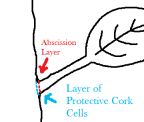 standard are very likely to be rejected at the outset, even though there are other values that also need to be considered. If it isn’t thoughtful and gentle, I don’t want to consider it. I was shopping for a metaphor that would help me think through the process and in the middle of my search, I stumbled on the metaphor I used last January for leaving the neighborhood: it is “the abscission layer.” As soon as I saw that, I knew that I wanted to go around to the other end of the process, which is grafting. Bette and I want to be grafted in to our new neighborhood.
 ced by sunlight and magic and sent to wherever in the tree it is needed. I don’t understand photosynthesis, really, but I know it involves an interaction at a part of the tree whose principal responsibility is to make nutrients and put them into a transportation system that will bring them to the right place.
 Not everyone would call the action of hormones like auxins, cytokinins, and gibberellins “politics,” but I would. The production and inhibition of growth and the distribution of resources to one place rather than another sound like the ordinary work of the legislature to me. We’ll see.
 vision the end” the saying goes, “resist the beginnings.”
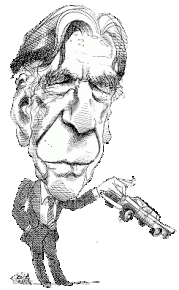 people argue that this or that can be done. Mulgan has the advantage of saying “while this might have happened…it did not actually happen.” Mulgan knows what happened—“is happening,” we would say—and so he knows that the faith in technology was misplaced. And here we have John Kenneth Galbraith, whose book, The Affluent Society focused attention on the early phases of a lot of the issues that are completely out of hand by 2140.
 C. S. Lewis’s setting is entirely different, but the mechanism is the same. The “divorce” of the title is the separation between Hell and Heaven. Every day, the people in Hell (the Ghosts) have the chance to get on a bus and go to Heaven to commune with the people there (the Spirits), and to stay forever if they want to. Nearly everyone doesn’t want to. They get back on the bus in the afternoon and go back to Hell where, apparently, they feel more “at home.”
 suggested in the first part can be logically extended to the second part. All that passage is nonsense, of course, but I would like for you to stop and consider just why it is nonsense. It is not the words. They work fine. It is not the ideas. They can be made to work. It is the sources. What I am going to call the genres.
 Messiah and king and son of God all had triumphant overtones. Jesus just can’t be, according to the Jewish understanding at the time (and today) the triumphant messiah and the suffering servant. One or the other; not both.
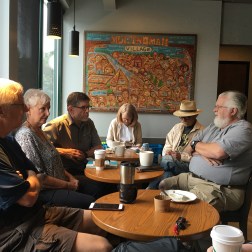 I experienced one of the few failures of conversation I have ever had in our Starbucks group last week. I had a position I wanted to sell. It is position the group almost certainly accepts in general, but they didn’t want to accept it this time. And it is the failure of the conversation I want to point to, not my own failure. Although… (see below)
 When I referred, above, to the position the group accepts as a general matter, this is the position I had in mind. People should be granted the right to feel what they feel. This means only that we understand that every decision is made on the basis of a welter of considerations, many of them contradictory. I would really like to have my son and his family nearby, but the best job offer is in a distant city and I know the family will be better off there. The Caucus would, as a rule, say that they “understand” my feeling of personal loss and that they “approve” my giving greater weight to the more important consideration. On the other hand, if I said that I am opposed to my son and his family moving to a distant city even though I know it would be the best thing for them and that my opposition is based on my own regret that they will no longer live near me, they would not approve. They might very well characterize my consideration as “selfish.”
 The white working class of the post-bellum south has every right to mourn the loss of the one social advantage they had, but they should set that aside in favor of the much greater importance of racial equity and social justice.
 trade-off at issue really was. It doesn’t really matter for this essay. Let’s say that it was the satisfaction that Trump voters feel is seeing “their guy” stand up to the enforcers of “sensitivity.” They, it seems to them, are forever being corrected by the Nazis of Political Correctness and they have to adopt new terms because the common old ones are now “offensive” and adopt tortured syntax to work their way around a word that can’t be used any more. They have to stammer and apologize and kowtow to criticisms. But Trump doesn’t. He just doesn’t. He faces the same forces that require us to submit and punish us if we don’t and he refuses to kowtow. How satisfying to see someone stand up to them!
 This argument represents an authentic feeling. As the guy assigned to argue the Trump voter out of his madness, the intensity of this feeling is my problem. I can argue that the objection in that form is the sheerest nonsense; that “status quo” doesn’t mean anything at all if we are talking about the effects of all policies at the same time. That doesn’t help me. The anger against “the status quo” will not be mollified by more abstract considerations. Revoking Medicare and Social Security, for instance, would be a dramatic rejection of “the status quo,” but it turns out that is not what they were thinking of.
 what is truly—that ordinarily means “economically”—in their interest, but I find that they are not interested in arguments and are prepared to deny the truth value of anything that has ever been studied. They don’t believe the reporting of journalists if it is inconvenient because of “the liberal media.” They don’t believe the overwhelming consensus of experts about the causes of global warming because it is not unanimous.
 The problem I am confronting in dealing with these Trump voters is that I need a solution to the grievances they have that will feel good for them to hold. I can’t think of one.
 The Dilettante's Dilemma