
I was in a discussion recently where the ability of comics who use politics as their medium was celebrated. There were kind memories of Jon Stewart on the Daily Show, of Stephen Colbert, and of the current cast of characters on Saturday Night Live.
We celebrated their freedom to tell the truth everyone already knows—both the liberals who like to see conservatives ridiculed and those young people (40% was the last figure I saw) who don’t know the difference between satire and news. They were contrasted to journalists, whose commitment to “covering” the conventional events of “news stories” required them to serve as the tools of media manipulators.
Until recently, I would have said those were our options—just the fools and the media. The fools, the jesters, get to tell the truth so long as it is presented as humor. The press gets to tell the facts, but are precluded from telling any larger truth. Recently, I have seen the tentative opening up of a middle ground and that’s what I want to think about today.
The Fools and the Journalists
As in so many of Shakespeare’s plays, the fool gets to tell the truth everyone knows, but he is the only person in the room who wouldn’t be punished for it. Here are some examples.
Touchstone says in As You Like It, “By my troth, we that have good wits have much to answer for.” Act 5, scene 1.
And the Fool in King Lear smirks, “Truth’s a dog must to kennel; he must be whipped out.” Act 1, scene 4.
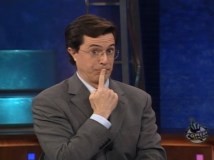 And Stephen Colbert blusters, “If our Founding Fathers wanted us to care about the rest of the world, they wouldn’t have declared their independence from it.” Season 3, Episode 2
We could modernize any of those–except, of course, the last one–and run them on the late night comedy shows. So we already have our supply of Fools, who dare to tell the truth.
The major news media, by contrast are shackled by their notion of what is”professional.” It is “professional,” for instance to say what the candidate said. It is not professional to opine about whether it was true. It is “professional” to pair a speaker representing one side [1] of an issue with a speaker from the other side, so an eminent climatologist is paired with a creationist from Feathertown, Tennessee. [2] It’s one “opinion” against another.
A New Center Option?
I’m wondering, though, if that isn’t changing. It may be that the New York Times, my principal news source, is breaking some new ground. On January 23, the Times headlined: “Trump Repeats Lie About Popular Vote in Meeting With Lawmakers.”
Then, on January 24th, I saw this headline in the Times: “Trump Won’t Back Down From His Voting Fraud Lie. Here Are the Facts.”
These are not the headlines of opinion columns. They are not even headlines of newspaper  articles called “analysis.” These are “news stories.” In a long life of reading the New York Times, I have never seen anything like it.
And this is not, by my reading, just a retaliation against a President that the Times doesn’t like. They didn’t like George W. Bush either and I don’t remember any headlines calling him a liar. No, this is something more important. This is—it might be—a change is what “professionalism” allows the press to say.
If it were that kind of change, that would be a really big deal.
Papers like the New York Times and the Wall Street Journal and the Washington Post (and back in the old days, ABC, CBS, and NBC) are not niche sources for news. Fox news is a niche source; MSNBC is a niche source. They are the friends that we go to for the selection of stories you want with the spin we like best. So it would not be “a really big deal” for Fox to be pushing the notion of “alternative facts” or for MSNBC to call President Trump our Liar-in-Chief.
The freedom of those niche sources to say what we want them to say represents what the newspapers of record, like the three I gave as examples, have rejected as “not professional.” Real journalism means not only:
- checking allegations to make sure they are factual and
- checking quotations to make sure they are accurate;
- It means appearing “evenhanded.” (Evenhandedness means citing one source for one side of a political issue and one from the other.)
- Above all, it means not taking editorial positions in the news articles.
That made them easy to manipulate in the recent presidential election. What does “real journalism” do with Donald Trump’s continued assertion that Barack Obama was not born in the United States? Do you say, “Some say this and others say that; conclusive evidence has not been presented?” Do you keep saying that after conclusive evidence has been presented?
What do you say about the denial of global warming and the volatile climatic changes that are happening before our eyes? Do you keep saying, “Most climate scientists are persuaded that the warming hypothesis is solidly supported, although some disagree?” Is there a point at which you say, “These politicians are denying facts for their own political advantage?” Is that professional journalism?
Here’s what I think the short answer is.
The media have realized that when the lies are big enough and when they are repeated 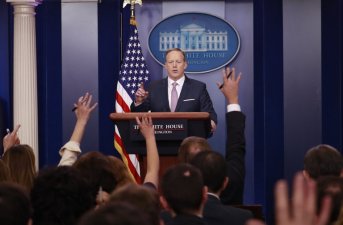 often enough, there is simply no way for the media to deal with them while staying within the boundaries of “professional journalism” as previously defined. I think they have decided that the pallid responses to which they have limited themselves have made them tools of some of the worst elements of American politics and they have decided that if that is what “professional” means, it is time to give it up. (This is Sean Spicer, by the way, President Trump’s Press Secretary. For fans of The West Wing, he is standing where C. J. Craig used to stand.)
If they have, in fact, decided to do that, I find it encouraging. If this is what is really happening—it is very early in the process, after all—then the Times, the Post, and the Wall Street Journal are creating a new center for political journalism. They would, in doing this, have shoved the Fools, who are entitled to tell the truth as long as it is on the Comedy channel, to one side. They would have shoved the ardent partisanship of the niche organizations, the Friends, to the other side. That is, after all, how you create a center.
And in that center, you would have respected papers of record using words that 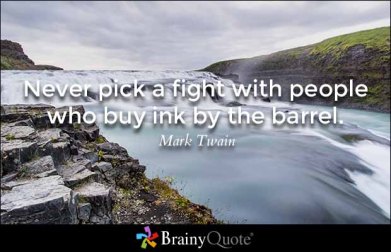 communicate the truth in plain language. “He knows it isn’t true and he keeps on saying it is true. If that isn’t lying, what is?” And these bald confrontational questions wind up in the headlines, not buried in the text. And not countered by someone representing “the other side.
The Trump administration will, of course, retaliate. But in the past, the media have been pretty capable of defending themselves, and, when it comes right down to it, defending their sources as well. [3] Mark Twain’s advice still seems good to me.
[1] The whole notion that there is “another side” imagines issues with only one axis of concern. Ordinarily, there are at least three or four axes (so 6 or eight “positions” to be covered) along which the issue may be understood. If there really are 6 or 8 “other sides,”then the notion of getting a spokesman to represent it (them) no longer works.
[2] Feathertown, Tennessee is the fictional setting of Barbara Kingsolver’s superb novel, Flight Behavior, in which local climate change deniers come into contact with scientists studying the changed migration of Monarch butterflies.
[3] When there is a very large swing in the style of administrations, usually a lot of people a moved to become whistleblowers. They will need to talk to the press and they will need for the press to protect them.
 and Pharisees accuse Jesus of blasphemy, interpreting his statement as something he, himself, was doing. It would have been easy for Jesus to have said that God had obviously forgiven this man, so it was not something Jesus was doing, but only something Jesus recognized. Then they could argue about whether God had done that or not, citing various interpretations against each other.
 requires that you forego association with violators of the law. Jesus did not dispute that the other people at the party were sinners and he did not dispute that he would become ceremonially impure by association with them. He said, as I hear it, “They may be impure, but they are also spiritually sick. It is my mission to heal as many as I can. Why would God send me to people—like you—who are not sick and who, therefore, have no need of my special gift?”
 Let’s begin with Jesus as a chooser of what issues are going to be salient. Etymologically, and issue is “salient” when it jumps out at you. [5] Each of the events I have chosen as examples brings some new aspect of Judaism front and center. In the case of the paralytic, the question of God’s forgiveness is raised. At the party, the question of holiness as separation from the needy is raised. In the “cornfield,” the question of the applicability of the Law to Jesus and his mission is raised.
 Jesus picked this fight, it seems to me, in order to establish that he dare not subordinate his mission to the ordinary constraints of Judaism. That’s why he didn’t stop with the rabbinic justification of his disciples’ actions, but went on to make a claim about himself.
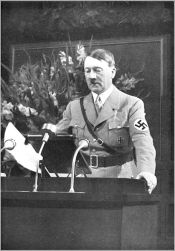 I have taught in public schools and universities nearly all my life, so I can tell you that comparing anyone to Adolf Hitler is taken as a serious insult. If you say to a politician who is five feet and nine inches tall that he is as tall as Hitler, he will take it as a mortal insult. He will say, incredulously, “Are you comparing me to Hitler?” If I say that Hitler was a marvelously gifted tactician, deploying a largely unwilling bureaucracy with great skill, I will be accused of “justifying Hitler.”
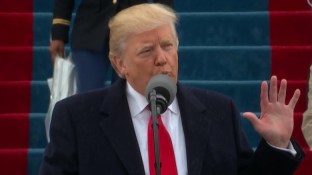 Noting these similarities is not a charge against Trump. You can go down the two speeches and just substitute a German expression for an English one and just doing that is scary.[2] It is true, however, that Trump sees many more similarities than I do between the time of his assuming power and the time of Hitler’s assuming power. And because Trump sees these similarities, he chooses words that highlight them. Any good speaker would do that. Abraham Lincoln did the same thing; he was a superb speaker as a result.
 achievement to the appropriate agencies, funding them adequately, and then holding them accountable for their work. That’s not how you build a movement. A movement needs a leader. The leader needs to focus the movement on himself and to give indications that he, personally, is bound to the success of the movement.
 United States of our time (by contrast with the Germany of Hitler’s time) there are many social and political institutions, including a robust federal system, in place. They can’t simply be set aside. They will have to be bargained with.
 OK, how are we going to have such ceremonies if people say that the ceremony is about the person who is being honored? We will not have them. If the ceremony is about the person rather than the office, then the ceremonies that are supposed to celebrate our unity as Americans and the peaceful transfer of power from one party to another, will have no power at all. Everything is politics—the pursuit of power. Nothing is government—things like providing for a common defense and protecting domestic tranquility.
 Trump will be the 45th President of the United States. But winning an election does not mean a man can show contempt for millions of Americans and then expect those very people to celebrate him.
 It takes her a little longer to get to the “but;” still, when she gets there, she wiggles the same way Rep. Castro did. I respect the office. Good. I respect the peaceful transfer of power. Good. But the man who will take the office is a jerk and the man to whom power is transferred is offensive…and therefore we cannot participate in this celebration of peaceful democracy in America.
 I think that President Trump’s actions, proposed and executed, should be opposed by everything we have. He is going to want to cozy up to Russia with predictable consequences for Germany and France. Make him pay. He is going to want to gut the health protections President Obama put in place and that the Supreme Court declared to be constitutional. Make him pay. He is going to continue to engage in business practices that are wholly out of line with the office of the President. Make him pay. He is responsible for his actions and when he does wrong, he should pay the consequences.

 Let’s look at what the word itself—as opposed to our use of it—would like to be or what it would like to do. It’s a little like agreeing to recognize gravity or inertia. I wouldn’t want to go so far as to say that the word’s intentions have been frustrating our intentions. There are quite a few things wrong with that formulation. [1] But I do want to start with the word.
 These are not things I am going to decide to do, as if they were foreign countries I had not yet invaded or competitors I had not yet eliminated. These are not decisions that I have been struggling with—a di-lemma is a common kind of struggle [4]—what with the two lemmas to deal with.
 intend anything and then act on that intention. On the other hand, sometimes it is the easiest way to say something and if you stay vigilant, it doesn’t do any harm. Take Dawkins’ The Selfish Gene, for instance. Dawkins does not think that genes “intend;” his contention is that imagining that they do helps us make sense of the pattern of their actions.
 ampion. So far as it is possible, they are going to deny that he really did what all the papers say he did. Failing that, they are going to say that it was an understandable mistake by a new president or that it was well-intentioned by the president but mishandled by his supporters. They are going to say that huge errors are mere foibles.


 Ominous, isn’t it? But it is the reason I changed Kevin Quinn’s sign-off line from “my story” to “our story.” If there is an “our story” and if joining with others in the community to support it is the way people can tell whether you are “one of us,” then joining in is crucially important. Being right about the changes in butterfly migration and the reasons for it, is not crucially important.
 and professionally to the same conclusion. But I found that same conclusion, much more graphically expressed in Kingsolver’s Flight Behavior. Had Hochschild and Cramer studied Dellarobia Turnbow, they would have come to exactly the same conclusion each reached about the groups they studied.
 Two further things. There is a resentment of Al Gore the person in this remark. Gore is invited to “toast his buns” on the frost. Not a very dignified reference, surely, to a man who lost the presidency by one vote. Even “toast his toes” is not so demeaning. And all such expressions are beside the point anyway, unless the point is to derogate Gore.
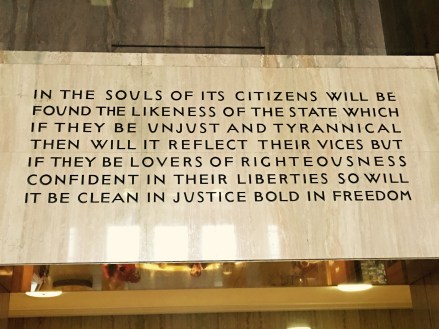
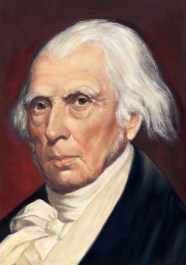 So the Framers put their hopes elsewhere. They put their hopes in the architecture of the system. I have said it this way sometimes [3]. “The Framers no more believed in the goodness of citizens than Newton believed in the goodness of planets. Newton’s idea was that if the planets were of a certain size and density and velocity and a certain distance from each other, they would just keep doing what they are doing and no “intervention” would be necessary. That’s what the Framers thought about federalism, the separation of powers, and checks and balances.”
 could produce a good state. They despaired also of forcing people to act as if they were good citizens, as if their own interests did not matter more to them than the welfare of the state. They settled on a system that would allow them to be as bad as they actually were, hoping that the long and torturous maze that confronted them would tire them out before they took over the government.

