
I don’t have a view, myself, about whether impeaching Donald Trump (hereafter, CHEB, the Current Head of the Executive Branch) is a good idea or not. Speaker of the House Nancy Pelosi said, when she authorized the first tentative step toward impeachment, “No man is above the law.” I appreciate the sentiment, but I think we would have to call it an aspirational statement.
No one is above the law
Here’s why I say that. We were in Scotland recently and while I was there, I learned a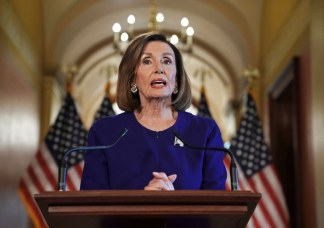 good deal more than I had ever wanted to know about clan governance. Clans cohere around the leader. Until, of course, someone kills him and takes over, at which point they cohere around the new leader. “The law of the clan” is a fiction for the same reason the “law of the mob” was fiction in Chicago when it was being run by Al Capone. These are “leader-driven” not “law-driven” societies.
I think we might be better off thinking of some such notion as “outside the law” than “above the law.” These leaders are people to whom the law does not pertain. These leaders are not, in the eyes of their respective clans, “illegal;” they are a-legal.” That is why I referred to Speaker Pelosi’s standard—no man is above the law—as aspirational.
It is a commonplace that the U. S. is divided into “tribes” [1] but the implications of that observation, which is correct, are not always made clear. When you go to a collection of tribes and ask whether they want to follow their leader or to submit to someone’s notion of “law and order,” they will choose the leader. It is unnatural—I use that word with care—to prefer to be governed by an abstract set of norms than by a person you trust. There are some strata in American society who have achieved that unnatural standard and maintained it across several eras of American life, but the strata are thin and few and they are routinely dismissed by most of the population. The U. S. is more tribal now than it has been since the decade leading up to the Civil War. [2]
In that sense, the tribalism of the Congress, which is more formal, simply lags behind the tribalism of the electorate. The Constitution, in specifying that the President may be impeached for “high crimes and misdemeanors” refused to specify just what actions could be called that and tossed the ball over to the political process. That is what the Framers intended.
As a result, the House of Representatives, which has the power to impeach, may call anything it wants “high crimes and misdemeanors.” It is true that CHEB has broken new ground in the areas of obstruction of justice, of collusion with foreign leaders, and in treason, but he need not have done all that to be impeached. Just as “the Constitution says what the Supreme Court says it says,” so “high crimes and misdemeanors” are what the House says they are. [3] The House could impeach CHEB for having an astounding sequence of bad hair days provided that they called the offense, “high crimes and misdemeanors.”
Is it a good idea?
Some people say we really no longer have a choice. The longer we go on saying nothing, the more complicit we are in his crimes. In this view, it is courageous and moral to point to the crimes and call for impeachment and this is the case NO MATTER WHAT THE OUTCOME OF THOSE ACTIONS WILL BE. Sorry for the shouting. The case here is that when we consent to this kind of behavior on the part of our elected leader, we have lost a moral battle we will never be able to win back. This is, in the eyes of people who hold this perspective, a “crossing the Rubicon” sort of moment. [4]
They may be right. It may be that in allowing the President to do unprecedentedly scandalous things and to be approved of for them, we have finally ceded the high ground and will never be able to get it back. On the other hand “the moral high ground” requires a law and order perspective and the liberals are very nearly (not quite) as tribal as the Trump voters. In a nation as divided as ours “the moral high ground” is just a rhetorical tool of one of the tribes. It is not, any longer, a way of mediating among the tribes.
If that is what the “moral culture” critics are afraid of losing, it is already lost.
Other people say we do have a choice. These are the “keep your eye on the ball” people, of whom, I should pause to say, I am one. I want Donald Trump out of office; I want a Democratic House and Senate; I want a fair electoral system; I want aggressive conservation measures; I want decent sustainable treatment of immigrants. I want a lot of other things too and I want to take a position on impeachment that maximizes my chances of getting as many of those as I can. If impeachment proceedings help, fine. If not, fine. Keep your eye on the ball [5]
CHEB is not going to be convicted by the Senate no matter how high the impeachment count gets in the House. He is not going to be removed from office that way. He can, of course, be voted out of office, which I think is the surest way to do it and the best way to pursue the collection of goals I specified above. I have always felt that Speaker Pelosi agreed with me on that, but she has suddenly changed and I don’t really understand why. I am quite confident that she has not gone over to the “moral critique” camp. She is still a numbers counter. What does she know that I don’t? It makes me less sure that relying on the 2020 election results is the best way to get all the things I want.
Finally, some people argue that a premature impeachment—an impeachment with no likely conviction—will still weaken CHEB. All his dirty laundry hung out in public view and producing public disgust. I don’t think so. At a certain point, you have to decide whether the dirtiness of the laundry is worse or the mean-spiritedness of the people hanging it out. We (our tribe) keep pointing to how dirty the laundry is. They (the other tribe) keep pointing to the distorted and shriveled morality of the people hanging the laundry out. Oh…they are hypocrites too, of course.
That’s the way if worked for Bill Clinton, if you recall. The more grievous the charges the Republicans brought, the more they seemed like bullies who might turn on people like me when they were done with poor ol’ Bill, who had, after all, only showed his common humanity. Clinton’s popularity went up sharply as a result of that impeachment and the Republicans’ went sharply down.
I don’t want that to happen to me and I don’t want it to happen to us.
[1] I am going to shift now to talking about tribes rather than clans. It sounds more contemporary, for one thing, and it offers a useable adjectival form, “tribal.”
[2] The standard that political scientist Robert A. Dahl used in measuring the degree of division in the U. S. House was ingenious: how many things do you need to know about a Representative to correctly predict his vote? When it got down to one—you need to know only one thing (region, in the case of the Civil War) then you are justified in calling the nation “divided.”
[3] There is the practical matter of living in glass houses and throwing stones, but that is practical only in the long term and we are not living in a “long term” era.
[4] Joseph N. Welch is celebrated by liberals for saying to Sen. Joseph McCarthy, “At long last, sir, have you left no sense of decency,” but “at long last” points to how very long he waited to say that.
[5] I realize I have defined “the ball” as the political and policy outcomes most important to me, but I would be willing to share the agenda space with others.


 It is easy to be critical of these choices of crucial virtues and/or of the choice to attach a fragment of scripture to each of them and/or of the particular scripture that is chosen.
 This short essay is in praise of the kind of place it is.
  no content would be problematic.
 The similarity between the kind of appeal Egan is using—tribal, primal, vindictive—and the kind he is condemning is very clear to me.
 In this piece, Egan contributes to the degradation of dialogue about crucial public issues.
 evident. I would like to summon up parallel terms, one for offense and one for defense. I am thinking of something like the pair of fouls that occurs so often in basketball when one player runs into another. Was it charging? Was it blocking? Was it a case of really good acting?
 So it is plausible but it is only plausible if you don’t know what an encyclopedia is, which Jed does and Hiram does not. So…why does Hiram not know what an encyclopedia is? Everybody knows what an encyclopedia is.
 These discrepancies may be left over from earlier patterns of use, as where occupational names ended in –man. They may be national stereotypes: Scotsmen (Scotswomen too, I suppose) are stingy, French are sexy, Irish are drunk and rowdy. If you take those not as statements of belief or fact, but as the presuppositions necessary for the “witty remark” to follow, there is no reason to take offense. If you are microdefensive, there is every reason to take offense.
 Upton Sinclair is associated with the saying, “It is difficult to get a man to understand something, when his salary depends on his not understanding it.” That is the kind of connection I have in mind. It is really hard to recognize that you are not offended when there are such advantages to discovering that you are offended. One simply cannot reward the feeling of offense and expect it not to show up more frequently.
 played by Herod and his team of scholars. Why does Matthew have characters like this? How does he prefigure the gospel he is about to write by the stories about Jesus’ birth? I love this picture because it shows the Wise Men following the star to Jerusalem (which they did not do) instead of from Jerusalem to Bethlehem (which they did do).
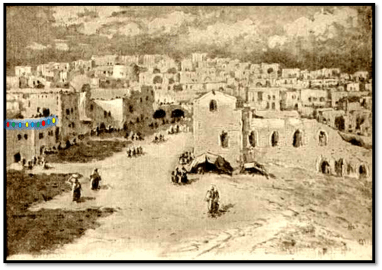 My approach, emphasizing the point of the story Matthew is putting together, has not raised at all the question of the spot Herod was in. That’s not what Matthew’s interest was. The journalistic account my strategic friend was using—in what looks to me in retrospect like a judo move— did raise those questions and I have to say, they are really interesting. Just how is it that “the whole of Jerusalem was perturbed?” I never wondered that. How is it that Herod never meets with his own academics and the academics from the East at the same time? Does the general upset of the city affect how he has to play his own cards? This picture has been adapted by my son, Doug, to show how else the Wise Men could have found the house where Joseph and Mary lived. It was the one with the Christmas lights.

 generally used in disparagement. “It should have been a hardball (difficult) question, but instead, it was just a softball (easy) question.” As you can readily see, this gets us into much more difficult territory. In order to know whether it was a “softball question,” we need to know whether it should have been a hardball question.
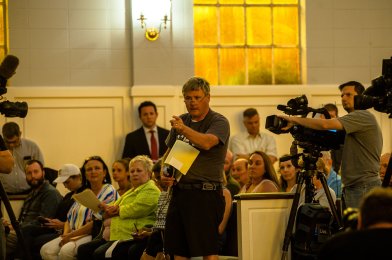 We might ask of a question, rather than asking about hardness and velocity, whether it had a useful notion of the causes of the event in question. Holladay Park Plaza is going to have to spend a substantial amount of money replacing its heating and cooling systems. If that was caused by sabotage, we need to know about that; if it was caused by the gradual deterioration of the present system over the last 50+ years, then we need to know that. It isn’t that the sabotage idea is harder and therefore more appropriate, it is that it misattributes the cause. The virtue of the explanation that the system is old and needs to be replaces is not that it is a softball question, and therefore inappropriate, but that it correctly attributes the cause of the problem and sets us up for appropriate action.
 The Dilettante's Dilemma