
The first pass I made over my first ten years of blogging considered the foundational questions. Why blogging? Why the “dilettante” theme? Today I want to review what the political arc of the first decade has been. You wouldn’t think I would be surprised by it; I did write all of them, after all. And they all seemed appropriate to what was going on at the time.
Still, different things were going on at the time and there is an arc that has, as I look back along its shape, a predictability to it. Almost, but not quite, an inevitability. Looking back, I think, “Well of course I wrote about that; and then that; and now this.”
 When I started in 2010, we were half way through Obama’s first term and I assumed, as most people did, that I was only one quarter of the way through his whole presidency. The first political blogs took the Obama presidency and the kind of politics in which it was set, for granted.
At the end of June 2010, for instance, I wrote a piece called “Obama’s Waterloo,” in which I took him to task for not making better use of the Gulf Oil Crisis and thereby violating Thomas Friedman’s maxim, “Never let a crisis go to waste.”
In August, I wrote “Good News for President Obama.” The good news was that the Republicans were looking like they were going to control everything for awhile, so it was time for the President to stop hiding out in the Congress—trying to get Obamacare passed—and come out in public again.
In November, right after a very discouraging election, I wrote “November 3, 2010: Day 1 of the 2012 Campaign” about how things were setting up nicely for Obama’s 2012 bid for re-election.
But then, the Tea Party Caucus in the House of Representatives didn’t go away as I 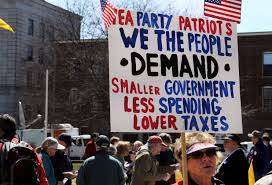 thought it would and it stymied the Speaker of the House, John Boehner and that was when I discovered Arlie Russell Hochschild’s book about the Tea Party. Strangers in Their Own Land helped me understand why “the Tea Party”—which was about to become the Donald Trump gang—wasn’t going to go away. [1]
At that point, I began to get seriously interested in how broad the support was for Donald Trump. Trump himself is just a flamboyant narcissist and for all his outrages, he never really interested me. It was the culture that produced and supported such a leader that interested me more. And that brought me to March 2016’s post, “The Donald is Just a Weed.”
The major metaphor there was that your lawn will produce what thrives best in that particular soil. You can treat what the soil produces, killing the weeds, but it will continue to produce what thrives best in that particular soil. It wasn’t a particularly subtle point. American society is constructed in such a way that candidates like Donald Trump are successful. To change that, you need to change the makeup of the polity itself. You simply cannot have high rates of poverty and high rates of immigration without producing populist resentment and Donald Trump is the expression of that resentment. That’s what the “soil” of the U. S. is like now.
Since that time, there has been a recovery of some of the institutions that will be necessary to oppose Trump himself and the political expressions of Trumpism. I am all for that democratic recovery, but nothing I have seen looks like an amendment of the soil that produced the Trump weed. It takes a great deal more than being anti-Trump to be anti-Trump-producing soil.
Since I realized that, I have become more interested in, and have written more about the soil. The soil has mendae (flaws) [2] in it and taking them out ex- mendae is “amendment.” We are more likely to think of “amending” as adding something to the soil than as taking something out, but you could argue that adding something is taking out the imbalance.
On February 6, 2019, I finally got around to proposing some amendments.
The first is the large value discrepancies in our society. The second is the completely inadequate system of economic distribution. The third is the “warring tribes” model by which the previous two inadequacies are translated into the governmental impasse I referred to above.
The value discrepancies were dealt with, briefly, in a post in May of 2019, which reflected on the work of Pippa Norris and Ronald Inglehart, especially their Cultural Backlash: Trump, Brexit, and Authoritarian Populism. They were willing to be specific about what kinds of attacks have been made on the values of white working class Americans. I had read a fair amount about the “backlash” without wondering just what “back-“ referred to. Backlash is a “hitting back” but there is almost nothing in the press I read that talks about what has been taken away from anyone, so the “back” of hitting back is mysterious.
That moved me to the question of social media, a way for angry people to pass around anonymously the most scandalous charges against their enemies. I get an article on my Facebook page and it alleges some awful thing that has the effect of justifying my anger, so I send it out to all my friends. I “share it” as we say. I don’t ask whether it is correct; it just stokes my anger so it must be right. In January 2019, I wrote a post called “Thou shalt not share false witness,” to protest against this practice. [3]
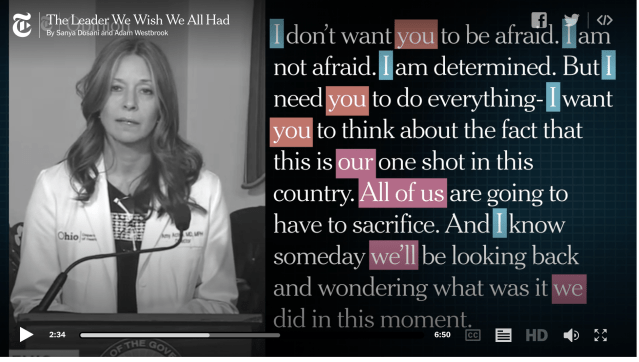
In the summer of 2019, Bette and I visited Scotland and I learned a lot about clan politics that was new to me. There was nothing democratic about how clans worked. The clan chief was the principal legislative, executive, and judicial force. That is why clans worked, internally, and why there was always warfare between the clans. I learned while I was there that Clan Donald was one of the major clans of the period and it made me feel right at home. President Trump’s inclinations are all clan leader. He wants, in what is supposed to be divided government—that’s what Madison thought is was— to have in his government only “people he trusts fully.” What he trusts these people to do is not always clear, but it appears to have very little to do with the impartial administration of the law. That is why he has turned to firing inspectors. Here, Dr. Amy Acton of Ohio makes a contribution to democratic politics.
But most of my thinking and writing have not been about the administration. They have been about the value discrepancies that are afflicting us and about the decline in the value of “truth.” Once, a hypothesis could be supported or not by examining the facts carefully and impartially. Global warming, for instance. Now that there are only “your facts” and “my facts” there is no way to resolve disputes. The old dispute resolvers—scientists—have been declared to be “really on the other team.”
This great flaw—summarized this week in the aphorism “truth is tribal”—is hard to deal with. Science is supposed to be the law and order of dispute resolution. Without law and order, it comes down just to firepower. But nobody wins a “just firepower” war. The armies just retreat to some safe place from which the battle can be continued by guerrilla means
The last decade seems to me to have been as long slow slide from government into social institutions and on into the free sharing of false information.
[1] I was enthusiastic about Hochschild’s book. The post in which I described it was called “Read this book!”
[2] The “amendment” series was built around the realization that the Latin menda means “flaw, blemish’ and and to amend ex + menda means to take out the flaws. I forgot about all that until this review essay.
[3] I liked the title because it identified “sharing lies” as lying, which I think it is. It also suggests the phrase “bear false witness” which is the way the King James Bible translates that particular prohibition.
 So now that we have corralled the question to a certain extent, we can ask it more meaningfully.
 Let’s pause for an example.
 strong,” you are going to have to change the question that is being asked.
 The king promises his soldiers, mostly ragtag peasants, that in the future, some wonderful thing will happen to them. There are two elements of this I want to point out. The first is that the reference point is in the future. This is very comforting to soldiers confronting a battle; it imagines that they will have a future. It doesn’t say so. That would be cheap. It just takes it for granted, which is much more powerful.
 have had some interest in it, but more likely, I found it in the places I ordinarily go for reading material and started into it by habit. If I don’t find anything that is of immediate interest, I move on. This is especially true of technical writing. It seems, sometimes, that there is more below the surface of a text than there is right at the surface.
 For a story as fraught as the Genesis account of creation, there are other reasons. All my early exposure to the Genesis accounts—I am trying to remember to use a plural there—was in church. The preacher or teacher had lessons to impart and the lessons were much more important than the text. When you come to consider the text as a matter of interest in itself, you begin to stumble across things; really “obvious” things. And you wonder how you could possibly not have noticed that the first time through. Answer: you were busy with other things. Of the many pictures of Adam and Eve, I chose this one because I thought she was kind of cute and it looks like she is in a sharing mood.
 by citing scripture. So he turns to Genesis and he is undeterred by the 1st story/2nd story differences that have so captivated me. Presumably the two stories he is looking at say the same thing they do now. Chapter one has Adam and Eve created simultaneously by the spoken word of God. Chapter two has Adam created first, then Eve; and Adam was not created by a word of command, but physically, out of dirt. [2]
 the solution to a problem I was already acutely aware of. It was that I wrote essays from time to time and was curious about how this friend or that one might respond. I was reluctant to send these essays to people who might turn out not be interested and who might feel obligated to read them. So Bette said, “Why don’t you just start a blog? That way they can read it if they want and won’t feel obligated.”
 After a few years, I changed my calendar. I invented “the blogging year” for myself. Because I spent some time around the legislature in Oregon, I got accustomed to different calendars for different purposes. So the January to December calendar was just a default setting. I started my blogging calendar (BY 2020 began in December 2019) so that I could more or less start fresh with the church calendar. So every year, I get to “turn the page,” in a sense, and start with Advent. I write a fair amount about Advent, so it was a natural place to start a new “year” of blogging.
 disorientation occurred, [1]
 lar one, I tried to describe how I wanted her to be.
 What might I be told to do?
 Phase III of the spiritual therapy.
 When you come to the question of rationale, the urgency of the question “Why am I doing this?” comes immediately to mind. A famous experiment which I ran across in grad school, had students performing a meaningless task turning pegs on a board. Some are paid a little for doing it; others are not. When they are asked to come back to the lab and do it again, voluntarily this time and without pay, some said yes and some said no.
 When I first thought of this, I got as far as “junk activities” as analogous to “junk food.” But now that I am into it a little, I think it might be worthwhile to pursue further questions. What activities have the effect of providing energy, like proteins do? What activities help us dispose of waste products like fibers do? What activities have the effect of helping us build and maintain tissues? [5]
 wouldn’t think they would work at the same time with the same people, would you? Or that you could cycle back and forth quickly between one kind of appeal and the other?
 could inflict not just on THEM, the people who are denying me and ordering me around, but on THEM, the people who are posting notices that we are all in this together. There just might be something that felt very good about that?
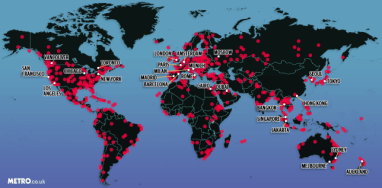 going to spread most rapidly to the places who do not have the resources to defend their populations against it and to the places who do have the resources but are slow in deploying them.
 On the other hand, you still see people out walking, most with face masks on and there in an undeniable camaraderie that reminds me of World War II.
 famous.
 But that is not what I want to do. I want to build a model of human functioning that makes sense to me and that I can use. So I need some premises about human functioning and then I need some observations that test and affirm the premises. [1] I plug the day’s observations, the reading I do, the conversations I have, into the system and up pops new idea—sometimes a really intriguing idea. Take loneliness, for instance.
 receiving what feels like an unedited flow of self-expression from an intimate other and am allowing that same kind of unedited flow to come from myself. There is nothing particularly erotic about this exchange, although there is no reason it could not involve erotic commitment. We hunger, I think, to know who another person really is and at the same time, we know that society simply can’t operate that way. Society—civil association—requires that we play our parts and do our jobs and relate to each other with the psychic surplus. And that is why we hunger to know who another person really is.
 I don’t object to the things that are being proposed, but I also don’t see any connection between those proposals and the kinds of things I think—using the system I have derived for my own use—actually help people. So I see those proposals and I wave them away. Yeah, fine. But when I am pressed to adopt or support them, I am forced to say that I don’t think they will help. And when I am pushed to say why I think that, I trot out my own set of presuppositions and the observations that are consistent with them. That is often not received well.

