But is it really therapy?

I am just about to read a news article (New York Times, June 1) about a “therapist” app named “Woebot.” I have read enough in the area that I think I have a sense of what has to be said. I don’t know the big names in the field, with the exception of Sherry Turkle, author of Alone Together, and I don’t know any studies at all. Still, it seems to me that whoever is talking, there are some things that have to be said.

This is what I think they are.

On the question of whether this is really “therapy,” the therapists [1] will be facing off against the technologists. [2] The therapists will ask if this is really therapy. Therapy is defined as a set of interactions that require human beings. Therapy requires honesty and insight; it requires empathy and understanding. Having declared that, they will turn to the technologists and dare them to show that Woebot has those things.

The technologists won’t do that, of course. They will change the presuppositions. “What is therapy, really?” they will ask. You guys are talking about history. This is the way it has always been done. Let’s talk, instead, about “it.” What is it, really, that needs to get done? People who are confused need to make a choice; people who need to change their behavior need a reason to do so and encouragement to continue, Woebot does that. Read the transcripts. “Therapy” is healing. Woebot causes or promotes or facilitates “healing.” It is therefore a “therapist.”

There is a lot of merit to talking about why the interaction between therapist and client works. What is it about the “therapeutic exchange” that causes the changes that are desired. It’s hard to tell, really. Outcome measures won’t do it, obviously. Reports of insight won’t do it.

The second question that will arise is what the effect of Woebot is in the long run. Woebot is a phone app. Everybody has a phone. “Therapy,” is therefore available everywhere and everywhen,. How can anyone be opposed to that? That’s what the technologists will have to say.

The therapists will say that what the app will do is the direct the attention of some really needy people away from the humans who can help them. There is really no substitute for the meaningful interaction we can have with other minds, but we can be trained to call something “good enough” even when it is not. If therapy were, as you argue, like scratching an itch, then the client would always know whether the itch has been scratched. But in real therapy, the client realizes whole new options, he constructs whole new approaches to problems. Woebot can’t have that effect on people. What it can do is to teach them that the kind of mechanical “performance of empathy” is all there is and that it is, therefore, “good enough.”

The technologists will have to say that the therapists are denying a lot of people small amounts of real progress because it is not “real” therapy—this despite their failure to define just what “real” therapy is.

Now I think I will go read the article. If they say other things—things I did not foresee that they would have to say—I am going to be really surprised.

[1] Old fashioned, no disrespect intended, person to person types.
[2] They focus on the hardware and construct the algorithms that make it do what it does and seem like it seems.

Posted in Uncategorized | Tagged , , | 1 Comment

I and AI

Sherry Turkle’s memoir, The Empathy Diaries, was published recently and I bought it as soon as I heard about it. She has spent nearly all of her professional career studying the human-robot interaction.  She is the one who, in Alone Together, reported on the children to whom MIT has given little playmate robots for a little while. The language the children chose was that the robots were “alive enough” to do the things they liked to do with them.


There are lots of things wrong with “alive enough” as a standard of being, but you can see how it solved the problem for the kids. They know that the robots are not “alive” in the way people are. On the other hand, it is very hard for them to use words like “not alive” or “dead” or “inert” or “insensate” of cherished companions. This dilemma pushed them to innovation. The robots have a place on the “scale” of aliveness. Alive and Dead are not binary positions for these kids.


I’ve been a fan of Turkle’s ever since. Her mostly engineer colleagues at MIT think of her as a conservative. I think of her as a humanist. Robots, she says, “perform empathy.” Humans “have” empathy.


That is a powerful point, but it is more subtle than it first appears. How do we know that humans experience empathy? Well, they act as if they understand us and our situation. We infer, therefore, that they can imagine being in our “place.” If they do it badly, we judge that they do not really have empathy, but are only performing it. And badly, too. But AI robots are performing it better and better all the time. They “seem to care.” We respond as if they do care, even when we know better.


Now we come to the crucial point. If AI empathy is done better and is more reliable, why would we not prefer it to human empathy–what we used to call “real empathy?” I say it is the crucial point because in the first instance we said that human empathy is real and robot “empathy” is not. Now the point is that if empathy is empathy and if robots do it better, we have every reason to prefer them.


Turkle’s argument is that performed “empathy” is not really empathy no matter how good it is. But that is hard for us. We tend to prefer “the experience” to “the reality:” in cases where they are not the same. This puts what we feel( it understands me) in conflict with what we know (it has been programmed to seem to understand me). It requires us to put an abstract understanding ahead of an immediate pleasure.

Turkle’s approach to the problem is to spend more time being ourselves. It is not hard to see the damage we do to ourselves by being online all the time. The new electronic access we have to each other makes it easier to stay “connected” but being really together is another thing entirely. “Connected” is a kind of being in touch that lets us surf from one person to another, avoiding three kinds of difficulties: people we don’t like, traits we don’t like (even in people we do like) and quiet time when nothing at all is going on.

Turkle says we need those things in order to be who we are. The constant connection is just a distraction from spending time with ourselves. She values “solitude” in which we are alone but not lonely. I follow her argument without any difficulty so long as she is describing how busy we are and how endlessly in touch. I get it that doing those things doesn’t do for us what needs to be done, but I still think that choosing what is real will require rejecting what is merely performed which will mean choosing the mix of pleasant and unpleasant over the completely positive.

We will need to have confidence in “who we really are” in relationship in order to reject what is merely performed and to affirm what is real–and maybe not quite to affirming. That confidence will be born in relationships we invest in; not those we collapse into. Wanting that kind of contact as urgently as we will need to will be necessary if we are to keep ourselves separate from the increasingly competent robots that are available.

“Alive enough” is not going to save us forever. Hating robots is not going to save us at all. We are going to have to learn to value and to prefer who we really are. It’s not a job for Superman. It’s a job for us.


Posted in Living My Life, sociability, ways of knowing | Tagged , , , , | Leave a comment

Another Marshmallow Test

Many years ago, psychologist Walter Mischel devised a test of the ability to defer rewards. For experimental subjects, he used students at his daughter’s grade school. For rewards, he used whatever kind of treat a child might choose. Some years later, New York Times columnist David Brooks called it “the marshmallow test,:” and, like a lot of the names David Brooks thinks up, it became a widely used term. [1]

What Makes the 'Marshmallow Test' So Iconic? - Early Learning Nation

The test was simplicity itself. You can have the chosen treat now or, if you are willing to wait for a little while, you can have several treats. I don’t know what Mischel’s initial expectation was but I do know, thanks to the book he wrote about the experience, that he very quickly became interested in the strategies children used to dismiss the marshmallow from their attention for awhile.

“The Tragedy of the Commons” (Garrett Hardin this time) is another such test. If each person grazes his cows on his share of the commons (ONLY) everything will work out, but if you graze on more than your share, it will not. Others will follow your example; the commons will be grazed unsustainably, and it will crash. No one wants it to crash, but the potential for environmental collapse is remote, whereas the reward of cheating just a little is immediate. Besides, your neighbors are already doing it.

It is very hard to discipline ourselves to achieve a distant goal, particularly if it is abstract, when there are immediate rewards available for undercutting that goal. Everybody believers in “democracy.” That’s what the polls say. But that’s like believing in marshmallows or in the commons. What behaviors are inconsistent with sustaining a democracy”

The one that is facing us at the moment is the Big Lie. Many elected Republicans continue to maintain that the election of 2020 was not fair and that Joe Biden did not win it. A majority of Republican voters feel the same way. There is no standard of proof to which anyone could appeal in making the argument. But even if there were such a standard, “what actually happened” and the proof that it did really happen are both remote. They gratify some do-gooder sense that we really ought to tell the truth; ought to admit the observable realities that would enable us to live together.

Commitment to those “remote” consequences is what makes democracy possible.  “Free and fair elections” is a remote standard.  “Our guy won” is an immediate value and holding it unquestioningly–demanding not that it be proved, but that it be taken for granted–is what makes you part of your group.  It is the entry fee for many friendship groups.  It might very well be a requirement for continued attendance at your church.  It is the Marshmallow Test for Republicans.

The question it poses is clear.  Can you defer your dessert–that would be a Trump victory–until such time as he wins a majority of the votes?  If you can wait, you could get a much greater reward.  You could win democracy as a functioning system AND your preferred candidate as the leader of the executive branch.  Both.  It’s what the children got who met the challenge of the Marshmallow Test–more candy.

But–one more time–to do that, the R’s would have to put their loyalty to democracy first.  First, they would have to say, we demand free and fair elections.  Then we want our candidate to win those elections.

Over the years, democracies have not been stable.  This is why.  It puts the things people care about only in an abstract way, first.  And it puts the things people care most passionately about, second.  “Democracy,” as President Alan Shepherd said, “isn’t easy.  You got to want it bad.”  I hope very sincerely that we want it that bad.


[1] I had a friend once who, in a fit of bad temper, dismissed all the results of the studies on the grounds that some kids, surely, would not like marshmallows and the test was therefore invalid.

[2] The Marshmallow Test: Why Self-Control Is the Engine of Success

[3] Stuart Stevens, a Republican media consultant says “For the first time since 1860, a major American political party (Republicans) doesn’t believe America is a democracy.”

Posted in Political Psychology, Politics, Sustainability | Tagged , , , , | Leave a comment

Really want to have a partner

I have taken a fair amount of abuse lately–abuse of the raised eyebrow kind–for a story I tell about the early courtship days with Bette. The story as I tell it, and I tell it as I remember it, has a crisis in it; a point where my way of thinking requires me to go one way or the other. People who don’t know me say things like, “Surely you didn’t!” when I get to that part of the story. People who do know me say, “Well…sure. Of course you did.”

Here is a paragraph of back-story. During the time that Marilyn and I were married, just short of a quarter of a century, I became a fan of a certain kind of marriage. Sometimes I call it a Courtship Marriage. [1] During that time I learned a lot about what a marriage could be. Those years with Marilyn just blew the lid off the concept and I had a lot of years of living with her to formulate the experience into certain regularities. Just observations about why it worked and what it would take to keep it working.

Marilyn died in 2003 after several years of a danse macabre with cancer and I had to learn to cope with grief, first, then loneliness. Then I had to build a life for myself that I liked and was proud of. After I got those done–they are never “done” actually, but you know what I mean, I’m sure–I began to look around for a partner. “Partner” turns out to be the crucial term because it presupposes the task in which we would exercise that partnership.

“Romance” isn’t that task. It feels like it at the time, but it isn’t. So I got online and dated quite a few women. Following, by the way, the sage advice of my elder son, who said that if I didn’t, I would just use my dating to find a replacement for Marilyn. He said that dating actual women while maintaining a secret “ideal” wouldn’t be fair to my dates and would systematically distort my own search.

And then I found Bette. I liked her right away and I enjoyed our times together, but I was still looking for a partner and there is no way I could ask Bette if she would be my partner without telling her what sort of project I had in mind. And I felt some urgency about it, because I was falling for her fast and I began to worry that if I had to choose between the relationship as it then was and finding a partner for the marriage I wanted, I would make a bad choice. I knew at the time, for instance, that the English infatuated was based on the Latin fatuuus, which means “foolish.”

That brings me to the crisis I mentioned in starting. In the worst scenario, I would just do the things I thought Bette would respond to most positively and then ask her to marry me and then after we were married, start to bring out these really important things that I had never mentioned to her during our courtship. She would have married a man to made a commitment to her, but with serious–but always tacit–reservations. In the next to worst scenario, I would tell her candidly that I was committed to a certain kind of marriage. It was a kind that required the attention and the honest effort of both partners, so I could not in good conscience continue to court her without asking her whether she wanted to be in such a relationship. At that point, in this next to worst scenario, she would say that she really didn’t find that kind of marriage attractive [2] and that we would have to stop seeing each other.

I could have “resolved” this dilemma in several dishonest ways. I could have said that I really didn’t want the Courtship Marriage. It was just nostalgia about my marriage to Marilyn and it would pass away. Or I could have said that the model really didn’t, however much I once thought it did, require the full-time active participation of both partners, so Bette’s lack of initial enthusiasm wasn’t a real obstacle.

Possibly, I should pause here to say that she was, in fact, really intrigued by the idea and said she would really like to be part of a marriage like that. So the crisis passed nicely.

But the place in the story where the eyebrows go up is the place where I have to decide in good conscience that I have to tell Bette that, however much I am attracted to her, I have a prior commitment. I am not just looking for a woman I like who also likes me. I am looking for a partner who will join me in making this thing–this kind of marriage–work year after year. It is hard, I want to tell you, to sit down with a woman you are besotted with and say, “This has been really wonderful, but there is something I need to tell you before we go any further.”

I think most of the criticism comes from romantics who think that if I liked her and she liked me, that was really all that mattered. They think, upon hearing the story, that it is not really right to court a woman by specifying your own heart’s desire about the relationship you would like to have. It feels to them like asking the woman you are courting to sign a contract. It feels deeply unromantic.

Another kind of criticism comes, I think, from the idea that the kind of marriage Bette and I have should be the product of out living together and figuring it out together. Confessing my “prior commitment” to Bette is good, but it is not as good as not having a prior commitment. What I thought at the time was that the way Bette and I worked out our unique plan for making this kind of marriage work would provide for all the individuality our marriage would require of us. And so far–fifteen years into it–it has.

There are, of course, challenges yet to meet. There is the “in sickness or in health” challenge. Can I continue to “court” a woman who is seriously ill; can I continue to “court” when I am seriously ill? We’ll see. I have hope. There is the “for richer, for poorer” challenge. Can we joyfully spend money together and joyfully endure hard times together. I have hope. We’ll see.

But the conversations I began with never seem to get that far and Bette and I leave the conversation with disappointed romantics behind us. Oh well. The courtship-style marriage we have really does take a lot of tending and we are fortunate that it is work we like to do together. That’s actually the only way it can be done.

[1] The basic idea of it is that you don’t stop courting your wife just because you have married her. There are complications, of course, but that is the premise.

[2] Or impossible or requiring the sacrifice of things she was no longer willing to sacrifice, or some such.

Posted in Love and Marriage | Tagged , , | Leave a comment

Where totalitarianism comes from

The book I am reading now has three quotes at the beginning: one by Jean
Casson, a Toulouse resistance leader and poet; one by Robert F. Kennedy; and one by Hannah Arendt.  The book is about the adventures of Virginia Hall, who set up local networks of resistance to the Nazis all over France.  It is called, A Woman of No Importance.  Here is the quote from Arendt.  It is from her book, The Origins of Totalitarianism.

The ideal subject of totalitarian rule is not the convinced Nazi or the convinced Communist, but people for whom the distinction between fact and fiction (i.e. the reality of experience) and the distinction between true and false (i.e. the standards of thought) no longer exist.

Hannah Arendt knows a great deal about totalitarianism, but I wonder how much she knows about social media.  That is the question I would like to puzzle about today.

Bertram Gross, in his book Friendly Fascism, suggests that when fascism comes to the United States, it will not look like jackbooted thugs as it did in Weimar Germany.  No, he says, it will look like Disneyland. [1]

When I think about it, I think about it as Facebook Fascism.  I have friends who “share”—that’s what they call it—scurrilous condemnations of this, that, or the other thing,  If you were to ask them whether these condemnations are based on fact, they would way one or the other of two things.  Let’s look at them.

The first is, “Who cares?”  The answer, most likely, is “No one to whom I am forwarding this post.”  So in this post, you are passing along (sharing) allegations that something actually happened.  You don’t know whether they happened.  You were “told” by the person who shared the post with you.  And in further sharing it, you are almost certainly doing some things that matter to you.  You are reaffirming your social/ideological solidarity with the person who sent it to you.  You are very likely striking a blow against the person (or a kind of person or possibly even a whole political party made up of such persons) who is alleged to have done this awful thing.   Because they are bad, taking action against them (by forwarding the post) is “good” by definition.

These two outcomes of your passing the post along are presumptive, of course, rather than confirmed, but we judge pretty accurately in matters like this.  You get confirmatory notes back from the network you shared with, for instance, or you read an article about how bad the people are whom you have been vilifying.  Well…not vilifying, I guess, if they were already villains.

Against those two certain and immediate benefits, you weigh the likelihood that the event or condition you described is actually true.  First, there is a lot of hard work involved in confirming the actuality of an event.  Think of it as a series of filters.  The most forgiving filter will tell you that it is outrageous and has no basis in fact.  The next finer filter will tell you that allegations have been made and these allegations are being “considered” by some people.  The next one down, or the one after that, will look at eyewitness accounts or source documents or—more likely—video footage and ask you to make your own judgment.

How many times a day could you afford to do that?  And for what?

The good part of doing all that work was once that you would not be passing along lies.  But apart from the work of finding out for yourself, there is the additional question of whether lies are…oh…untruthful.

You have to stay with this part of the argument.  If you relax your vigilance, it could sound just silly. [2]  Is an allegation that can be shown to be “false” just a part of someone else’s truth?  Is the world we live in filled with alternate and contradictory accounts?  Of course.  Is it possible that they are all true?  Of course it is.  I am going to make a different argument about facts later; here we are just considering accounts.

Accounts hang together is a lot of ways.  There are the values on which they are based, the presuppositions those values require, the logical support they gain from the network of other views that make up the whole way of looking at the world.  You could even say that there are alternative sources of “factual verification” if the proponents get to define all the terms and choose all the standards of verification.

This is a hard place to be for a society.  Coffee conversation at the local diner has gotten a lot more sophisticated than it was when I was a kid. [3]  What is right and what is wrong were eroded by the much more subtle notion of situational ethics.  What is demonstrably true or false was eroded by the failure of the experts to articulate and defend a single notion of what “truth” is as well as the later, postmodern, argument that what we have been calling truth is just the version put forward by the most powerful.

All of these developments have merits of their own, but if Arendt is right, society really needs common commitments to “what really happened” and whether an allegation is “true or false.”  The conversation at the coffee shop requires those commitments and if they are taken for granted, so much the better for society.

Sen. Daniel Patrick Moynihan is known for saying, “You are entitled to your own views, but not to your own facts.”  Bold words from Sen. Moynihan.  And I would agree with him if the “facts” in question were to be determined by commonly agreed upon measurements and if the valuational elements of these assertions were carefully screened out.

Hitler made great use of the “stabbed in the back” argument.  Germany was making great progress in winning World War I, but they we were stabbed the back by powerful people at home—a cabal of internationalist Jews, no doubt.  Consider for a moment how you would go about “refuting” that story if you had no access to commonly accepted standards of evidence.

Donald Trump, not to equate the two men but to point out the similarity of the two allegations, is making great use of the “We was robbed” theory of the 2020 election.  The means by which this theft took place has necessarily varied: Trump votes were not counted, voting machines malfunctioned, vote counters cheated, and so on.  The fact, the bald assertion, continues to flourish even as each specific supporting argument is challenged.

These “Big Lies” cannot be disproved without a commonly agreed to standard of evidence.  There is no such standard and there will never be.  I would be happy to take on the job of arguing that the 2020 election was fraudulent if I could set the standard for proof (not a single ballot was incorrectly cast or counted) and the standard for evidence (I can get an election official to swear to the accuracy of his testimony).

Besides, in this era of the privatization of “truth,” we find that “I know a lot of people who feel the same way I do” will hold up most of the time.  We live in information silos and we consume silage.  That’s why there are silos.

If the people most prone to welcome totalitarian rule are those who are no longer protected by commonly held standards of actuality and evidence, they we are waiting only for a populist force strong enough to assert their truth and punish skeptics.

[1]  The more you know about Disneyland, the more chilling that is.

[2]  Or I could sound just silly, which I really don’t want, so I urge you to stay vigilant.

[3]  This is largely hypothetical.  There was not a diner in my little town where people went for coffee and conversation.

Posted in Political Psychology | Tagged , , , | Leave a comment

“I wasn’t built to follow your rules”

Looking at it from the outside, I might call that a design flaw.  I’m sure she wouldn’t call it that.

It may be that the woman who tossed this line at the hospital security guard, didn’t actually mean it.  As seriously as the sentiment was meant,  the expression of the sentiment gave no leeway at all.  I was’t any part of the action, but I was so close to it that the woman turned to me and invited me to be join in.  Several times.  So I was at the right distance to think about what she might have meant.

Maybe I should say at this point that I have been interested in causal attributions since grad school.[1]  Without any active effort at all, I maintain in my mind a set of categories about what sort of explanation is being offered.  Or more often, is being presumed.

I am used to hearing people say (or imply) that they can not do something or that they will not do something. [2] or that something in the environment prevents them, or that the reward is not great enough, or that they really shouldn’t.  Of all these, the argument from “essential structure” is the sturdiest.  In these days where identity is so fraught and is such a large part of public discourse, “It just isn’t me” is extraordinarily powerful.

That might not be what the angry woman meant, but it is, in fact, what she said, which makes it worth something.

Your Rules

There are two really prominent elements in her statement  “These are your rules, not mine” is the first.  The guard’s point was that they are THE rules.  They were not his, although he had some responsibilities related to seeing that they were followed.  They were the hospital’s rules, and therefor binding on them both. [3]

There is a notable level of alienation connoted by “your rules,” if it implies that I should not be bound by them.  Consider some of the possibilities.  “Your rule says that I can’t ride the bus without paying a fare.”  Currently, it is “Your rules say I can’t ride the bus without wearing a face mask.”

“Not built that way”

This second part of the objection is harder to see clearly, but I think it is more fundamental.  To see how fundamental, you have to see what else it could have been.  I think we can pass over the “built” phrasing as if it implied a builder, who might, presumably, have something to say about how she was built.  But we don’t dare pass over her claim that she could not follow the rules.  Could not.

The argument from fundamental design—or, most often, in adults, from core identity—is that the design precludes compliance.  That means it is not something she could choose to do.  The guard’s orders presumed that she would do what he was asking her to do.  Her response presumed that she could not.  It would be fundamentally incompatible with her personhood to comply with the rule in question.

I don’t think she meant any of that and I don’t think she was aware of any of it.  My reason for writing about it is only that I have gotten accustomed to hearing causal attributions as if they were one of a set.  That means I hear the reasons that are not being chosen as well as the one that is being relied on.

This woman could have said that she did not have the skill to do what was being demanded of her.  She could have said the didn’t understand.  She could have said the demand was illegitimate. [4]  She could have said it was untimely.  She could have said that she would require assistance.

I referred above to my long term interest in the kinds of causal attributions people use.  Here is the point in my account where I get to use that idea.  Ir there are five possible causes that could be given (there are of course, many more) I hear all five of them.  I hear the one that has been chosen and I notice the four that have not been chosen.  And I say, “Hm.  She didn’t use 2, 3, or 5.  I wonder why not.”

This woman did, in fact, say that the demand was illegitimate.  She said that it was a public building and that she was a member of the public.  The guard rejected that on factual grounds (it was not a public building) but that didn’t change things for her and he didn’t expect that it would.  So she went back to her go to attribution, which was “I am not built to…”

My attention to this might be a little unusual.  I maintain that the way reality is created and presented matters along with what the reality “is.”  The explanation this woman relied on—and, I would guess, frequently relies on—matters a great deal.  It shapes the conceptual environment in which we all live.  It is the conceptual equivalent to releasing toxins into the air supply that we all use.

The use of such a pathetically poor attribution might actually be a plea for help although I am sure this woman would say it was not.

[1]  Causal attributions are assignments of cause.  This is what caused that to happen.  The action to which a cause was attributed here was the woman’s principled refusal to obey a rule of the hospital.

[2]  The “can not” form is usually better because it is better accepted.  The risk is that is you keep on saying you cannot do something, you may eventually believe yourself.

[3]  There was a minor, low power, scuffle over whether she, as a member of the public, had a right to be in a public building.  He had to inform her that it was not a public building; it was owned by Providence Health Systems, who had the right to make the rules.  She didn’t care, and he didn’t think she would.

[4]  Had she been a black woman, for example, who was objecting to a rule that was not being applied to whites, she could be claiming an illegitimacy based on her racial identity.

Posted in Uncategorized | Tagged , , | Leave a comment

How to grieve

Let’s start with how bad a title that is.  If you chose to read this because the title rubbed you the wrong way,  welcome.  Let’s talk.

In my reading about the process of grieving, I see a lot of emphasis that “there is no right way to grieve.”  I appreciate the sentiment, but it is clearly wrong.  There are ways of grieving that make everything worse.  Those ways are not a “right way to grieve.”  

What the people mean, I think, by pushing the “no right way to grieve” is that there is not a single clearly defined way to grieve that everyone should follow.  That’s true, of course, but is that the problem we are facing?

What is the disease for which this is the cure?

As I said, it seems to me that there is a lot of emphasis on this these days.  The idea is iterated and then reiterated.  It is as if someone thinks that there is an upsurge of belief in the “one right way” theory.  I don’t think there is.  I haven’t seen, heard, or smelled it and I have been paying attention.

What I think is more likely is that it is an artifact of our hyperindividualization.  There is scarcely any way that sharing a common attitude can be represented as better than opposing what is shared.  “Mine and mine alone” is the high ground.  My feelings are unique; no one has ever had them before.  Consequently, any help I might require with my feelings also needs to be unique.

The grief I feel is, for instance, quite unlike the grief you feel or, as a matter of fact, the grief anyone else has ever felt.  The right way to grieve, for me, needs to be invented (not accepted) and it needs to be tailored precisely to my own individual nature.

This leads us to reject as helpful models, the experiences of others.  “You just don’t understand me” used to be portrayed as the lament of a teenage girl.  As it becomes more popular, it is being made a principle of interpersonal relations.

A Counter-example

I have a picture in mind of what “doing it right looks like.”  It doesn’t answer all the questions, but it’s a very powerful picture for me.  By 2003, when my wife, Marilyn, died, she and I had been in a book group for twenty years.  It was a really good group.  We chose good books and sometimes discussed them well.  We cared for each other and knew quite a bit about each other’s lives.

“The Bookies,” attended the memorial service the family had for Marilyn at our church, but they really had their hearts set on a picnic in the afternoon.  It would be a picnic where they could remember and celebrate the Marilyn they knew.  Anybody who wanted to remember who Marilyn was among her friends was invited to come, but it was a Bookie picnic.

I will never forget the invitation I got.  They told me they had no way of knowing just how much I would have left after the service and the reception that followed.  I didn’t know either, of course.  So they made it plain to me that the picnic was not for me.  It was for them.  It was going to happen.  And I was invited to come if the earlier events had not completely depleted me.

I loved it.  I didn’t know how I was going to feel?  How could I?  But when all the ceremonies were over, I consulted my feelings and my energy level and saw that I really wanted to go.  So I went.

You could criticize a picnic like this in the way the assumed models of grief were criticized in he introduction to this essay.  It doesn’t open the experience of grieving as something we share.  Or it defines the common experience as a rigid and mandatory set of expectations.  Or it doesn’t give a griever any guidance at all and just leaves him to flounder.  But I didn’t experience it in any of those ways.

First, the picnic was going to happen.  It met their needs—the Bookies’ needs—so they

made some time to celebrate Marilyn as they had known her.  The fact that it was going to happen whether I liked it or not was a great relief to me.  I had already made 50% more decisions that day than I make in a normal day and many of them were highly emotional.  This wasn’t yet another decision to make.

And although the picnic wasn’t aimed at me, it was open to me.  I was invited to grieve along with them about our common loss.  The loss of Marilyn was a particular kind of loss to me, of course, but I also lost what they lost.  I lost a person who read and discussed the books and had good ideas just as they lost her.  I was comforted that that much of our grief was in common.

It allowed me to define at the time of the picnic—not in advance—how separate I needed to be and how social I could afford to try to be.  And really, isn’t that when you will know best what you can do?

Why this is a counter-example?

I could, of course, have rejected the whole thing.  No one has ever felt the unique and precise grief I am feeling.  Therefore, you really don’t “know how I am feeling” and you really shouldn’t impose on me any notion of what would help.  A picnic, for instance.

And if I were a chip swirling around in the cascade of uniqueness, that is what I might have done.  In actual fact, I clung onto the group’s determination to celebrate Marilyn’s life in their own way and at their own time.

And to invite me to come if I could.

Posted in Uncategorized | Leave a comment

Abraham Lincoln to the Rescue. Again.

I have been thinking, especially during the Trump era, about our democratic political institutions.  Trump and “Trumpism” put a great deal of pressure on these institutions.  Trump offered an alternative model: the authoritarian leader.  To followers of such a leader, he is “our guy” and everything else is negotiable.  Democracy, for instance, is negotiable.

It’s hard to feel strongly about democracy.  It is a set of means; it is not an end.  It is a way of consulting “the people” on matters that affect them as citizens.  You can feel strongly about the people—things like allowing them to vote and counting the votes fairly—or you can feel strongly about some particular outcome.  When you feel strongly about both, there is a conflict.  If you resolve the conflict by supporting the institutions that make democracy possible, you are one of those people who make democracy possible in the U. S.

That’s why I have been thinking about our political institutions.  Will they stand up to the strain?

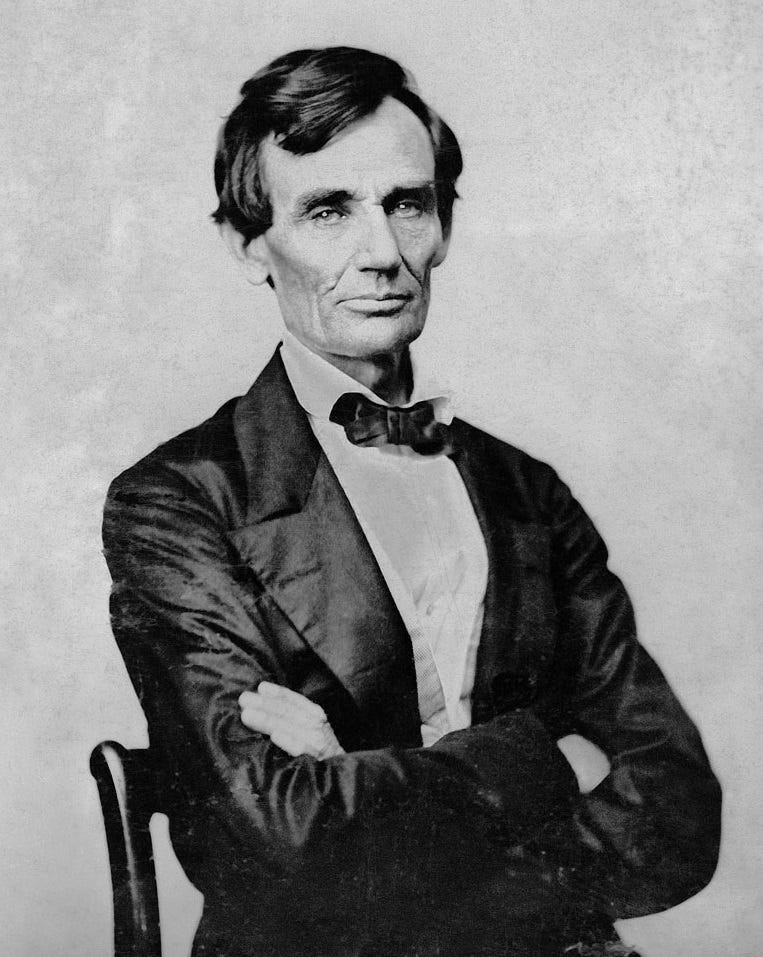
In the middle of all this, I ran across Abraham Lincoln’s first public speech, which he introduces this way.

As a subject for the remarks of the evening, the perpetuation of our political institutions, is selected.

This introduces Lincoln’s famous “Lyceum Speech,” delivered in 1838 [1] to the Young Men’s Lyceum of Springfield, Illinois.  In it, Lincoln takes the position that now that the glories and passions of the revolutionary era have passed, we are going to have to rely on something else to sustain us.  He chooses “obeying the law.”  That is what his generation can contribute to the republic.

Lincoln is worried that there is coming to be a spirit of mob rule in his time.  In the reference to “mobocracy” in the quotation below, he is providing a jab at the popular support for President Andrew Jackson.  Lincoln was a Whig and Jackson was a Democrat—the other party in the partisan configuration of the time.  “Mobocracy” is just another form of “democracy” (demos = the people) and Jackson was accused at the time of stirring up the common folk.  So Lincoln is getting a two-fer here.  He is arguing against the violence of mobs and also getting a jab in at the leader of the other party. [2]  Here is what he said.

Thus, then, by the operation of this mobocractic spirit, which all must admit, is now abroad in the land, the strongest bulwark of any Government, and particularly of those constituted like ours, may effectually be broken down and destroyed–I mean the attachment of the People. Whenever this effect shall be produced among us; whenever the vicious portion of population shall be permitted to gather in bands of hundreds and thousands, and burn churches, ravage and rob provision-stores, throw printing presses into rivers, shoot editors, and hang and burn obnoxious persons at pleasure, and with impunity; depend on it, this Government cannot last.

As I write today, it is impossible for me not to note the irony of these remarks by the first Republican president.  I have, still vivid in my memory, the scenes of a Trumpist mob storming the Capitol to interrupt the certification of the Electoral College votes from the 2020 election.

Lincoln refers to “the mobocratic spirit.”  In 1838, that was a jab at Democrats, but now it is the Republicans who are wielding the mob.  The mobocratic spirit is, as Lincoln said, “abroad in the land”

The strongest bulwark of a government constituted like ours—a government based on free and fair elections, he means—is the attachment of the People and that attachment can be “broken down and destroyed.” by this mobocratic spirit.

Whenever “the vicious portion of the population” Lincoln says, shall be permitted to gather in bands of hundreds and thousands [3] and destroy with impunity, “depend on it, that government cannot last.”

That makes sense to me.  There must be legal consequences for that “vicious portion of the population.”  I, myself, would include President Trump in that vicious portion of the population.  Winding them up and aiming them at the Capitol while the votes are being certified seems too close to the destruction and the deaths to be reasonably denied.

But that isn’t really where Lincoln goes from his point about the accountability that the mob must face.  He goes somewhere much more useful.  This is his next point.

And not only so; the innocent, those who have ever set their faces against violations of law in every shape, alike with the guilty, fall victims to the ravages of mob law; and thus it goes on, step by step, till all the walls erected for the defense of the persons and property of individuals, are trodden down, and disregarded.

Mobs are not that good at discriminating those they consider guilty from those they consider innocent.  At one point on January 6, the mob was only a few feet away from Senators, whose offense on that day was to fairly certify the results of the election.  What would the guy with the plastic twist-tie handcuffs have done had the two groups met?

And finally, Lincoln solution to the problem—and remember, the problem he has chosen is how to “secure the perpetuation of our political institutions”—is for the citizens of his time to be as passionate about obeying the laws as their forbears were about attaining their independence.

Let every American, every lover of liberty, every well wisher to his posterity, swear by the blood of the Revolution, never to violate in the least particular, the laws of the country; and never to tolerate their violation by others. 

There is more, but let’s pause to look at those two.  “Be law-abiding” doesn’t sound too bad.  “Never tolerate [the violation of the laws of the country] by others is a good deal more daunting.  First, it sets us up as judges of the behavior of our neighbors.  People hate to be criticized and especially in the absence of a common and popularly supported moral code, the criticisms seem idiosyncratic and picky.  “Different strokes for different folks” we say, making room for behavior that we, otherwise, would not tolerate.

But the real problem is that attachment to a populist leader like Donald Trump makes “whatever he wants” seem the immediate good and “what democracy requires,” by contrast, thin and remote.  Following the tenets of Trumpism, one may do, out of the demands of conscience, what the Constitution forbids and what the laws punish.

Lincoln’s solution to that problem is grandiloquent, which makes it hard to take seriously, but I am going to quote nearly all the paragraph anyway.  Look at these five specifics.

  • let every man remember that to violate the law, is to trample on the blood of his father, and to tear the character of his own, and his children’s liberty. 
  • Let reverence for the laws, be breathed by every American mother, to the lisping babe, that prattles on her lap—
  • let it be taught in schools, in seminaries, and in colleges; 
  • let it be written in Primers, spelling books, and in Almanacs;—
  • let it be preached from the pulpit, proclaimed in legislative halls, and enforced in courts of justice.

That’s Lincoln’s solution.  The particulars are not phrased to make them seem appealing in our time, but they could, perhaps, be abbreviated to this:  Let us revere the procedures that underlie the system we call democracy.  They may seem remote, but they are in fact crucial to “securing the perpetuation of our political institutions.”

“Democracy isn’t easy,” says President Andrew Shepherd, in Aaron Sorkin’s classic, The American President.  “You have to want it bad.”  And in that, Democratic President Shepherd is on the same page as Republican President Lincoln.  Maybe we should take time to notice and enjoy that.

[1]  Nine score and 3 years ago, just to save you from having to count it out yourself.

[2]  He does not mention at all the recent murder of abolitionist editor Elijah Lovejoy at Alton, Illinois just 80 miles down the road from where Lincoln was speaking.  In the opinion of Professor David Zarefsky, who offers a series of lectures in the Great Courses program (Abraham Lincoln: In His Own Words), this was Lincoln’s way of making Lovejoy’s murder “the elephant in the room.”  Zarefsky reasons that by keeping this recent nearby murder quiet, Lincoln caused the crowd to keep wondering, “When is he going to mention Lovejoy’s murder by a mob?”

[3]  I’ve seen an estimate that 10,000 people made up the “vicious portion of the population” who stormed the Capitol on January 6, 2021.


Posted in Communication, Politics, Sustainability | Tagged , , , , , | Leave a comment

Two Cheers for the Wheaton faculty!

The last time I looked, 284 faculty has signed a statement called  Statement from Wheaton College Faculty and Staff Concerning the January 6 Attack on the Capitol.  See the Appendix for the full statement. Other Wheaton friends of mine grumbled that this statement was not put on the college website or supported in any visible way by the trustees, but I think that is asking a lot.  The faculty are more liberal than any administration of an evangelical school can afford to be and more liberal than any collection of rich conservative trustees will want to be.  From the standpoint of institutional politics, I think it is wonderful that the faculty and staff drafted this, signed it, and published it.

I say good for them (Two Cheers!)  and I speak as a member of the Class of 1959 [1]  I no longer feel at home with the political, theological, or biblical commitments of the college, but I got a very good education there from some superb teachers.

I’m going to take the faculty statement apart a little, just for the purposes of admiring it more analytically.  I hope none of that seems critical.  I am a fan.

First, I notice that amid all the general handwringing, there is a specific confession of error.  These are things they say they have done wrong—have failed to do what is right—that are daring.

The Failure of Evangelicals

This is an important point because it positions Wheaton—“Wheaton” as these faculty and staff see it—with reference to evangelical institutions nationally.  All over the U. S., evangelical leaders either accepted the attempted coup as just or minimized its importance.  Surveys show that self-identified evangelicals support Trump by 80% or more.  The stance taken by this statement distinguishes Wheaton from that stance.  “The Wheaton we know,” says the statement—making special reference to the Christian teachings or ethics that we “submit to” [2]—is not like that. Having said that, they have given the institution itself—not themselves—a place to stand.  It is good to do that first.

Failure of Leaders

“…many evangelical leaders…wittingly propagated lies…or were unduly silent.”  As you can see by all the ellipses, that is an excerpt.  It is the spine of the condemnation contained in paragraph two in the Appendix.  It is, in fact, all of the charge except for a little throat-clearing.  And the cause of their behavior is given as “a lack of courage.”

This is a powerful charge on the merits.  It is always easier to blame someone else, of course, but it is hard to escape the bluntness of “Many evangelical leaders lied.”  The deeper charge is that many were silent.  It is deeper because it puts the condemnation of a president who is hugely popular among evangelicals right at the heart of the ministry of evangelical leaders.  It demands that the standard of “the right thing” be substituted for the standard of “he’s one of us.”  That is a shift that evangelical churches, by and large, have not been willing to make and the writers know that.

Our Failure

The final paragraph is where the power is.  These faculty and staff have established a place for Wheaton—the Wheaton they see and value—to stand to criticize.  They have used that place to condemn evangelical leaders for their lying and their cowardly silence.  At this point, you wonder what else there is to say by way of denunciation.

I want you to look at these four verbs.  Consider each in its own right; consider the sequence. [3]  We repent; we lament; we grieve; we commit.

Of what do we repent?  We repent of “our own failures to speak and to act in accordance with justice.”  I think this is worth saying because of the contribution it makes to the argument, but it is not a strong condemnation.  “Justice” is deeply debated.  “Failure to speak and act” is, accordingly, weak. [4]

Next, we “lament.”  What do we lament?  We lament the failures of the church.  “Lament” is a weak word; it connotes hand-wringing.  But the setting to which it is applied makes it a kind of evangelical molotov cocktail.  The statement laments the church’s failure to “teach clearly” and to “exercise adequate church discipline.”

This is not a condemnation of silence.  This calls on the churches to actively teach justice and also to act justly.  It might call on the members of the church to act justly as well.  Certainly that is the direction “church discipline” moves the argument.

Let me pause briefly for a little political setting of the scene.  Most American political issues are matters of balance.  This is obscured by the rhetorical practice of raging against the extremes of either side.  Who’s for autocracy?  Who’s for anarchy?  These are silly slogans.  The real argument is how much power should be exercised over whom at what level for what purposes.  How much support should be given farmers?:  What responsibility for balanced accounts of events should be required of the media?  Where should the bulk of the burden fall for ameliorating the damage done by an increasingly erratic climate?

So it is good to lament the failures of the church, but what, exactly, should they teach about our politics?  And how will “church discipline” be brought to bear?  I have never, in a lifetime of listening to evangelical rhetoric, heard this argument posed.

For what do we grieve?  Here, the risky step taken in “lament” is powerfully expanded.  We grieve “over the inadequate level of discipleship that has made room for this type of behavior.”  We are considering here not what the church might consider doing in the case of failures in the cause of justice.  We are considering here leaving no room for such failures.  

In this picture, the resources of Christians and of Christian churches are so fully engaged with X that there are no resources left to spend on injustice and deceit.  “Leaving no room” is very aggressive.  Bad behavior is crowded out by good behavior.  There is no question that that works at the individual level on goals that are clearly defined and for which resources are available.  But what is X?

In a religious context, you could oppose sin to righteousness.  That gives us the rhetorical questions that echo the set on anarchy and autocracy.  Who is for sin?  Who is for righteousness?  But this is not a religious context; this is a political context.  This is a context where most of the issues are issues of balance and emphasis as the examples of farmers, media, and climate establish.  Rhetorically, the political goal of any congregation could be “justice.”  But this is not rhetorical.  This has to do with church discipline and a life so fully committed to “justice” that the congregation has no room for “injustice.”

What on earth?  What in heaven?

To what do we “commit?”  Well…“We commit ourselves to a more faithful witness in our callings as the faculty and staff of Wheaton College.”  This would be much more aggressive if it applied to the church, as the previous three verbs have done.  But this applies to themselves, so although the level of interaction is even more intense, the playing field is small.

And what is the more faithful witness?  Slowly the trial balloon begins to come back to earth.  Faithful witness requires “discernment in civic engagement,” and a “communication of the truth.”  That doesn’t seem so bad.  Who is against discernment?

Notice that it also commits them to demonstrate the connections between love and justice..  I wish them well with that.  I myself believe, as does Reinhold Niebuhr, that “justice” is as close to love as one can come in the pursuit and use of political power.  You could argue, I suppose that love for unjustly treated people requires that you work for justice for them.  That would work. But love here is a private motive.  You can always do that.  Justice is a public standard, the character of which will always be in contention between two parties, even two parties of good faith.

I think we will have to do more.  But I am nearly overwhelmed that the faculty and staff of my alma mater have done as much as this.  Good for them, I say.  “Two cheers!”

[1]  As the class song says, “We’re the class of ’59/In all things we really shine.”  Not advanced poetry but if you sing it loud enough in the right setting, it works fine.

[2]  I think their choice of the verb “submit” jumps out in that statement.

[3]  As you see, I am leaving out “pray” from the series.  It is theologically crucial, of course, but it gets no grip at all on political critique, unlike all the others.

[4]  Although it is possible that in that setting the use of a religiously powerful word will resonate.  It is the first word of Jesus’ ministry, for instance, and it has lately been interpreted more cognitively than emotionally.  “Repent” has come, in church circles, to connote “changing your mind,” rather than just feeling sorry.  The Greek noun metanoia, which is commonly used in sermons, literally means “to change your mind.”  That might be the implication the drafters of the statement were hoping for.

Appendix 

Statement from Wheaton College Faculty and Staff
Concerning the January 6 Attack on the Capitol

The January 6 attack on the Capitol was characterized not only by vicious lies, deplorable violence, white supremacy, white nationalism, and wicked leadership—especially by President Trump—but also by idolatrous and blasphemous abuses of Christian symbols. The behaviors that many participants celebrated in Jesus’ name bear absolutely no resemblance to the Christian teachings or ethics that we submit to as faculty and staff of Wheaton College. Furthermore, the differential treatment displayed by those with a duty to protect in their engagement with rioters who trespassed on the Capitol grounds illegally, when compared to recent protests over police brutality in D.C. last summer, illustrates the ongoing reality that systemic racism in our country is tragically and undeniably alive and well. These realities are reprehensible. Our Christian faith demands shining a light on these evils and the simultaneous commitment to take appropriate action.

In the days and weeks preceding January 6, many more leaders, including many evangelical leaders, could have spoken truth to the disillusioned supporters of President Trump—diminishing the prospects for violence and bolstering the witness of Christian love and the call for justice in our civic life. Some did. However, many wittingly propagated lies, or were unduly silent in a just cause. Our Christian faith demands greater courage. 

We repent of our own failures to speak and to act in accordance with justice, and we lament the failures of the Church to teach clearly and to exercise adequate church discipline in these areas. Moreover, we grieve over the inadequate level of discipleship that has made room for this type of behavior among those who self-identify as Christian. We pray that the Holy Spirit will reveal to us all manner of idolatry, and we commit to speaking plainly against it wherever and whenever we find it.  We commit ourselves to a more faithful witness in our callings as the faculty and staff of Wheaton College, and will work diligently to provide ample opportunities to show students, as well as the larger Wheaton College and Christian community, how to practice discernment in civic engagement, to demonstrate the connections between love and justice, and to courageously communicate the truth—even and especially when the truth is difficult to hear.

We pray that, in so doing, we will fulfill the Lord’s requirement of us: “To do justice, to love mercy, and to walk humbly before our God” (Micah 6:8).


Posted in A life of faith, Political Psychology | Tagged , , , | 1 Comment

The Warmth of Flowers

We are having a power outage here at the moment.  I have been going back and forth on the question of whether I should write a little note about Little Dorrit.  I get used to the power of Charles Dickens’ language, especially in his descriptions of social and political hardship.  And then I forget that he can we as sweetly charming as anyone, as he is in this passage.

Here is the context.  Arthur Clennam, the principal character,  has always been rich and now, suddenly, he is poor and is living in the Marshalsea debtors prison, where Amy Dorrit (Little Dorrit) has lived her whole life until she recently became rich.  Being suddenly poor and dishonored is hard and it makes Arthur ill and barely cogent.

One day, this happens to him.

Beside the teacup on his table, he saw, then, a blooming nosegay: a wonderful handful of the choicest and most lovely flowers.  Nothing had ever appeared so beautiful in his sight.  He took them up and inhaled their fragrance; and he lifted them to his hot head, and he put them down and opened his parched hands to them as cold hands are opened to receive the cheering of a fire.

I like each piece of that.  I enjoyed “inhaling the fragrance;” I enjoyed “lifting them to his hot head;” I enjoyed “opening his parched hands to them.”  That one is my favorite and I want to return to it.

But more than anything I like the order.  “Inhaling the fragrance” is something anyone could have written.  I could have written it.  “Lifting then to his hot head” is surprising.  It isn’t that the flowers are cool; it is that they are beautiful.  Being beautiful, they are therapeutic to his head.  But even that does not prepare us for “opening his hands to them.”  Especially not parched hands.

Dickens is drawing here on a very common experience.  Your hands are cold and you find a fire or even a warm surface and you open your hands to it, multiplying the surface of the skin the warmth can reach.  Everyone has done that.  But Clennam opens his hands to the beauty of the flowers.  Multiplying the skin surface does not address this question or make sense of the response.  Yet we do understand it.

The flowers do nothing for his hands open that it would not do closed.  We could say that he opens his heart to the flowers, and in doing that opens whatever he can.  He opens himself to the flowers and his body follows his lead.

It’s just beautiful writing and I have been enjoying it.  Tonight, I am enjoying it in a blackout.

Posted in Books | Tagged , , | Leave a comment