Church and State

In Salem, Oregon, where I got nearly all my political training, there is a Church Street and a State Street.  The First Methodist Church of Salem sits there quietly at the intersection of Church and State where, by all rights, there should be a Wall of Separation.  The Capitol Building is only a block away, but no one seems to be alarmed.

Cardinal Timothy M. Dolan appeared on “Face the Nation” on Easter Sunday and made some remarks about the Wall of Separation that truly amazed me.  You can see them here.   In his conversation with Bob Schieffer, Dolan said two things that strike me as remarkable.

The first is that JFK’s speech to the Greater Houston Ministerial Association (here) has been misinterpreted, that Kennedy had not meant to say that the “separation of church and state also means a cleavage, a wall, between one’s faith and one’s political decisions, between one’s moral focus and between the way one might act in the political sphere.”

What Kennedy did say is, “Whatever issue may come before me as President, if I should be elected, on birth control, divorce, censorship, gambling or any other subject, I will make my decision in accordance with what my conscience tells me to be in the national interest, and without regard to outside religious pressure of dictates.”  It is easy, in the present climate of opinion, to be drawn off by “what my conscience tells me,” but we should note carefully what Kennedy was listening for in the voice of his conscience.  He was counting on his conscience to tell him what was in the national interest. Doesn’t that seem like part of a different conversation than the one we are having now?

Let me amend Cardinal Dolan’s statement a little to emphasize what I think he is saying.  He thinks Kennedy has been misunderstood to say that he would put a wall between his “personal” faith and his performance of the office of President.  I think that is precisely what Kennedy did say.  Behind all the language about “not being dictated to by the Pope,” there is the commitment to act in the public’s interest as a public official if he can–and a promise to resign if he cannot.  I think the Cardinal is trying very hard to misinterpret Kennedy’s stance and calling a correct interpretation (mine, in this case) a “misinterpretation.”

The second element of the interview that concerns me is the Cardinal’s notion of “the public square.”  This has been debated for thirty years that I know about, and probably for more than that.  The view Cardinal Dolan rejects is that “faith has no place in the public square.” That way of putting it makes is sound like the question is whether public debate should be dominated by secularists or whether “religious people” should also be allowed to participate.  I get that in my classes at PSU all the time by students who believe that the Supreme Court has said that students are not allowed to pray in public schools.  They are often surprised to learn that what the Court said is that students may not be required to pray in public schools.  The issue has never been prayer; the issue is compulsion.

The Cardinal does not distinguish, the way I wish he would, between the motive for participating in public debate and the views one expresses.  I am driven to participate in the public discussions because of my commitment to protect the poor from the depredations of the rich.  Fine.  The founder of my faith, to whom I owe ultimate allegiance teaches that there should be a negative income tax, tied to the federally defined poverty line and augmented annually by cost of living adjustments.  Not so fine.

In my commitment to the poor, I enter into alliance with everyone else who believes the public good is served by reducing somewhat the catastrophically large gap between the rich and the poor.  I work with whomever to establish whatever that will achieve that noble goal.  But when I take the other route, I claim the authority I grant to the founder of my faith–“I grant”…”my faith”–and I use it to establish the public policy of the government which may leave everyone worse off.  If God requires it, it doesn’t really matter if it leaves everyone worse off.  If I object to God’s requirement on the grounds that it would leave everyone worse off, I lay a public outcome against God’s will, as I understand it, because I don’t want everyone to be worse off.  And God does?

If the public square concept means that public policy is to be enacted based on my notion of what God wants, the well-being of aside, then I think the public square concept is a menace and should be dropped.  If it means that people of my faith, your faith, and no faith are all allowed to propose policies that, before enactment, must meet the public test of fairness and must run the gamut of political constituencies, than I say let ‘er fly.
Posted in Politics, Words | Tagged , , | 3 Comments

Just Ignore Them and Make the Shot

I’m giving some serious thought to ending my career as an educator.  But being an educator, I don’t just decide to stop and then stop.  Oh, no.  I think about it; I write about it; I examine whether I really am at that place on the trajectory of declining effectiveness that I seem to be.  Am I going through a bad patch?  Is it just going to keep on getting worse?  Could I do anything that would make it better?

Here are a few ways of thinking about it.

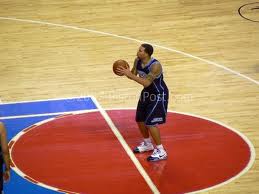
Justice Clarence Thomas likens all the outside political pressure that the Supreme Court is facing over its review of the Obama administration’s sweeping health care law to the distraction faced by a free-throw shooter confronted with fans waving wildly behind the basket. Neither, in his view, has much impact in the end.

“Why do you think they’re never distracted? They’re focusing on the rim, right?” Justice Thomas said when asked at a forum two weeks ago about the pressures of the health care case. “That’s the same thing here. You stay focused on what you’re supposed to do. All that other stuff is just noise.”

These are the opening paragraphs of the March 25 New York Times piece about the forthcoming Supreme Court review of the Patient Protection Act.  Most of Justice Thomas’s published remarks have not made all that much sense to me, but I got this one right away.

Let’s imagine a development of those crowds who, these days, sit behind the basket so they can wave objects and make noise to distract the shooter.  Let’s imagine that once upon a time, the people who sat in that section were those most interested in the quality of the game being played, rather than the outcome.[1] Then there were, in this entirely imaginary history, groups of people who followed the cheerleader’s exhortations while an opponent was shooting free throws.  The cheer in its original form could have been, with the first name of the shooter filled it, “Miss it, Patrick, miss it.  Miss it, Patrick, miss it!”  Later on, it would become, “Miss it, scumball, miss it!”  And it could get worse from there: questions of parentage, ethnic slurs, allegations of failed manliness, etc.

Please don’t allow yourselves to be distracted by this extended metaphor.  I am writing about how to think about when I should end my career as an educator.

In the next phase, we could have people who really don’t care about the game at all, not even about who will win, but who enjoy harassing “the players.”  We who sit in the stands are “the people” and those hotshot jocks who make so much money are “the enemy” and anything we can do to prevent their best performance will serve them right.

Now let’s consider the player whose job it is to make the free throws.  This is the character in the drama with whom Clarence Thomas identifies.  This player’s  job, as Thomas sees it, is to focus on the rim and ignore the distractions.  But now imagine that he begins to think that the behavior of this unruly mob behind the backboard is intolerable.[2]  He, the player who is trying to make the shot, is doing what must and should be done.  They, who come to the game with entirely malevolent intentions, are doing what should not be done.  Justice Thomas has just been changed from a player—focus on the rim, make the shot, win the game—to a critic.  As a critic, he will not be as good a player.

I think that is where I am as an educator; I am becoming a critic.  I am having more and more trouble remembering how much more important it is to make the shot than it is to disapprove of the mob behind the basket.  Let me illustrate.  When cell phones became popular, students began sneaking them into class and texting on them discretely.  The looked to me like my classmates in elementary school looked when they were writing notes under the desk and trying not to get caught.  Then they started bringing laptops and, along with all the asserted uses, like note taking, they are rummaging through their Facebook accounts.  Every now and then, one laughs out loud.

These actions, disruptive as they are to a teacher who is not used to them, are important mostly because they signal the student’s orientation to the class session.  I have always thought that at my best, I was providing them skills they would be able to use for the rest of their lives.  At my worst, I was providing them information they would need to pass the tests.  Nothing in my life as a teacher prepared me to be considered a distraction from the entertainment they had brought with them.

I got a good look at this phenomenon from the other side recently.  I record the academy awards show because there are some movies I care about and some actors I care about and I have the normal curiosity about Best Supporting Actress and so on.  Then, when I get a chance, I buzz quickly through the show, looking for the parts I want to actually watch.  As I was doing that again this year, I recognized in myself the attitude I have been seeing recently in my students.  In their minds, they are fast-forwarding through the class session, monitoring casually in case anything interesting shows up.  I’m trying to build concepts and that often requires the reexamination of the ideas the students brought in with them, the discarding of some pieces, and the reorganization of others into a new structure.

It takes a real focus on the matter and some willingness to accept some discomfort. Let’s say you begin with the idea that most people are so ill-informed that they can’t even cast consistent votes in support of their own interests.  But the studies show that people do, in fact, vote “correctly.” i.e., they vote for the people and the issues that would vote for if they knew a lot more.  Navigating cognitive/emotional rapids like that isn’t easy.  It certainly takes full attention and then some discussion and then some reconsideration.  You can’t do it while you are fast-forwarding through the class.

And the writing my current students do is so much worse.  I’d guess that most of the writing these students do is texting.  Whatever it is, it is a kind of writing where adding…you know…every few words is enough to convey the general sense the writer has in mind.  Most of the writing I assign really can’t be done well in that mode and I find myself facing two problems.  The first is that the students don’t know anything about more formal writing.  I’m thinking of things like sentences that have…you know…subjects and verbs.  Or, if we are studying James Madison, indirect objects.[3]  The second is the growing sense that the kind of writing I am asking for is neither desirable nor reasonable.  I shouldn’t be asking them to write in a clear cogent manner; it’s just not something anyone ought to be asked to do.

These two kinds of changes are moral affronts.  They are things the students really shouldn’t be doing.  They are wrong!  (Do you notice my attention drifting away from the rim?)

So if I were to begin to design a class session to move them from where they are to where they really need to be—there is a syllabus, after all, and the course goals are published in the university catalog—I would find I was not starting from the right place.  Full-throated condemnation is not the best way to begin this “path back to the lesson.”  Also, I find that I can’t get “back” to where I think we need to be from where the students are starting.  I used to get students who didn’t know how to do footnotes.  Then I got students who have never seen footnotes.  Now I am getting students who think there really shouldn’t be footnotes.  These are students who cite Google as a source because, in fact, that is where they found the information.

For me, the result of these developments is that I have begun to attend much more to the mob of crazies behind the basket.  That makes me less good as a player and I have been missing a lot of shots.  These students still need to be taught, but they need to be taught by teachers who know how to focus on the rim and how to hit the shot and how to win the game.


[1] That is actually the way I feel, myself, when I am watching two teams I have no commitment to.  When one of the teams is “my team,” my hope for a particular outcome changes the way I look at the game.  I see blocking fouls where the refs call charges and charging fouls where the refs call blocks.

[2] “Intolerable” is a word that is often used to mean “bad,” but I would like to use it more exactly.  The task this word has in mind is tolerating something and the word says that it can’t be tolerated.  Not—you will note—that it should not be tolerated, but that it cannot be.  When the question of “intolerable” comes up for the player, the focus has already shifted from making the shot to responding to the crowd.  If that same question were to come up for a sociologist who studies sporting events, it is perfectly acceptable.

[3] A republican (small r-) joke.

Posted in Education, Getting Old, Political Psychology | 3 Comments

I Want a Second Opinion

The story goes that a mentally unstable and unattractive woman was seeing a psychiatrist.  She had been seeing him for awhile and no diagnosis of her difficulties was forthcoming.  “Well,” the shrink said, when pressed, “You’re crazy.”

 “I demand a second opinion,” said the patient.

 “OK.  You’re ugly,” responded the psychiatrist.

 It isn’t a pretty story, but it brings the hearer abruptly up against some other possible meanings of “second opinion.”  There has been a lot of enthusiasm, lately, for the assessment of professionals by non-professionals.  There was an interesting piece in this morning’s New York Times(here) about the online evaluation of medical doctors.

Here are two engaging paragraphs from that article.

Companies have tried to collect reviews of doctors since the early days of the Web, and RateMDs.com has gathered more than most. The founder, John Swapceinski, was inspired to create it after his success with a site called RateMyProfessors.com, which is well known for the “hotness” rating that college students assign (or not) to their teachers.

“Anything that people spend time or money on ought to be rated,” he said. RateMDs now has reviews of more than 1,370,000 doctors in the United States and Canada.

 My first concern is the criterion of “hot” to rate university professors.  Over the forty years of so that I have been a professor, I have had my really good days in class and my really bad days.  I don’t think I have every impressed anyone as “hot.”  So the use of this criterion is not good news for me.  Also, I wonder whether one student who used that word to describe a professor would mean the same thing another student meant.  Beyond that, there is the question of the variety of uses to which the “hotness” criterion should be put.  Is there a relationship, for instance, between the availability of hot professors and the proportion of students who graduate within five years?  Or is it more the correlation of hot professors and the proportion of As in his courses.

My second concern is with the standard John Swapceinski uses for rating.  “Anything that people spend time or money on,” he says, “should be rated.”  That seems overbroad to me.  Possibly, I have been reading too much about pure research and how hard it is to make the case for funding.  And as someone who spends a fair amount of time on his marriage, I wonder about the implication that I should be “rating” it.  On “hotness,” possibly.

Seriously, I do have two sensible concerns.  The first is that students or patients will be competent to judge all aspects of their teachers or doctors.  My students know whether I come to class on time, they know whether I am egregiously partisan, they know whether I have enough office hours, they know whether I confuse them.  Probably, they do not know whether the confusion they experience from time to time is a stage necessary to the acquisition of new concepts or whether if comes from my own failure to explain.  It’s an important distinction.  Every student who thinks about it, knows whether he or she is confused.  Only the best ones, and only by the end of the term, know whether it was necessary and worthwhile. 

The second sensible concern I have is whether students can be trusted to voice the opinions they actually have.  That isn’t as easy as it might seem.  It requires that I screen out my own feelings so that I can make a correct and useful assessment.  It means not giving high marks to the professors I like when they don’t deserve them.  It means not giving high marks to professors I don’t like when they don’t deserve them.

Imagine that a student has been in to see me about a grade he thinks is too low.  It may be “too low” for purposes of his own, like graduating on time.  It may be “too low” in that the student thinks the answer is worth more than I think it is worth.  I am persuaded, let’s say, that his is answer is notably worse than the other fifty answers to this question that I have read and I tell him, on that basis, that I cannot revise it upward.  He is angry because he knows it is something I could do and might even imagine that the score I recorded had to do with feelings I had toward him.  In any case, he leaves the office angry.

At the next class session, he is given a course evaluation form that will go straight to the head of my division.  If he goes through the unpleasant effort of screening out his personal feelings so that he can pass on a valid assessment, the purpose of the evaluation process will have been met.  If he treats the evaluation as a chance to get back at me for my refusal to raise his grade and, in that way, to meet his need, the purpose of the evaluation process will not have been met.

The student knows what his opinion is.  And he knows he is angry.  The struggle of which “truth” to pass on is sometimes, I am sure, fierce, and I am not sure that the better angels of his nature always triumph.


Posted in Political Psychology, Uncategorized, ways of knowing | 2 Comments

Two Happy Guys on Mt. Rushmore

Here is a little squib from the movie, Prairie Home CompanionGuy Noir (Kevin Kline) was engaging in an extended fantasy about how good the Angel of Death looked when she came to the theater.  We are free to laugh at what he says because we see her on the screen.  She is blonde in a white trench coat.  Period.

Mr. Noir goes on and on about what she was wearing underneath the trenchcoat.  Here’s my favorite.

“She was wearing a Mount Rushmore tee shirt and I’m telling you those guys never looked so good—especially Jefferson and Lincoln.”

Posted in Saturday Evening Post | Tagged , | Leave a comment

Remembering to Leave in Time

I want to raise the question here of how to decide when to go live in a Senior Center of some kind—I’m thinking of a nice generic name like Paleo Acres.  This could be a Paleo Acres; I guess I’d have to find out where it is first.

In preparation for this question, I would like to rule out some other questions.  The first question I am ruling out is whether to go live at Paleo Acres.  I’m sure there are good reasons for living in your own home for as long as you can, but Bette and I have decided not to do (for reasons that will become clearer in a moment), so I am ruling it out as a question that concerns me.

The second, a Frequently Heard Objection, (FHO) is: “I want to stay here as long as I/we can.”  That raises the question of what “can” means.  I don’t think there should be some Old Folks Agency (OFA), measuring whether old people ought to be allowed to stay in their homes and evicting them when the Agency feels some old couple doesn’t meet the criteria.[1]  On the other hand, I have seen old people who clutch their homes as if they were defending them from the Visigoths.  Their attitude is that there are a lot of things about being old that are really difficult, but there is no way we are going to let THEM throw us out.  Since THEM are bad guys, opposing them at all costs is the right thing to do.

Third, the question of “at all costs” introduces us to the question of just who will pay these costs.  I have seen families stretched to and beyond their limits to care for aging and home-bound parents who are “protecting their independence.”  This “independence” requires a thoroughgoing dependence upon a small army of caregivers (mostly family), accountants, nurses, therapists, and maids, but none of those people are THEM so we are still “independent.”  Putting the family through the wringer like that does not seem to me an act a loving parent would choose.

Fourth, there is the matter of “we really like our life these days.”  The thought that comes to my mind when I hear that said—and, occasionally, when I hear myself saying it—is “compared to what?”  There is a way of valuing the way you live now that slides into the sense that the way you are living now is the only way or the best way for you to live.  For that reason, it tends to obscure what would otherwise be obvious, which is that the way you are living is one good way among many possible good ways for you to live.  Is it really reasonable to give up this way only when you have to and to postpone any of the future good ways as if they were illusory?  I don’t think so.  It is natural, but mostly, I think we can do better by thinking it through.

So there are four approaches, chosen at random from a list that could have been a lot longer.  I want to clear those away so I can get a closer look at my own approach, which is: how will I know when the best time is to leave here and move there?  I have thought about this for a while and I have it down to two elements.

The first element is that I want to head off to Paleo Acres when my work is there.  I have a neighbor who is a woodworker.  He has nearly finished entirely re-doing their house: kitchen, floors, cabinets, rec room—nearly the whole house.  His work is where the house is.  That’s where it has to be.  My work isn’t like that.  My work has more to do with ideas and conversations and caring about people and being willing to be cared about and teaching and learning and reading and writing.  And, since I am writing this in March, with NCAA post-season basketball.  Those are my work now, as Bette and I are living here in the only house where we have lived together.  It will be my work then, when we arrive at Paleo Acres.

For me, so far as this first idea is concerned, it’s more a choice of venue.  And “work” is just a metaphor.  I call the whole pattern of working and playing, “work.”  I might just as well call it “the way I live.”  In some settings, I think I would call it my “ministry.”[2] The point of this designation is that I hope to continue doing what I am doing for as long as I am able.  That is what I want in the forefront of my mind.  I want to put the question of where I do it in the back of my mind.

It is going to be easy, in any case, to mourn the loss of familiar surroundings.  Remember that third step that always squeaked?  Remember the show the hummingbirds put on for us when you put out a fresh batch of sugar water?  Remember the sight of the Tualatin Valley in the morning with the fog packed densely over the river and visible hardly at all anywhere else?  Those are all good things and I know that when I leave them, I will miss them.  But imagine what my life would be like if I couldn’t “do my work,” i.e., to “live my life.”  And all the practices that are familiar in that way, I will take with me IF I go soon enough.

The second element points out the advantage of being “there.”  I have no idea, of course, what the physical course of my life will be.  You don’t either.  We all play the odds.  But let’s say I can count on another ten fully functioning years.[3]  If Bette and I go to Paleo Acres when I am 80 and she is 71—the current plan—I am going to be one of the relatively resource-rich people there.  I can go for walks with new friends.  I can drive someone to see a doctor.  I can carry on a conversation about political events.[4] I can remember to bring the beer to the Superbowl party. I can be the one who invites people over to see movies or who serves as the sheepdog of a book group.[5]

If I don’t get there in time—and I won’t if I stay here as long as I am able to— I can’t do those things.  If I wait to go to Paleo Acres until I am no longer competent to live in my present home, I will never be one of those people who helps make Paleo Acres a good place.  I will be someone who benefits from its being a good place, but I will have no part in making it what it is.  I will have no part in making “this is how we do it here” and affirming and clarifying culture.

If I do get there in time, I can belong to the group of people who provide resources.  I will know the other members of the group in that capacity and they will know me in that capacity.  And as I lose my ability to do those things, I will still know these people in that way—because that is who they were when I met them—and they will remember me in that way as well.  I won’t be the new guy who began drawing down the pool of social capital from the day I arrived.  I will be the old guy who served long and well until his abilities began to fail him.

That’s really what I want and if I get there in time, I don’t see why I can’t have it.  But to get there in time, I have to leave here in time.


[1] Presumably these are the same folks who would run the “death squads,” purportedly embraced by Obama’s Patient Protection and Responsible Care Act.

[2] I have been much more tolerant of ministry as a word I could use since I discovered what kinship it has with minus and minor (meaning small).  In fact, if we had a word “admagistrator,” instead of magistrate, using magus (large), it would be the perfect foil for administrator.  So a ministry of small gifts is almost a redundancy.

[3] It’s just a number.  I actually like my life and I would be very grateful to have another twenty years of the kind of life I am living now.  On the other hand, death really isn’t a big deal for me, so it isn’t true that the big thing about “living” another twenty years is that it postpones dying.  I have felt this way in, so far, Illinois, Ohio, Pennsylvania, and Oregon.  I mention those because when I was a mere lad, I read this admonition from the Apostle Paul: “I have learned in whatsoever state I am, therewith to be content.” (Philippians 4:11).  There is no way to know for sure just what states Paul had in mind, but my set goes from coast to coast.

[4] You might not think it, knowing that I have been a political science professor most of my life, but I am really good about talking politics with nearly anyone who is willing to be civil about it.  A fair amount of my time in class has been spent constructing structures, within which fairly goofy questions can be treated as sensible and to which answers can be found.

[5] A book group without someone to herd in the stragglers and clarify the reading schedule and the times we are supposed to meet will not be a very long-lived group.  Really, somebody has to do that.

Posted in Getting Old, ways of knowing, Words | 9 Comments

“Loose Talk of War.” Yeah, right.

When a political campaign is at full throttle, it is easy to think that any disagreement is mostly a partisan disagreement.  Given the current disposition of the parties, that would mean an ideological disagreement.  The current exchange on Iran’s nuclear ambitions sounds like that, but I don’t think it really is.  Here’s a thoughtful piece from this morning’s New York Times.

I think the position President Obama has taken is a discretion-enhancing attitude.  This is not at all unusual for presidents, who will be the ones to exercise discretion.  Candidates tend to take a fear-enhancing (on this case) or a condemnatory position.

This means turning the current debate about 85 degrees.  There is not a pro-Israeli party and a pro-Iranian party.  There is not a pro-military position and a pro-diplomatic position.  What we have instead is a position taken by the decision maker, the goal of which is to allow him to juggle all the balls as long as necessary—but without losing the support of the American Israeli Public Affairs Committee (AIPAC).  The Republicans are trying to scare people by imagining forthcoming horrors for Israel and to court AIPAC by taking a more bellicose stand than any sitting president—including any of the current candidates—could afford to take if he was the one who had to make the decision.

This way of looking at things requires the analyst to leave verbal style out of consideration.  No one will deny that Gingrich, Santorum, and Romney have different rhetorical styles and whatever position any of them took on the issue of Iran’s nuclear ambitions would use that style.  Ron Paul appears to have an entirely different position, the headline of which is “I won’t interfere with Israel’s Self-defense.”  I think that means, “OK guys, you’re on your own.”

But if Mitt Romney were president now and the cast of the Democratic party candidates were up against him—Obama, Clinton, Dodd, Biden, Edwards, Gravel, and Richardson—they would say the same kinds of things.[1]  They would not necessarily take the position that the Republicans are taking now, but they would take a position that they hoped would have the same effect.  Candidates want to reduce the latitude for decision of the sitting president and to move him away from powerful groups (AIPAC, in this case) and contrary to public opinions.  If President Romney cited the need to consult allies, he would get dinged for failing to put “America First.”  If he directly threatened military intervention, he would get dinged for being a warmonger.[2]

The strong language of the campaign makes this look like a war between Democrats and Republicans.  It is not.  It is not a war, it is a dance.  And it is not between Democrats and Republicans; it is between the “ins,” who get to make the decision, but who are responsible for fifty other decisions at the same time, and “outs” who have no immediate goals except winning.


[1]  I didn’t forget Dennis Kucinich.  I left him out for the same reason I left Ron Paul out.

[2]  Really though, what does President Obama’s “all options are on the table” stand mean except that he will resort to direct military action if necessary?

Posted in Politics | Leave a comment

A Defense of Dilettantes

One of the pitfalls of thinking of yourself as “a person who knows things” is that you sometimes don’t have a clear sense of just what it is you know.  I’ve been a teacher for the last fifty years or so and when my attempts to ensnare the students’ curiosity fail, I wind up standing at the front of the room giving the answers to questions very few of the students have asked.  Or, on other days—particularly in lower division university classes—thundering away about some aspect of politics that has agitated me and that could, with some generosity of spirit, be thought to belong within the course I am teaching at the moment.

That much to introduce the idea that when my subscription to A-Word-A-Day popped dilettante up on my screen, I deleted it and went on to more pressing matters.  Fortunately, my brother John knows of my interest in the word and forwarded it to me.  Not, I hasten to say, as an accusation; just as an affirmation that this word has interest for me and that the thought of me when he saw it.  Here is what it said:

MEANING:

noun: One who takes up an activity or interest in a superficial or casual way. adjective: Superficial; amateurish.

ETYMOLOGY:

From Italian dilettante (amateur), from Latin delectare (to delight). Earliest documented use: 1733.

USAGE:

“I long ago came to realize that I am a putterer, a grazer, a dilettante. I create the impression of getting a lot done by dabbling through my days: I read two pages of a book, write half a letter, paint a portion of the front porch, bake half a tin of muffins, teach a class, wash a window.” Robert Klose; Confessions of a Dedicated Dilettante; The Christian Science Monitor (Boston, Massachusetts); May 10, 2004.

Not very attractive, is it?  Obviously, I don’t feel that way about the word or I would not have tattooed it, metaphorically speaking, on my forehead.  Also, it’s not like I feel the word can be refurbished.  It is what it has become.  This post will have abundant illustrations of what it has become.  You get the illustrations by googling dilettante and choosing “images.”

I do think the word could be given a little more fiber, though.  Maybe furbished up a little.  I have two approaches in mind.  The second will be etymological.  I suppose that won’t surprise anyone.  But let’s start with an approach that is, for  lack of a better word, “temporal.”  Robert Klose, in the quote above, has a very short span of time in mind: “two pages of a book” and “half a tin of muffins” and washing a single window.  This is puttering, certainly, but there is no delight in it and I hate to see a line of words deriving from delectare, “to delight,” stoop to simple puttering.

Mr. Klose believes, apparently, that one cannot delight in projects that take longer than washing one window.  A man could not, in this usage, take delight in the times he spent with his children when they were small or the confidences he exchanges with them now that they are large.[1]  He could not take delight in the strength and warmth of his own marriage.  He could not delight in the steady endurance of friends who have hung around in times when that was not easy to do.  He could not delight in the fruits of his own work; neither the slow but growing readiness his students show to question common assumptions or the eruption of new insights.  I’m a teacher, remember.

Someone who wanted to defend the most common notions of what dilettante means would be almost certain to say that words like satisfaction or approval are used to indicate our response to outcomes like those, and he would be right.  But, first, those words don’t mean any more what they have meant over most of their histories and second, those words don’t specify what my own response to those outcomes must be.  Is there any reason, for instance, that I cannot find satisfaction with the way I have parented my children and stepchildren today and take delight in it tomorrow?  I don’t think so.

And if delight is restricted to the first spoonful of the hot fudge sundae or to the reaction to an author’s first page or to the first paragraph (only) of a blogpost, then I can see why “putterer” would be an adequate synonym for dilettanteBut, of course, I don’t see any reason why it should be limited like that.  What shall we do, for instance, if we are “ensnared?”

When I make a reference to the origins of dilettante, I usually stop at delectare, “to delight,” but in a quest for “fiber,” I want to look a little further up the tree today.  The Latin delectare is a frequentative (happens over and over, like the “sparkle,” which is a frequentative of “spark.”) of the Old Latin delicere, itself a combination of de-, “from,” and lacere, “to entice.”  Or, my dictionary says, “literally, to ensnare.”  Now there’s a notion with a little grit in it.

It is not only what I delight in, as a putterer might, but what I am ensnared by.  A snare, let me remind you, is a device for catching and holding; for not allowing to escape.  If we are looking at being ensnared in the context of being delighted, we are looking at something from which one does not wish to escape.  The question of whether I could escape if I wanted to is moot; I don’t want to.

Being enticed and consequently ensnared and consequently delighted sounds pretty substantial to me.  Let’s just say that if you have been really ensnared, you aren’t puttering.  The students I introduced in the first paragraph may or may not have had puttering in mind when they registered for my course, but if I have been able to ensnare their curiosity, to fix and hold it, they are on their way to being dilettantes and I say, “Welcome, there is room for you all.”


[1] These examples are all male examples because I am reflecting on my own life.  I do not mean to imply that women could not take the same kind of delight; only that if it is different from men, I wouldn’t know enough about it to write about it.

Posted in Education, Words | 4 Comments

Republican Polar Bears

One of the most surprising events of recent years is the death by drowning of polar bears.  Polar bears are some of the strongest swimmers in the world of mammals.  Why are they drowning?  Well, it turns out that that as the polar caps melt, the bears have to go farther and farther from their natural home to find food.  Sometimes they make it back safely; sometimes they don’t.

That strikes me as a dilemma unexpectedly similar to what the current crop of Republican candidates face.  Most of the undergraduates I teach don’t know this, but for most of the 20th Century, the Republican party was the party of social moderation and fiscal restraint.  Republican candidates campaigned by referring to their party that way (the G in GOP meant “grand,” although it is hard to remember it today) and promised that, if elected, they would govern that way.

Then the ice caps began to melt.  Party primaries became the principal route to the presidential nomination.  Discussions by party elders in smoke-filled rooms were superceded.  Then, as the parties became more ideologically consistent, the most extreme fringes of the parties took over the presidential primaries.  These extremists have long provided most of the funds and most of the workers for candidates.  Funds and volunteers are the food that has traditionally sustained candidates.  Where does that leave us? 

Any Republican who wants to be president will need to go to where the resources are, just as the polar bears must.  The distance between where the party has always lived–the prudent center–and where candidates must now go to get access to those resources has gotten larger and larger, just as it has for the bears.  Not all the candidates can manage the growing gap between the governing center and the campaigning resources and more and more of them drown in transit.  Actually, some of the best potential candidates decide not to make the trip at all.  If only that were an option for the bears!

There are two ways out of this death swim.  The party elders, if there are still party elders, will need to recover control of the party and choose candidates who don’t have to swim that far to get to the feeding grounds.  That’s probably what will happen eventually, but it isn’t going to be this year.  The second is that Republican moderates (and I know there are still Republican moderates because they complain to me that their party has forsaken them) will flow into the primaries and provide resources closer to the natural home of the Republican party.  “Closer” means that fewer candidates will drown trying to cross the open ocean between where they live–and where they will have to be if they are going to govern–and where they feed, where they must go if they are to endure the grueling nomination process.

Thinking now only of the political side of this analogy, I think that some Republicans–the elders or the voters–will have to find a way to reverse the global warming that has endangered their party.  Either that, or they will need to find a better answer to God’s question to Noah in Bill Cosby’s famous skit: “Noah,” God asks, “How long can you tread water?”


Posted in Politics | Leave a comment

What Will the General Election Be About?

New York Times CBS Poll

Feb 3—13, 2012

 Registered Voters 1064

Registered Republicans 316

Registered Democrats 368

How is President Obama Doing?

Pretty well, all things being considered. His numbers are nowhere near where they were when he was elected, all promise and post-partisanship. They are better than they were several months ago, however.

50% approve of the way he is handling his job. That was 43% last November. 50% approve of the way he is handling foreign policy. He started at 50% in February 2009; then went as low as 39% (last April) and now is back to 50%. Approval of the way he is “handling the economy” was at 33% last December and is now up to 44%. Approval of his job creation successes is at 41%; his handling of the federal budget deficit at 32%.

People are feeling better about the economy itself, as well as Obama’ s contribution to it. People who think the economy is “very good” are about 1% or 2%. You wonder what line of work they are in. The major categories are “fairly good” and “fairly bad.” 22% are now saying they think the economy is in fairly good condition—up from 10% last September. The “fairly bad” numbers have ranged from 50% to 41% in that same time period. Currently, 46% say things are “fairly bad.”

The next question is whether things are getting better or not. The largest number is people who think things are “staying just about the same,” so I add that number to those who are more positive; then to those who are more negative. People who think the economy is staying the same or improving add to77%; those who think it is staying the same of getting worse add to 65%.

Reelection Prospects

Let me start by saying that the numbers of whichever Republican wins the most convention delegates are going to go up. So any of the current four candidates will be better off than these numbers imply. Here’s why I think that. The number of Republicans who wish there were more choices of Republican candidates are at 62% compared to those who are satisfied with the current field, 32%. To that, add the trait most desired by Republican voters—the quality that is “most important in deciding who to support for the Republican nomination.”

The Republican nominee should be a “true conservative,” 22%. That’s the most important thing among the 316 registered Republicans in the poll. Another 34% say “strong moral character” is most important. The candidate who has had “the right experience” to be President is preferred by 22%. And the ability to beat President Obama, 19%. One fifth of the Republicans polled have the ability to win a general election as the highest priority. The “if the election were held today” question produces victories for President Obama against Ron Paul (50% to 39%); against Newt Gingrich (54% to36%). Mitt Romney (48% to 42%) and Rick Santorum (49% to 41%). So the President beats any of the Republican candidates so long as there are multiple candidates. The numbers will improve a lot for whoever wins the Super Tuesday contests. Currently the people think Romney has the best chance of defeating Obama (55%). Gingrich (15%) and Santorum (14%) are the only others in double figures. People also think that a Romney administration would be much more like the Obama administration than a Santorum administration, a Paul administration, or a Gingrich administration would be.

Another way to come at this question is to see which Republican candidates might be helped by which political emphases. I take it for granted that the worse the economy does, the better it is for any of the candidates, including Ron Paul. A campaign focused on economics would seem to play to Romney’s strength. Economic issues are more important, in deciding whom to vote for, by 69% to 21% for “social issues,” the alternative focus. That’s not good news for Santorum, who is the “values” candidate—39% of the Republican voters in this poll said Santorum represents “the values you try to live by.”

So a campaign focused on the economy in an economy that is not improving would be ideal for Romney. A campaign focused on values, in a climate of opinion where majorities of voters favored the Santorum position over Obama’s would be ideal for Santorum. We don’t know which way the economy is going to go, obviously. We don’t know, just to pick one example, whether a stable government in Greece can be formed and can hold to an austerity program.

We do have some clues about the values end of the spectrum, however. People support “a recent federal requirement that private health insurance plans cover.., birth control” by 66% to 26%. That religiously affiliated employers should be required to provide such plans, 61% to 31%. illegal immigrants currently working in the U. S. should be allowed to stay and apply for citizenship 42%, rather than stay as guest workers (22%) or required to leave (30%) Gay couples should be allowed to marry (40%), restricted to civil unions (23%), or receive no legal recognition at all (31%).

And that’s just a sample of the current “values issues.” My guess is that if they are clarified in the general election, support for the conservative options will drop further. That will mean less Republican money coming from social conservatives and fewer Republican foot soldiers from the social conservatives. President Obama is currently picking a fight with the Catholic Bishops, the result of which will be, I think, a growing gap between the political views of the bishops and the political views of most Catholics.

Polls are useful because they point directions. They don’t do any more than that. There is scarcely a Democrat in the country who can start breathing more easily after looking at these polling numbers. On the other hand, if I were the Obama administration, I’d have to say I would rather be in his position than anyone else’s.

Posted in Politics | Tagged , , , | Leave a comment

Beane Soup 2: Peter denies him thrice

In this series, I am pulling together little fragments of the movie, Moneyball, to form themes that I noticed and liked.  Or maybe I just invented them.  This one has to do with Peter Brand.  Peter is supposed to be the rock on which Billy Beane, the general manager, rebuilds the Oakland A’s.  And he is.  For a while.

Billy meets Pete in Cleveland where Pete has just ended Billy’s attempt to trade for Garcia, an outfielder.  Pete is willing to tell Billy that he ruined the trade because he “likes Garcia.”  But he won’t tell Billy, in a public setting, just why he likes Garcia.  The reason turns out to be that Pete likes Garcia because of the value Garcia can be shown to have using the mathematical analysis Pete knows how to use.  Except that he isn’t allowed to use it in Cleveland.  It scares the baseball people in Cleveland and they shun him.

Pete is relying on an analysis of baseball that in the movie, Moneyball,  is represented by Bill James and that, in the book, Moneyball, has a long and distinguished heritage. The scene where Pete tells Billy the truth about baseball looks for all the world like the Deep Throat scenes from All the President’s Men.  Probably, it is supposed to.  Managers misevaluate and misuse their players, says Pete, because they don’t know any better, but “Bill James and mathematics cuts through all that.”

“Cutting through all that” sounds pretty good, doesn’t it?  I hope it does, because that’s as good as it gets in this movie.

In the scene that caught my attention most recently, Pete is in the unfamiliar position of doing something with what he knows.  Keep “Bill James and mathematics cuts through all that” in the center of your attention.  Now, while you are holding on to that, add the caution, “but if it doesn’t go the way we want…”  Do those fit?

Here’s the context.  Billy can’t get Art Howe, the field manager, to play the people Billy and Pete have chosen.  Billy’s solution to that difficulty is to trade all the people Art is actually playing so he will have to play the new guys.  That means that Carlos Peña has to go and Scott Hatteberg will stay and play first.  Pete has projected that Hatteberg will be better at first.  He gets on base 20% more than Peña does.  That 20% is a reflection of the old “Bill James and mathematics” standard.  It is what Pete ought to be most confident about.

But the prospect of action and—to be fair, Pete’s friendship for Billy—have shaken Pete’s confidence.  That’s why he says that if Billy trades Peña and “things don’t go the way we want…”  Pete really shouldn’t be contrasting “the way we hope things will go” with “the way things will actually go.”  Pete has enemies everywhere and his math—not his hopes– is all he has to go on.

So Billy tries again.  “Do you project we’ll win more games with Peña or with Hatteberg at first?”  You’d think that would be the only question worth asking, wouldn’t you?  It is the only question Pete thought was worth asking until this scene.  “It’s close,” Pete says, “but theoretically, Hatteberg.”  Notice Pete groping again for somewhere to escape.  Theoretically?  Excuse me?  Pete, “theoretically” is all you have to go on.  It is what you sold Billy and it is the current approach of the Oakland A’s.  Theoretically rather than what?  Is there another way to go?

Of course there is.  The “other way to go” is what the scouts have been urging on Billy.  The scouts with their experienced eye and their intuition can tell what young player has the stuff to be an Oakland A.   That is the approach Billy destroyed in his early meeting with the scouts by pointing out that if a player had that much promise, the A’s wouldn’t be able to afford to sign him.  So Pete and “theoretically” are the alternative.

So Pete doesn’t stumble at every question.  When Billy asks him point blank, “Do you believe in this or not?” Pete says, “I do.”  It does seem odd, now that I think of it, that Pete because of his friendship with Billy and because of his wariness of abrupt action could be brought to let go of the one thing that is keeping them all afloat—“Bill James and mathematics.”  But he does.

Just one more thing.  I wrote this post in my head when I was running on the trail in Portland’s Forest Park.  I’m an endorphin runner and when I get high on the kind of painkillers the body produces in those circumstances, I think some odd things.  Mostly I forget them.  Or if not, I have the sense not to publish them.  But this one has continued to please me, so here it is.

In this scene, Peter denies Billy thrice.  Doesn’t that sound familiar?

Posted in Movies, ways of knowing | Leave a comment