Building Abscission Layers

For the last twenty years or so, I’ve been thinking about abscission layers.  I have read meticulous accounts of those layers and the processes that reliably produce them in biology texts where, after several readings, I thought I got the general idea.  I read those texts because it occurred to me that the “career” of a leaf and the career of a person like me had some similarities that might be clarified by a thoughtful analogy.  If you are going to work it out analogically, you need to get at least the rudiments of the science right.  That’s what the biology texts were for.

I’m picturing the red oak tree outside the bedroom window.  It’s a deciduous tree, so all the leaves fall off every winter.  Deciduous simply means “falls off.”  Every leaf that oak produces during the productive seasons needs to be connected to the tree so it can send back to tree system the energy it has produced and so it can be part of the complex internal communications system of the tree.  When it is done with all those things, it needs to fall off of the twig it was attached to and it needs to do so in a way that doesn’t leave a wound behind.  To get an idea of the difference, think of allowing the leaves to fall off naturally—just what “naturally” means is going to be explored in a moment—as opposed to just ripping the leaves off before they are “ready.”

Leaves fall off effortlessly and naturally.  They do that by developing abscission layers that look like this.  The action I am thinking about happens where the leaf stalk comes out of the stem.  It is the abscission layer that allows the leaf to fall off when it is time and the protective layer (cork) that allows the tree to be unharmed by the departure of the leaf.

That’s how the leaves do it; people, very often, do it differently.  Being attached to the stem is all we’ve ever known.  Through that stem we send the complete product of our working lives.  Through that stem we receive the nutrients we need and all the messages that the hormonal messengers bring us.  Then, one day, a message comes that we have never had before.  “Thanks for all the good work.  We couldn’t have survived without you and your colleagues.  But we are entering a period of rest and recovery and won’t need you any longer.”

At that point, the abscission layer begins to develop.  The leaf, which has worn the characteristic green (chlorophyll) coveralls since it was brand new on the job, takes the work clothes off and reveals the marvelous yellows and oranges and reds—carotenoids and anthocyanins– that go with its retirement.  Eventually the leaf drops off and leaves the tree safe from the water loss and the danger of infection that the tree would have experienced had the abscission layer not been formed—and leaves a space where a new working leaf can appear when business picks up again next spring.

My idea is that the way a leaf does it is a really good description of how we would do it ourselves if we were smart enough and good-hearted enough and brave enough.  But what the leaves do naturally, we must do intentionally.  We must be willing to receive the message that the tree is shutting down for a while.  Some people refuse to receive the message.  Some manage to suppress its plain meaning and many spend a good deal of money in the process.  We must deliberately set the appropriate processes going.  Abscission layers aren’t going to build themselves the way they do in leaves.  The protective layer that will protect the tree from the bad things that would otherwise happen in our absence will not build itself as it does in leaves.  Leaves know that there is a time to grow, a time to work, and a time to shut down and fall off.  People don’t always know that.

I’ve been looking at this process from the standpoint of the leaf, but now I want to switch to the standpoint of the tree.  Like most people in their seventies, I have had some experiences of loss and I have learned two things:  a) an attachment like an important relationship doesn’t just end at one time and b) there are better ways to manage the experience and worse ways.

My mother died 24 years ago, give or take a week.  In some ways, I knew right away what that would mean.  I knew, for instance, that I wouldn’t be talking to her on the phone any more, but I didn’t know that each of the ways we had known each other during my whole life would die a separate little death.  The joke we shared about the tag in my shirt is now a joke with no one to share it.  That leaf has fallen.  The form letters that served as “family letters” and which were redeemed by the personal notes she wrote on the bottom of the last page will not come any more.  That leaf has fallen, too.  The thousand childhood tricks by which I tried to avoid doing something I should have done are now gone, because only Mother appreciated them—an appreciation dimmed only slightly by her trying, and failing, to put on a stern face to lecture me about it.  All those leaves have fallen as well.

So it doesn’t happen all at once.  If you are going to manage all the abscission layers of all the leaves—not likely, really—you are going to have to prepare thoughtfully for the safe departure of each leaf.  And they don’t all happen at once.  We don’t leave our productive lives all at once; we don’t leave our social settings all at once; we don’t leave our various friendships, central and peripheral, all at once.  And each one of them needs to have a careful sealing off on the stem side and an effective breaking off (“deciduous,” remember) on the leaf side.  Bad things happen when those are not properly done.

So attachments don’t end all at once and if you are a person, rather than a leaf, the ending will require careful thought and consistent practice.  This brings us to the second point, which is that there are better ways and worse ways to do that.  We can take the end of our productive careers not as an appropriate and satisfying end—that is what the yellow, the orange, and the red mean to me—but as a renunciation of the value our work.  “After all I’ve done for you,” we say, “…now this!”    And we say, “No one really understood how important my work really was.  If the tree really understood how important my livelihood as a leaf is, it would postpone the slowdown until I was ready.”[1]  And, of course, “It isn’t fair!”

Other lives end the way a long-running Broadway play ends.  There is celebration and satisfaction.  It had a great run!  Everyone who has been part of that particular play is given a brief vision of the way their work has connected with the work of others they didn’t even know.  There are nostalgic retrospectives.  And then the scenery is put away for the last time and the actors and directors and producers and stagehands move on to the next project.

I know it is beyond me to accomplish this, but in my status as a tree, I do understand that my life has been made possible by the thousands upon thousands of contributions from the leaves that have provided the energy I needed to do what I have done.  I want to prepare for each of those separations with the appreciation they deserve and I want to protect my own life for the next round of productive work.  I don’t want ragged or thoughtless separations.  They hurt; and they run the risk of diseases I can’t afford.  And they aren’t necessary.

In my status as a leaf, I have only one abscission layer to manage.  I want to do it right because otherwise the tree to which[2] I have given the results of my whole working life will experience losses and risks I don’t want.  I want to get the news of the impending slowdown at the right time.  I want to know immediately what it means.  I want to start right away building the layers that will allow me to fall away without damage to the tree.  I want to display the beautiful colors of my life that were always there, beneath the green work coveralls.  I want the people who see those colors to enjoy them fully, even if they don’t know what they mean.  And then I want to fall off.  I know business is going to pick up again in a little bit and I want there to be room for the new guy to get to work when the time comes.

After Dad died, I sent Mother a picture of a leaf from the red oak in my lawn.  The colors were as rich as any the oak produced that year.  The abscission layer had been built.  The tree had been protected.  I knew that’s the way Mother understood that part of her life, so on the picture, I had a really good calligrapher write, “The leaf that wholly loves its Tree[3]/Will never know despair.” I knew she would know what that meant.



[1] Of course, a leaf that would say that would never be “ready.”

[2] From a theological standpoint, I get to say, “to Whom.”

[3] The capital T- in Tree makes the same point I made above in changing “to which” to “to Whom.”

Posted in Getting Old, Living My Life | Tagged , , , | Leave a comment

Supreme Court Agrees that Congress Has the Power to Tax

All of the opinions, concurring and dissenting, run to 193 pages.  That’s a lot of pages.  But you have to read only as far as page 20 to get this from Chief Justice Roberts: “Every day individuals do not do an infinite number of things.”

I know the ultimate disposition of the Patient’s Protection and Affordable Care Act (I call it Pea-pack, possibly because of my time working pea-pack for the Del Monte Canning Company) is an important public matter and I want to think seriously about it eventually, but right now, I am thinking seriously about introducing my Fall term Political Psychology class with this quote from Chief Justice Roberts.[1]

That is the question Chief Justice Roberts invites us to consider.  The actual heart of his opinion is that Congress does have the authority to punish people who do not purchase health insurance because this punishment—“a fine” in some readings—is actually “a tax” and everyone agrees that Congress has the right to tax.

That wasn’t the reasoning the Obama administration really wanted.  The administration “played” the authority to tax argument the way a good coach plays a deep bench.  The “authority to tax” argument was a substitute who just happened to be on the floor when somebody has to take the last shot. The starting players for Coach Obama were: a) health insurance affects interstate commerce and Congress has the right to regulate interstate commerce and b) even if it didn’t have that direct right, there is the justly famous “elastic clause,” which says that Congress has the right to take actions that are only instrumentally authorized, i.e., you have to be able to do these things (not mentioned in the Constitution) so you can accomplish those things (directly authorized by the Constitution).  Those two—the interstate commerce clause and the elastic clause—were the starting players.  One of them was supposed to have the ball.

But with the clock winding down, the ball was in the hands of the sub—the power to tax—and he is the player who took the shot that won the game.  On the other hand, David, the shepherd boy who killed Goliath, was a sub as well and he too was saved, as one wag put it, by his outside shooting.

The Obama administration’s real case—not the one they made to the court—is that you cannot have an insurance system that covers (nearly) everyone and that is (mostly) affordable without having everyone in the insurance pool.  That’s what the individual mandate is for.  But Chief Justice Roberts, who, in an alternative metaphor, runs a swimming pool, ruled that the lifeguard has the authority to get everyone out of the pool, but not the authority to get everyone into the pool.

When he said, “Every day individuals do not do an infinite number of things,” the thing he had in mind was buying healthcare insurance.  Congress has a lot of authority over the things people do, he argued, but no authority over what people don’t do.  So the interstate commerce clause gives the Congress the right to “regulate” commerce, but not to “require” commerce.  Roberts ruled that “not buying healthcare insurance” was not an activity; it was an inactivity.  Therefore regulating it was not regulating commerce, but demanding commerce.

One of the commentators pointed out that with this judicial confirmation, the U. S. joined every other rich country in the world in requiring healthcare coverage.  Everybody says that a health insurance “pool” is not going to work unless everyone—those who currently need care and those who currently do not—is in it.  That’s really the whole case as a policy matter.

The Supreme Court’s job is to say whether this job can get done with the tools (constitutionally) available.  It’s one thing to say you really have to have a house and another to say that the materials and the equipment to build the house are on site and ready for use.  The Obama administration said we have to have the house.  The majority of the court said that the tools needed to build it are available.  The minority of the court said that the tools were not available and we would have to find a way to do without the house.

Next they’ll be saying we will have to do without the Senate.


[1] I encountered this logic late in the 1970s when I began wearing orthotics in my running shoes and therefore had to begin wearing socks—something I had refused to do up to that point.  And since I was wearing only one orthotic, I wore only one sock and people would say, “Look. You have one sock on and one sock off.”  On my best days, I would stop and invite this particular observer to tell me just how he knows how many socks I am not wearing.

Posted in Politics | Tagged , , , , | 5 Comments

Groundhog Day

Phil Connors has this problem.  Every year, as Groundhog Day draws near, he feels the bile piling up in his stomach.  Every year, it is the same. You go to Punxsutawney, Pennsylvania and watch a bunch of bozos haul an over-fed rodent out of a box and act out a charade about how much more winter there is.  And the worst of it is, he knows that next year, he is going to have to do it all again—the whole meaningless round.

Except that this year, 1993, it didn’t happen that way.  It was much much worse.   Or so it seemed to weatherman Phil Conners.  The argument of this post is that his nightmare was just a little riff on his life—the life he was already choosing.

I’m going to skip the plot except for the barest essentials because only people who know the story will have read this far.  The movie is based—so it says on the imdb.com website—on a book by Frederick Nietsche called The Gay Science.  In it, as in Groundhog Day, a person is trapped in a noticeably small period of time and is doomed to live it over and over.  Phil Connors (Bill Murray) is a meteorologist in nearby Pittsburgh.  He and his sweet little producer, Rita, (Andie McDowell) and inept cameraman Larry (Chris Elliott) go off to “cover” the emerging groundhog.  The next morning, when Phil gets up, he discovers that it is the same day as yesterday—the same weather, the same banter on the radio, the same people walking down the street.

He is horrorstruck.  He panics. Then he sees some possibilities, all of them bad.  His intimate knowledge of the day, based on endless repetitions of it, enable him to indulge himself in every vice he desires.  Sex first; then wealth; then a straightforward seduction of Rita.  Everything works except getting Rita into bed. Then he gets sick of it and kills himself several times.  Nothing works: the next morning, he wakes up with the same bad jokes being told by the same people on the radio.

There is a flaw in Phil’s system somewhere and it needs to be overcome before he can get on to the next day.  There are a lot of candidates for “crucial flaw remedied.”  Phil turns, for example, from doing bad deeds to doing good deeds.  Maybe that’s it.  He finally gets Rita into bed.  Maybe that’s it.  He learns to play the piano.  I think that would be my mother’s favorite.   He achieves a much sharper notion of who he has been, finally admitting to Rita that he has been—IS, he says—a jerk.

I’d hate to have to argue against those, especially the piano, but here’s my favorite.  In his best moment with Rita, he says, ”Whatever happens tomorrow, or for the rest of my life, I’m happy now… because I love you.”  You have to know the movie to know what a step that is.  “Whatever happens tomorrow…” is pretty powerful from a man who has been denied and has finally renounced all  “tomorrows.”  Ditto for “for the rest of my life.”  And “because I love you” does not include her loving him.  It is not her love for him that has fulfilled him, but his love for her.  It is quixotic in the full Don Quixote sense of the word.  Phil Connors has accepted living the rest of his life doing the same good deeds for the same people over and over again and loving a woman to whom he has been a jerk as recently as yesterday.  Nice work, Phil.

There’s another reason this movie has been on my mind, though.  It is that being trapped in that day—forever Groundhog Day—isn’t all that different from the rest of Phil Connors’ life.  In the first phase of his enchantment, he is a nasty person using (abusing) today because tomorrow is all he values.  But before he was enchanted, he was a nasty person abusing every one of his todays and all the people those todays contained on behalf of an amorphous “tomorrow” whose principal virtue was that it was not “today.”

Phil thought that, as a rising young TV meteorologist, he was going to go to a bigger and better station and have colleagues who were not as mean-spirited as his current ones.  As viewers, we know that Phil is going to take his problems with him and that every new station will become a place he wants to leave and every set of colleagues will be inadequate in the one virtue that matters most to Phil—how much they admire him.  So Phil isn’t really any more “on an endless treadmill” when he gets trapped in Groundhog Day than he was before.  It’s just that the size of the trap is so small—24 hours—that he can see that he is trapped.

And whatever the magic ingredient is—see the list above or compile your own—that enables him to escape from the Groundhog Day trap, it enables him also to escape from the trap he has built for himself in his own life.  You could say that the Groundhog Day event was just a vivid illustration of the kind of trap he had built and in escaping from Groundhog Day, he escaped, also, from being the Phil Connors he had been.

It’s a pretty good day’s work.


Posted in Movies, Paying Attention | Tagged , , | 2 Comments

Robots are better than anything

Not, as in the earlier post, “better than nothing.”  Let me say up front that this whole “social robot” thing scares me.  It’s creepy, but the path to there from here is lit up like a strip with landing lights.

These are some further reflections from my reading of Sherry Turkle’s truly wonderful book, Alone Together.  Turkle doesn’t seem to me to be alarmist.  She is a professor of the Social Studies of Science and Technology at MIT.  I like that.  She is also a clinical psychologist.  I like that too.  And as an experimenter, she has a touch with the children she studies that I find reassuring; she has empathy, but she persists in getting the data she needs.

In her own uneasiness, she begins with what authenticity means:  “Authenticity, for me, follows from the ability to put oneself in the place of another, to relate to the other because of a shared store of human experiences: we are born, have families, and know loss and the reality of death.”

Let’s start now with Anne. She confided that she would trade in her boyfriend “for a sophisticated Japanese robot” if the robot would produce what she called “caring behavior.”  And:  “She was looking for a ‘no-risk relationship’ that would stave off loneliness. A responsive robot, even one just exhibiting scripted behavior, seemed better to her than a demanding boyfriend.

Can we really outsource our intimacy needs?  What is a “no-risk relationship?”  I understand the tradeoff that couples sometimes make.  They want a high-intimacy relationship and are willing to take all the heartbreak that comes as part of the package.  I understand the tradeoff other couples make to have a more formal, more predictable relationship in which each partner agrees to ride herd on the tendency to emotional extravagance.  Neither of those is exactly my own choice, but I don’t find either one morally offensive.  Anne is choosing a “performance of behaviors we associate with feelings of intimacy,” knowing that they are inauthentic and, using Turkle’s definition, that they don’t elicit anything authentic in her either.  That’s not “better than anything” is it?

Let’s take a look at ordinary conversation.  Try this one: A thirty-year-old man remarks, “I’d rather talk to a robot. Friends can be exhausting. The robot will always be there for me. And whenever I’m done, I can walk away.  I know friends can be exhausting.  I don’t always choose to be with friends because sometimes they can be exhausting.  But what does “the robot will always be there for me” mean?  “There” is a little bit troublesome because it doesn’t mean “in the room,” but “for me” is much worse.  The robot is not there, in the emotional sense of “there,” and it is not “for you”—or against you.  You don’t matter to it at all.

Bette says that when you prepare a plot of ground for seeds and then don’t plant and nourish them, you are just laying down a welcome mat for weeds.  I know that’s right about weeds and I suspect it is right about robots.  What kind of lives are we living that offer such welcome mats for weeds.  Here’s a “back of the envelope” list from Turkle.  She calls this invitation to weeds, “the robotic moment.”

As I listen for what stands behind this moment, I hear a certain fatigue with the difficulties of life with people. We insert robots into every narrative of human frailty. People make too many demands; robot demands would be of a more manageable sort. People disappoint; robots will not. When people talk about relationships with robots, they talk about cheating husbands, wives who fake orgasms, and children who take drugs. They talk about how hard it is to understand family and friends.

I hear such resignation in those settings.  People make too many demands—and there is nothing we can do about it.  People disappoint us—and we can find no way to manage or to redeem the situation. Why is the husband cheating?  Why is the wife faking orgasms?  Why are the children taking drugs?  Does it matter? Is there really nothing we can do?  The “robotic moment” seems to be made up of people who have judged their own ability to understand and deal with these situations or, at worst, to endure them with grace, as entirely inadequate.  Reducing the need for action by outsourcing our emotional “relationships” to social robots seems, somehow, “better.”

One of the defenses of this tradeoff that Turkle introduces, then discards, is that these “relationships” might not be the very best thing, but there is no harm in using them. 

Dependence on a robot presents itself as risk free. But when one becomes accustomed to “companionship” without demands, life with people may seem overwhelming. Dependence on a person is risky—it makes us subject to rejection—but it also opens us to deeply knowing another. Robotic companionship may seem a sweet deal, but it consigns us to a closed world—the loveable as safe and made to measure.

This seems right to me.  If we learn “companionship” with demands, how will we accustom ourselves to humans?  Can there be a love relationship that is “safe and made to measure?”  Is there any way to open yourself to intimacy without risking rejection?  I don’t think so.  One of my several brothers uses the metaphor of “hostages” to describe how intimacy is built.  When I tell you something true about me, something that would hurt me if it were not received and honored, I give you a hostage.  Then you give me a hostage and each of us keeps an eye on how the hostages are faring.  Eventually we come to know and trust each other.  That doesn’t mean that nothing bad will ever happen to the hostages.  It means that when something bad does happen, you and I will have the resources to sustain the relationship.

How would I accept a hostage offered to me by a robot?  Could I offer a hostage to a robot?

And there is one more thing that is bothering me.  It is the way we redefine ourselves to make us fit the world of robots.  There don’t need to actually be robots for us to begin to do this.  All we really need is to identify and accept “the performance of intimacy” as good enough.  When we do that, we redefine what “intimacy” means for us and for any human friends we might have.  And it isn’t just intimacy.

The meaning of intelligence changed when the field of artificial intelligence declared it was something computers could have. The meaning of memory changed when it was something computers used. Here the word “trust” is under siege, now that it is something of which robots are worthy.

Turkle’s point here, as I understand it, is that we have changed what “intelligence” means so that it can be a term that is commensurable—robotic and human “intelligence” can be judged, that is to say, by the same standard.  And the meaning of memory changes—what it means to remember something—when we adopt a common standard.  And not, Turkle says, “trust.”  There won’t be two kinds of trust; one for humans and one for robots.  The meaning of the word for us will change to accommodate the two kinds of users on a level playing field.


Posted in Living My Life, Love and Marriage, Paying Attention, ways of knowing | Tagged , , | 2 Comments

My Father’s Magic and How He Worked It

When I was in my 20’s, I had the rare privilege of watching my father teach an adult Sunday School class, using abysmally bad materials.  The classes were a lot better than the materials.  That puzzled me.

I got the materials myself and began to work with them during the week leading up to the Sunday class.  I didn’t find anything there.  It was as nearly without ideas as a desert is without waterfalls.  The writing was thoughtlessly bad.  It was trite.  When I forced myself to get past my assessment of the materials and to ask a much better question (“What would I do if I had to teach this lesson?), I found that I had no clue.  And even as I was coming to that conclusion, I knew that the next Sunday, Dad would find a way to create a good warming fire of discussion out of these dead embers of written lessons.  And he did.  And I would try to see what he knew that I didn’t.

Even while it was going on, I knew it pleased him.[1]  How would it not please him?  Your son comes up to you and says, “Will you teach me how to do this?  My efforts are failures and yours are successes. I know that you have skills I don’t have.”

It turned out that he didn’t know how to say “what he did.” He told me that “experience helped him.”  I was in my mid-20s and I didn’t have any experience and too little patience to like the answer.  Now I am in my mid-70s and I know exactly what he meant.  But where Dad’s gift was to do, and not so much to say, my gift is to say.  That is what I am going to do here.

Here’s a line from Dorothy Sayers’s book, Busman’s Honeymoon.  It isn’t much of a line, but it is as good as the much more extensive materials Dad had to work with.  Lord Peter Wimsey has just taken his wife, Harriet, his mother, and his cousin to the local church on Sunday morning.  Peter has been asked to read the morning scripture.

“The congregation sat down with a creak and a shuffle, and disposed itself to listen with approval to his lordship’s rendering of Jewish prophecy.”

Having lived as long as I have and read as much as I have and, recently, having written as much as I have, I discover that most statements of this sort attract my attention.  Words like “disposed itself to listen” and “listen with approval” take on some significance to me because of the categories they fit into.[2] 

Let’s start with what it means to “dispose oneself” to listen.  This is a little bit of a sore point with me because I teach undergraduates who seldom “dispose themselves to listen” and who, if this were to be pointed out, would argue that such a “disposition” is not their job.  There are a lot of alternatives to “disposing oneself to listen.”  One can avoid the setting.  “Never go to church (class).”  Boring old sermons (lectures).”  One can “enact listening”[3] while actually attending to other things or to nothing at all.  And without even the pretense of listening, one can hop onto Facebook on one’s laptop or text friends on one’s phone.  You really don’t have to “dispose yourself to listen.”

And not everyone knows how.  As the obligation to listen has decayed and the occasions where one must listen have melted away, the skills necessary have atrophied as well.  Note the relationship of those three.  If you have the obligation to listen and not the skills, you are in for a long period of boredom.  If you are often in settings where you must listen, you are quite likely to develop, on the one hand, the sense of obligation, and on the other hand, the necessary skills.  I don’t mean to imply that those happen in the same order all the time nor that one is logically prior to another.  I think you will agree with me, however, that the three positive dispositions reinforce each other (obligation, settings, skills) and that the three negative dispositions also reinforce each other (no obligation, few settings, and low levels of skill).

The fact is that even when you know how to do it, it isn’t always the first tool to come out of the shed.  I often find myself listening to a performance of some kind and finding that it is too fast or too slow for me.  Sometimes I really want to invest myself in the listening, but when I begin, I find this discrepancy.  Generally, I am fast and it, whatever it is, is slow.  When I remember that this is something I have chosen to invest myself in, I know how to “dispose myself to listen.”  I slow myself down to the speed of the presentation.  I listen to it as it ought to be listened to.

As a rule, two things happen.  The first is that I really enjoy it.  It might have been a slow-developing movie or a very long adagio in a symphony or a conversation that is properly preceded by exchanges of pleasantries and which will, if I continue to attend to it, become significant and enjoyable.  So I get all the enjoyment that comes naturally from those good things.  The second is that I get a break.  It is not necessary for me to have been functioning in the high gear I was in and slowing down—disposing myself to listen—provides a reminder that I ought to slow down and a very restful demonstration of the benefits. 

The second phrase that caught my attention is “listen with approval.”  This is a part, remember, of the longer phrase, “and disposed itself to listen with approval to his lordship’s rendering…”  One cannot, of course, approve of a rendering he has not yet heard.  He can, anyone can who knows how, prepare to listen with approval.  Some would say that “listening with approval” improves the quality of what you are listening to.  That is a point with some merit, I think, but it might take quite a while to work.

It is the mechanism I am interested in.  One of the scholars I studied in grad school called it “membershipping.”  I’ll grant you it is an ugly term.  He meant, by inventing it, to say that we do not ordinarily test what people say to see if it deserves “membership” in our conversation.  Rather, we “membership” it; we ask how it belongs, rather than whether it belongs.  We set our minds, in other words, to explain WHY it was a brilliant remark, rather than the task of determining whether it was or not.  This is not always a good thing to do, for obvious reasons, but I will guarantee you that the members of the congregation listening to Lord Peter’s rendering of the prophecy of Jeremiah enjoyed every part of it more than they would have had they “disposed themselves to listen critically” to the reading.

Listening critically gives your mind the task of deciding how good it is.  Listening approvingly gives your mind the task of enjoying how good it is.  The first task is harder.  Not everyone can do it well although nearly everyone can pretend he is doing it well.  It is not hard, using Sherry Turkle’s words, to “perform criticism.”  The second task is easier.  Nearly anyone who is willing can do it.  The product of the first task is an evaluation of the performance.  The product of the second task is an enjoyment of the performance.  Each has its place.[4]

To return now, to how my father did what he did.  He took each of the elements available in the insipid materials and allowed it to ruffle his mind a little.  He found contexts of thought where they could be profitably be put.  He could teach the specific item, if that were needed.  He could teach the general category, if that were needed.  He could teach the relationship between the specific and the general and, to those who were paying attention, he taught just how to do what he was doing.

We’re close enough now to Fathers’ Day that I have been thinking with a more vivid enjoyment about what he taught me.  He would not tell me what he was doing, but he did it with such regularity that I figured it out.  And now that I am old, I have a batch of categories myself.  They aren’t the same categories Dad had, but they work the same way.


[1] I also know because I have sons of my own who, at one time or another, have asked me the question I asked my dad.  It felt really good.

[2] I will pass over the way “his lordship’s rendering” requires an understanding of the role of the nobility in Edwardian England and over what “render” might mean in “rendering Jewish prophecy.”

[3] Sherry Turkle’s phrase in Alone Together.  Robots cannot give you their attention—they are robots, after all—but they can “enact attention” and that is enough to satisfy many users of social robots.

[4] This would be the time, in another sort of post, to point out that oneself is at the center of criticism; the performer is at the center of “approval.”  In our era, being a keen-eyed judge of quality is a very desirable status.  Being able to give oneself to the experience of approval and enjoyment is not so highly thought of.

Posted in Getting Old, Living My Life, ways of knowing | Tagged | 2 Comments

Squeaky Clean Hearts and Teeth

The pivot point of today’s reflection is going to be squeaky clean hair (point 1) and “you can tell it’s working by the tingle” toothpaste (point 2).  After that, all bets are off but this might be the time to admit that I am feeling just a little snarky as I write this.

I remember hearing about “squeaky clean” hair from the time I was old enough to see ads in magazines.  All the derivative kinds of “squeaky clean”—politicians, Mormons (I know those are overlapping categories this year), boy scouts, librarians, etc.—are built on the metaphor of the hair.  This is what I remember.

Then I ran across this.  “In reality, that squeak is a cry for help: hair that squeaks signifies bad clean; it can mean that it has been over-cleaned, stripped of natural oils, and just plain damaged.”  Or, the way I heard it first, “That ‘squeak’ is your hair screaming for the oils you just stole from it.”

So hair is “squeaking.”  Or it is “screaming?”  Not quite the same.  The squeaking/screaming distinction has been dear to the makers of “mild shampoos,” which “do not wash the good out with the bad,” and to makers of conditioners, which restore the good after you have stripped it out.  The great thing about strong shampoos is that you pay to strip all the natural oils out and then you need to pay for a conditioner to put them all back in.

Then I ran into this in Charlie Duhigg’s  The Power of Habit: Why We Do What We Do in Life and Business.

Unlike other toothpastes of that period, Pepsodent contained citric acid, as well as doses of mint oil and other chemicals that at the time were relatively exotic in consumer goods.  Pepsodent’s inventor had used those ingredients to make his toothpaste taste minty and to make sure the paste wouldn’t become gluey as it sat on the shelves.  But those chemicals had another, unanticipated effect as well: They’re irritants that create a tingling sensation on the tongue and gums.

It’s clear from this account that the mint oil and the citric acid do nothing at all to clean your teeth.  What they do is irritate your tongue and gums.  Is this irritation a good thing?  Is it something you would pay extra money for?  Yes, it is, it turns out, because the irritation is called “tingling” and the tingling has a meaning—it means your teeth are clean.  In fact, people soon came to feel that the tingling—the indicator light—meant that the teeth were clean and that your teeth were not clean unless you felt the tingling.

Here’s Duhigg again.

 When researchers at competing companies started interviewing customers, they found that people said that if they forgot to use Pepsodent, they realized their mistake because they missed that cool, tingling sensation in their mouths.  They expected—they craved—that slight irritation.  If it wasn’t there, their mouths didn’t feel clean.

I don’t care one way or the other about the toothpaste, actually, but I am fascinated by how powerful this indicator light is.  Remember that the citric acid and the mint oil don’t do anything for your teeth and nothing valuable for your tongue and your gums.  Their only function is to give you a sensation, the meaning of which was marketed just like the toothpaste.  The meaning is that the toothpaste is still working; your teeth are still clean.  And, of course, just as important: without that assurance that your teeth are clean, they aren’t really “clean.”  The product (the toothpaste) and the irritant (the oils and acids) and the assurance of meaning all come in the same package and the fact that only the second two are related to each other at all doesn’t seem to matter.

So let’s give up on the toothpaste and get to something really important.  Let’s talk about “doing the right thing.”  What we need, clearly, is an indicator light—like the irritation—which tells you that you did the right thing.  For the purposes of this reflection, it doesn’t matter in the slightest what “the right thing” is.  Irritation already means clean teeth, so how about warmth? 

When you do the right thing, your body temperature goes up two degrees and your cheeks “burn” (as we say). That burn is the indicator light.  When your cheeks burn, you know you are doing the right thing.  You could call it “an inner warmth” if you wanted.  Now this is not a neutral indicator, like thumbs up or down from the judges.  No, this is ardently desired.  When you don’t have this inner warmth, how do you really know you did the right thing?  It is the inner warmth that tells you that you did the right thing.  If you don’t have that warmth, maybe you didn’t do the right thing.

Notice that the value, the “goodness” of the action, is now the same thing as the indicator.  It isn’t that you know you did something wrong when the inner warmth isn’t there.  There isn’t an “inner coldness” that shows up when you have done something wrong.  It’s that you don’t KNOW you did something right without the inner warmth.  You find yourself putting your hand on your cheek now and then, just to make sure it is still warmer than it would be “naturally.”

Now that would work.  Back in the old days, you had to do an action out of a pure or benevolent motive or it had to have beneficial effects on people.  There are rewards there, certainly, but not enough to maintain them consistently.  What we need is the inner warmth as an indicator.  That’s how you know for sure.  Keeping that inner warmth going is ardently to be desired, not, you will recall, because there is anything good about it, but because it is the constant presence of an indicator of virtue.

It’s great.  It’s just like the teeth.  The inner warmth doesn’t have to do anything for your soul, just as the irritation doesn’t have to do anything for your teeth.  The irritation tells you “it’s working.”  The warmth tells you “you done good.”

Inner warmth.  “Don’t leave home without it.”  Or, “Are you really sure you did the right thing?”


Posted in Living My Life, ways of knowing | Tagged , , | Leave a comment

What deciding to love can do

In 2001, Director Ron Howard made a movie about the perilous career of John Nash, who won the 1994 Nobel Prize for economics.  Nash’s life, as portrayed by the movie, is pretty dark and I have heard that his actual life was even darker.  I have heard that his marriage to Alicia was not as stirringly redemptive as the story is told in the movie.  It is also entirely possible that the actual John Nash was not as photogenic as Russell Crowe, who played him in the movie, and that Alicia Nash was not as photogenic as Jennifer Connelly.

I don’t care.

I want to think today about their relationship as it is portrayed in the movie, which is all I actually know about it.  I want to begin with a few lines that Nash included in his acceptance speech in Stockholm.  He said, speaking to Alicia as though she were the only person in the audience, “I am only here tonight because of you.  You are the reason I am.”

I’d like to puzzle a little today about how that was true.  To my mind, John and Alicia Nash are heroes.  Each of them made the very very hard choice about what to do.  It isn’t hard, is it, to imagine what it costs to do the hard thing; to take the redemptive action when only your decision to do so is supporting you?  Look around your own life.  Such occasions are not hard to find.  However different—however less daunting—the circumstances are from those the Nashes faced, the choice to do the hard thing, which often enough is the right thing, is the choice that faces us all.

One day, their friend Sol asked Alicia Nash how she was doing, given John’s illness.  She began by telling him about John’s symptoms.  “No,” said Sol, “How are you?”  Here’s what she said.

I think often what I feel is obligation…or guilt over wanting to leave.  Rage…against John, against God…and…  But then I look at him and I force myself to see the man I married.  And he becomes that man.  He is transformed into someone that I love and I am transformed into someone who loves him.  It’s not all the time, but it’s enough.

A few scenes later, Thomas King, on behalf of the Nobel Committee, tells John that he is being considered for a Nobel prize.  He has been sent to make an assessment of Nash, to see whether, if the prize were granted him, he would embarrass the Committee in his acceptance of it.  Here’s what he said.

Would I embarrass you?  Yes, it is possible.  You see, I am crazy. I take the newer medications, but I still see things that are not here.  I just choose not to acknowledge them.  Like a diet of the mind, I choose not to indulge certain appetites, like my appetite for patterns; perhaps my appetite to imagine and to dream.

Nash was a paranoid schizophrenic.  He saw patterns which were, in the delusional world he entered from time to time, the basis of his heroic service to the U. S. intelligence community. Spymaster Ed Harris is shown here in the middle of one of Nash’s fantasies.  Nash’s ability to see patterns no one else could see were at the heart of who he was and very probably contributed in a major way to his recognized work as a mathematician and economic theoretician.  “Not indulging” that appetite involved renouncing his core strength.  And he didn’t have to do it just once.  He had to do it every day.  He chose, every day, to refuse to acknowledge a substantial part of the life he saw around him.  And these people whose reality he now denied but whom he nevertheless saw around him every day, represented the highest and most heroic deeds he had ever done, the best friend he had ever had, and an enchanting little girl who loved him dearly.  And one of the great strengths of the movie is that when he sees them, we see them.  We, too, have to choose to know they are not there.

How did Nash do that?  It isn’t so hard to see why he would have wanted to.  It was his only way to have a life outside a mental institution.  What is hard is to see how he was able to.  As I see it, Alicia is how he was able to.  He made the contribution he made because she made the contribution she made.

What Alicia did seems to me every bit as hard as what John did.  The man she was married to at the time she gave that account to Sol, was a bumbler and entirely untrustworthy to boot.  He took his antipsychotic meds sometimes and sometimes not.  When he did not take them, he succumbed to the fantasies that had seduced him since his years as an undergraduate.  He couldn’t be trusted to look after their baby, even briefly.  She knew that she herself was not safe from harm when he was in the grip of these fantasies.  And she had no way to know it would ever get any better.

Keep that in mind as you are thinking of these two things Alicia said to Sol.  The first is “I am transformed into someone who loves him.”  And before that, “…He is transformed into someone that I love.”  Remarkable!  It is not hard to want those transformations to happen, but wanting did not make them happen.  For that, we need to go further back.  “But then I look at him and I force myself to see the man I married.  And he becomes that man.”  That’s how it happens.

The second is, “It’s not all the time, but it’s enough.”  These wonderful and sustaining “transformations” don’t happen all the time.  The judgment that the times they do happen are “enough” is a separate and distinct act of heroism, as I see it.  As I wrote that, I wondered how Alicia’s mother felt about the choice Alicia was making—whether Alicia’s mother or any of her friends thought that these hit and miss “transformations” ought to be “enough.”

The story of the Nashes, as Ron Howard tells it, is completely clear about what causes what.  John Nash said nothing more than the truth when, in his acceptance speech, he said to Alicia, “You are the reason I am here.”  It was Alicia’s “I force myself to see the man I married” which undergirded John’s “I choose not to indulge certain appetites” and it was his refusal to indulge those appetites that took him to Stockholm to receive his Nobel prize.

Posted in Love and Marriage, Movies | Tagged , , , | Leave a comment

The DEBT I owed

How does this line strike you?  “I was raised by a cool systematic father and a warm episodic mother.”  Of all the material that wound up in the 106 page document, it is my favorite.  It heads the third paragraph on page three of a Chapter called “Biography” in a document which, at the time I wrote it, didn’t have a title at all and there was no plan to give it one.

My mind has been wandering back to this document lately.  It has a name now.  I call the collection of essays, The DEBT We Owe, the “we” referring to parents generally.  It has been ten years this month since I finished the last one and emailed that last one to my three children.  I don’t know if I am moved more by my amazement that a decade has passed already or by some not quite clear feeling that any relevant statute of limitations has run out by now.

My three children were 41, 39, and 37 years old when I started these essays.  I knew I couldn’t write the essays without their cooperation so the first thing I did is call them and ask if they would help.  It was the feeling of writing an essay and sending it off into the void that I most feared.  I was pretty sure I couldn’t keep writing under those circumstances, so I asked them if they would email me every week when they got that week’s essay.  They didn’t have to read the essay; they were responsible only to tell me that they had received it.  All three agreed and, to the best of my recollection, I received confirmatory emails from all three for the next 52 weeks.  The most common such response was, “Got it.  Thanks, Dad.”  The picture shows what it felt like to get that kind of help from my kids.

The essays were supposed to be about theology.  I’ll grant you it’s an odd topic for man in his 60s to choose for his adult children, but one or the other of them would respond very positively from time to time to religious writers who looked like quacks to me.  So the project in its first incarnation was something like teaching small children to read the nutrition information on the label of the food they are thinking of buying.  Teaching them where that information is and why it is important isn’t like telling them what to eat.  That never worked with my children anyway.  It was like equipping them to make choices that would enable them to pursue their own goals.

So the theology I was prepared to offer them (mine) was supposed to enable them to “read the label” and make their own judgments.  It was a project that even a very liberal and permissive father (me) could justify.  That is not, of course, how it worked out.  It turned out to be better than that in every way.

First, after receiving their willingness to help me, I sat down and wrote a bunch of theology.  Not essays; just a bunch of theology.  It was only after I had written quite a bit that I realized that the kids couldn’t get to these positions even if they wanted to unless they were starting from my starting point.  And that isn’t where they were starting.  So I started writing about how we can know things; epistemological questions, but still not yet essays.  My idea was that if they knew my views about epistemology, they would be able to follow the “logic” that led me to hold the theological views I hold.  None of this was intended to be persuasive; only descriptive.[1]

That didn’t work either.  Their childhoods had been very different from mine.  The epistemological views I held simply did not arise naturally from their childhoods as it did from mine.  To follow my journey, they needed to know why I had felt the need to formulate the ideas I had about how we can know things and they had to know why it was so important to me—especially if it was not all that important to them.  So I gave up, temporarily, on my epistemological writings and started writing about my childhood and the first sentence I wrote about my childhood was “I was raised by a cool systematic father and a warm episodic mother.”[2]

The project by now was to tell them enough about how I grew up that they would understand why I made the epistemology choices I had made and enough about epistemology to understand how they supported the theological positions I had adopted.  And after I had written enough theology, I noted that those writings didn’t say much about what it meant to me to live my life as a Christian, so I subdivided the theological writings and called the more practical ones, “discipleship.”  It was well after those divisions had been made that I noticed I now had four “chapters,” one beginning with B (biography); one with E (epistemology); one with T (theology); and one with D (discipleship).  It didn’t take much rearranging to make those D-E-B-T; nor did it take much to think that there was an important sense that these essays were something I owed my adult children.  It was, as the title of this post has it, “The DEBT I owed.”

When I pitched it to the kids, I promised that no essay would be longer than two pages and I held to that.  I didn’t play with the font size, although some weeks I wanted to.  I didn’t play with the margins, although some weeks I wanted to.  I did re-write essays that I thought when I finished them were “just right.”  But they were not just right because there were two lines on page three and I had promised there would never be a page three.

The first essay went out on June 15, 2001, a Friday.  The next 51 essays went out on the next 51 Fridays.  There were a few additional essays required to get from one section to another, so the numbers I am using her don’t quite add up, but there were six biographical essays, ten epistemological essays, nineteen theological essays, and fifteen discipleship essays, counting the last one, called “Looking Back,” which was a celebration of the year we had spent together.

It is not at all uncommon for the giver of a gift or the teacher of a course to realize afterward that he, himself, was the principal beneficiary.  That is certainly true here.  No child is really called to love his father as a debt.  It doesn’t work.  But if it did, I would say that my children have paid their debt.  Not only did they write me every week to say that they had received that week’s essay—and you can imagine where in their priorities reassuring an anxious father fell—but it turned out to matter to us all that we had run the whole race together and were still together at the end.  I learned a great deal about who I have been and why I adopted the epistemology I did and what the overall, often reconsidered structure of my theology is, and just how those beliefs express themselves in the life to which my faith has called me.


[1] I did have the model, however, of learning to understand and even to appreciate the path my father took to establishing his own views.  I never shared the views, entirely, but knowing where he started and how he proceeded helped me to honor the man for the journey he had begun and completed.  I think that is what I was hoping for from my own children.

[2] Since I was writing about myself, the phrase “autobiographical writings” would be more narrowly appropriate.  I justify my choice of “biographical” instead by noting that a)  autobiography is a subfield, a kind of biography and b) that I needed a B for my title and could not use an A.

Posted in ways of knowing | Tagged , , , , , | Leave a comment

Robots are “better than nothing”

Back in the old days, when there began to be science fiction fantasies about robots taking over the world, reassurance came with the line, “You can always just unplug them.”  And, with a quibble occasioned by robotic security measures, that is still true.  But what if you didn’t want to unplug them.  Then what?

I’m going to be working with some of the implications of Sherry Turkle’s superb book, Alone Together: Why We Expect More from Technology and Less from Each Other.  This is Dr. Turkle.   It’s the   “ expecting less from each other” part that first caught my interest and it still the part I find most worrying.  I began to find it worrying well before I got to the part about Roxxxy, the sex robot.

Here are some fragments of a conversation she had with “Bruce.” 

In 1983, thirteen year-old Bruce talked about robots and argued for the unique “emotionality” of people.  Bruce rested his case on the idea that computers and robots are “perfect,” while people are “imperfect,” flawed and frail.  Robots, he said, “do everything right;” people “do the best they know how.”  But for Bruce it was human imperfection that makes for the ties that bind.  Specifically, his own limitations made him feel close to his father (I have a lot in common with my father…we both have chaos.”)

Twenty-five years later, Howard, fifteen, compares his father to the idea of a robot confidant and his father does not fare well in the comparison.

 Howard thinks the robot would be better able to grasp the intricacies of high school life.  “Its database would be larger than Dad’s.  Dad has knowledge of basic things, but not enough of high school.”  In contrast to Bruce’s sense that robots are not qualified to have an opinion about the goings-on in families, Howard hopes that robots might be specially trained to take care of “the elderly and children”—something he doesn’t see the people around him as much interested in.

From Bruce to Howard, Turkle says in summary, “human fallibility has gone from being an endearment to a liability.”  What’s going on here?

Part of it, the least scary part, is that the people Turkle has been talking to feel that robots have less of a downside than humans.  Here are Harry, a 42-year-old architect, and Jane, a 36-year-old teacher.  Both are “relating to” a robot named AIBO, seen at the left.

Harry knows that AIBO is not aware of him as a person but says, “I don’t feel bad about this.  A pet isn’t as aware of me as a person might be…Dogs don’t measure up to people…Each level of creature simply does their best.  I like it that he [AIBO] recognizes me as his master.”  Jane says she turns to AIBO for “amusement,” but also for “companionship.”  Jane looks forward to its company after a long workday.  Jane talks to her AIBO.  “Spending time” with AIBO means sharing the events of her day, “like who I’m having lunch with at school, which students give me trouble.”  Her husband, says Jane, is not interested in these topics.  It is more comfortable to talk to AIBO than to force her husband to listen to stories that bore him.

These functions of the robots match the criterion Turkle calls “better than nothing.”  Someone, we don’t know who, is not regarding Harry as “the master” (her master?) in the way he wants and AIBO is “better than nothing.”  Jane’s husband is not interested in who Jane had lunch with at school or which students are giving her trouble, so she tells AIBO.  That is, after all, “better than nothing.”

I’ve always said that if there is only one horse in the race, you know who is going to win.  But I am not sure these examples are like that.  Harry wants to be someone’s (something’s?) master but has apparently not found anyone who wants him as a his/her/its master.  AIBO is not going to help Harry wonder what it is about himself that wants to be a master

Jane wants “someone” to tell the day’s stories to.  Her husband isn’t interested, so she tells them to AIBO—“sharing,” she says, the events of her day.[1]  She gets to tell the stories without watching her husband be bored.  The husband gets off without having to hear the stories at all.  But why does the husband not want to hear the stories?  Why does Jane not tell the stories in a way that interests her husband?   These stories are about her, after all.  Does she tell too many stories?  Do the stories crowd out some things her husband would like to say if he had the chance?  What is going on in this marriage?  For all those questions, AIBO is a step in the wrong direction.

Which brings us to Roxxxy, the sex robot.

Roxxxy cannot move, although it (she) has electronically warmed skin and internal organs that pulse.  It (she) does, however make conversation.  The robot’s creator, Douglas Hines, helpfully offers, “Sex only goes so far—then you want to be able to talk to the person.”  So, for example, when Roxxxy senses that her hand is being held, the robot says “I love holding hands with you” and moves into more erotic conversations when the physical caresses become more intimate.  One can choose different personalities for Roxxxy, ranging from wild to frigid.

If Harry and Jane didn’t make you want to stop and think, how about Roxxxy?  Again, the first justifications come from the down side of the equation.  Here’s Wesley.

Ex-wives have told him he is too moody.  He sees himself as a “pressure” on a woman and he feels pressure as well because he has not been able to protect women he cared for from his “ups and downs.”  He likes the idea of a robot because he could act naturally—it could not be hurt by his dark moods.  Wesley considers the possibility of two “women,” one real and the other artificial: “Maybe I would want a robot that would be the perfect mate—less needs—and a real woman.  The robot could take some of the pressure off the real woman.  She wouldn’t have to perform emotionally at such a high level, really an unrealistic level…I could stay in my comfort zone.

Here we have the “better than nothing” defense again; this time mixed with a “real woman.”  Wesley thinks he might be able to live with a real woman if he had a robot who could “take some of the pressure off.”    Here’s Roxxxy and a friend.  It looks like the friend who is having the drink.

Turkle worries—and now that I have read her, I worry too—about the transition from the “better than nothing” defense to the “better than anything” defense.  I’d like to take a look at that next time, but there is a darker side to even this first step.  The Furbies, a children’s robot of the 1998 holiday season, were built so they would shut down if they were “abused.”  Scholars who work in Turkle’s field debated at the time whether shutting down was the best response for a robot (does not provide reinforcement to the abuser) or whether it would be better for the abuser to experience the simulated distress a Furby was perfectly capable of producing.  It’s hard to know.

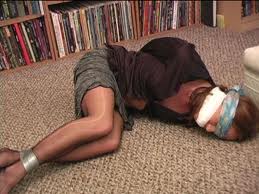
But when it comes to sex robots, it is even harder to know.  Let’s say this sex robot—bound and gagged in duct tape—is Wesley’s “other woman.”  What happens when his human woman objects to doing for Wesley what Roxxxy doesn’t seem to mind?

Uncomfortable yet?  Me too.


[1] I have been wary for some time now of the perversion of the word sharing.  Sharing is “a good thing” because the thing being shared is good.  Sharing food with people who need food is good; sharing warmth with people who need warmth is good.  Sharing the stories of the day might be good if someone wanted to share them, but Jane doesn’t have anyone who wants to share them.  Telling them to her husband is not likely to seem like “sharing” to the husband.  Telling them to AIBO is not, in fact, “sharing” them at all, but Jane feels better for having told the stories even when they are not “shared.”

Posted in Paying Attention, Politics, ways of knowing, Words | Tagged | 2 Comments

Oh What a Tangled Web We Weave…

I have two anecdotes to share today.  I still read Orwell’s 1984 every now and then, just to keep the calluses on my mind thick and supple.  It helps me deal with things like this.

Whenever I go to the airport in Portland—on my way, usually, to the Southwest counter—I pass the United Airlines counter, where they advertise their policy on luggage.  It isn’t that I don’t admire the candor.  They give you the price for transporting one bag or two or more.  But if you aren’t taking a bag at all, they announce that it will be…free.

It will be free.  They will not charge you for not checking a bag.  Or look at it this way.  If you will agree to travel without luggage, they will agree not to charge you for the luggage you are not taking.

Yesterday, I had a conversation with a very pleasant young woman at The Oregonian, Portland’s only daily newspaper.  It wasn’t a very comfortable conversation for me because I was up in Forest Park running and as I stopped to talk to her, I began to chill.  And then, as you will see, I got warm again.

She was just checking to see why we had stopped subscribing to The OregonianWhy we actually did stop is not germane here—Bette found too little news in it to continue reading it—but when she had fixed it in her mind that we had allowed our subscription to run out, she said that there was an amount due on the account.  I was incredulous.  We pay by the year.

But that wasn’t it, she said.  It was that after our subscription ran out, they continued to deliver papers to our house.  The said it was the Oregonian’s policy to have a “grace period” at the end of a subscription.  And now she wanted me to pay for the papers they had delivered during the “grace period.”

I hadn’t been running for several minutes, but when she said that—in a breezy and confident way, I will say—I had to work to catch my breath.  “You want me to pay for the papers you delivered during the grace period?” I said.  I saw where that was going and switched quickly to a less explosive response.  I said that I was happy to pay for all the papers we had asked them to sell us, but I was not eager to pay for the papers they gave us afterward.  That turned out to be enough to end the conversation amicably.

But I am a man with a theological vocabulary and she had nicked a corner of that vocabulary by putting “grace” and “pay” that close together in the same sentence.  I came worryingly close to asking her if she had ever heard of the Protestant Reformation and whether paying for grace didn’t seem…well, confusing.

But I didn’t.

Posted in Words | 1 Comment