
A recent column by Charles Blow, a columnist for the New York Times, is one of the worst I have seen anywhere. It stands out particularly in the Times, where the columns written by people who work for the paper are most often thoughtful and informative.
This column is neither. Not only is it racist and sexist, it is dehumanizing as well. That third charge is the one I would like to start with. If I am still angry when I am done doing that, I will provide evidence for the other two cases as well.
The subject of Blow’s diatribe is “white women.” To this category, he is going to attribute knowledge, intention, and cruelty. It is true that along the path of this accusation about white women in general, he does use particular white women as examples.
He says that ‘a white woman in New York’s Central Park”—that would be Amy Cooper although Blow does not use her name— told a black man, a bird-watcher, that she was going to call the police and tell them that he was threatening her life. Blow could plausibly say things about what Ms. Cooper knew for sure and what her motivations were. It is possible to learn those things about Amy Cooper, the person. But when she is made an instance in a more general accusation about “white women,” the meaning of the charge evaporates. It is not true about “white women” and no listing of actual instances could make it true about the whole category.
The vicious killing of Emmet Till, Blow says, came about because “a white woman said that he “grabbed her and was menacing and sexually crude toward her.” …
A few years ago, the woman admitted to an author that she had lied.” The woman’s name was Carolyn Bryant Donham. She said, in an interview with, Timothy B. Tyson, that part of her allegation—that he had grabbed her and was menacing and sexually crude toward her— “that part is not true.”
Mrs. Denham has not provided much evidence about how she saw the situation, but she did give the Tyson interview and Mr. Blow is free to explain Mrs. Denham’s actions as best he can. What Mrs. Denham has in common with Amy Cooper is that she is not “white women,” which is what Blow is so hot about. Consider the following paragraph.
Specifically, I am enraged by white women weaponizing racial anxiety, using their white femininity to activate systems of white terror against black men. This has long been a power white women realized they had and that they exerted.
There is a category here: “white women.” It is argued that this category of people “realized” something: they realized that they had a power. Let’s pause for a moment to realize just how silly this is. Either we have a category realizing something or we have all members of the category realizing something. You’re kidding, right?
In addition, this category acts. It (they) recognize the availability of an attitude in the more general public and they “weaponize it.” Again, this is not something categories can do and it is empirically untrue that all the members of the category do this.
Mr. Blow probably has the gender status shared by all white women in mind, but when he says “femininity” he is going way beyond the constraints of “femaleness.” “Femininity” is a particular style of behavior much admired and practiced by some women and vigorously deplored and avoided by others. To attribute “femininity” to white women as a category is not a good thing to do. First, it is, as the above uses show, silly. In addition, he risks the wrath of women who think the equating of “femininity” with womanhood is a gross calumny against all women.
This category of women is, in addition, “cruel.” This is not, just to make the obvious point one more time, a charge against any particular woman, with the exception of the examples he gives. This is a charge against the category as if the category itself were sentient and/or a charge against all the women in the category.
I expressed my anger at the beginning of this essay saying that Mr. Blow’s charges are racist, sexist, and dehumanizing. The charges are “racial,” obviously and “sexual” obviously. They have to do with race and sex. I charge, in addition, that they are “racist” and “sexist” using the -ist suffix to indicate my disapproval of it.
The case for “dehumanizing” is easier. Treating human beings as if they were no more than the attributes expected of the social categories they belong to obviously “dehumanizes” them. But maybe it would be easier to see if we looked at some other categories.
What are poor midwestern farmers like?
What are Africa-born black American citizens like?
What are autistic fathers like?
You see the problem. Everyone who uses the language sees the need for discriminating within the category when using psychological notions like “intention.” What intention do autistic fathers have? Thank goodness there is only one such intention because it is so much easier to describe what “it” is than it would be to describe the many intentions that “normal people” have.
Just one question, Mr. Blow. What intention (just one, please) do columnists have?
 As a (nearly) life long professor of political science, I used to field questions like this in class and the first thing I wanted to know from the questioner was, “Why do you want to know?” I would ask that because some reasons for wanting to know can be satisfied, even within the context of a political science class. Other reasons have no hope at all of being adequately addressed. In the case of President Trump, I have three answers in mind and none of them can be fully addressed by the social institutions we have now.
 being the greatest. This is giving “talking points” to people who was to “hit back.” These people are aggrieved, remember, and whatever they do, is something “back.” They are “retaliating.” Notice the re- in retaliating; It represents the “back” in “hitting back.” And not only does it give talking points, it gives permission to say things like that. These are social slurs or ethnic slurs or class slurs. These are things that until recently, were not OK to say in public. The avalanche of Trump lies addresses these two problems: it justifies language that used to be “bad manners” and it scripts the charges against their enemies. And…of course…their truth of falsity is not an obstacle. Not for a man who tells 15.6 lies a day.
 The most recent response by the press is to aggressively call President Trump’s lies for what they are. This doesn’t work either. This is equivalent to the referee starting a fight with a pitcher who threw a beanball or with a defensive end who laid a late hit on the quarterback. The referee cannot become a participant and still adjudicate quarrels between players. The New York Times cannot challenge the Trump administrations claims as intentional and unconscionable lies without being “an opposing player.” The guy in the yellow shirt, no matter how severely he was provoked, is no longer refereeing the game.
 Admiral McRaven, speaking on the 76th anniversary of D-Day said “those wartime leaders inspired Americans with their words, their actions, and their humanity.” In contrast, he said,” “Mr. Trump has failed his leadership test.”
 more make public announcements that they feel they are allowed to make. Broadening the boundaries of the things people are allowed to say about President Trump could be devastating and may be under way. The patriotism card is compromised by the Joint Chiefs; the national intelligence card is compromised by the complaints of recent intelligence leaders; the party elders’ card is compromised by the clear refusal of some to adhere to the leadership and the announcement by some that they are going to vote for a Democrat this time. The Republican candidates will have to find a way to navigate these difficult currents but the permission structure opens a lot of options.
 expect to find.
 t for me to do the same. To help in that, I invented my “Blogging Year (BY)” which runs from December 1 to November 30, taking the date of the ending year. So I am currently in BY 2020 and in December, I will begin BY 2021.
 Wheaton College, one of my several alma maters fired Larycia Hawkins (left), a political science professor, for a very public, but ill-defined offense. (December 2015) The theological faculty voted unanimously that she had not violated her obligations to the college in anything she had said or had done. The crux of the issue was really, what do we mean when we say “God?” The face of the issue was this professor’s wearing a hijab in solidarity with her “sisters.” One of the things she did was, apparently, conduct unbecoming an evangelical.
 addresses him directly from “heaven” and urges him to stay. He makes every appeal he can, but every appeal shows that he has no idea what living Truman’s kind of life is like. He has never been there. And that brought the power of the Incarnation to mind. “He pitched his tent among us” is a claim that is central to Christianity and it is utterly unavailable to Christof. Here Truman (Jim Carrey) makes one of the best exits ever.
 When I started in 2010, we were half way through Obama’s first term and I assumed, as most people did, that I was only one quarter of the way through his whole presidency. The first political blogs took the Obama presidency and the kind of politics in which it was set, for granted.
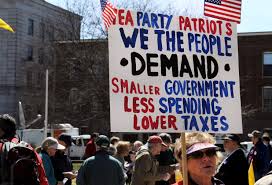 thought it would and it stymied the Speaker of the House, John Boehner and that was when I discovered Arlie Russell Hochschild’s book about the Tea Party. Strangers in Their Own Land helped me understand why “the Tea Party”—which was about to become the Donald Trump gang—wasn’t going to go away. [1]
 that was new to me. There was nothing democratic about how clans worked. The clan chief was the principal legislative, executive, and judicial force. That is why clans worked, internally, and why there was always warfare between the clans. I learned while I was there that Clan Donald was one of the major clans of the period and it made me feel right at home. President Trump’s inclinations are all clan leader. He wants, in what is supposed to be divided government—that’s what Madison thought is was— to have in his government only “people he trusts fully.” What he trusts these people to do is not always clear, but it appears to have very little to do with the impartial administration of the law. That is why he has turned to firing inspectors. Here, Dr. Amy Acton of Ohio makes a contribution to democratic politics.
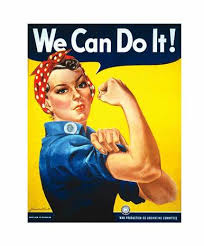 So now that we have corralled the question to a certain extent, we can ask it more meaningfully.
 Let’s pause for an example.
 strong,” you are going to have to change the question that is being asked.
 The king promises his soldiers, mostly ragtag peasants, that in the future, some wonderful thing will happen to them. There are two elements of this I want to point out. The first is that the reference point is in the future. This is very comforting to soldiers confronting a battle; it imagines that they will have a future. It doesn’t say so. That would be cheap. It just takes it for granted, which is much more powerful.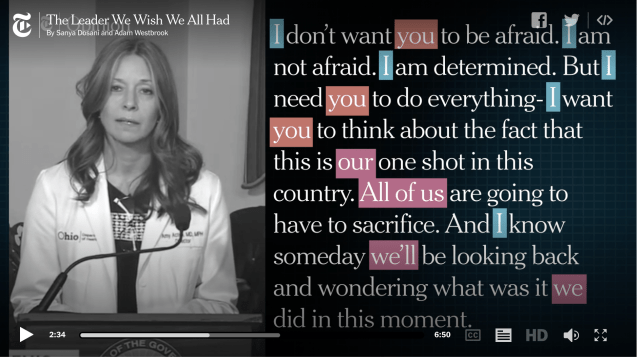
 have had some interest in it, but more likely, I found it in the places I ordinarily go for reading material and started into it by habit. If I don’t find anything that is of immediate interest, I move on. This is especially true of technical writing. It seems, sometimes, that there is more below the surface of a text than there is right at the surface.
 For a story as fraught as the Genesis account of creation, there are other reasons. All my early exposure to the Genesis accounts—I am trying to remember to use a plural there—was in church. The preacher or teacher had lessons to impart and the lessons were much more important than the text. When you come to consider the text as a matter of interest in itself, you begin to stumble across things; really “obvious” things. And you wonder how you could possibly not have noticed that the first time through. Answer: you were busy with other things. Of the many pictures of Adam and Eve, I chose this one because I thought she was kind of cute and it looks like she is in a sharing mood.
 by citing scripture. So he turns to Genesis and he is undeterred by the 1st story/2nd story differences that have so captivated me. Presumably the two stories he is looking at say the same thing they do now. Chapter one has Adam and Eve created simultaneously by the spoken word of God. Chapter two has Adam created first, then Eve; and Adam was not created by a word of command, but physically, out of dirt. [2]
 The Dilettante's Dilemma