And Remember to Breathe

I am writing this on the morning after the election.  You might think that a blogger like me would want to talk about politics this morning.  Not really.  I want to write about adjusting the balance between my life, taken as a whole, and how my life seems when I allow it to be squeezed down into one small part of that life. Even politics.

There are some people who are able to focus very intently on one reality.  This is a “reality” that can be lived in to the exclusion of the rest of your life.  I am one of those people.  

Recently, I have been focusing on politics.  

Very likely, you think that the problematic word in that sentence is “politics.”  Not really.  It is “focusing.”  Imagine that this tendency to focus so sharply that awareness of other realities goes away.  It would be like living in one room of your house.  It isn’t that the other rooms are not there; it is only that you don’t care about them while you are focused on the one room.

I wrote that so it would sound silly.  It isn’t really silly, but it is a mistake.  What I need to do is to remember the other rooms and then care about the other rooms and then make a decision to live in the other rooms as well as this one.  It seems obvious if we are thinking about rooms.  Let’s think about passions. [1]

I am madly in love with…oh….Darlene.  Nothing matters except my courtship of her and the possibility that she will accept me.  I put the proposition to her directly and she says no.  Maybe she even says, “Surely you are joking!”  My courtship of Darlene is the room, the one room, I have been living it.  I will very likely collapse in that room and feel sorry for myself for awhile and experience my failure and I humiliation.

But at some point, I realize that before Darlene, I was looking for a woman I could like and respect who also liked and respected me. [2]  So, after I am done feeling bad, I resume looking for a woman like that.  Darlene is now an episode; a dark episode, certainly, but one among many.  She is one room of my house and when I remember that, I can live differently.

What I need to do is to remember the other rooms and then care about the other rooms and then make a decision to live in the other rooms as well as this one. [3]  

Note the sequence: remember, care about, decide.  That’s the sequence for me.  Maybe you put them in a different order.

It may seem odd, but I have, on occasion been completely focused on whether my beloved Oregon Ducks—mostly football, but sometimes basketball—are winning.  It has become, for the duration of that time, either what I am doing or some part of my personal weather.  A dark cloud that follows me around, like Joe Btfsplk in Li’l Abner.  It is a very constrained and uncomfortable existence and it feels completely inevitable when I am in it..

What I need to do is to remember the other rooms and then care about the other rooms and then make a decision to live in the other rooms as well as this one. [4]  

For the last week, I have been engaged in national politics or have been hiding from national politics.  Last night, election night, I alternated between hiding from the tracking of the election results and attending to them.  For purposes of this essay, those are the same thing.  It takes a lot of effort to watch the election returns and also a lot of effort to pretend to be doing something else.  Both are living in that same room; both are caring only about how Darlene feels about me or whether the Ducks are playing up to their potential.  Neither is genuinely caring about something else.

When I genuinely care about something else, politics becomes just another part of my life.  It is what it is, but it is only one of the things I care about; only one of the things I am acting on.  I am still, in all these other parts of my life, an “agent;” I am someone who is making plans and acting on his own account. [5]  

The specific things I care about are unique to me, of course, just as the mix of things you care about are unique to you, but there are some common elements too.  Take my body, for instance.  When I am entirely focused on how ballots are being counted in Wisconsin, I am not conscious of breathing.  I am not conscious of the sense of sitting on something or of the pressure of the floor on my soles when I walk around.  For as much good as it is doing me, I might as well refer to my body as “it” and say that it continues to do all those things while “I” exhaust myself with politics.

But it doesn’t have to be that way.  I can withdraw myself from politics and invest myself in the sensations of my body.

What I need to do is to remember the other rooms and then care about the other rooms and then make a decision to live in the other rooms as well as this one. 

I need to remember that “it” is there and that I can pay a great deal of attention to the experiences “it” is having.  When I do that, they become the experiences “I” am having.  A really good deep breath can be a wonderful thing when it has been awhile since you have had one and taking that breath intentionally can be a wonderful thing if you have been passive before all those passions for a long time.

I am going to schedule myself fairly tightly today.  It isn’t that I have so much to do as that I need the help of the schedule to remind me how many rooms I really do live in most of the time.  That’s one of the nice things about obligations—you are tied to them. [6]  You might say, probably not out loud, “I’d really like to go on sulking in the one room of my house where I am living, but I promised Aunt Lois that I would do her shopping for her and pick up a book at the library for Uncle Harold.”

There’s no magic there.  It is just that having obligations helps remind you that other things are important too and that the life you live is diverse and that one part of it—currently the political part—is filled with tension and disappointment.

[1]  I have had a different attitude toward the word “passion” since I learned that it shares a root (the Latin pati, “to suffer,” with passive.  Passions, as seen through this lens, are things that happen to you.  They are active; you are passive.

[2]  “Liking” might seem pallid, but I think of it as something that grows, given the proper conditions and the proper nutrition.

[3]  It is just a little awkward to quote yourself from the distance of just a few paragraphs away, but I am hoping the will become a theme.

[4]  See how nicely that works?

[5]  Just in case the language of agent/agency is unfamiliar, acting for the benefit of others is included in “acting on my own account.”

[6]  The very helpful etymology is from the Latin ligare, “to bind.”  You can think of “being bound” as a negative thing, of course, but in the present context, we are talking about being bound to this or that or—more exactly—bound to one thing or to many things.

 

Posted in Uncategorized | 1 Comment

Discontented Thoughts

Here is a passage I found in Middlemarch this week.  There is not the slightest indication that the author, George Eliot (Mary Ann Evans) or the character who thought them, intended these remarks to be taken in a political way, but for me, this is the week before the most fraught election of my life and it sounds political to my ears

For me, just for this year, I find myself wishing that election day were further from Halloween and closer to Thanksgiving.

We are on a perilous margin when we begin to look passively at our future selves, and see our own figures led with dull consent into insipid misdoing and shabby achievement,

I’d like to examine this passage as a literary product first.  I think that is how it stuck me when I read it.  I had to go back and look at it again to find out what it actually said.

First, I liked “look…and see.”  We look passively and we see our figures [passive verb] being acted upon.

Second, once I got to looking at the actions, I liked the adjective + noun patterns.  Notice “dull consent” followed by “insipid misdoing” followed by “shabby achievement.”

Third, consider the tone of the adjectives.  It isn’t just, I think, that these are not words in common speech today; I think that they may be extraordinarily precise words.  Consider “dull” in “dull consent.”  There are lots of other words available to suggest that the consent is less that full and active.  You could say it was “grudging,” for example.  That is probably what I would have said.  Or “thin,” setting up “thick” or “full” as a better grade of consent.  I think “dull” is better than any of those.  For one thing, “dull” is the kind of thing you can feel.  You would’t want to say that you had given “sharp” consent, but you know that when you are sharp, you would not give dull consent.

The Latin adjective is sapidus, “tasteless.” [1]  If we may consider misdoings to be sins, it gives us “tasteless sins.”  In the modern imagination “sins” are daring violations of God’s “law” or even of society’s laws.  We imagine “sinners” to be bold adventurers, daring the consequences.  But a sin that didn’t even have an interesting flavor…that wouldn’t be much of a sin.  It is, plausibly, the kind of sin into which one might be led by dull consent. [2]

Before we get to the third one, achievement, note the pattern of the last two: we have misdeeds first, then achievements.  “Wrong-doings” and “right-doings;” neither of which meaning much of anything to us.  With that quality of consent, neither deeds nor misdeeds provide a significant experience.

So, finally, we have “shabby achievement.”  I like it that it was a failed attempt at an achievement.  This is an actual achievement, but it is shabby.  “Shabby” is a tone word.  Behavior that is not “wrong” exactly, can still be shabby.  One person can treat another shabbily.  Shabby behavior is overused and under-maintained.  It is not polished and fit for the task at hand.  It is functional, but ragged.

This indictment is not a powerful charge against any human or any kind of human.  It is really more of a reflection; something one might mull over about oneself.  That is why I especially like “experience words” like dull, insipid, and shabby.  They are words that anyone with a good vocabulary might use in thinking about their own life and their behavior.

It is an altogether exalting passage.  I am glad that something stopped me and made me go back and celebrate it.

[1}  Ironically, the verb form, sapere, is also the source of sapient, and carries the root meaning “to be wise.”  It is why we are called homo sapiens, although it must be said that we gave that name to ourselves.

[2]  There is a recent Polish film, Ida, in which Ida wants to be accepted as a nun, but due to some events, she is required to leave the convent for awhile, comes into a bunch of money for awhile, and commits in rapid order all the sins she has heard of.  She moves down her imaginary list, checking each one off.  All these “sins” baffle her.  She has given them her dull consent and they don’t really taste like anything to her.


Posted in Books, Words | Tagged , , | Leave a comment

Thoughtless Lying

I come from a small town in a conservative part of Ohio.  In some ways, that has been a very good preparation for the kind of life I have lived.  In our town, we believed in “the virtues,” despite violating them as often as everyone else.  It has taken me quite a little while to get far enough away from my upbringing that to see that it was a good thing to teach the value of these virtues.  It was good even apart from our success in achieving them.

President Trump has brought that to my mind recently.  A part of my upbringing was what used to be considered a natural consequence.  When you lied a lot, people stopped believing you.  That seemed to me at the time to be a very appropriate response and it still seems that way to me.

I am not really sure why it doesn’t work for President Trump.  I remember that during World War II, there was a relaxation about “truth” that was attributed to the war.  If our leaders said things that were not true, surely they were compelled to do so by the contingencies of conflict.  And that didn’t stop all at once.  When a U-2 pilot was shot down, President Eisenhower went on the air to say that we had no such craft and no such pilots.  We did, of course.  My father, who was a big fan of Eisenhower’s, passed it off as “a cover statement.”

I don’t have a criticism to make of “cover statements.”  You really can’t expect our leaders to be candid and transparent about our spy operations.  Still, I wonder if that Eisenhower experience might not have introduced a little buffer between hearing what the President said and coming to some judgment about what was true.

Significance

We have, of course, come a long way from there.  We have come so far that I want to think today not about individual officeholders telling individual lies, but about the culture that makes lying insignificant.  Telling a lie, in other words, no longer signifies anything about the person; not about his upbringing or his ethnicity or his character. [1]

It is an acceptable style of speech by which one person identifies themself [2] as a member of the team.  I am not entirely sure what the mechanism for this is.  Is it an art form like a punch at exactly the right place or is it just the butchery of beating with a baseball bat?  Is there extra merit in telling outrageous lies?  This would be like a “tall tales” contest where the truth of the tale is no part of the competition, but only the extravagance?

So, for instance, saying that there is a child pornography ring operating in the basement of a building would be OK.  It would be a contestant in a contest like this.  But saying that there was a child pornography ring operating in the basement of a building that did not have a basement, would be much much better.

Try to imagine rebutting a “tall tale.”  You see how it doesn’t work.  The supposed refutation isn’t on the same track as the tale; there is no way to bring them into contact with each other.

Or possibly it is not the extravagance of the lie but the effect on the person at whom the lie is being thrown.  If they just stand there and say it is not true, it wasn’t that much of a lie; it was a low scoring lie.  If it arouses them to inarticulate anger, especially at a televised event, it is much better.  If they break down in tears, it is much much better.

Remember that we were considering significance.  What does a truly destructive lie signify.  It no longer signifies that the liar’s word cannot be trusted.  That is a question that cannot be asked.  It signifies, instead, that this liar is especially good, since lies are only words and words are only weapons.

Truth as a Victim

The examples I have given so far imagine that they include things like personal attacks and group slanders.  But what if there is no person or group to receive the lie?  What if the lie is clearly no part of a “tall tale” contest, but is represented as true.  This is “true” in the sense that empirical and logical statements exist that could confirm its truth to a panel of impartial judges.

Take for instance, the claim that a certain number of persons attended an inaugural ceremony.  There are lots of ways to estimate the number of people in a large crowd.  Any one of them could, in principle, be brought in evidence against a claim that there were many more than that.  This is not a claim like saying that people who attended enjoyed this inauguration more than the attendees enjoyed other inaugurations.  Who knows?  Who checked?  We expect to know things like the number of attendees; we do not expect to know the relative enjoyment of different crowds at different events.

But what’s the harm, you might ask?  The statement of verifiable facts engages the supposition that these statements really can be true or false.  You come to a meeting in an unfamiliar part of town and wonder where to park.  I tell you that you can park on the street because all the meters have been turned off.  After the meeting, you find a traffic ticket on your car.  It almost seems odd to say it out loud, but really, if you assume I did that to you as a prank or as an act of political sabotage, those are the good scenarios.  If you think I did that to harm you, you also believe that the meters are actually turned off and on and that I knew which they would be and misrepresented them.

The Bad Scenario

How could that possibly be the good scenario?  Well, think about it.  It presupposes that the meters are on or off; that one can know whether they are on or off; that they are on or off apart from whether I wish them to be on or off.  They presume, in other words, an orderly world in which things can be true and can be known to be true.  How is that not a good scenario?

On the other hand, telling lies—these are misrepresentations of facts acceptable to an impartial jury—because they make the assumption of meaningful speech impossible is a much worse offense.  These are not self-serving lies, as when I make hold up a payment to an ally until they comply with my wishes and then say I have done no such thing.  That’s a motivated lie and while it is bad, it is not as bad as telling lies that benefit no one.  But if I say that there are only half as many national parks as there are in fact or that that average daily temperatures have been trending down over the last decade or that there is no evidence to support evolution or that the need for supplemental nutrition is going down as a result of the COVID crisis—these are casual lies.  They are lies with no purpose and no probable effect other than weakening the belief that statements can be expected to mean something.  They can be true or false; they can be significant or insignificant.

You see now why the parking meter lies were the good scenario.  Hordes of casual, unmotivated lies simply flood the field.  They make correction impossible by their very numbers.  They make it not really worth our while to  continue to assume that claims about the world can mean something; that, on the other hand, saying what you feel like saying at the moment is enough to secure your approval and your support.

I don’t think that is where we are, but we need to start acting now if we are not going to go there.  We can start by electing Joe Biden, who misspeaks quite a bit for public person, but who knows the value of truth in public discourse.

[1]  You might have though that series was a little odd, with “ethnicity” stuck in there, but I added it so that I would have a chance to say that where I grew up, a common compliment that one man might pay to another was, “That’s mighty white of you.”  I had no idea what that meant.  I was no more likely to identify that as a racial remark than I was to identify, “Who’s the fairest of them all?” as a racial question.

[2] It hurts.  I’m trying to learn to live with it.

Posted in Politics, ways of knowing, Words | Tagged , , , , | Leave a comment

Bo Knows Politics?

There comes a time when, as the logic of a movement plays out, it just goes too far.  In this essay I want to say that I have reached that point myself, so far as the self-righteous political left is concerned. [1]  I’ve been following along.  I have said Yes.  Then I said…O.K.  Then I said, Really?  Now I am at the place where I want to say No,

I want to provide an illustration shortly.  This represents the bridge too far.  It’s not that it is SO bad; it is, rather, that it came at the time when I really couldn’t take one more.  And it is bad.

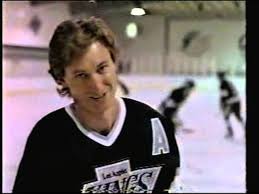
But I want to begin with one of my favorite commercials.  You can look at it yourself by looking up “Bo Knows” on You Tube.  The “Bo” is Bo Jackson; It’s a Nike ad.  But well-known athletes appear in very brief cameos to say, “Bo knows ______” [whatever their sport is.]  I remember John McEnroe saying “Bo knows tennis?” and Michael Jackson saying “Bo knows basketball.”  As I remember the sequence, the affirmations get weaker until Wayne Gretsky shows up.  He is supposed to say, “Bo knows hockey.”  He doesn’t say that.  There is a little pause, while we digest the idea that Gretsky is struggling with what he is supposed to say, then he looks at the camera and says, “No.”

“Bo knows hockey” is one station too far for Gretsky.  I cite that well-known ad because it carries the flavor of where my political life is at the moment.  The camera turns to me and I know, as Gretsky did, what I am supposed to say and in that moment, I am not willing to say it.  So finally, I am saying No.

Liberals have gotten weird.  They are still on the train that I have gotten off of.  I’m still as liberal as I was, which I always thought of as an achievement for a small town southern Ohio boy who went to an evangelical college.  I suppose there are other liberals who, like me, are still liberal and wonder where their comrades think that train is going.

I could spent some time on what I mean by “liberal,” but I mean roughly what Joe Biden and Kamala Harris mean by it, so that wouldn’t add much.  Let me move, instead, to the petition that moved me to my Wayne Gretsky moment.  Here is the petition, at least all the parts of it that deal directly with Trader Joe’s.

This is the work of a young woman named Briones Bedell, if you would like to find it on line.

We demand that Trader Joe’s remove racist branding and packaging from its stores. The grocery chain labels some of its ethnic foods with modifications of “Joe” that belies a narrative of exoticism that perpetuates harmful stereotypes. For example, “Trader Ming’s” is used to brand the chain’s Chinese food, “Arabian Joe” brands Middle Eastern foods, “Trader José” brands Mexican foods, “Trader Giotto’s” is for Italian food, and “Trader Joe San” brands their Japanese cuisine. 

The Trader Joe’s branding is racist because it exoticizes other cultures – it presents “Joe” as the default “normal” and the other characters falling outside of it – they are “Arabian Joe,” “Trader José,” and “Trader Joe San.”

The common thread between all of these [the other examples included Disney’s Jungle Cruise and the book White Shadows in the South Seas] transgressions is the perpetuation of exoticism, the goal of which is not to appreciate other cultures, but to further other and distance them from the perceived “normal.” The current branding, given this essential context, then becomes even more trivializing and demeaning than before. What at first seems, at worst, insensitive, further is called into question. 


I think I would like to begin with “exoticize.”  The -ize ending is used to say that one thing has been made into another.  You can’t homogenize homogenized milk, for example, because that has already happened.  In Ms. Bedell’s use of “exoticize” she suggests that something was not exotic and that it has been made exotic.  My question is, “Where was it not exotic before?”

Where I grew up big cities and high mountains and endless plains were exotic.  They aren’t exotic to the people who live there.  Groups of Hasidic Jews are exotic to me and large Amish communities and the Los Vegas culture of risking and losing.  But they are the normal habitat of the people who live there.  They are not exotic to the locals.  They are exotic to me because I am not local.

I don’t “exoticize” these places.  They seem exotic to me and it might very well be that my kind of life would seem exotic to them.  Consider, for instance, reporter Sue Charlton’s response to Australia and Mick Dundee’s response to New York City in Crocodile Dundee.  Each of those settings is exotic to the other.  

Ms. Bedell’s use of exotic sets up her criticism of “normal.”  “Joe” is presented as normal in the context of Trader Joe’s, she says.  And it is.  All those other names are adaptations to—puns on, really—other language traditions.  They are not pejorative; they are playful.  My early years were spent in the verbal environment of World War II where other nationalities were routinely disparaged.  This isn’t that.  Ms. Bedell seem to believe that if a norm is not universal, it is somehow perverse.  There are local norms, Ms. Bedell.  If things are not “normal,” it doesn’t mean that they are ab-normal.

And, finally, she moves directly from exotic—“exoticizing, really—to racist.  I have a whole attic full of difficulties with the word “racist” but this breaks new ground.  If you call something unusual because it is not usual where you live, that is the same as calling it exotic, which is clearly a racist thing to say.

It isn’t that Ms. Bedell’s petition is SO bad.  It’s bad, but it really just takes the kinds of arguments a lot of liberals are making and extends it too far.  It is the reductio ad absurdum presented as a sober logical conclusion.  And for me, it was just too much.  I reached my Wayne Gretsky moment and I had to say, NO.

And it wasn’t that saying No was such a big deal.  It was the sense of relaxation that accompanied it.  That relaxation told me that I had been working a lot harder than I had realized to hold on to liberal excesses.  I had exerted myself to hold together the excesses of sexism and racism and sizeism and ageism and a lot of other -isms. [2]  I apparently accepted, being a good liberal, the weight of one excess after another without sensing what the cost was.  But when I said No to the exoticism = racism charge against Trader Joe’s, I felt a lot of weight fall off and it made me wonder why I had been carrying it all this time.

That’s why I called this post “Bo Knows Politics.”  That series runs, with increasing puzzlement, up to Wayne Gretsky.  The ad continues, but I stop at Gretsky.  I don’t want to call what those guys are doing, “liberalism.”  I want to call why I am doing as “liberalism.”  

I want to call what they are doing, “wretched excess.”

[1]  You can tell that, of course, when I categorize a group by their motives rather than by the nobility of their cause.

[2]  If I were feeling playful about it—I’m not—I would say that we had been enduring a wave of ism-ism.  Maybe one day.

Posted in Political Psychology, Politics, Uncategorized, Words | Tagged , , , , | Leave a comment

And forgive us our maladjustments

I had a friend once who had learned to apologize for his lateness and to minimize his error at the same time.  I was fascinated.  I had no idea you could do that.  He would say, “Hi guys.  I’m so sorry that I am just a little bit late.”  The “so sorry” part recognized the error and apologized for it; the “just a little bit late” part minimized the error and made the apology seem unnecessary.

I was reminded of that recently when I heard an invitation to a period of common confession at church.  The need to confess our sins before God is fundamental to Presbyterians and the sins we confess are horrible without mitigation.  That is the whole point that is made when we emphasize God’s grace in refusing to hold these horrible sins against us and blotting them out completely.

The “sins” we commit against each other are mere peccadillos by comparison.  We sin against each other as we sin against God—in thought word, and deed—but we are sinning against people who have also sinned against us.  This calls for a kind of “adjustment” which may have, as Paul’s admonitions often did, the unity of the congregation in mind.  That is why he implored the sophisticates of the church in Corinth not to casually dismiss the most conscientious among them and why he implored the conscientious not to condemn the sophisticates.  These are matters for forgiveness, certainly, but mutual forgiveness. [Nothing here, you notice, calls our attention to whether the arrow has gone “far enough,” which is the presupposition of “fallen short.”]

That’s not how it is with God.  God is holy and our sins are glaring violations of the relationship He offers, enables, and demands.  Here, for instance, in one we have used from time to time in our church.

Gracious God, our sins are too heavy to carry, too real to hide, and too deep to undo. Forgive what our lips tremble to name, what our hearts can no longer bear, and what has become for us a consuming fire of judgment. Set us free from a past that we cannot change; open to us a future in which we can be changed; and grant us grace to grow more and more in your likeness and image, through Jesus Christ, the light of the world. Amen.

Our sins, in this confession, are “heavy, real, and deep.”  They have become for us “a consuming fire of judgment.”  And we cannot change what we have done; we can only hope to “be changed” by God’s intervention in our lives.  There is no softening our our faults here; not a hint of what I called, in the title, “maladjustment.”

Forgiveness as therapy

There is a slow drift, it seems to me, away from the notion that sins are really bad and that we are really guilty because we keep committing them.  A friend who is a therapist once told me that it is a good practice in counseling the assume that the client is doing as well as he or she can.  That gives you a chance to focus on how the client can look at the problem in a different way, how to learn new skills, and how to create some non-judgmental space for learning those skills.  That sounds really good to me.  It is therapy, however.  It is not how the Christian faith has been understood.

Therapy does not provide us with a model for faith.  There is no God against whom we have offended.  There is no God to whom we can confess and to whom we can appeal for forgiveness.  And the closer we come to adopting the understandings that work perfectly well in therapy, the worse will be our understanding of what faith in God entails.

All this was brought on by a “call” to “confession” I heard recently.

“We confess ways in which we have not yet quite made the mark.”

Three things concern me here.  One is mere pedantry, so I’ll deal with that first.  As I understand it, “falling short of the mark,” the traditional way of phrasing it,  is a term from ancient archery.  A line is drawn and all the archers are to shoot their arrows beyond it if they can.  If you can’t shoot it that far, your arrow falls short of the mark.  Literally.  It’s more like the modern competition in javelin.  You don’t really “make” marks in archery.

In the context of the prayer of confession, the mark is the life to which God calls us.  It is a life with respect to Him and with respect to each other.  The line is at a challenging distance and we fall short.  In the expression above, we have the picture of “making the mark.”  That may be a version of an accomplishment, as in “she made her mark in popular music.”  Or maybe it is just a rephrasing of “not falling short;” we “made” the mark that is set for us.  Neither calls the familiar “falling short of the mark” to mind. 

The second matter is not mere pedantry..  This formulation has us “not quite” making the mark.  The emphasis there is not on missing it, but on how close we came.  That is what “not quite” contributes to this formulation.  It is not the language of confession.  It is apologizing profusely for “being just a little bit late.”  In confession, the emphasis is on our failure.  This language doesn’t do that.

The third matter is also serious.  It is that we have “not yet…made the mark.”  That achievement is, by this phrasing, just a matter of time.  We are coming closer and closer.  We have not achieved the goal, but we are about to.  That is what “yet” contributes to this picture.  But the Christian view is not that we are coming closer and closer and that God, if He were willing to wait.  It is, rather, that we are fundamentally flawed and that the guilt of our lives will be dealt with by God’s unmerited mercy or not at all.  “Not yet” doesn’t say that.

If this was a public misstatement, no more than a slip of the tongue, it really doesn’t matter.  I know what it is like to have a microphone stuck in your face and later on, you can scarcely imagine that you could have said such a thing.  If this was one of those, I have spent way too much time on it already.

But I don’t think it was.  To me, this is part of a much larger pattern—the slow drift of real religion into therapy is a real thing.  It is actually occurring.  Studies that take no position on this change show it to be occurring and I can see why it is attractive.  We, after all, control the outcomes in therapy.  

We don’t control the life of faith.  In our service of God, we can see a future in which we may “be changed,” as it says in the confession above.  That’s a passive verb.  We are not doing the changing; it is us who are being changed.  The Agent of this change is elsewhere and we receive the action and respond to it as we are able.

I like therapy.  I have benefitted greatly from my experience of it.  But I don’t want it instead of worship.


Posted in A life of faith, Words | Tagged , , , | Leave a comment

A Skeptic has a Mystical Experience. Who would have thought it?

A few weeks ago, I had a mystical experience.  I mention it because I am not at all sure what a mystical experience is and because I am not somebody who has mystical experiences.  Still…this time I did.

So what’s a mystical experience?  Some people talk easily about experiences that are “inexplicable,” but all kinds of things have been explained satisfactorily that were once “inexplicable,” so I would rather say that, for me, a mystical experience is unexplained.

I have a very low bar for unexplained events, so you would think I would have a lot of
them.  The picture I use of my own conscious experience is a small campfire in a large dark forest.  The campfire casts a little zone of light and beyond that, everything is shadowy, and then pitch black.  Some of that darkness is inside me and some outside.  The common element is that I have no conscious access to it.

That’s a lot of darkness and just a little light.  When I say that something has come to me, a realization, let’s say, from “out there,” it’s not a big deal.  Most of the things I once knew are out there and a lot of things I spend energy on not knowing or not remembering.  They are all out there, too.  I don’t call those mystical. They are just “out there.”

But this experience was not like that.  This was an intimate and powerful  feeling and it came with a very persuasive visualization of the event.  I was asleep—kind of—and I immediately felt that something had happened and that it was a really good thing.  I saw a man dressed in a long coat or maybe a robe walking away from me into the fog.  The fog is the reason I don’t know if it was a trench coat or a robe.

He had been close to me, apparently.  Maybe even as close as conversational distance, but by the time I saw him, he was maybe 30 feet away and walking slowly into the fog.  I knew at once what “it” was.

This is an odd time to begin saying “it,” isn’t it?  I have been saying “he.”  But I change now to “it” because although the figure was the figure of a man, I knew that it was the embodiment of a grievance I have held for a long time.  “It,” the grievance, was walking “away,: walking out of my life.  I hoped ardently that he/it was gone for good.  It was a real relief to think that that particular grievance might be gone for good.

I don’t want to deal with the particularities of the grievance—at this distance from the events, it doesn’t matter much anyway—but I do want to say that I have been alternately treasuring and fighting this grievance.  Do you know what that is like?  I’m guessing it is a common experience, but I don’t really know.  An unfair and hurtful action was taken against me.  I resented it, of course.  It was hurtful; it was nightmarish.  Being angry about it felt a lot better than cowering under it.

After a while, it became clear that I was the only one still suffering from it and it was time to let it go.  And I tried for a while to let it go.  But I also kept on feeling angry about it.  I think that is why it hung around my life for so long.  I would try to let it go for a while, then I would burst out in righteous anger against it for awhile.  I thought I would be really proud to have mastered it and just let it go.  But I also thought I would be accepting and consenting to some really bad behavior by letting it go and I didn’t want to do that.

So I wanted sometimes to treat it like a crime and make my case in court and have it validated and the perpetrator punished in some way.  I also wanted to rise above the whole petty event; to think that I was a better person that the guy who would keep on holding on to a grievance years after everyone else has forgotten it.  

So I managed, by wanting one thing at one time and another thing at another time, to tie myself in knots.  Then I saw it walk away from me.  It walked slowly into the fog and was gone and I knew exactly what “it” was and what its “going away” meant and I remember hoping that it would stay gone and not ever come back.

And it hasn’t.  Yet.

The one piece of the experience I have not yet had a chance to fill in is that I had no sense at all that this was something I was doing.  This was something I was watching.  “It” was going away.  I wasn’t sending it away.  I had been trying that for a long time.  Of course, I was also trying, during that time, to have my cause judged and myself vindicated so if “it” was paying any attention to me at all, “it” must have been confused.

I am a big fan of acting in my own behalf.  I call it “agency.”  I spend a good deal of time thinking and writing about just what is worth pursuing, what kind of accomplishments I would be proud of.  This experience had nothing at all to do with agency.  When I say, as I did above, that this was something I watched, not something I did, it is agency I am ruling out.

So “he,” who was the embodiment of “it” walked away from me into the fog and I felt immediately that something important had happened.  And when I was fully awake, it felt just the same.  I felt that I was breathing more freely, more deeply, with less effort.  I felt like a weight had been lifted off my shoulders.  I felt as if I could do all the things I do in a day with more focus and more energy now that “it” had left and wasn’t coming back.

It’s been several weeks now and there has been so sign of that old internal struggle.  I haven’t had to deal with it in any way since I saw its embodiment walk away from me into the fog.  I don’t understand it at all and I am someone who really likes understanding things.  I didn’t do it, myself, and I am someone who really likes acting on his own behalf.  I am experiencing a sense of confidence that the whole thing is over.  I hope that is right, but I know I am not in control of it.  I am the beneficiary of whatever it is that happened and I am grateful.

Posted in Living My Life | Tagged , , , , | Leave a comment

C’est Monyafeek

This is (yet another) celebration of the way Neal Stephenson uses language and the illustration is taken (yet again) from his Anathem.

You need to know a little bit about the story or you won’t be able to share the joke.  In Anathem, the action takes place on a very Earth-like planet called Arbre. [1]  Arbre is invaded by a space ship that is the home of four other planetary civilizations, one of which is called LaTerre and which is, in fact, Earth. [2]

The story is told by a young scholar named Fra (his title) Erasmus.  We need to know that because it tells us how he hears and understands languages from elsewhere.  “Elsewhere,” in this case, is a place on LaTerre that we know as France.

When we know that the Laterran who visits them is named Jules Verne Durand, we are prepared for the possibility that he is French.  But Erasmus doesn’t hear French and he is the one who is telling the story.  So this happens.

“The entire stage weighs considerably less than I do,” says Erasmus.  It doesn’t look like the kind of thing you would trust to get you safely into space.  Fra Jesry asks, “Where’s the rest of it?” 

“This is the whole thing,” proclaimed Jules Verne Durand, understanding it perfectly even though he was seeing it for the first time.  “The conception is monyafeek.” (page 775)

Durand sees the design, sees the function, and is immediately impressed by the thinking that has gone into it.  It is that, the whole concept, that is magnifique.

Monyafeek is so crude.  For one thing the word doesn’t look anything like magnifique.  And English speakers who have had a chance to adjust to how French words work (the -gn, for instance, and the -que) know how to hear such a word.  Erasmus does not and Stephenson gives us the word on the page just the way Erasmus hears it.  And it is never spelled according to French rules.  Always, we see the way the word looks, but we also know how it should look and we celebrate—I do, in any case—the friction between the two. [This is the way Michael Kingery, a concept artist, pictures the monyafeek.]

The second little friction is the function of the word.  You notice that Jules Verne Durand uses the word in the passage above as a predicate adjective.  The conception is monyafeek.  Erasmus’s friend, Lio, who is the local expert on these vehicles hears it as a noun and why wouldn’t he.  He says, “It’s not called a monyafeek.  It’s called…oh, never mind.”

And that “Oh…never mind” establishes that the team will continue to call them monyafeeks.  The representation of magnifique as monyafeek is just a gaffe when it first happens.  But these devices are part of a daring attack on a space ship and the attacking force, which includes Erasmus, Lio, and Durand, come to take these little devices very seriously.

That means that we get one more look at what happens to this word when Suur (her title) Tulia, part of the Arbre-based support team [3] tries to correct the usage.  That goes like this. (page 812)

Tulia: I’m going to talk you through the process of unstrapping yourself from the S2-35B.

Erasmus: Up here we call it a monyafeek.

Tulia: Whatever…

This is a whole different development, as you see.  Tulia is in a storage shed in some remote part of Arbre.  Erasmus is “on the front lines,” so to speak.  He is the one who is risking his life in deeds of derring-do and he gets to say what “we” call it.  This grotesque misspelling is now the official name of the device because that is what the people in the line of fire are calling it.  And Tulia, who knows better, says, “Whatever…”  Monyafeek is now not only a noun, and not only a term of art, but a name validated by the the pride of warriors.

Pretty cool.

I suspect that I will never hear magnifique again with having to dedicate a neuron or two to keep me from smiling along with Erasmus, Lio, and Jules Verne Durand.

[1] Stevenson says that if you have any trouble pronouncing the name of the planet, you should ask a friend who is currently studying French.  That takes care of what to do with the -re at the end.  Of course, you still have to be able to make that sound, but you get the idea.

[2]  People who live on LaTerre are called Laterrans.  Stephenson doesn’t giver any help with that, but I have chosen to accent the -terr.

[3]  Picture a very small “Houston,” as in “Houston, we have a problem.”

Posted in Words | Tagged , , , , | 1 Comment

The -ize has it

Now I think that’s just fun.  It sounds wrong, of course, but it probably isn’t.  It sounds like “eyes,” which would require a plural verb, “have.”  But -ize is not a noun, like “eyes;” it is a “word-forming element” used to make verbs. As a “word-forming element,” it does not qualify as any of the parts of speech I am familiar with. [1]

If the formulation, “the –ize has it” is wrong, it may be because “the” does not properly apply to the suffix, -ize.  Can “word-forming elements” take definite articles? [2]  Or is it the case that some “word-forming elements” can take definite articles and some can’t.

Let’s take “-ify” as another relevant case.  This is, obviously, also a “verb-forming element” but it is also a verb.  It derives from the Latin facere, “to make.” [3]  So if I “specify,” I “make specific” something that was not specific before.  For our purposes, the case of -ify is difficult because it doesn’t sound like another English word, the way -ize does.  If there were two f’s, it would suggest the slang word “iffy,” meaning uncertain, but there are not two f’s.

In this difficult matter, I am going to rule in my own behalf.  Because it would be proper to say “the word-forming element” I am going to say it is proper to say “the -ize”—meaning “the word-forming element -ize.

Besides, I have gained some courage from Jeff Aronson, a clinical pharmacologist, who wrote an article in the British Medical Journal called “-ize right.”  That might be just a little cheeky for a Brit, when the British use has consistently been -ise instead of –ize, but I take heart from it anyway.

It couragizes me.

[1]  Because it turns nouns into verbs, however, it brings about a very substantial change.  If -ize denotes the new outcome, then we know what the previous condition was.  A personal greeting card, for instance, cannot be “personalized.”  If you can “personalize” it, then it was not personal before.  

[2]  Can newspapers?

[3]  And a host of other meanings.  “To make” is the meaning of interest to this investigation.

Posted in Words | Tagged , , | Leave a comment

The Banner of Republicanism

I’ve been teaching a course about parables.  I want to offer that as an excuse.  One of the easiest things to do with a parable is to turn it into an allegory, in which each element of the story represents some other entity.  If you are going to do that, you need to know a good deal about the “reality” the allegory represents and you need to know what your audience is likely to know.

You can violate that rule for the fun of it, certainly.  In the movie, Galaxy Quest, Sir Alexander Dane (the analog to Mr. Spock) delivers this line to the dying Quellek: “By Grabthar’s hammer…by the Suns of Worvan…you shall be…avenged!”  That’s good comedy because the viewers have no idea what any of that means and Dane (Alan Rickman) delivers the line with such intensity.

It may be that you didn’t see this coming, but I had a quick and very visual image of the plight of the Republican Party.  This is just an allegory,(see cautions above) but I’ve enjoyed it so far.

The Republican Party is Bruce Banner.  For those of you who don’t follow the comics, the TV shows, or the movies of the Hulk, Bruce Banner is the Hulk when he is not being the Hulk.  Bruce Banner, as the icon of the Republican Party back in the day, was careful, prudent, and alert to what wold be good for us all.  Banner is the Republican Party of Eisenhower, Rockefeller, Romney, and even, to a large extent, of Nixon  Then something happened to him.  He was given, accidentally, a dose of gamma rays during the explosion of an experimental bomb and ever after than, when he is subjected to emotional stress, he turns into the Hulk.

That is where the Republican Party is now.

This came to me in a moment of reflection.  I caught myself looking back to the current time from a point in the future, when a democratic system driven by the contest of two policy-driven parties, had been restored.  From that distance, the current identity of the Republicans as the Hulk seemed clear.  Encouraging too, in a way, because after the rampages of the Hulk, he simmers down and becomes nice guy Bruce Banner again.

For the Republican Party, I see the gamma rays as the steady deterioration of the party’s position in American politics.  We’re going back to the allegory, remember.  Back in those days, the Republicans had a moderate wing and a conservative wing, just as the Democrats has a pro-civil rights northern wing and an anti-civil rights southern wing.

Some time in the 1960s, the Democrats threw out (most of the anti-civil rights Congressmen, and became much more ideologically integrated.  At about the same time, the Republicans devised “the Southern Strategy,” popularized by Republican strategist Kevin Phillips, and became more ideologically integrated as well.

At this point, I am going to leave the two party analysis and focus just on the Republicans.  In any case, it is this capitalizing on the racist politics necessary to win Southern votes that is like the exposure to gamma rays for poor Bruce Banner.  Now, with the parties internally unified and with most congressional seats non-competitive, the primary election process drives the parties apart.  For the Republicans, this could have meant an extreme and ruthless pro-business emphasis—something Karl Marx would have recognized and applauded.

But that isn’t what is did mean.  The Republicans went the other way.  They went on the path of populist rage.  Congressmen elected as “Tea Party” candidates and seated in the House with the Republicans, rebelled openly against their Speaker and demanded populist rage.  The Republicans kept nominating candidates for President who wanted more than that, but who could not be elected without the votes of the populist and paranoid Right, so they tried to appeal to both.

Eventually, this anger washed over the party—this is the overwhelming dose of adrenalin that pushes poor Bruce Banner over the edge and he becomes the Hulk.  At last, the R’s nominate and elect a man with no policy aspirations at all.  Donald Trump was a tantrum; a fit of anger against whoever the populists hated at the moment and there was no more left of the Republican party after 2016 than there is left of Bruce Banner after he becomes the Hulk.

That’s where we are now.  A lot of Republicans are deeply concerned about this.  There are lots of former Republicans who would like to see Joe Biden elected in the short run because they see that that is their only hope of recovering the Republican party to which they once pledged their loyalty.  This morning I happened on REPAIR, the Republican Political Alliance for Integrity and Reform.  They want “the old party” back, in a way, but of course, they would like to Build (the party) Back Better if they can.

This is the Bruce Banner faction.

But now we need to look at the last piece of this preposterous allegory.  When he wakes up as Bruce Banner, what does he remember about what he did as the Hulk?  It’s hard to say, really.

Here’s a conversation between Bruce Banner (Edward Norton) and Betty Ross (Liv Tyler)

Betty Ross: : Do you remember anything?

Bruce Banner: : Just fragments. Images. There’s too much noise. I can never derive anything out of it.

Betty Ross: : But then it’s still YOU inside of it.

Bruce Banner: : No. No, it’s not.

Jay Alexander, who seems to know what he is talking about, puts it this way:

Banner has recollections of what happened but not clearly as if he was seeing it first hand but more as if it was a very lucid dream. So he remembers bits and pieces and other stuff ends up becoming a mess as to what was really happening and what his mind was most probably trying to comprehend what was going on. 

So let’s look at this from the standpoint of a group like REPAIR.  As they go about trying to restore the party—to make it once more the party they were proud of—they have a distorted memory to work with.  Imagine this.  They are trying to restore some interest in actually governing the country and they need to talk to people who actively hollowed out the federal agencies, diminishing their ability to do the work that is required of them.  They talk to them about what they did; what the records show they did.  What they celebrated at the time—the time of their Hulkishness.

And they remember “bits and pieces;” as if it were a lucid dream.  “Fragments,” Bruce Banner says, “Images.”  That’s what he remembers of what the Hulk did.

Recovering from the rampages of the Hulk is going to be difficult under those conditions.  If any of you are fans of the Hulk oeuvre, you might know about things that help Banner come to grips with what the Hulk has done.  Any such information that could be made available to those few who are trying to raise the Banner of real Republicanism could be a real help to them and we Democrats wish them well.


Posted in Politics | Tagged , , , , | 1 Comment

Just Enough Evidence for Now

I have one model of persuasion I would like to explore today and one I would like to reject.  I am sure these models have names that are known to people who study persuasion, but I don’t know what they are and today, I really don’t care.

The context in which I have been hearing the model I want to reject is the present substantial and growing rejection of President Trump’s leadership.  That’s just the context.  Someone is open in principle to the case that President Trump has failed badly in his duties.  She, to assign gender arbitrarily, is open to evidence that you are going to present.  Here’s the question.  I think it is a bad question, but let’s start with it.  How much evidence is it going to take?

The major flaw in that question is that it presupposes that more evidence is going to be better than less evidence.  That’s true up to a point and then it stops being true.  Let’s examine some analogies.

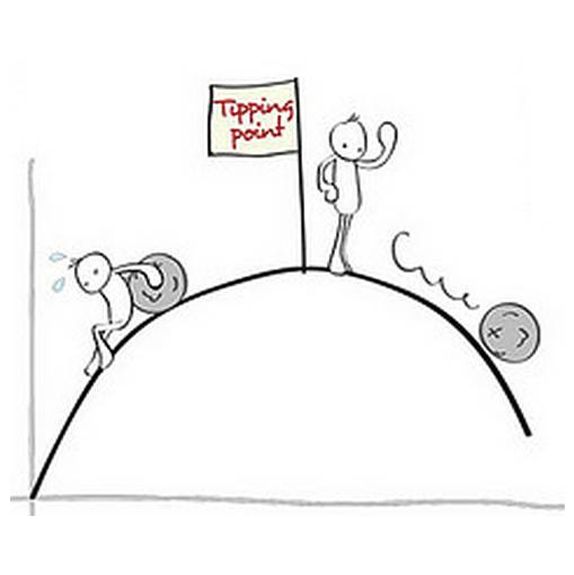
How heavily should a state tax tobacco products?  The advantage to the state of taxing tobacco products is that: a) the state gets to keep the money and b) there is a disincentive (higher cost) to using tobacco products.  So you would think that the higher you raise the tax, the better.  Except that that really isn’t true.  There is a level of taxation at which covert means of importing tobacco (black market) become profitable and at that point, you start losing the money you wanted to raise.  There is a tipping point.  The higher the taxes, up to that point, the more you make; after that point, you start making less.  Or, briefly, “more” is worse.

The alternative model presupposes that there is no response.  Nothing in the alternative model suggests a tipping point after which “more” is worse.  Imagine a wall that resists the pressure you are putting on it.  You put X pressure on it; then X + 1; then X + 2.  Finally the wall breaks down

In the beginning, I introduced a Trump supporter, a woman, whom I am trying to persuade.  Being unsophisticated and also deeply committed to the data I have,  I am trying to persuade to abandon her case that he has been a good president.

So I say that President Trump has asked for and received the help of foreign spy agencies in defaming his opponent.  I have five pieces of evidence that is true.  I say that President Trump has led the country poorly in response to the pandemic.  I have five pieces of evidence.  I say he has begun and pursued an unnecessary and costly trade war with China.  I have five pieces of evidence.  The evidence is all really good.  Irrefutable, really.  So I ought to win this one, right?

She seems receptive to the first point.  President Trump has been receiving aid from the Russians.  She accepts the first argument in support, and the second, and…eventually…the third.  But something is starting to go wrong.  Her agreements are slower and seem more ambivalent.  If I knew anything at all about the signs of the tipping point, I would pay attention to them.  But I don’t.  I’m just increasing the logical force, imagining that she has no options.

But she does, of course.  She can just get up and leave, which the wall could not.  She could deny the accuracy of the evidence by making the evidence-gatherers self-interested. [1]  Finally, she could reject me, her friend, as a source of information about President Trump.  I have cherrypicked the data; I have a hostile emotional bias; I am just trying to embarrass her.

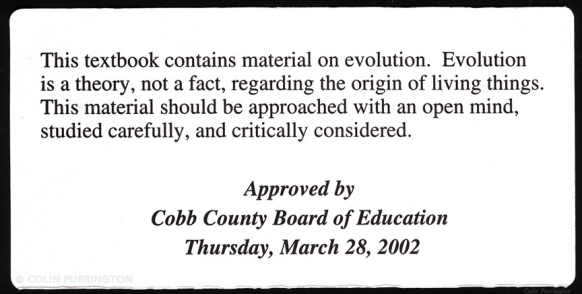
This is like the topic of evolution is some southern school districts.  If you try too hard to
establish the “truth,” [2]  you show the problem.  You show how the theory of evolution provides efficient solutions to that problem and you prepare to move on.  But the responses of the class become slower and more ambivalent.  But you proceed because you have Science on your side and what choice to they have?

But you are putting at risk the relationship of trust these students have in their parents and in the local Baptist church, where all their friends meet.  That’s a lot of emotional drag.  These students are not like the wall; they are like the black market in tobacco.

So they respond by trying to separate “fact” from “theory.”  This is deadly.  In science, it isthe facts that support the theory.  The school board makes up little stickers that say (Evolution is a theory, not a fact) and stick them in the text where assertions about the adequacy of the evolutionary point of view are asserted.  Page after page, lies are told about the relationship of facts to theories.

And if that separation doesn’t work, they can move on to the denial of science broadly.  As President Trump said on his recent visit to California, “Science really doesn’t know.” [3]  Failing that, they can “home school” their children using anti-evolution biology texts.

When you get to that point, you realize that you should have stopped earlier.  The conditions that prevail after the tipping point has been passed are: a) the whole set of arrangements for weighing evidence are are scrapped, b) the relationship between you and the person who trusted you to be fair is damaged, and c) they might just leave and set up institutional arrangements that will prevent evidence from being presented at all.  Those are really bad outcomes.  Everyone loses; even the ones who think they won.

What to do.

First, accept the tipping point model.  When you push beyond that, you yourself become the point at issue and when that happens you will lose the argument and possibly the relationship.

Second, make room for a little time to adjust to the topic.  The first response you get is partly skepticism about the information and partly wariness of you as a presenter, but it may be partly just the novelty.  She says, “I have never heard anyone say that about the President before.”  That’s three separate stresses on the listener, but the last one may just dissipate on its own.  By the next time you talk—and if you don’t bully her, there may well be a next time—it won’t be new anymore and there will be only two stresses.  And the two remaining stresses may have weakened as well.

Third, agree with her as much as you can.  There is very little to be gained in identifying a political figure that is important to her as “evil.”  If you can share a goal with her—protecting the intelligence services of the United States—you can reduce the argument to the best way to do that.  Reducing President Trump’s mistakes to “understandable failures” might be a good thing to do first.  It establishes that they are failures and it sustains the relationship you have with her.  It moves less quickly to the tipping point.  You can come back next time to question just how “understandable” they are.

Finally, don’t gloat.  Gloating makes the discussion a zero-sum game.  Everything that makes her feel bad, makes you feel good.  She experiences the pain you are causing her—which is bad enough—but if she also experiences the pleasure you take in inflicting that pain, she may leave the discussion and the relationship on those grounds alone.  A point that you make, sympathizing with her about how hard it is to really believe the corruption is that widespread, does put you on one side and her on the other but only factually.  Emotionally, you are—or could be—on the same side.  And if you can’t feel about the issue the way she does, you can still feel about her emotional response the way she does.

The point is this.  If there is a tipping point—a point at which you become the issue—then you need to understand that there will be no more persuasion when you pass it.  If you are interested in persuasion, you need to respect that.  There are things you can do to move the tipping point a little further away.  Sometimes these will be costly to you, but you have to remind yourself about what you are trying to do and to do the things that will help you.

Make the case.  Make it repeatedly.  Don’t gloat if you’re winning.  Save the relationship.

[1]  This does not challenge the data themselves; only the motive in collecting the data.  It’s not a refutation, but it is always available in time of need.

[2]  “Truth” is not a viable concept in scientific writing.  There are theories that are well supported and others that are poorly supported.  Sometimes, as in the case of evolution, the support is so deep that you just start with it as a presupposition.  But, of course, “presuppositions” aren’t true or false.  They are just a good place to start.

[3]  There is the temptation to ask what the alternative is, but I have resisted that so far.

Posted in Political Psychology, Politics, Uncategorized | Tagged , , , , | Leave a comment