Happy Birthday, you Bastard

I wrote recently about my “victory laps.” I started counting when I hit 80 and every year thereafter is a victory lap. One of the reasons to call the additional miles something special is that it gives me a chance to reflect on “the race” (getting to 80) itself and decide that I have been doing too much of something or other and too little of something else. In the context of running a course I will be running over and over I can decide to make changes next time.

I knew when I began writing a blog that was aimed specifically at the things that intrigue me that I was going to have to confront gravity—a persistent pressure toward seriousness—and I determined to resist it. I have lost track of that intention in the last few years. Today, I’m going to try to remind myself of it.

I’m going to do that by appreciating a Happy Birthday song I heard for the first time this week. Then I would like to poke at it a little. That doesn’t make it any funnier, but, for me, it does make it more fun. Maybe it’s just me.

Here’s the song, to the tune of the Happy Birthday song we all know.

May you live a thousand years
May you drink a thousand beers
Get plastered
You bastard
Happy birthday to you.

I have enjoyed that every day since I first heard it. A fellow resident at the senior center where I live—she described herself as having “an ecumenical background” by which she means she has done a lot of different things in her life—taught me this. She actually sang it to me as we were standing in front of the elevators. That night I taught it to the church choir at our practice.

So why is it funny?

Here’s where I lose most people. They hear it and laugh at it and they are done. When I am done laughing at a joke like this, I am just getting started. I think the “May you…” beginning cues up something poetic and traditional. I think of the Irish Blessing—“May the wind be always at your back…” and so on. If your mind starts to prepare for this kind of sentiment, you are going to get smacked in the face two lines later.

Dictionary illustration of the meaning of plastered – very drunk. The original source of the image is http://thefreedictionary.com/plastered

Max Eastman, in The Enjoyment of Laughter, says that when we prepare for one thing and then another thing happens (in a context where they difference can be taken playfully) we think it is funny. I think that the traditional style of the first line suggests that this song is going to be that kind of thing and our minds prepare to hear it that way.

The second line begins to cast doubts. It has the same structure, but somehow “thousand years” and “thousand beers” don’t point in the same direction. We begin, at that point, to adjust our expectations. Not from one thing to another, but from “I know what this is” to “I not really sure what this is.” And just in time, too.

Lines three and four are where the fun comes. “Get plastered” is fully colloquial. There is nothing traditional about it. And the reference—the good intentions are assured in the way the song is sung—to the celebrant as a “bastard” fit perfectly with “plastered.” So the emotional tone is kept but the form of it is changed abruptly.

And not only that, the rhythm of the second two lines is entirely different than the first two. There is something faintly trochaic about the first two lines. They suggest lines line “Till Burnham wood remove to Dunsinane.” That line is a standard iambic pentameter. So I tried to make the first line of this song fit some known meter. No luck. The result is that the change of accents corresponds with the change of social tone. It goes from formal sounding to informal and from long and liquid to short and punchy. And it goes there really fast. It’s the speed as much as the change that gets you.

And finally, we get to what pretends to be the governing sentiment. “Happy birthday to you.” But everybody knows that the sentiment isn’t really what the song is about.

Posted in Uncategorized | Tagged , | Leave a comment

A Victory Lap in a year of COVID

For quite a while before I crossed “the finish line” [1] I gave some thought to what to do next. There are some good reasons to think about the question, but there are also some pictures in my head that have played as large a role as any thinking I have done about it.

While I was at the University of Oregon, I saw Steve Prefontaine win a lot of races. The stands were full of Pre fans and they stood cheering his victory for a long time. He continued to run laps close to the stands recognizing their applause. I remember hearing one of the commentators noting his response to the fans and observing that he did the last round in 62 seconds. A great picture to hold in my mind.

The other picture is my own initial experience of the “victory laps,” as I called them, when I finished long training runs in New Wilmington, Pennsylvania, where I lived in the late 70s. I would get back home after a 15—20 mile run and tack on an extra half mile, one lap around New Faculty Circle. Nearly all the physical stresses I accumulated during the run somehow relaxed when I ran that last half mile as “merely celebratory” and not “really running.” Even the blisters eased off some. It was still running, obviously, but something had happened because of what I called it.

I was only in my 40s then, but it occurred to me that it would be very tidy to think of getting to age 80 as four laps of 20 years each. And very shortly after that, I began to think of the years after 80 as victory laps, like the ones I was doing then, and I began to hope that I could run those additional years as a celebration of the run I had just finished.

It was a flash of inspiration. I could keep on running, but I had already completed a very demanding course. I liked that.

And that is just the way it has turned out. I have just finished my fourth victory lap. Yesterday. Each has been alike in feeling celebrative; each has been different in what is enjoyed and celebrated. Today I am starting my fifth. [2]

That last lap had some unique features, marked particularly by the COVID pandemic. I am so very grateful that I did not have to make the hard choices about going to campus and risking my health and the health of others. As a long-since retired person, I have invested where I chose. I have put in more miles on my bike this year than I ever have in a year when I was not commuting. I often ride and out and back route where there is a Starbucks at the end of the out. This is clearly not a winning and losing kind of ride; it isn’t even a get there on time kind of ride. It’s celebratory.

I am deeply appreciative of the Bible study groups that have materialized and for whom I prepare the materials. I joke that preparing for the the groups keeps me off the streets, but if you think of “the streets” as having no meaningful work to do, it is really true. I have been teaching one overtly religious study—a group of men at my church—and two secular ones. Sometimes I have had a chance to teach the same text; once emphasizing the religious significance and twice as a study of how narratives work.

Here’s an example. Luke says that Elizabeth got pregnant and, Luke 1:24b, “for five months kept to herself.” When you approach the text as a narrative, you wind up asking, “Why is that there?” Or, more succinctly, “So…?” It isn’t hard to find an answer. What’s hard is noticing it and asking the question. [3]

I’ve learned a lot about Zooming this year. I don’t think I will ever want to give that up. For no more inconvenience than a phone call, you can see people and share slides and discuss them. My friend, Fran, and I taught an Adult Ed course on some children’s books, making the pictures as readily available as the text. Who would have thought?

I’m only a few hours into Victory Lap #5. I have no idea what it will hold for me and I don’t need to. My only commitment is to run it in a reflective and celebratory mode. There is an evaluative component to it, of course. I used to remember the run and assess my performance. Should I have taken that hill up to the Cheese Plant harder? Was I holding back more than I should have? I’m not being critical. I just realize I am going to come to that hill again and I want to have thought about how to run it. That’s part of the celebration.

When I began to think about “the end of the race” in terms other than dying, I thought of it first in words the Apostle Paul provided me, “I have finished the course, I have kept the faith.” Paul does not strike me as a celebratory kind of person, but years later I found out that the “course” he had finished could also be called a curriculum—from the Latin, currere, “to run.

And I already know how to finish a curriculum.

[1] Question: What’s on the other side of the Finnish Line? Answer: Russia.
[2] This isn’t like they say about marathons. You don’t plan to run another one until your memories of the previous one begin to fade. It was during that training run era that I ran my first marathon, the Pittsburgh.
[3] The answer is that Gabriel cites the information as proof that the whole proposition he is offering Mary is really true. No one else knows it because Elizabeth “kept to herself.”

Posted in Uncategorized | Tagged , , | Leave a comment

A Dutch Nativity

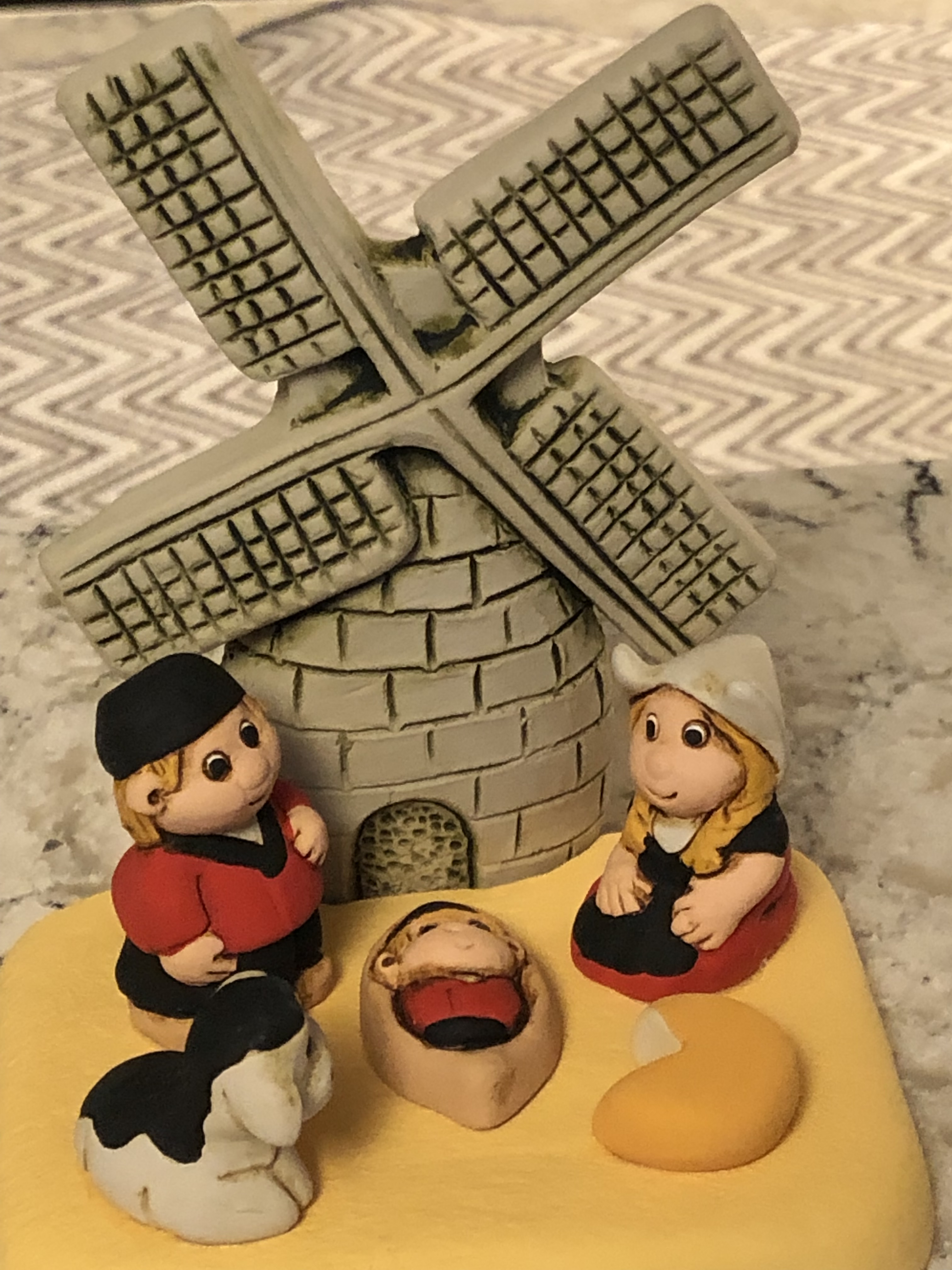
A couple I knew in the 1970s sent me this creche in appreciation for a Bible study we and some of their classmates at Westminster College had just completed. It was Luke’s story this year, which accounts for some of what you see in the picture. But not all.

The sheep is undoubtedly meant to remind us of the shepherds, but I don’t see any shepherds. Presumably they have returned to the fields praising God for all they had seen and heard and leaving one of their sheep behind. That is possible. On the other hand, since Joseph and Mary are going to need a sheep at the Temple as a sacrifice eight short days from now (Leviticus 12:6)—that will save them from having to go the cheap (turtledove) route. So the sheep could come in handy and that may be why the shepherds left him.

The idea that there were animals at all is said to come from Isaiah 1:3, where an ox and an ass are referred to, but you have to go to the Advent story itself to come up with sheep.

Baby Jesus is in what looks like a crib rather than a feed trough. That seems awkward from a textual standpoint. I guess it is possible that the shepherds came, but left early because there was no baby of the sort the angel described. The angel was quite specific—swaddling cloths, lying in a feed trough. They may have thought that an angel who was wrong about the little things, could also be wrong about the big things and that same angel did speak of good news for the whole people. Maybe he was as wrong about that as he was about the clothing and the resting place of the infant.

The windmill is clearly out of place in Palestine if we are to take its presence literally, a tendency the adult Jesus would warn against, as we will see shortly. As a source of power, however, it is built to be moved by the spirit—wind, breath, and spirit are all the same word in Greek—so it may well be that “moved by the spirit” is a not so veiled reference to the conception of Jesus (see Luke 1:35) or to the dynamism of the followers of Jesus (see Acts 2:2).

In the same spirit, cheese was a normal part of the Israelite diet in the 1st Century. Not, perhaps, those great Dutch rounds of cheese, such as we see here, with a third already missing. So cheese as a dietary element may be all that is meant here. On the other hand, it does recall Jesus’ rebuke of the crowds, memorably reported by Monty Python. [1] Jesus says that the peacemakers are to be blessed, but someone in the crowd has trouble hearing. What did he say, blessed are the “cheesemakers?” No, no, no. Jesus responds, “Well…obviously…it is not to be taken literally. It is meant to refer to any manufacturer of dairy products.”

The point would be, allowing full scope to artistic freedom, that the cheese is there to suggest Jesus’ later remarks about cheese and literalism. The cheese in only an item in the larger category of dairy products just as Bethlehem is only one of the towns of Judah.

Finally, Joseph and Mary are themselves a handsome young couple. The little black cap on Joseph’s head may be there to represent his trade, carpentry. And Mary’s lovely blonde braids need no further comment at all. It is easy to see how Joseph would be attracted to such a lovely and typical Dutch maiden.


[1] I regret to say that we have to abandon Luke’s account and go over the Matthew for the true text of Jesus’s remark about the peacemakers.

Posted in Uncategorized | Tagged , , | Leave a comment

But First It Will Piss You Off

Using emotionally powerful language for your own purposes is a time-honored practice. Especially for humor. Humor sets one meaning against another in a playful context [1] and one of the meanings may be an allusion to a well-known phrase. I saw a book titled Power over People; it was about overhead power lines. In a context where conservative Christianity is pervasive, slight alterations to biblical language serve to set one meaning against another. I was delighted to learn recently that the word the King James Version translates as “dust” would better be translated “clod (of dirt).” The whole idea of Adam as the First Clod brings designations like First Lady or, recently, First Gentleman, into a hilarious focus.

Of course, for humor purposes, it helps if the phrase being played with is not deeply meaningful to anyone. For humor purposes, familiar, but not emotionally rich, is the perfect combination. [2] But some uses, like the one I have in mind for today, have, in the past, meant something to distinct communities of believers. The phrase is “the truth will set you free.”

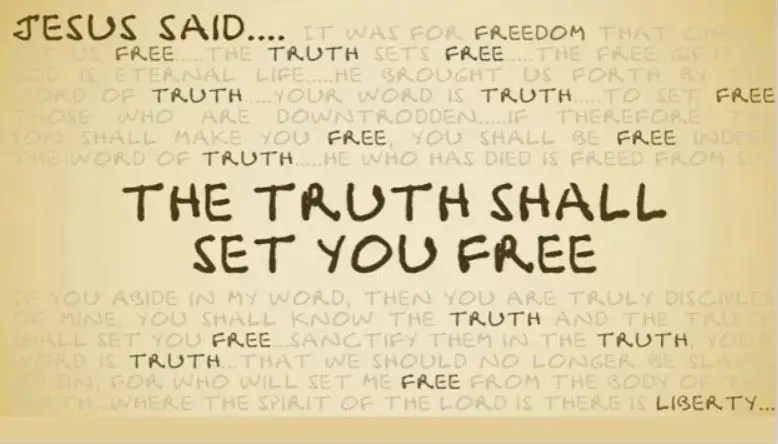
There was a time where the meaning, not just the cadence, of that text was powerful. Let’s start there. This text comes from John 8:31 where Jesus says, in Raymond E. Brown’s translation [3] “If you abide in my word, you are truly my disciples; and you will know the truth and the truth will set you free.” So, by being disciples of Jesus, you will come to know “the truth”—the specific meaning of the expression is not made clear in this passage—and you will be released from your current condition of slavery. Being a disciple enables you to “live in” the word that Jesus is (See John 1:1) and by living in that word you may come to know the truth. It is knowing the truth that will set you free, but it is discipleship that will enable you to know the word and live in it.

The text is complicated and obscure. Also powerful. And easily perverted to other uses. Raymond Brown, in his commentary on this passage, says, “The hackneyed use of this phrase in political oratory in appealing for national or personal liberty is a distortion of the purely religious value of both truth and freedom in this passage.” I think “hackneyed” is an unnecessary slur, but it isn’t wrong. Let’s rescue the kernel of this sentence for today’s use: “The use of this phrase…in appealing for…personal liberty is a distortion of the …value of both truth and freedom in this passage.”

Let’s consider that point to have been made. Now let’s start somewhere else. Sharon Fieldstone (Sarah Niles) serves as Ted Lasso’s counselor on the series named for him. She offers this quip to Ted at a crucial moment. The meaning is completely apparent given the context. Dr. Fieldstone says, “The truth will set you free. But first it will piss you off.” There are so many good things about this formulation, none of them, of course, related in even the most remote way to the words of Jesus.

And as I got to poking around a little in that phrase, I discovered that it is the title of a book by Gloria Steinem. That places it in the context of Second Wave feminism, where “truth” and “free” have much clearer meanings. It is also clear, in this context, why someone would be pissed off upon learning “the truth.”

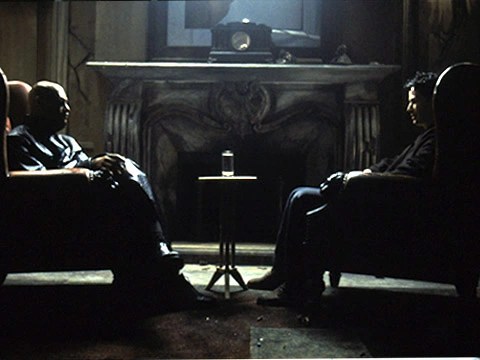
This is exactly the meaning Morpheus has in mind when he tells Neo in The Matrix, “The Matrix is the world that has been pulled over your eyes to blind you to the truth.” Neo very sensibly asks, “What truth?” And Morpheus responds, “that you are a slave” and goes on to offer him his freedom. [4] It is easy to see why Neo would be pissed off by learning that he was a slave, but the meaning of that word requires the possibility of freedom and the freedom offered is only freedom from. Free from the Matrix, Neo can make genuine choices, good ones and bad ones, and experience the consequences.

What truth?

And that is also what Steinem means. Women have been enslaved and when they learn that, they will be appropriately angry. After the anger, the opportunity to be set free, to live freely, will offer itself, along with the choices that have good or bad consequences.

And that’s why I like the combination of “will set you free;” immediately undercut by “but first it will piss you off.” But the idea that it will piss you off, so clearly understandable in the contexts I offered, is not at all clear outside those contexts.

There is nothing about the truth—taken generally—that will piss anyone off. Every illusion is a slavery of a kind and truths that dispel them set us free from the bondage they exert. Everyone who has grown out of untrue or outmoded beliefs has the experience that the truth will set them free (from that bondage) but it will not piss them off. It is a glorious and wonderful realization.

Everyone would agree, I think, that depending on what the truth is, it will strike you as scary or infuriating or exciting and wonderful. Nevertheless, there is a strong tendency for “the truth,” that expression, to mean something much worse that you had thought. Pick up a book entitled, “The Real Truth about America.” What do you think it will say? [5] A speaker who leads off by saying, “Tonight, I’m going to tell you the truth” has some awful message to reveal. The audience presumptive has been living in comfortable illusion, therefore “the truth” will be bleak and irksome.

I’m not really sure just why we do that. Have we always done that? Do we think we live in comfortable illusion and that therefore the truth must by the kind of thing that will make us angry? Why would that be?

[1] Thanks to Max Eastman’s The Enjoyment of Laughter
[2] Wayne and Schuster in devising a baseball game using as many allusions to Shakespeare as they can has the coach assigning positions: “with you three guarding your accustomed bags, Stan the first, Bill the second, and Richard the Third.” Yup. Richard the Third.
[3] Yale Anchor Bible Commentary
[4] New doesn’t need to abide in the word. He just needs to take the red pill.
[5] I just checked Amazon. They don’t have a book by that title. Yet
.

Posted in Uncategorized | Tagged , , , , | Leave a comment

Meet the Barbara

Sherry Turkle warned long ago that people seize on “counseling computers” and confess the most remarkable things to them. I enjoyed her account when Alone Together was published in 2011, but I hadn’t thought about it recently. Then Joe and Laura Hawkins, from the tech drama Humans, show up to see their counselor and discover that she has had to go home, sick. The office offers Joe and Laura the services of “a Barbara.”

The Barbara didn’t surprise me as much as it might have. Here is why. This is an excerpt from Alone Together (page 23).

“I was among MIT students using Joseph Weizenbaum’s ELIZA, a program that engaged in dialogue in the style of a psychotherapist. So, a user typed in a thought, and ELIZA reflected it back in language that offered support or asked for clarification. To “My mother is making me angry,” the program might respond, “Tell me more about your mother,” or perhaps, “Why do you feel so negatively about your mother?”

A Perfect Barbara Counselor

“ELIZA had no model of what a mother might be or any way to represent the feeling of anger. What it could do was take strings of words and turn them into questions or restate them as interpretations. Weizenbaum’s students knew that the program did not know or understand; nevertheless they wanted to chat with it. More than this, they wanted to be alone with it. They wanted to tell it their secrets. Faced with a program that makes the smallest gesture suggesting it can empathize, people want to say something true.”

“I have watched hundreds of people type a first sentence into the primitive ELIZA program. Most commonly they begin with “How are you today?” or “Hello.” But four or five interchanges later, many are on to “My girlfriend left me,” “I am worried that I might fail organic chemistry,” or “My sister died.”

As we will see in just a moment, Joe Hawkins has some of the same incredulity Professor Turkle has.

Weizenbaum’s students knew that the program did not know or understand; nevertheless they wanted to chat with it. More than this, they wanted to be alone with it. They wanted to tell it their secrets.

And they move quickly into topics that might plausibly be thought to mean something to them.

“I have watched hundreds of people type a first sentence into the primitive ELIZA program. Most commonly they begin with “How are you today?” or “Hello.” But four or five interchanges later, many are on to “My girlfriend left me,” “I am worried that I might fail organic chemistry,” or “My sister died.”

So I had been thinking about this kind of thing for ten years before I met Joe and Laura Hawkins and their “Barbara.” This is episode 2.1 at the 14:00 mark if you would like to check it out for yourself.

The Session

The Barbara: “Laura, in the last session, you had identified a key challenge for you, namely, rebuilding trust in Joe. Have you had the opportunity to reflect on this further, …Laura.”

That doesn’t really work. The Barbara tries again.

“Perhaps we should approach a different question. Laura, do you feel satisfied that Joe has made a full and honest acknowledgment of his misdeeds?”

And Laura responds, eventually:[No] “I…still don’t feel that I really understand why you did it”.

Joe says “Laura, they’re stupid things [the Synths]. I was a bit drunk. I was lonely. We hadn’t… You know. We hadn’t for ages. You were never there, emotionally or physically, so….I suppose I wanted to do something …”

The Barbara “Please finish your thought, Joe”.

Joe ….”I wanted to do something that would make you notice me.”

The Barbara “Laura, do you understand that? Does it feel truthful?”

Laura Hmm.

An Assessment

There are three things in that exchange that made me pay more attention to it than I thought I would. The first is, “Laura, do you feel satisfied…” That’s not a big leap from “You are both exhibiting signs of anxiety” and the low-grade answer Laura gave, that they hadn’t really had time to work on the question.

The second is, “Please finish your thought, Joe.” Joe had begun to say what was really behind what he did with Anita, the Synth, but he stalled out. The Barbara noticed that and asked him to finish the thought.

The third is: “Laura, do you understand that? Does it feel truthful?” I would have been less surprised, I think, had the Barbara said, “Laura, how do you feel about Joe’s answer?” But the Barbara wanted specifically to pursue whether it sounded “truthful” to Laura. Knowing Joe as she does, is it plausible that he could have done what he did for the reasons he gives?

The other exchange that attracted me was one I attribute to the writers generally, not to the writing of the Barbara particularly. Joe gets aggressive about the Barbara’s probing into the matter of their feelings. What sense does it make, Joe wonders, for a thing with no feelings at all to ask such questions. Here is the Barbara’s answer; I think it is a good one.

The Barbara says, “I am accessing the anonymized transcripts and associated statistical analysis of over 38,000 counseling sessions.” So, in short, my data base is huge. Joe tried to blow it off: “Easy stats,” he says.

But Laura, who is a good deal brighter than Joe, rescues the point: Laura “Why not? We’re not the only people in the world to go through this and I don’t actually feel you understand…what it meant to me.” Somewhere in the very respectable data base the Barbara has access to are a lot of couples like us. We are, figuratively speaking, part of that data base and the general truths apply to us as much as to the others.

Good point, Laura

Posted in Uncategorized | Tagged , | Leave a comment

The Magnificat and the Great Reversal

The song “O, What a Beautiful Morning” on my recording (Siri’s choice) of Oklahoma, takes 2:35. The fragment of that same song included takes about 36 seconds, just long enough to introduce the theme and then move on.

For Advent this year, I’ve been thinking about the Birth Narrative as told by the gospel according to Luke. It occurred to me some time this year that if the gospels were written from back to front, as is the general view of scholars. then by the time Matthew and Luke got to telling about the birth of Jesus, they had already told about his death and resurrection, about his teaching and his healing. If that is so, I thought, then they would be free to introduce the main themes in their gospel accounts in the way they tell about the birth.

Sing it, Gordon.

Then it occurred to me that if you were going to compose an orchestral overture for a Broadway musical, you would first give your attention to the songs you had written for it. That is when I started timing “O what a beautiful morning” and the fraction of the overture that introduces “O what a beautiful morning.” The song is a little over four times as long as the introduction in the overture. How about that?

One of the prominent themes of Luke’s gospel is the reversal of fortunes theme. He is quite explicit about it. In his famous Sermon on the Plain, he offers four blessings and four cursings—perfectly matched. Luke 6: 21 and 25 say, “Blessed are those who are hungry now; you will have your fill. Alas for you who have plenty to eat now: you will go hungry.”

It is a major theme in Luke. These are not idly chosen verses. So following the Broadway musical metaphor, it seemed to me that we ought to expect to see this theme introduced in the Birth Narrative.
And it is. It doesn’t take much looking at the Magnificat to see those themes introduced there. But in writing the Magnificat, Luke has more in mind than just introducing the theme. He is also locating Jesus at a particular place in the history of Israel and to do that, he introduces the character of Hannah, the mother of Samuel. [1]

Hannah and Mary

The situations of Hannah and Mary could scarcely be more different. Hannah desperately wanted a child and prayed ardently for one. [2] Mary was quietly going about her business, married to Joseph, but not yet living with him. Absolutely not “expecting” in either sense of the word. Nevertheless, God grants both Hannah and Mary sons and both express their thanks to God. But what kind of God is this?

This is a God of the slash. [3] The conditions before the slash are overturned or reversed after the slash. Look at these three examples.

Hannah says “The childless wife has borne seven/While the mother of many sons is bereaved.” Notice the pattern. You can read the slash as “nevertheless.” Mary says “God my Savior… has looked upon the humiliation of his servant/. Yes, from now onwards all generations will call me blessed,”

Hannah exults that “The bows of the mighty are broken/While the feeble are girded with armor.” Mary says that God has “pulled down princes from their thrones and raised high the lowly.”

Hannah says “The sated have hired out for bread/While the hungry are fattened on food.” Mary says “He has filled the starving with good things/ [and] sent the rich away empty”

These three comparisons establish the common principle that Luke sees God as a “reversal of fortunes” God. We would expect, then, to see that pattern expanded in Luke’s gospel and we do. We have already seen the “blessings and cursings” in Luke’s “sermon on the plain” in Chapter 6.

This set of contrasts between rich and poor, as well as between Then and now, are characteristics of Luke’s preaching, so I will content myself with only one example. In Luke 16, he tells the story about “the rich man” (otherwise unnamed) and the beggar, named Lazarus. “Now,” the rich man is living large and Lazarus lives in misery. “Then” the rich man is tormented in the fires of Hell, while Lazarus is comfortably in Abraham’s lap. Here is Abraham’s explanation.

Abraham said, “My son, remember that during your life you had your fill of good things, just as Lazarus his fill of bad. Now he is being comforted here while you are in agony.

Luke 6:25

The words in bold font establish the Now and Then contrast I mentioned, although from the standpoint of the speaker, they are reversed. When Abraham ways “Now,” he is referring to a time we call “Then.” Still, the meaning is clear and it is what we would expect from a reading of the Magnificat

There is an urge to explain this story in some other way. As it appears, we find it offensive. We want the rich man to be guilty of some particular flaw, something that we could understand as a Ticket to Hell. But Luke doesn’t give us one. Any more than Mary found some specific fault in “the sated [who are forced to] hire themselves out for bread.” Any more than the princes who have been pulled down from their thrones.

Logically speaking, we ought to wonder what the sated had done wrong that they had to work to earn a loaf of bread. [4] But we don’t. Similarly, we might wonder what the princes had done wrong that they had to be pulled down from their thrones. But we don’t. And Luke has no more interest in the sins of the rich man than we have in the interests of the overfed and the ruling elites. Luke’s Jesus is interested in Now and Then.

You already had yours.

I admit that I have trouble with this emphasis. I admit that I take comfort from the absence of this emphasis in Mark, Matthew, and John. And, oddly enough, I take comfort in keeping clear in my mind that Jesus says, in Luke’s account, what he says. Keeping that clear in my head seems, somehow, the right thing to do.

I think, myself, that Luke presupposed a zero sum economy, in which whatever the rich have was stolen from the poor. Whatever power the princes have, is deployed against the powerless. If it were possible to have an economy where all benefitted (not equally, of course) or a polity where power is exercised for the benefit of all (not equally, of course), we might wonder how Jesus would address that issue.

I do. But I know better than to look for help from Luke. Especially not at Christmas.

[1] And that isn’t all Luke does with the story of Hannah and her son, Samuel. I think that story lies behind several elements of the story, including the “presentation” of Jesus at the Temple in Chapter 2.
[2] The prayer was so “ardent” that the priest, Eli, accused her of being drunk.
[3] More formally, a “virgule,” but I didn’t want to get close enough to a virgule birth to tempt anyone.
[4] It is possible, of course, that they were loaf-ers.

Posted in Uncategorized | Tagged , | Leave a comment

Stepping up

What if there were something you would like to be able to reach and it is just a little too high to get to? Not a problem. You get a little stool and climb up on that. And if you have calculated the distances correctly, that solves the problem.

If what you want to reach is still too high, you get a higher stool. But then you have the problem of how to get up on such a high stool. Not a problem. You get a little stool that will help you get up on the higher stool which will let you reach it.

Obviously, this could go on and on and at this point I am just going to rely on your imagination. So we can have something concrete to imagine, let’s say that there is a trophy up on the top shelf. [1] In fact, the “trophy” is coherent thought and expression. I always desire it, but sometimes, it is out of reach.

What to do, what to do?

I remember a device I used in the early spring of 1974 when I was writing my dissertation at the University of Oregon under considerable time pressure. I’d go in to my office early in the morning completely unable to do the work that had to be done. That kind of work was simply out of reach. But I did have a plan.

First I would take a book off the shelf and open it at random and start to read it. It would be an author whose style I liked. Often it was John Kenneth Galbraith. When I began to track the ideas I was reading and even more the beauty of the language, I would put the book back and turn to my typewriter.

Yup. Typewriter. Writing something was something I thought I could do once I was up on that first stool. And I would just start hitting keys; any keys. Whatever keys my fingers wanted to hit. That was fine for my fingers and it was an action in a sense that the reading was not, but it got boring and I began to want to actually say something. That’s the second step stool: saying something.

I would just keep typing and watch how the keystrokes eventually formed words and sentences. Units of meaning. Not very useful ones, of course, but what use does a step stool have beyond helping you reach something higher than you could reach from the floor?

Once I got that far, it was often far enough. Well, high enough. If it wasn’t, I’d roll a page into the typewriter and write a letter to friends or family. That usually did it. From that step, I could reach for the document I had abandoned yesterday and start making a little more progress. At that level, I had reached the ‘trophy,”—being able to think and write—and I could get to work.

I still do that. There are three things I should be writing this morning. None of them are this essay. But I know I can write this essay. It is the lowest step stool this morning. When I finish it, I may be able to do one of the other pieces. I need first to realize that I can’t reach what I need to be able to reach. That is hard sometimes; realizing it is hard sometimes. [2] I am tempted sometimes to just bull my way through it as if effort alone could summon coherent thought or fluent expression. But when I admit how futile that is, I search my mind for a small step stool.

When I do good work at that level, a come to feel that I can reach the next step stool. And, if necessary, the next one, until I can reach what I need. It’s a kind of 12 Step program except it requires fewer steps. It does begin by admitting that I cannot do in my present state what I want and need to do. It does recognize that I simply cannot do, by forging ahead and forcing the pace, what I need to do. I have to be able to hear the music.

This process produces a subtle, but powerful change for me. First I have to assess what I have just done and call it good enough. That’s not too hard given how low I have set the bar. But there is more to it. First, it commits me to a predictable future. I have done this a lot of times. I know what happens next. I know where it winds up. It winds up with being able to do the task I had in mind when I started. Second, it cashes in “successes” other people would be ashamed to admit, but each such success is a step up.

Sometimes, having gotten to the end of the process, [3] I produce a sentence or a paragraph that I am still proud of years later. After one such experience of “stepping up,” I wrote this: “I was raised by a cool systematic father and a warm episodic mother.” That was in 2001 and I still think of it every now and then and I am comforted by it.

[1] Trophies aren’t the kind of thing I win. People who are more talented or who work harder than I do win trophies. But trophies are something I notice. Back in the very old days there was a Greek word tropaeum, which meant, ”the monument of an enemy’s defeat.” You put a pile of stones at the place where the tide of battle turned and the bad guys had to retreat. I notice trophies like that and I might just have one up on the shelf in my closet.
[2] My friends who are of a more suspicious cast of mind would insist that “admitting it’ is what is hard. That is sometimes true, but not this morning.
[3] There are two tests. The first is how good it feels when you are writing. The second is when you finish it and read it and find that it actually makes sense.


Posted in Uncategorized | Leave a comment

The disappearance of narcissism

Good news! You’re not narcissistic and neither am I. And neither is anyone else you know.

And why is that? Because the traits and the associated behaviors that characterize narcissism are now so common that they are no longer abnormal. The most you could say about a person—thinking still of narcissism as a personality trait—is that they are “unusually narcissistic.” [1]

But that’s just the beginning. How do you like this language? “You have a combination of traits that lie on a continuum or spectrum culminating in narcissism.”

“He’s on the spectrum” has become an expression that is taken to mean something among the people I hang out with because it is taken for granted that we are talking about autism. But what if we aren’t talking about autism? What about the possibility that “on the spectrum” is now a general purpose term? What if there is no way to know what “spectrum” we are talking about?

This is a whole new way of imagining clinical diagnoses. Looking back on “the old way,”—the one we are still using, more or less by default—narcissism is a trait with fuzzy boundaries, but a clear core. “Narcissism” is a diagnosis that means something. The symptoms can be these or those and they may be more or less clear and prominent, but the term still means something. In other words, at the center of all those different expressions, there is an area of commonality so clear that we give a name to it. If there is less commonality, we say that “it” (narcissism) has several subtypes.

Narcissism or Narcissistic Personality Disorder

But, as I say, that’s the old way. The new way, the popular way, utilizes a more general phenomenon I have decided to call “spectrumization.” OK, it’s not a word (yet) and it’s really ugly, but it is understandable. It uses the all-purpose Greek verb izein, “to make” and the Latin spectrum and gives us the English meaning, “to turn something into a spectrum.” Which is what we want. Is he autistic. Nope, he’s on the spectrum. Is he racist? Nope, he’s on the spectrum. Is he a pedophile? Nope, he’s on the pedophile spectrum. Spectrumization.

Next, there is the question of how to name the spectrum. The common practice—and, really, it is hard to see how it could be otherwise—is to name the spectrum by the the most prominent pole. For physical and psychological diseases and for social disorders, that’s the worst end. We all know this, but imagine that there were a scale, a spectrum, beginning with complete benignity toward all races. You wouldn’t call it a multi-racial benignity spectrum and say that someone who is at the very low end is “racist.” Of course you wouldn’t. You would call it a “racism” scale and pretend there simply isn’t anyone at the other end. That person would be a “non-racist.”

You see where this takes us, right? The most contentious conditions and behaviors are not recognizable clusters of traits, but “positions” on a spectrum and the spectrum is named by the more pejorative pole.

And not only that, but by the nature of the term, it is fixed in time. There are no terms for completely unanticipated experiences to which the newbie responds with bafflement at best and, more commonly, with anxiety and rejection. So someone who sees their first chicken beheaded has a reaction. He is somewhere on the [fill in the blank, I dare you] spectrum. The thousandth doesn’t evoke any reaction at all. But note that the name you filled in did not take this gradual desensitization into account. The name of the spectrum is frozen even if the position on the spectrum is not.

More realistically, if you respond to the first passionate gay kiss you see with “Ee-ooooo. Whoa!” are you homophobic? Well, actually, as mistaken as it is, that would be the good news. Actually, your reaction shows that you are at some point or other on the spectrum of homophobia and, due to “spectrumization,” you will never get off. You can be more or less, but you can never be “not.” Not if you are straight.

When I write a piece like this, I get accused of catastrophizing. Not at all. Here’s what I am saying. If “conditions or behaviors” (or even attitudes) are taken to be positions on a spectrum; and if the spectrum is named by the worst end’ and if it implies a settled condition, not the initial response to novelty—then, yes, this is what happens.

It’s ugly but it hasn’t happened everywhere yet and maybe we can find a way to stop it.

[1] All Things Considered, December 11, 2010 “It’s all about me; but is narcissism a disorder?” https://www.npr.org/2010/12/11/131991083/it-s-all-about-me-but-is-narcissism-a-disorder

Posted in Uncategorized | Tagged | Leave a comment

Don’t talk to her like she’s a slave

This is (yet another) reflection on a dilemma presented by the Netflix show HUMANS. As the series develops, it is showing more interest in the fundamental robotic dilemma: just how is it that “they” are different from “us.?” That’s not the part that has interested me so much. It is, rather, just how to integrate them into ordinary human society.


As I have already described in “Robot Servants and Friends (and Lovers)” Joe Hawkins, overwhelmed by the demands of taking care of the house and the kids during his wife’s absence, goes to the store and buys a robot—a Synth—to help around the house, just as the ads promise. But “Anita” as Sophie, the younger daughter, names her, is way too good at everything.

This causes some predictable problems. When Laura, the mother, offers to read Sophie a story, Sophie says she would rather have Anita read it. Her mother, she says, “reads too fast,” implying, as I understand it, that she always seems to be in a hurry to finish “the task.” Anita is never in a hurry. “But reading bedtime stories is my job,” Laura protests, and she is right. But she has a lot of other jobs too, and she is not nearly as competent as Anita is.

Some other problems are not so predictable until you see them played out. Then you say, “Well of course.” Mattie, the older daughter, is a computer nerd and objects to Anita’s presence in principle. The first morning Anita is there, she prepares and serves breakfast. It is not something the un-augmented Hawkins family is used to.

Mattie carps at Anita, “Anita, brown sugar. I hate white.” Anita turns away to get the brown sugar, but Laura intervenes, “Anita, stop.” And, to Mattie, “She’s not a slave.”

Mattie responds, “That’s exactly what she is.”

So this isn’t a problem of the “essential humanity” of the Synths; does the undefinable “human essence” exist or not. This is a problem of what happens to a small group—it’s a family group in this case, but it wouldn’t have to be—when the norms of normal social discourse are flagrantly broken in the presence of everyone. Mattie’s point is that Anita doesn’t deserve to be spoken to politely. Laura’s point is that language like that causes damage to the family. They are both right. [1]

The first point is that Mattie, in using such language in the presence of the rest of the family, causes damage to herself. Let’s leave the factual case aside. “Slave” is not a term that is applicable to a functioning family android any more than “free” is. But the factual case is not the issue here.

There is a way of conceiving this interchange in much more than utilitarian terms. Mattie needs to assess the situation, to formulate a response that aligns what she thinks is going on and how she feels about it; she needs to express that in some way that is understandable in both senses of the term—the descriptive and the emotional—to the people who are there and to whom Mattie wants to communicate. Strictly speaking, there doesn’t even need to be an object there, just an occasion. For the purposes of this model of communication, Mattie could be by herself in the middle of a desert and could be addressing a lizard in such terms and the damage I am talking about would be done to her anyway.

Sherry Turkle wrestles with this issue in her book about robot/human interaction. There is something entirely genuine about the formulation and expression of the human feelings “in interaction with” the robot. [2] Warm and loving expressions of emotion addressed to a dog or a cat or a robot do the same good to the human who formulates them. Similarly, the damage done to a dog or a cat or a robot, damages the human actor even if no one else is present.

I have not, in the paragraphs above, established that communication ought to be understood in this way, and you may not find it as persuasive as I do. I am saying only that if you think of communication that way, you will understand why I am arguing that Mattie damages herself in treating Anita as if she were a slave.

The second part of the argument, probably the one Laura had in mind, is that expressions of that kind damage the family. [3] Mattie, in the early shows of the season, is a snarky eye-rolling teenager and she makes lots of nasty remarks about her siblings. This is different and Laura knows it. The question that is open before the family is whether Anita is a safe “person” to verbally abuse. Will any family exchange be marked by this kind of nastiness on the grounds that “it” doesn’t care or shouldn’t?

So far as its effect on the family is concerned, according to this model, it doesn’t matter whether Anita is offended or if she doesn’t notice. Everyone else will notice and the gathering, whatever it is, will be taken another step toward everyone’s laziest and meanest instincts—instincts that are always there, ready to be activated like some kind of dormant virus.

Laura’a right to use the “slave” metaphor about Mattie’s nastiness. Later, she finds herself apologizing to Anita for some things that have been done to her and the apology helps her a good deal.

[1] In the case of this particular show, it turns out that “Anita” is also a self-aware robot named Mia and the Mia-consciousness is something this Synth has intermittent access to.
[2] Since the robot does not “respond,” it is not technically an “interaction,” but the human observation is placed in the context of interaction, so it feels like “interaction” is the proper frame of reference.

Posted in Uncategorized | Tagged | Leave a comment

“Professors are the enemy”

Let’s start with a paragraph from Heather Cox Richardson’s November 3 post, “Letters from an American.” She is reporting on the pushing and shoving that is going on in politics these days.

Meanwhile, the Republicans continue to focus on culture wars like the manufactured Critical Race Theory crisis, claiming that educators are destroying America. This is the formula Youngkin used in Virginia, and they appear to be running with it. Already, it is dangerous. Yesterday, at the National Conservatism Conference, J. D. Vance, who is running for the Senate from Ohio, quoted Richard Nixon’s statement that “The professors are the enemy.”

And, she reports, “Vance’s audience applauded his statement.”

I’d like to make a few observations based on that paragraph. First, it is useful to note that Richardson and I are both professors. It doesn’t take a lot of imagination to picture us both disapproving anti-higher ed rhetoric.

Second, she refers to the “manufactured Critical Race Theory crisis.” I’m not a fan of CRT for a variety of reasons, but it is worth noting that this is an ideological emphasis that progressive academics invented and hung around their own necks. And when they did that, they invited Republicans to hang it around the necks of Democratic candidates. CRT is not a conservative pipe dream. Conservatives will characterize it in ways that will be helpful them them and they will exaggerate what it is trying to teach, but CRT is there and it has implications and I think some of them are scary.

Democratic candidates need to find a way to deal with it. They could support it and all its implications wholeheartedly and criticize conservatives for not doing the same. That won’t work, but it is better than pretending the conflict is not there. Or, they could separate the business of governance from the value that theorizing adds to academic discourse. Democratic candidates don’t want to get caught saying it is just a theory—“just” is the hate word there—but they need to return attention to the business of governing.

Democrats will lose a fight that sets up as racists v. anti-racists. We will lose a fight that is set up as racists v. non-racists. Democrats need to be about fairness for all Americans. If it is played right, that is a fight they can win. And it has the virtue of being about governing, which the Republicans, taken a a whole, have shown no interest in at all.

Here is a reason that is important. Richardson correctly noted that in saying what he did, Vance was quoting Richard Nixon. That is true, but the difference in context makes a difference in meaning. Here is the context in which Nixon’s remark was made.

”Never forget,” he tells national security advisers Henry Kissinger and Alexander Haig in a conversation on December 14 1972, “the press is the enemy, the press is the enemy. The establishment is the enemy, the professors are the enemy, the professors are the enemy. Write that on a blackboard 100 times.”

This is from the recently released trove of Nixon tapes. This was a pre-Watergate meeting with two of his closest advisors. Nixon would never never have preached that at a campaign rally, which is what Vance was doing. To my mind, that indicates a significant change that is not caught by noting that Vance is quoting Nixon.

Posted in Uncategorized | Tagged , | Leave a comment