Self-sacrifice. Why?

I have a fantasy in which the people who make the points I like best use language that makes sense. The way I look at it, the language I use actually does make sense and if these other people would just use it, it would make me happy.


As you might suspect, I have an example in mind. David Brooks wrote a column today in which he appreciated Tim Keller’s insight into life in a very broad way. One of the teachings Brooks cites is Keller’s emphasis on what he calls “self-sacrifice.”


I love the idea. I strongly dislike the language.


Here is the idea: “The only way forward is to recognize that your own selfishness is the only selfishness you can control; your self-centeredness is the problem here. Love is an action, not just an emotion, and the marriage will only thrive if both people in it make daily sacrificial commitments to each other, learning to serve and, harder still, be served. “Whether we are husband or wife,” the Kellers wrote, “we are not to live for ourselves but for the other. And that is the hardest yet single most important function of being a husband or a wife in marriage.”


What kind of thing is this “self” that is sacrificed in building a stable cooperative marriage? The first step is to define “the self” as a shrunken grasping little demon. In order to work, this will have to be an essential description. This not something all of us are vulnerable to from time to time. This has to be who we truly are all the time. This is what a “self” is.


Well…that’s nonsense. Selves are much more complex; they are also dynamic. They are mixtures of traits we approve of and traits we deplore. They are not things that need to be sacrificed.
If a self is necessarily and essentially as defined above, there is no reason not to sacrifice it. But who will do the sacrificing? Who else is there? You see the problem. Even the proposed treatment defies the diagnosis.


Here’s some better language. In offering this language, I have nothing more in mind that to affirm the “message” Keller was preaching according to Brooks. In order to achieve a very important thing—real relationship—you have to curtail some aspects of your self. Which aspects? Those that are incompatible with the new good that you want to pursue.


How bad is that? I desire to love and serve, and to be loved and served by, my partner. Together, we can be so much more than either of us could be alone. So I sacrifice the parts of my life that are incompatible with this new relationship; I do it willingly and gladly because I want what I can have only if I do.


It’s all good. It’s not all fun, but it is all good.

This is no more “self-sacrifice” than the changes a high-scoring point guard makes in adapting to a new team. He can’t be ignored by the defense because everyone knows he is a good shot. So he becomes the team leader in assists; the team thrives; the fans are ecstatic. What has been “sacrificed?” The old role.


The language of self-sacrifice does us all a disservice. What the self gains by sustained and mutually beneficial exchange does not need to be sacrificed. Such an active and thriving self does not need to be sacrificed. It needs to be celebrated.

Posted in Uncategorized | Leave a comment

My Whetstone

There’s nothing quite like a good metaphor. A powerful metaphor realigns ideas and experiences as surely as a powerful magnet realigns iron filings and sometimes just as quickly.

I teach a series of classes on ancient narratives from other cultures.[1] It takes up most of my time for most of the weeks of the year. I love it. It requires a good deal of academic study for reasons I will describe shortly. It requires all the pedagogical ingenuity I have been able to assemble in a career of teaching that has lasted over 60 years so far. It is frustrating and exhilarating and some weeks it takes all I’ve got. I love it.

This morning, when I got up, I realized that some time during the night I had found another way to deal with a problem in Luke 17:10, in which Jesus seems to be saying that regarding ourselves as “unprofitable” slaves of God is the attitude we ought to aspire to. When I was awake enough to realize what had happened, I got out of bed with some enthusiasm (not the way I always get out of bed) and started writing.

My son Dan, when we met for coffee last week, called that collection of experiences—the classes and the instant realizations— my whetstone. And he knows what he is talking about. Most of the classes are on Thursdays and Dan and I meet on Fridays. On good weeks, I am flying high and want to tell him what went unexpectedly well. That’s how he knows what he is talking about. But he also knows what it costs me to teach those classes and that’s what he captured in the whetstone metaphor.

“I think it’s what keeps you sharp.” he said.

The whetstone metaphor takes seriously the abrasion that occurs as I prepare and teach these courses. I don’t experience that abrasion, myself. My attention is elsewhere, like the puzzling word in Luke 17:10 (“unprofitable”), or like how to elicit from the members the discipline that will allow us to pursue the same project together. Discipline is required because as we discuss, hundreds of related ideas occur. It takes a presence of mind and a willingness to postpone the rush of a new and sometimes very personal idea. That’s the source of some of the abrasion I experience as we study together.

And then, some members of these classes like to argue with me just because they like to argue. I like that too, but arguing with them because I don’t want to lose the argument is the wrong kind of abrasion. Metaphorically, I am holding the knife blade at the wrong angle to the stone. Arguing for a better frame of reference—one that will continue the argument along useful lines and may very well invite others to join in it productively—that is what holding the knife at the right angle looks like.

Similarly, some topics present difficulties that can be resolved by any one of a number of intellectual shortcuts. This is a challenge I face as I am preparing for the classes. If I want the students to approach the texts in a scholarly way, then certainly I need to approach them in a scholarly way. I need, for instance, to work with the most likely meaning of a text, rather than the meaning I would be most comfortable with. The abrasions I experience in setting aside my preferences and focusing instead on the most likely meaning are the kind that will keep me sharp.

Not pursuing my preferences feels like work some days, but if it helps keep me sharp, it is well worth it. And a good metaphor is a treasure.

[1] They are actually Bible studies, but in trying to explain what they are and how they work, I have learned that once I use the expression “Bible study,” most people stop listening, believing that they already know what kind of learning project I am talking about. They don’t.

Posted in Biblical Studies | Leave a comment

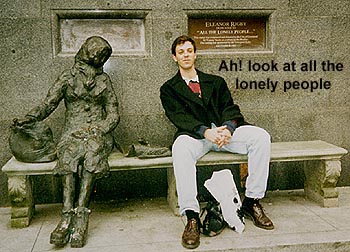
Eleanor Rigby

I know Eleanor Rigby as background music. I’ve never actually paid any attention to the words. But I belong to a singing group that is getting ready to sing a Beatles concert and we are learning some Beatles songs. Kind of.

I have learned that Beatles songs are hard to sing unless you are the Beatles and my guess is that they sang them differently from night to night and they were all “right” because they were, after all, the Beatles. But if you look at the music, you see right away that the notation and the rhythm are just suggestions. In the first line—hum a little “all the lonely people” to yourself and you will know where I am—the “the” comes on the second half of the first beat; the “lone” of “lonely” comes on the second half of the second beat; -ly comes on the second half of the third beat; and the “peo-“ of “people” on the second half of the fourth beat.

Briefly, none of the words starts on the beat. No big deal? Hah! There is only one way to be on the beat but there are a dozen ways to be “off the beat.” And if you are singing as an ensemble, you have to all choose the same amount of “off the beat” all the time. Music notation was not developed for that level of cooperation.

You can be as exact as you like with the notation and the best you can do is sing it “right.” But any audience will tell you that singing if “right” sounds wrong. And it is wrong. The music values will get you all in the same parking lot; they won’t get you in the same slot—particularly if the slot you are all supposed to be in changes from night to night.

That’s why “actually being the Beatles” is the only really good solution. People hear what you are doing and assume it is what you intended to do and that it is therefore “right.” Singing it “right,” which is the best you can do by looking at the sheet music, sounds wrong.

Some years ago I was singing in the tenor section of a choir which was trying to learn to sing a response that had been written by a guy in my section. I was sitting right next to him. I could hear him singing his music and he was singing it wrong. There were three quarter rests in the first line. He gave each of them a different value and he did it the same way every time. In other words, he knew what he was doing.

I was right on the edge of getting snarky with him. I was singing it exactly the way the music said to sing it and he was not. Then, finally, it occurred to me that he was singing it the way he wanted it and it was the notation that was flawed. If there was a sign for pause for “about two thirds of a quarter rest” and another sign for “just a little more than one third a quarter rest” then the music could have been printed the way he was singing it. There is not.

Finally, I gave up and did what the Beatles do. I learned to sing it the way he was singing it. That means sensing how he is about to sing it and then singing it that way at the times when he sang it that way. It wasn’t easy, but is was exciting and singing with the composer was a real kick.

That’s the musical part of the Eleanor Rigby problem. The second part is easier. How on earth did this become a popular song? It’s not about love. It’s not about loss. It’s not about cheating. It’s about pervasive and meaningless failure. Oh boy!

Eleanor Rigby waits at a window in a church where a wedding has been. Not hers, obviously. She is “wearing the face that she keeps in a jar by the door.” It is not her face. She keeps it handy in case she has to wear it. As an image of profound alienation, I don’t see how Lennon and McCartney could have done any better.

Father McKenzie is busy writing the words of a sermon no one will hear. You would have to know a great deal to know that no one will hear the sermon, but Lennon and McCartney need it only as marker of futility and it does that really well. As does the last line, which remarks on the effects of Father McKenzie’s funeral liturgy: “no one was saved.” Saved? Really? Were they supposed to be? Well not really, but if you can hang a priest simultaneously for trying to do some pointless thing and also for failing at it, this is a marvelous line.

Eleanor is buried at the service where Father McKenzie gives the homily that doesn’t save anyone. No one attended the service. Eleanor lived an inconsequential life. The only marker suggested is that she might have left progeny behind and she did not. Her name was buried along with her body.

So these four young men with Liverpudlian accents get up and sing a rhythmically challenging song about a priest and a young woman who are living or have lived inconsequential lives. And the crowd goes wild.

Right.

Posted in Uncategorized | Leave a comment

Celebrating a Return to “the way things used to be”

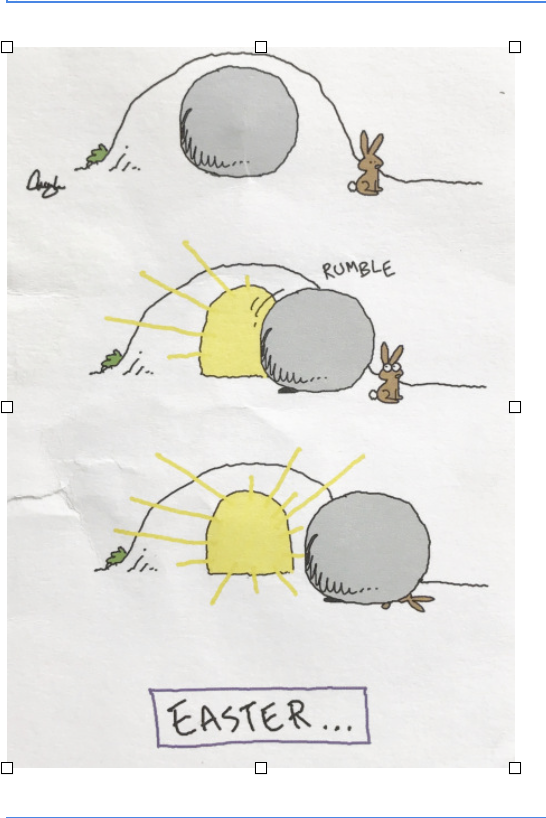
Many years ago, my ingenious niece, Lisa Hess, sent me these two pictures as a way of wishing me Happy Easter. Knowing Lisa, I am sure she had more in mind than just that, but I doubt that she had any idea how deeply I would bond with this card. I don’t keep it with the other cards. In the drawer where I keep it, it is the only card there.

I’ve written about it several times before. I don’t think it gets funnier;

there isn’t much room at the top of the Funny scale for this card. It starts near the top. I think that it might become richer. I’ve spent some of this morning reading earlier posts about this card and I think that this year, I am ready to take another step. The step is this: “This is a very nice Bunny, but to the extent he stands for the Natural Order, he is wrong.”

So here’s the card. The bunny is facing away from the tomb; also away from the rock covering the entrance to the tomb. He notices—too late—that the rock is headed his direction and just after he notices it, the rock crushes him and kills him.

The card gives us, on the front, “Easter…” On the inside, it says “…It’s not about a Bunny.”

OK, that’s fine. It does raise the question, of course, of just what Easter is about. In this card, Jesus, having moved on to another kind of life entirely, heals the inattentive Bunny, and receives his thanks. To the best of my recollection, the Bunny is the only beneficiary of Jesus’ healing powers who directly thanks him for his trouble.

But the next thing the Bunny says—the thing that makes the card so funny—is “Welcome back.” “Back?” We know what the Bunny means. The Bunny would have said the same thing to Lazarus after Jesus had raised him temporarily from death. Welcome back to the world of nature you left.

That raises two questions. The first is whether the Bunny is right. Is Jesus “back?” Twenty centuries of Christian teaching say no. The second is what status the Bunny is assuming. In saying Thanks, he represents only himself. Paul can go on at length about how all of nature is to be healed from the endless decline into corruption, but that’s not what the Bunny has in mind. He has received a favor and he says Thanks.

But in saying “Welcome back,” he takes on a new role. He is the representative of Nature—of the natural order which, as he understands it, Jesus left and now he has returned. The Bunny is the host, welcoming Jesus back to the club.

But has Jesus come “back to the club?” This is not going to be solved by slapping a Bible verse on it, but I think the spatial orientation of John 13 is interesting in this regard. Here’s John 14:2,3 as the New Jerusalem Bible has it.

“In my Father’s house there are many places to live in; otherwise I would have told you. I am going now to prepare a place for you, 3and after I have gone and prepared you a place, I shall return to take you to myself, so that you may be with me where I am.

Notice, “going” and “gone” and “return” and “take” and “where I am.” Think of them as spatial markers. There is not the faintest notion of the “back” in the Bunny’s welcome except “return,” which is, by the nature of the case, brief.


In fact, the re- of resuscitate cannot mean the same as the re- of resurrection. Resuscitation, like Lazarus, would have fully justified the Bunny’s welcome back. But all the texts we are considering think that the re- of resurrection points not to a coming back, but to a going on. There are, here, some easy questions and some hard questions. The hard one—I’m not going any closer to it than the writers of the gospels did—is this: “What is the life like that is on the other side of death.” The easy one, on the other hand, is this: “Did Jesus having been raised from death, return to “life” in the same sense that he left it?”

No. He didn’t No one who writes on the topic thinks that. Skeptics think the whole thing is a hoax. Docetists think that since Jesus only “seemed” to live, that he did not really die. Gnostics think that the real true part of Jesus, the immortal soul, returned to the glory where all souls belong, leaving only the meaningless husk of flesh behind. No one thinks, as the Bunny apparently does, that Jesus has come “back” to the life he recently left.

That’s why it’s easy. And, being that easy, it can also be funny. Thanks, Lisa, for many Easters that have been happier than they would have been without this card.

Posted in Uncategorized | Tagged | Leave a comment

Peter, you Rock!

One day, Jesus looked at his most outspoken disciple and said, “Peter, you rock!”

As an opening line, that makes sense in so many different ways that it doesn’t really make a point at all. It does open up a range of possibilities, however, and that is why it keeps coming back to my mind.

This spring, I am teaching a short course on the apostle, Peter. It’s a secular course, so it isn’t a “Bible study” even though all the information comes from the Bible. It isn’t a “literature study” either, to the extent that the phrase connotes a focus on the structure or the beauty of the language used. It is, rather than those, an exercise in “characterization.”

After many years of paying attention to suffixes, I have gotten sensitive to the -ize suffix. It is a version of the Greek izein, which means to make or do. It calls attention immediately to the fact that something has been done to whatever the root of the word is. Consider, for instance, the difference between “marginal” and “marginalized.” The latter term takes for granted that something—a topic or a person, for instance—had not been marginal and now it is. That is what ‘ize’ means.

What is a character?

A character is a construct. There isn’t one unless it has been “-ized.” There may very well have been a person named Simon to whom Jesus gave the nickname “Rock” but every writer who makes some narrative use of this person has to turn him into a character; and moreover, a character who will have the effect on the narrative that the writer wants that character to have.

It is not true, of course, that the historical person that his wife usually called Simon had no character. What is true is that no gospel writer has been content—nor should he be—to report on just what this character was. The character of Simon Peter, as Mark constructs it is distinctly different from the character of Simon Peter as Matthew constructs it. It is that process the -ize alerts us to. Mark has made Peter into the character his narrative needs and so has Matthew. But, of course, they are constructing different narratives and if “the character of Peter” is to do the work each narrative needs, then his character needs to be adapted to the needs of each narrative.

And, of course, they are.

There are other limitations at play here. Each writer has access to some common information and some different information. Peter is going to be the principal spokesman for the Twelve most of the time and that means that “who he is” will depend to a certain extent on what issues have to be dealt with by the spokesman. Each writer has a perspective of his own about just who Jesus was and what his ministry meant and that will be a part of the shape of the narrative. Finally, each writer has a particular audience in mind and the needs of that audience are taken into account as the narrative is put together.

So it makes no sense at all to ask what Peter was really like. We have at least five accounts. That counts two for Luke, who needs Peter to be one kind of person in the gospel of Luke and another person in the Acts of the Apostles. These characterizations are what we have to work with and they are not at all unanimous. On they other hand, they are not entirely discrepant. They are variations on a theme and we learn more if we pay attention to both the theme and the variations.

Let me offer two brief examples. Matthew and John need very different Simon Peters. If you looked at the narrative apart from the characters, you would say, “Well…somebody will have to have said that” or “Who is this rebuke by Jesus aimed at?” The character who is formulated—not “invented:” but “adapted”—is the answer to the “somebody” problem. It is Peter who is characterized.

In John

The central character among the disciples of Jesus in John’s gospel is called “the disciple Jesus loved” or sometimes, “the beloved disciple.” He is never named, but John needs to be sure that his preeminence is clearly seen, so in scenes where this disciple (BD) [1] and Peter both appear, BD must be clearly superior.

John achieves this by having BD at the foot of the cross as Jesus is dying, while Peter is not. When BD and Peter go to the empty tomb to see what they can learn, John says that Peter looked; he says that BD looked and believed. It is BD who is next to Jesus at the Last Supper, so any question Peter wants to ask Jesus has to be asked to BD who will ask it of Jesus on Peter’s behalf. Peter is, in John’s account, the classic “second disciple.”

In Matthew

But in Matthew, Jesus is a teacher and the ongoing guarantor of the curriculum is Peter, the head of the church. How did Peter get to be the foundation of the church in Matthew’s account? Well, how did there get to be a church in Matthew’s account? Matthew’s Jesus is a teacher and the church is the repository of the teachings. If there is an institution that will be the home of these crucial truths, then an order will need to be maintained and somebody needs to be responsible for that. That is why Peter is who he is in Matthew. That answers why; in the course, we are working on how. What experiences does Matthew give to Peter so that Peter as “head of the church” makes sense to us, the readers?

Well, Jesus called “the Twelve,” but there was an inner core of disciples as well and Peter was one of the inner core. Peter and the other two members of this group saw Jesus raise a little girl from death, which the Twelve did not see; Peter and the other two were there to see Jesus’ transfiguration; Peter and the other two were the closest to Jesus during his prayers in Gethsemane. Peter is the disciple who asks, or who has to field, the questions about how the church will work. Does Jesus pay the Temple tax? Ask Peter. How may times are we called upon to forgive? Peter has to ask. Jesus asks all the disciples a question and Peter is the one who answers it.

If Matthew is to build a character who can become the Rock on which the church is founded, then he has to give Peter the experiences that will cause us, the readers, to say, “Of course it would be Peter.” If we don’t say that then Matthew has not done his job.

I need to know a lot more about the art of characterization than I do now, but the great thing about this study of Peter is, for me, that now I know I need to know more about characterization. So…if you will excuse me, I have work to do.

[1] Being careful not to confuse him with the character BD in Doonesbury.

Posted in Biblical Studies | Leave a comment

Make Northern Idaho College Great Again

When I first began taking political science seriously, it was moving rapidly to the left and demanding a much higher level of empirical support for its propositions. The Old Guard, deplored by my first political science professors, were “conservative” about what the discipline ought to do and were trapped into political ideology.

I remember struggling with one essay which argued against what the author called “intensity.” Since he was one of the bad guys (as the field was being painted for this new guy) I tried to dismiss his argument, but I never got rid of the intensity element. If some people care more intensely than others, it offsets to some extent the difference in numbers. A large listless majority will have its head handed to it on a platter by a small intense strategic minority.

These days, that truth is axiomatic. I’m thinking specifically about North Idaho College in Coeur D’Alene. I was really attracted to a phrase Charles Homans used in his New York Times column on the subject (March 6). The recent struggles at the College were, he said “a volatile experiment in turning grievances into governance.”

Grievances into governance? Why would anyone want to do that?

Governance is supposed to provide the context within which citizens of different persuasions make their arguments. Governance is like the downfield contact rules of a football game or the charging/blocking calls of a basketball game or the size of the strike zone in a baseball game. The players all learn how the game is being called that day and adapt as best they can.

But no one suggests that “scoring” be changed into “yards gained on running plays.” Particularly after the game has already been played. The game continues to be committed to the standard that whoever gets the most points wins. That is why people still trust the game and why they still attend. Since the U. S. has one of the lowest rates of citizen voting of any democratic state in the world, that might be a question worth considering.

Governance is the stable part. It enables conflict about issues. At Northern Idaho College, people have been pulling the fire alarms during the meetings of the board of trustees. Homans says:

Trustees backed by the county Republican Party hold a majority on the board. They have denounced liberal “indoctrination” by the college faculty and vowed to bring the school administration’s “deep state” to heel and “Make N.I.C. Great Again.”


Intensity anyone?


The college has had its debt downgraded by Moody’s. It has received warnings from the regional accreditation agency that could be stripped of its accreditation.


I’d be inclined to assess it the way Kathleen Miller Green, did. She is an assistant professor of child development at NIC and she said, “It’s pretty much a dystopian farce.”


That seems to me a sound, even a witty, assessment, but it isn’t going to help solve the problem. The problem is that the local Republican Party has decided to turn the governance of North Idaho College into a culture war You can tell by the terms used above: “liberal indoctrination” and “the administration’s deep state” and, of course, the “…Great Again” tagline.

There are not likely enough Democrats to make a difference in Coeur d’Alene—If memory serves, Trump won 70% of the vote in Idaho—but there might be some moderate Republicans who are willing to resist the trashing of a local resource. Or even some pragmatists of whatever party label, who would hate to see the college’s well respected technical training programs disappear.


The point here is that someone is going to have to care as much about some practical policy outcome as the current board cares about performing real life caricatures of culture war icons.
It’s the “intensity problem” again. I think those old conservative political scientists were onto something.

Posted in Uncategorized | Tagged | Leave a comment

Foster, by Claire Keegan

We are not cheap moviegoers, really. It is just that we do stay and watch until the last credit has appeared on the screen. That is how Bette and I found out that the movie we had just seen, The Quiet Girl, was made from a book called Foster, by Claire Keegan. We stopped on the way home and got it out of the library.

I have enjoyed reading it several times now. The language is unusual. It is told from the viewpoint of a young girl; younger, I think, in the book than in the film.

The first line that really caught my attention was spoken by the husband of the family who agreed to keep the girl for the summer. his name is John Kinsella. Here’s the line; then I’ll give a little context.

“Many’s the man lost much just because he missed a perfect opportunity to say nothing.”

John Kinsella’s wife, Edna, agreed to let a very nosy neighbor take the girl home early from a wake. The neighbor abused Edna’s trust by asking the girl a flock of inappropriate questions. That is what John Kinsella is referring to.

Strange things happen,’ he says. ‘A strange thing happened to you tonight, but Edna meant no harm. It’s too good, she is. She wants to find the good in others, and sometimes her way of finding that is to trust them, hoping she’ll not be disappointed, but she sometimes is.’

He laughs then, a queer, sad laugh. I don’t know what to say. ‘You don’t ever have to say anything,’ he says. ‘Always remember that as a thing you need never do. Many’s the man lost much just because he missed a perfect opportunity to say nothing.’

“Always remember that as a thing you never need do,” he says. That is the lesson that belongs with the proverb which begins, :Many’s the man…”

The summer ends—a truly wonderful summer for the Kinsellas and for the girl—and it is time for her to be taken home. Her mother is immediately suspicious.

‘What happened at all?’ Ma says, now that the car is gone.

‘Nothing,’ I say
.
‘Tell me.’

‘Nothing happened.’ This is my mother I am speaking to but I have learned enough, grown enough, to know that what happened is not something I need ever mention. It is my perfect opportunity to say nothing.

Look at the sequence of the girl’s reflections. “Learned enough to know, grown enough to know…” And then her conclusion. This is it; this is the time. “It is my perfect opportunity to say nothing.

The girl grew up in a lot of other ways, too, but this is the first one that caught my eye and the one I still like best. The perfect opportunity to say nothing.

Posted in Uncategorized | Leave a comment

Far enough away to enjoy it

I want to share with you today my favorite line from “The New Ashmolean Marching Society and Students’ Conservatory Band.” Yesterday, the Plaza Singers–a choral group at the Senior Center where I live– sang it and some other songs from failed Broadway plays.

To really appreciate the line, you have to grasp the perspective of the narrator. When he knows the band is coming he admits “the bright gleam of pride is in my eye.” Further, “the old college spirit is upon me and I shout every time at the top of my voice.” And “to me,” he summarizes, the finest in the land is the New Ashmolean Marching Society and Students’ Conservatory Band.”

He mentions some problems. There is, he admits, “a suggestion in the oboe of the sound of a hound beneath the moon; the “trombone’s a little independent” and so on.

So we know where the narrator is coming from. Even so, he is forced to admit that there are some who feel otherwise. It is the character of their critique that caught my attention. Here it is.

If you’re analytical, sensitive, or critical, you’ll like it more the farther back you stand

Note the three traits that he admits might make the experience problematic. Being “analytical” will not help, although he did make that invidious remark about the oboe. Being “sensitive” might also be a difficulty. It is a dysphonic marching band after all. And finally, being “critical” might predispose you toward offhand remarks.

There is something you can do, however, and this is what I like best about this line. You can keep your distance. In fact, if you have any of these three disabling difficulties, the farther away you stand the better.

But what do you get for taking these precautions? You will like it more than you would if you did not take the precautions. In the language of this payoff, two words stand out. They are “like” and “more.” As agile as the other language is, it cannot accommodate “like.” For people who tend to be ASC (analytical/sensitive/critical) there is no question of liking it. Possibly there is a question of surviving it.

But not only might you like it if you take the proper precautions, there is the chance that you will like it more. The more space you allow to buffer yourself from the experience, the more you will like it.

It is that final turn—not “like” so much as “more” that makes the whole lyric so sweet.

Posted in Uncategorized | Tagged , | Leave a comment

Packaging Ourselves

I liked Michelle Goldberg’s column in the February 24 New York Times. I liked it for some good reasons and some not so good. Among the not so good is that she said she had been working on the topic of “the politics of depression” for awhile, but “since I lost faith in my initial interpretation …I never ended up writing about it.

”It was an experience I have had so often that I was just barely able to keep myself from writing her to say, “Really? You too?” That is a really bad reason for liking her column.

Fortunately, there is a better reason That better reason is this paragraph:

Social media didn’t just cut into offline socializing. It precipitated a revolution in consciousness, in which people are constantly packaging themselves for public consumption and seeing their popularity and the popularity of others quantified. It’s not shocking that this new mode of existence would be particularly fraught for those in a stage of life where both fashioning the self and finding a place to belong are paramount.

Let’s start with “precipitated.” That saves her from having to say that social media caused “a revolution in consciousness.” She can say that it was the final element of some toxic cocktail. She could have said, herself, what the other elements of the cocktail were or she could have let anyone else do it. She has identified the straw that broke the camel’s back and it is that straw she wants to talk about. It is social media.

Social media precipitated “a revolution in consciousness.” There is a way of being before this revolution and a different way afterward. She doesn’t say what it was like before, but the “after” account is pretty vivid. People are “constantly packaging themselves for public consumption…” I would have said that that is the normal condition of society. We all do the things we need to do to belong. And after that, we all do the things we need to do to stand out. We are fully aware of neither process, discovering only later what we did and being forced to speculate about why we might have done it.

But the next part of Goldberg’s account is riveting: “…seeing their popularity and the popularity of others quantified.” Two aspects of that seem potentially disastrous to me. The first is the quantification. Nearly all the information that comes with normal social assessment is lost in a single quantified assessment and all the parts of it you might want to argue about are lost behind the blank fact of a number. Not only is it beyond argument as a number; it also seems truer.

What is not captured in this metric? Oh…not much. Only your own intention and your own assessment of the quality of your work. Hardly anything at all compared to the quantified and casual assessments of others.

What could be more central to the self than an answer to the question, “What am I trying to do?” What I am trying to do is more likely to be linked to my fundamental identity than any other single measure I know. The sense of self-efficacy as it is called in some fields or of “agency” as it is called in other fields begins with an answer to that question.

And that is true, I maintain, despite that fact that we are not always doing what we thought we were doing. The readiness of standard categories for intention and action means that we are quite likely to use one of the standard labels—Oh, I’m just making sure he is held accountable—rather than giving a more thoughtful and accurate account. Coming up with an acceptable account of why you are doing something is no mean feat in itself. To skip over that part and to consult, instead, a quantified measure of whether others approve of what you are doing, seems like giving away the store.

And not only that, if you know what you are trying to do, you know both whether you are succeeding and whether you are giving your best efforts to the project. Assuming that you would choose to make some changes if your efforts are failing, it would be nice to know whether they are failing. If you pay careful attention to what you are trying to do, you have a good chance of knowing that.

The world of quantified assessment that Michelle Goldberg talks about seems horrific by contrast. It is a world in which not only you but everyone else in that world is assessed on things that have nothing to do with their intentions. They have to do only with the reactions of others to the way you “package yourself for public consumption.”

The reaction that many young people have to this situation is one Goldberg describes as characterized by loneliness, depression, and alienation. And why would it not be? The people who buy this kind of world or find themselves swept up in it, have lost the crucial connection between what they intend and who they are,

Whether there is a way out of this or not depends on how deep a hold social media have on how many people. There are lots of other things to worry about. The aggregate category some are calling “deaths of depression” continues to rise, for example. Maybe the social media bubble is going to burst and we will look back on it as an oddity, as if we had been visited by a powerful and quirky relative and were glad to see them leave.

Or maybe it is fundamental to who we have become. I hope not.

Posted in Uncategorized | 1 Comment

The ashes of Ash Wednesday

This Wednesday, a lot of Christians are going to have a mixture of ash and olive oil applied to their foreheads. I am not. There are two reasons, one of which isn’t really very respectable. It is that it seems to “high church” for me. The churches that had access to me when I was young were markedly low church. I didn’t like that either, but when very high church things show up, I head back home in my mind.

The Ash Wednesday service at my church this year is going to be held at noon. That means that some people of our congregation are going to go about the rest of their day with a cross of ash on their foreheads. Why?

The second reason is really a better one. I teach a bunch of Bible study classes. It is what I am known for in the settings where I live most of my life. At the CCRC where Bette and I live, I regularly have the experience of seeing a new acquaintance learn that I teach Bible studies and then seeing them shrink back as if I have somehow become dangerous. If that’s how they react to learning how I spend my free time, how do you think they will respond when I show up with a dirty smudge on my forehead?

The principal resource I bring to the Bible studies is that I am not weird. Not, at least, in any ways that can be traced back to my religious life. In all the settings where I teach about the Bible, there are people who have been damaged by earlier teachers or—even more often, earlier preachers—and who welcome a chance to work it out.

I offer a framework of thought that is pretty robust. It isn’t going to bounce around or get distorted by anyone who says it’s ridiculous and self-contradictory. It is just going to stay there and the conversation we want to have will take place safely within it.

Often a starting point is that the Bible is ridiculous because it is self-contradictory and therefore unreliable. The issue there—the thing really worth talking about—is whether “the Bible” is a single thing, so that differences in the accounts it offers are “contradictory,” rather than just “different.”

Here are two examples. There are two Creation stories in Genesis. The first one—commonly attributed by scholars to the Priestly school of editors (referred to as P)—begins at Genesis 1:1 and goes to Genesis 2:4. The second one—thought to be the work of a Yahwist school of editors (and therefore designated “J”) begins at Genesis 2:5 and goes to the end of the second account.

When you give up “the Bible,” you give up the contradictions and then you get to ask what the P version of the Creation story is like contrasted with the J version. The “contradiction” vanishes. There are two accounts. It would be possible to press on to the question of which of them is true, but that is not ordinarily the concern of the people I talk to. Their common external response is, “Really? Why does P insist on this when it is of no interest to J at all?” Their internal response is likely something like, “Now that I have found a safe place to ask questions I have always been condemned for asking, I find that I am really curious.”

Ask yourself whether any part of that transaction would be improved by my wearing a cross of ash to class the next Thursday.

Another example is a course I have offered in several settings about how Matthew’s account of the life and ministry of Jesus differs from Mark’s. I’ll tell you why I think that has been so well received, then let’s go on and look at how it works. When attention is drawn to the differences between the two accounts, the conversation is not about what Jesus really said or did or what he was like. It is about why Matthew made the changes he made in Mark’s text, leaving some things out, adding other things, and rephrasing a good deal of the rest. That’s not all that horrible.

The material is taken over whole from W. D. Davies and Dale Allison’s study of Matthew. They list a series of occasions where Matthew makes changes and make observations about what those changes have in common. Matthew wants to use a much more reverential approach to his account of Jesus than Mark does, so every time Mark sounds caustic or critical, Matthew makes changes. Armed with Davies and Allison’s scholarship, all we have to do in class is look at the two particular texts and note the difference. Then we look at the next two and note the difference. Then we compare just how those differences are alike.

All those discussions arebiblical; they are all scholarly. They are all unthreatening to people who have been raised in the “contradictions in the Bible” culture and so they are a ground where real engagement with those texts can happen.

For me to help those things happen, I need to be knowledgeable. That means that I read Davies and Allison before they did. I need to be stable. I can easily do that. I don’t even have a dog in this fight. And I need to be willing to let them start from where the grievance is and work on it at whatever rate they like best—and to stop whenever they need to.

No one in any of those studies wonders whether I, myself, am a Christian. I am as candid about my own faith as I am about my commitment to secular study of the texts we work on together. I am reasonably sure that after a while, no one in any of the classes thinks I have designs—friendly or not—on their immortal souls.

Jesus does. Or so his followers maintain in the texts we have. One of the best-known of these texts pictures Jesus as standing at the door of someone’s house and knocking. The resident needs to decide what to do, at that point, and none of the answers is really easy. Listen to the knocking for a long time? Go to the door and say, “Go away.” Go to the door and invite him in? Then what?

So Jesus may be knocking on doors as I teach my classes. I wouldn’t know. But I am not. I need to keep on making that clear to people whose trust has been repeatedly abused. And wearing an ash cross on my forehead would not help. It would, in fact, be an imposition.

Posted in Uncategorized | Leave a comment