A Third Birth Narrative to Begin the New Blogging Year

I started blogging so I would have somebody to talk to. When I began—May 30, 2010—I was married to a wife I liked to talk to; I was teaching at PSU and had access to quite a few students to talk at (and even a few to talk to); I was part of a long-running book group, a very promising coffee group, and I taught adult ed classes at church. You wouldn’t think there would be a difficulty of any sort.

But what I really wanted was some place to say things like these. Did you see that? There they go again! You’d think they would have noticed by now that that doesn’t work. Did you ever notice the “cowed,” the verb and “coward” the noun, are not related to each other etymologically?

The book group only allows me three such “observations” a meeting and we meet only monthly. My wife had her own observations to take care of. The kinds of observations I am talking about will always be diversions from what we are doing in class at PSU—the occasional course in political psychology excepted.

So a blog seemed like a good idea. It was light-hearted and quippy at the beginning, like the sample observations above. But then national politics began to go dark and I didn’t feel so quippy so I didn’t write so often. I did notice, however, that when I encouraged myself to make in the blog the snarky little comments that ran through my mind, I kept on wanting to make them.

So let’s see how it goes.

Several years in, I decided to start the blogging year at the beginning of December. I always write a few essays about whichever account of the birth of Jesus is “the right one” for that year, so starting in December is more a convenience than anything else.

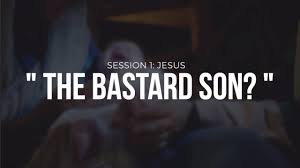
This year, for instance, I have begun to be intrigued by the observation that although Matthew and Luke have the only birth narratives worthy of the name, Mark and John have clear allegations of illegitimate birth, which I would have to say is a birth narrative of some kind. And if that is true, it opens the way for some observations that seem obvious to me now, but that I have always passed by before.

Here are two versions of Matthew 1:24-25. First the King James, which is the version I grew up on.

“24Then Joseph being raised from sleep did as the angel of the Lord had bidden him, and took unto him his wife: 25And knew her not till she had brought forth her firstborn son: and he called his name JESUS.”


Then the NIV


24When Joseph woke up, he did what the angel of the Lord had commanded him and took Mary home as his wife. 25But he did not consummate their marriage until she gave birth to a son. And he gave him the name Jesus.”

In the light of the snarky allegations in Mark and John, my attention falls on the first part of v. 25. Why did Matthew feel that he needed to add “but he did not consummate their marriage”—“he knew her not,” in the KJV—to the text? He already had God’s assurance, received in a dream in 1:20b “because she has conceived what is in her by the Holy Spirit” With that much assurance, Matthew changes his mind about divorcing Mary. It was a life-changing dream. So why does Matthew put a little reminder of Mary’s virginity back in v. 25, just five verses later?

There may be a good literary or apologetic reason for that, but my interest this morning is that with the charge of bastardy fresh in my mind (from Mark and John’s accounts) it strikes me as too much. It seems urgent. It seems, “Oh by the way, did I tell you that Mary was still a virgin when she conceived?” By my current reading, it is TMI.

It can be argued, of course that it is or that it isn’t, but I feel richer for seeing the passage that way and asking the question. At the moment, it seems overwhelmingly likely that Matthew is, by this addition to the text, (that’s a guess) responding to allegations he has heard made. But I also know that “overwhelmingly likely” is, at least in part, a function of being excited that I just now saw the discrepancy for the first time. I know that the excitement makes it seem truer right now.

The “third birth narrative”

So what traces are there of this “third birth narrative in Mark and John? I’ve referred to it, but I have not yet presented the texts.

In Mark 6, Jesus goes to Nazareth and begins teaching in the synagogue. His teaching is astounding to his neighbors. They know him; they know his family. Where did all this religious “wisdom” come from? It is as if Jesus were putting on airs, when they know for a fact that he is a local boy.

And in the process of mulling over that discrepancy, they ask a really telling question. Is this not Mary’s son? Not, notice, “Joseph’s son.” Joel Marcus observes in his commentary on Mark’s gospel, “In Jewish sources the father’s name is normally used to identify the son even when the father is dead.”

Why then does Mark choose to identify Jesus by a matronymic rather than a patronymic? Joel Marcus, in his commentary, answers this question this way: ‘it is likely that the use of Jesus’ mother’s name is a slur against his legitimacy… This aspersion would correspond to the tendency in later Jewish traditions to portray Jesus as a bastard…” [2]

Marcus says that: “…Mark 6:3 comes closer to being a genealogical formula than the parallels cited because of the extensive list of other male family members. McArthur’s theory, moreover, does not explain the apparent embarrassment of Matthew and Luke at Mark’s term or reckon with the hostile context of our passage and the evidence for a trajectory of Jewish aspersions against Jesus’ birth.

Both Matthew and Luke revert to the usual pattern in their accounts of this event. Luke 4:22 reads “the son of Joseph” (cf. John 6:42) and Matt 13:55 “the son of the carpenter.”

The example in John is better in some ways and worse in some ways. It is better in that the charge of illegitimacy is clearer. In 8:41, Jesus says to his antagonists “You are doing your father’s work.” What he means by that is a little complicated, but it is the response I am interested in here. They respond, “WE (unlike you) were not born illegitimate. The only father WE have is God.”

The only thing I added to that exchange is the parenthetical part and, in fact the use of what I call “exclusionary phrasing” is common in John. He says things like “only the Son,” meaning not Moses; and “earthly,” meaning not heavenly. It is that style of John’s that makes me confident that the WE, above, is intended to mean “unlike you.”

That clear use is how it is better. It is worse, of course, because this clip is taken from the middle of a heated argument and there is no way to know whether cooler heads prevailed in the morning. And if you are inclined to pass this exchange off as the Pharisees being snarky, let me remind you that this particular exchange is between Jesus and fellow Jews who believed in him (John 8:31).

So I may use these two passages as “the third birth narrative”—Jesus was a bastard—or not. Let’s see how the year goes.

[1] According to Marcus: “This aspersion would correspond to the tendency in later Jewish traditions to portray Jesus as a bastard, a pattern that may already be reflected in John 8:41.”
[2] There is additional fun to be had in that the English word bastard probably derives from the French
fils de bast (packsaddle child) and therefore does actually mean “born in a barn.” And that is true is Luke’s account, but not in Matthew’s.

Posted in Uncategorized | Leave a comment

Two Christmas Movies

The Christmas Visitor

In the letters of 1st, 2nd, and 3rd John, the author is really upset about some notion about the earthly ministry of Jesus. It is not easy to say just what it is, but someone seems to be open to the idea that Jesus “seemed to” have come to earth and taken on flesh and lived the same kind of life we did. He didn’t, actually, but he seemed to.

The Hallmark video, A Christmas Visitor, which I have enjoyed watching many times, presses right on the nerve that separates the gospel of John from the teaching the Johannine letters are trying to quash. I suspect it could be called docetism. We get this from the Greek dokein, “to seem,” so it could be called “seeming-ism.” What gets the writer of the Johannine letters so upset is that someone seems to be teaching that Jesus did not actually take on flesh and did not actually become a human being, but only seemed to.

In A Christmas Visitor, the Boyajian family lost a son in Iraq. It was a terrible loss for the family. The father carried on as TV fathers tend to do. “I gave them my son,” he says. “They gave me this medal.” The mother acts out her grief in some ways she recognizes (and justifies) and in many other ways as well. The daughter feels herself confined to a perpetual second place, never really as important as her martyred brother, and having very slim personal reserves.

The father, George Boyajian, decided, finally, that enough is enough and he is going to start over by celebrating Christmas again. The film loses track of this early moment until the very end of the film when the spirit of his son John, embodied in a “person” named Matthew is asked, “Why did you come back to us?” The person who is, but who does not seem to be, John, answers, “Because you were right. It was time.” [This is John in the body of Matthew.]

“You were right” points to what would be the most remarkable part of the movie if it were a part of the movie, which it is not. Somewhere, “John” is monitoring how his family is doing and when his father says it is time, “John” returns in the body of Matthew and does a lot of wonderful things to turn the family around. “John” was listening. Where, without “Matthew,” was he?

In the meantime, in the body of the plot, “Matthew,” heals the daughter, Jean, of her cancer, restores a long broken Christmas star to full functioning, and remembers things about John that he could not possibly know. How does he do all that? Because he is not Matthew; he only seems to be Matthew. He is actually John, visiting his earthly family in the body of Matthew. Matthew seems to be John, but he is not. The film maker puts the last nail in that board by having Matthew, as he is leaving, morph briefly into John, then back into Matthew, while the father holds his salute.

Miracle on 34th Street (1994)

On the other hand, the Santa Claus of Miracle on 34th Street really is Santa Claus. There are two phases in the identity positioning in this movie. We see a fat man with a white beard approached by a desperate employee of Coles Department Store, who asks him to fill in at the last minute as the Santa Claus in their parade. He is a very good “Santa Claus” and the department store hires him to be their official Santa.

The second phase is that at the hearing, it is the job of the judge to rule whether a man who believes himself to be Santa Claus can be ruled sane. His lawyer doesn’t argue that his client is sane; he argues that he is not dangerous. That doesn’t work.

Finally, the judge hits on an analogy that works for him. On a dollar bill a little girl gave him, he notices that it says “In God We Trust.” The judge argues that if the U. S. government can declare its belief in God without demanding any evidence, then he, the judge, can declare that the man before him actually is Santa Claus without demanding any evidence.

Between these two times—the parade at the beginning and the hearing at the end—viewers are treated to Santa Claus playing the part of “Santa Claus.”He speaks a lot of languages, which ought to seem odd. He knows sign language. He has his own “Santa suit” with real gold buttons and gold thread. By claiming that he is who he says he is, he brings the woman who hired him into existential crisis, and raises the desperate hopes of her daughter that she will finally get a home in the country and a baby brother.

At the hearing, there is casual banter about “department store Santas,” of which Kris Kringle, the main character, is one. The daughter of the Cole’s employee who hired Kris is very worldly wise. “I know how this works,” she confides to him. “You work for Coles.” Kris pauses momentarily and says, “That…is true.”

He pauses because he knows that the true answer he gives will be taken to mean things he does not mean and that are not true. The little girl will understand the answer to mean “I am an employee of Coles and therefore am not the real Santa.” What Kris really means and what all the viewers are in a position to appreciate is that he works for Coles AND he is the real Santa. He’s just filling in until he has to take off on Christmas eve

These two stories, both of which I enjoy watching every Christmas, are the formal opposite of each other and it doesn’t bother me a bit.

Posted in Uncategorized | Leave a comment

Comfort Zone follies

The last several hundred times I have heard references to a Comfort Zone—except, of course, from the heating and air conditioning people—they have pointed to the virtues of being outside it. Unfortunately, when you have been around and paying attention as long as I have, you hear the same pitches over and over and they get irritating.

I remember the era of “the gray flannel suit” with real clarity. I remember how everyone was urged in the direction of “nonconformity” as if that were a good thing of itself. I remembered those little sermons for quite a ways into the 1960s until it wasn’t fun any more. So these blanket prescriptions are not a new thing for me.

I am used to hearing them at church. I got used to hearing it in the announcements, which are at least partly ad-libbed. Then I heard it several times in the sermons, which are ordinarily read. To me, that means that someone has written it and then, having read it at a later time, has said, “Yes, that is what I want to say.” This last week, I heard it in a liturgical formulation and I said, “Surely not!” So today, I am reflecting.

Some time on the same day I heard this, I heard some NFL announcers assuring each other that a quarterback had just not found a way to get comfortable with the offense in the first half. They didn’t quite say that he had found his “comfort zone” in the second half, when he played very well, but they came close. They said he had “found his rhythm.”

I think I might be like that quarterback. When I can find comfort in a role or a setting, I do my best work. When I can’t, I pay more attention to the setting than I should or more attention to what I am doing than I should, and my performance suffers. That is my experience with my “comfort zone.” [Of more than a hundred images I looked at for “comfort zone,” this is the only one that showed any promise. What advice would I get from these people if I were already in the good green zone? Would they urge me toward the chaos ring because I was showing signs of comfort?]

It is not difficult to lob the “out of your comfort zone” idea at someone else, of course. Anyone who is not taking the risks you think they should take would be vulnerable to such a charge. Or anyone who is more conservative about risks than you are; or someone who values the associated rewards less than you do. I know people who are even more risk averse than I am and I would have no trouble at all in saying to that person, “Why don’t you give it a try? It looks to me as if you would do very well and if not, there are several alternative approaches to try.”

None of that approaches putting a generalized dismissal of comfort zones into the church’s liturgy as if God had something against comfort zones.

I think the complaint against comfort zones has become a linguistic habit, just as the complaint against “conformity” was in the 50s. It isn’t a thoughtful thing to say. It’s just a bromide. Why we should be attributing bromides to God I am not quite sure. [1]

The real loss in the linguistic habit—apart from the dull thoughtlessness of it—is that is doesn’t ask what a comfort zone is for. It doesn’t ask what other questions—not just comfort or no comfort—ought to be asked that are being shouldered aside. It doesn’t ask what benefits we can expect from someone who is operating in the comfort zone. I can see complaining about lack of productivity, of course, but what is the relationship between productivity and comfort?

And even if God is not offended at having “comfort zone” attached to the divinity, maybe it would be offensive enough if God did not want to be represented as a klutz. Well…a Klutz, I guess, being God.

[1] That might not be the use God had in mind when He created bromine. I guess we’ll never know.

Posted in Uncategorized | Leave a comment

“Good People” with “Legal Challenges”

I’ve been listening to more sports radio recently, so I have been hearing more ads imploring people who are being charged with drunk driving [1] to enlist the help of a law firm that specializes in helping people in their situations. I have no general objection to advertisers formulating their pitch in a way that does not insult and repel the people whose money they are trying to attract. What would be the point? An ad is a tool.

On the other hand, the pitch I hear most is addressed to “good people who are facing DUII charges.” [2] I have to focus my mind to remember that there is a story behind “facing…charges.”

First, the people who are being addressed are “good people.” When I focus, I remember that the law firm would also, in a pinch, take the money of bad people. Or even of intermediate people who are neither notably good or bad. So “good people” isn’t a screen that would separate out all the “not good” people who might need legal representation. It serves, rather, as a signal that there will be no moralizing about whatever the potential client is alleged to have done. Or, as the devil in the film Needful Things, puts it when a man tearfully confesses to him that he has just murdered his wife, “Hey…these things happen.”

Second, there is no consideration of what the potential client has done. He has not, in the language chosen by the ad, endangered the lives of other drivers, of any passengers he may have had, or made his family, if any, insolvent. The situation the client faces is a legal one. A charge has been brought against him. [3] He needs help in avoiding or minimizing the likelihood that he will be convicted for the purported offense; or, if convicted, in minimizing the punishment he will face.

Something has happened. That is why there is an ad. It is not the violation of public safety or the endangerment of people’s lives. What has happened is that this good person is facing a DUII change, the merit of which is entirely unconsidered.

Again, I am not protesting the ad. This is a legal firm seeking clients in the most effective way they have found. It does feel odd to me when I hear it that what the person has done is being passed over and his character is being praised in advance.

Surely that is worth something.

[1] The British crime shows we watch refer to it as “drink driving.”
[2] DUII has been a meaningful abbreviation for so long that I couldn’t remember what the acronym stood for. Driving Under the Influence of Intoxicants.
[3] I say “him” with a clear conscience. I had to scroll through 80—100 pictures under [drunk driver, images] to find a picture of a woman as a perpetrator rather than as a victim.

Posted in Uncategorized | Leave a comment

“Do You Like Your Life?”

I am a part of several studies that look at the life of declining older people, [1] and one that tracks changes in the life of an older couple. As a part of those studies, I answer a lot of questions that make perfect sense as part of the study, but that are completely preposterous on their own. The question that serves as the title of this reflection in one of those.

Here’s what I know about my sentiments toward the life I am living. On good days, I love it. This is one of those days. On bad days, I endure it. On intermediate days, I invest in the moments that invite investment and limit the damage, as I am able, of that comes from the others.

Those ways are “how I like my life.” What shall I say in answer to the question on the survey?

As you might imagine, not much management is required for the good moments (similarly, the good days), but in bad moments (or on bad days) there is a discrepancy between what I need to do and what I feel like doing, and I need to choose between what makes sense and what I know will help.

Without that discrepancy, I do what makes sense to me and everything works. With the discrepancy, I need to choose against what makes sense, and choose to do, instead, things that will help. Since I have done this for a long time—much more in recent years—I know what kinds of things will help.

That is important because my way of determining what “helps” is one of the parts of the machine that is broken—well…not functioning at the moment. That means that I cannot do something and see if it helps. I need, instead, to rely on my recollection of “what usually works” and just do that. And then keep doing it and keep resisting the desire to see if it is working.

So I do that. I do the things that have proved helpful in the past and I keep doing them despite the lack of feedback that they are working.

On good days, I use the machine (my life when everything is working) to address my life; to do the things that I think are worthwhile. I choose as many activities as I can that are also pleasurable because I think it is better for them to be both useful and pleasurable than to have to choose. [2] On bad days, I don’t use the machine; it tinker with it. It isn’t in working order, so I do the things that will keep me functioning until it returns to working order. Ordinarily, it does not return to working order as a result of the tinkering. At least I don’t think it does. I think it reboots itself and returns when that process is done.

There is one small problem. It is that I am embedded in a social network and the network works because of the expressed and fulfilled expectations of the members. The expectations—I am going to call them “demands” from here on, not meaning anything aggressive by that term—keep on coming. They do not distinguish between my good periods and my bad ones.

For example, I teach several courses that study what I am going to call, for the purposes of this essay, the narrative logic used by authors of ancient near eastern texts. The essays that will form the basis of these discussions go out of Mondays. The meetings themselves are on Thursdays. For a schedule like that, what does it really mean that I have good days, when I live my life expansively and bad days when I tinker with the machine?

Since the work to be done is constant, it means that sometimes I prepare the materials in Bad Day Mode and sometimes in Good Day Mode, but I always prepare them and distribute them. When, as often happens, I prepare the essays and teach the classes in Good Day Mode, they are spectacularly good. But, as you can see, if you look a couple of sentences ahead, sometimes I prepare in Bad Day Mode (BDM) and teach in Good Day Mode (GDM). At other times, I prepare in GDM and teach in BDM. Both those are…um…suboptimal. But I do them because they are what I have to offer and I do believe seriously in the value of the commitments.

I can, after all, commit to giving them what I have to give. [3] Some days it is spectacularly good. I have had good training and on those days I have a good mind and I have been a teacher all my life. On other days, I rely on the training and the history, but not on the mind, which is somewhere in the rebooting process and is “currently unavailable.”

I would really prefer it if I could do something about how I am in BDM. When I have a headache, I take a couple of aspirin and the headache goes away. That’s how I would like it to be. In the situation I have described, I can take the aspirin, metaphorically speaking, but I can’t know whether it did any good. That’s one of the parts of the machine that isn’t working anymore.

Oh well.

[1] Because I can rattle off the major forms of the Latin noun agricola, I am, as a matter of fact, a declining adult. You have doubts? Agricola, agricolae, agricolae, agricolam, agricola. And in the plural agriolae, agricolarum, agricolis, agriolas, agricolis. Those are the forms appropriate to the nominative, genitive, accusative, dative, and ablative cases in both singular and plural numbers.
[2] I am not one of those people who thinks that if it is pleasurable, it is somehow morally suspect.
[3] I suspect that they have BDM and GDM ways of being in those classes and have found ways to cope. Besides, nearly all the people in those classes are old people, like me, and likely have good days and bad days themselves.

Posted in Uncategorized | 1 Comment

Making Moral Distinctions


In an editorial the new House Speaker Mike Johnson wrote in the Shreveport times in 2005, he concluded with this line: “We must always remember,” Johnson concluded, “that it is not bigotry to make moral distinctions.”


That is the line I would like to think about today. First, it is hard not to admire the rhetorical advantages of a line like that. “Bigotry” is bad and “moral distinctions” are good. And if they aren’t good, they are at least inevitable. Try to imagine objecting to “moral distinctions.” The set of examples you would get to test your objection would certainly include traitors, rapists, and murderers and you would be invited to “make no moral distinctions” about the people in those categories.


Johnson, having established that “making moral distinctions” is good is then free to make whatever distinctions seem good to him. There is no end to the cultural issues the Republican party is pursuing that can pass a “distinctions.” Anything on gender identity will work. A lot of things on race and ethnicity will work. The “right kind of family” will work. Abortion as murder, obviously.


All these pass as moral distinctions. But what Johnson really has his eye on is the charge by Democrats—and by majorities of Americans—that these positions are bigotry. The power of his distinction, then, is that it reassures Republicans that it is not bigotry. Notice that it doesn’t support any particular moral distinction. It doesn’t even say that making moral distinctions is a good idea. It only says that it isn’t bigotry.


It actually says so little, but I suspect we will be hearing it as a Republican shield for quite a while now. Provided that it works.

It is really no different than Barry Goldwater’s famous line: “Extremism in the defense of liberty is no vice. And moderation in the pursuit of justice is no virtue. Moderation in the protection of liberty is no virtue; extremism in the defense of freedom is no vice.”

Posted in Uncategorized | 1 Comment

Under a Spell No One Has Cast

C. S. Lewis poses a nasty dilemma for the Narnian children in his book, The Silver Chair. Jill Pole (a newcomer to Narnia) and Eustace Scrubb (from The Voyage of the Dawn Treader) come across the prince just before the hour when, every day, he is released from his enchantment. During that hour of freedom, he is able to tell the truth.

In the fictional setting Lewis has provided, we can say that Rilian is his true self (I*)during this brief time. He tells the children that he is under an enchantment and that all the things he has told them before are false. Furthermore, all the things he will tell them when this hour has passed are also false. Only during this time can he be believed.

Keeping the dilemma in mind and changing settings, let’s look at a person’s right to specify what medical procedures will and will not be performed on him as he nears death. The Prince Rilian scenario has three time periods. He has before (when he is enchanted) during (when he is free to tell the truth) and after (when he is, again enchanted.) The patient I have in mind is suffering a progressive dementia. The more severe depths of the dementia are his “enchantment.” But there is a time, before the enchantment, when he is free to assess his preferences and to say clearly what he wants.

The reduction of the three periods Prince Rilian has to the two of the demented patient makes all kinds of trouble for us. For the impaired patient, there is only NOW and LATER. Now, I know who I am and what I* want. Then, I will still want something, but it will not be connected to who I* am right now; to the continuing self who has lived a life and has reflected on it.

OK, I cheated a little bit. I invented the I* (with the asterisk) to mean the continuing person, the essential person. In dementia, that is what goes away or, more exactly, I* don’t have unimpaired access to that person’s mind. Functionally, I* is Prince Rilian during the hour he is freed from the spell and is free to be himself. And “I” (without the asterisk) is Prince Rilian under the spell. In the example, it is the person who is under the “spell” of dementia.

I have heard of a court ruling—I haven’t bothered to find out if it actually occurred—in which the court accepted the decision of a patient at an earlier time to be binding on the patient at a later time. The decision and intention of the I* patient is accepted over the later statements of the person who no longer has regular access to the I* person. This later, impaired, person has “intentions,” but they are momentary and they have no relationship to all the other things that make up his life.

I like that distinction. It is, of course, clearer in the case of Prince Rilian. Once we accept the premise—he is under an enchantment except for this one hour—we know to accept the words of Rilian during this hour and to resist what “Prince Rilian” says during the other times. It is clear because there is a will behind the enchantment and it is an evil will. We know that when “Prince Rilian” speaks when he is under the enchantment he is expressing the views of the evil witch who cast the spell.

The patient is “under the spell” of distorted brain function. We know that the patient does not have access to the I* as he once did. We reject the idea that the spell he is under has been “cast” by anyone, but that does not mean it is not there and functioning. It means only that it has not been “cast.”

This brings us to the cusp of a dilemma and that is where I want to leave us for today. Dementia offers us a kind of Prince Rilian situation in which I am Prince Rilian and I want to be believed sometimes and not other times. I need to say ahead of time when the “accepted times”—I am right on the edge of calling them “canonical times”—will be. Then I need to empower others to refuse to accept what I say (the I without the asterisk) at other times, no matter what it is.

Do I really want that? Yes, I think I do.

Posted in Uncategorized | 1 Comment

Balanced on the Edge of the Blade

I’m teaching a Bible study this “term” [1] that I have called “Doing It Wrong.” I knew, in the most general terms, what I had in mind. If you survey the biblical material for the different kinds of ways—and by that, I mean categories of ways—that are formally objected to in some part of the Bible, you will have an interesting kind of dilemma before you. As a teacher, I like dilemmas. After a year or so, my students seems to develop a taste for dilemmas, too, so I have had hopes.

This particular group is set up to study the Bible from a secular and scholarly standpoint. That is not always easy. God does things, especially in some of the Old Testament stories, that we find offensive and we want to object. But if you are going to object in a scholarly way, you will first need to lay out the criteria on which the criticism is based and to show that they are criteria appropriate to the case to be judged.

That is hard. You find that you can’t quite get rid of the desire to criticize, nor can you demonstrate that the standards you propose are appropriate to God, as God is described in the text we are using. Today, if all goes well, we will consider the case of Uzzah, the man of good intentions. According to the story in 1 Chronicles 13 and 2 Samuel 6, Uzzah was helping to transport the Ark of the Covenant, which was being drawn on its journey by two oxen. One of the oxen stumbled and there was an immediate danger that the Ark would be dumped beside the road. Uzzah put out his hand to steady the Ark and for doing that God killed him.

My Bible study group is studying “holiness” as a category. This week, the existence of the category makes many things right and wrong. The painstaking cultic purity of Aaron, which he undergoes before sending the scapegoat out to meet his fate, is “right.” Step by step, profanation is avoided; dedicated materials and sacrifices are used. [2] Uzzah (and the sons of Aaron) did it wrong and died.

That doesn’t feel right. Particularly the fate of Uzzah, who seems to be a good guy. My class’s problem will be the one I described above. They know there is no scholarly way to criticize God’s actions so they should not voice their criticisms as part of the class. On the other hand, if their experience is like mine, it is also hard to just let go of it. I want to found a Friends of Uzzah chapter or something.

Now we will be moving on, not looking at the Law of Moses, but at what it means to have a law to follow. The people of Israel, as we have followed the story are now a People of the Covenant. That sounds lofty because right away the mind is drawn to Who It Is you have a Covenant with. But the Covenant itself does not include the intentions you might have for following it; it is the rules and regulations themselves.

And what happens when you have a system held together by rules? Two things—two categories of things— I will argue. The first is that some people will try to game the system. They follow the letter of the Law, but care nothing for its intention,. The second is that if “law-following” is meritorious, some people will pursue all the merit and acquire all the social status that merit earns them and flaunt their “righteousness” before everyone.

I am hoping that the class well help me deal seriously with that, but the fact is that if there are rules, they need to be adequately specified. How far is “a Sabbath day’s journey” exactly? If you specify it exactly, there are ways to get around it. If you don’t specify them adequately, everyone makes up their own mind about how much is enough and what God must have had in mind. In that way, you cease to be a “people” at all; bound by a common Covenant.

That’s the edge of the knife. If the rules are clear enough for everyone to know what is right and what is not, then they are clear enough for evasion and for status games. What to do?

[1] Since I am the one who proposed this particular gathering, I have taken the liberty to define what a “term” is. It is nine weeks.
[2] Two of Aaron’s sons did it wrong and were killed for it. They used “unauthorized fire,” as described in Leviticus 16. I hope the U. S. Forest Service doesn’t hear about that.

Posted in Uncategorized | Leave a comment

“Your Supreme Court”

If you remember 1968 at all, you will remember that it was a time of political turbulence. Consider only these four: Martin Luther King Jr. and Robert F. Kennedy were both assassinated; there were riots of a distinctly racial character in Washington D. C. and the widespread protest against the war in Vietnam began to turn really nasty.

In the middle of that, I was out in the streets of Canton, Ohio one night. I think I was in the vicinity of an anti-war protest, but I don’t remember for sure. The conversation that calls that night back to my mind was with a black man. He was saying that not only the society, but also the Constitution were thoroughly racist. Without working on a definitions of terms, I was OK with that. Then he began to substantiate his point by citing the Supreme Court’s comfort with all that racism and he cited cases that did not say what he thought they said.

So I contradicted him. I had no idea at that point what kind of conversation it was. “They didn’t do that,” I said. “The Supreme Court said that was a violation of the Constitution.”

“YOUR Supreme Court,” he said. That’s all I remember. I might have said that it was his Supreme Court too. He might have said that it didn’t look like it from where he was standing. I’m not really sure. My best hearing stopped at YOUR.

The Constitution and the Will of the People

Being a constitutional democracy has always been a little bit of a stretch. If a “democracy” [1] is a form of government in which “the people” (voters) always have the last word, how is it that there is an authoritative document that tells them what they can and cannot do? Arguments have been made that the two are really compatible—the people “consent” to having such a final document—but that only works when the people are close enough to being satisfied with the system that they don’t feel that they have to choose.

If they do feel that they have to choose, choosing the political, in which they have a role, may very well seem more attractive than the judicial, in which they know they do not have a role. In “identity politics,” which appears to be where we are headed, “one us us” is good and “one of them” is bad. You can imagine what that orientation does in a courtroom where a judge or a jury is supposed by be persuaded (or not) by evidence. Everyone in attendance knows who is telling the truth (our guys) and who is lying (their guys). Or, more concretely, US or THEM.

Politics can survive US and THEM for quite long periods. The interaction of politics and constitutionalism cannot survive it at all.

Ross Douthat

Douthat is a columnist for the New York Times. He is the semi-unofficial house conservative and, in my judgment, plays that role really well. On August 18, his column contained this argument.

“If the legal challenges against Trump have the power to shape the democratic politics of 2024, the shaping power also works the other way. As extraordinary judicial proceedings alter democratic politics, the legal arena is inevitably politicized as well, undermining its claim to standing some distance outside and above democratic realities.”


The courts must claim to stand outside of democratic realities—not to be judged by the same standards that apply inside. The courts must claim to be above—superior to, more fundamental than—democratic realities. And when, as Douthat says, there are extraordinary judicial proceedings (as in the multiple charges against Trump), the judiciary is politicized. It is no longer consensually outside nor is it consensually above.

As nightmarish as that sounds, I think Douthat is right. Americans must be spared the crisis of having to choose one or the other, or, if that cannot be done, Americans must choose judicial impartiality. Even the illusion of judicial impartiality would serve for a time.

This is hard to see in politics sometimes because politics is so contentious. Other kinds of illustrations make it clearer. People could decide that when then use the subjunctive mood, it does not necessarily refer to a hypothetical situation. Sometimes it does and sometimes it doesn’t; it can refer to an actual situation and I know when that is. If I enforce that because I have the power to do so, the subjunctive mood is no longer reliably available, even to me, and it is not available to you at all. All I wanted to do was to control the argument, and I wound up destroying one of the three grammatical moods.

In basketball, when two players collide, the refs may make no call; they may call the offensive player for charging; they may call the defensive player for blocking. If I watch the game in an US v. THEM mode, then I know that when one of your guys runs into one of my guys, it is charging. I don’t need to see the tape.

The famous phone call to Georgia’s Secretary of State saying “I need 11,780 votes,” followed by “Find me 11,780 votes” does not raise the question of how many votes were actually cast and for whom. It is the perfect analog to who ran into whom and how hard. It is determined entirely not by what was done, but by who did it. It is “identity politics” or “the politics of belonging.” It is not democracy. It is not compatible with democracy.

It was Douthat’s argument that brought back my conversation with the black guy in Canton. It seemed back then to be about race. In the present context, it just seems to be an early form of US v. THEM.

Are we nervous yet?

[1] We need to remember how the Framers hated that word. In their time, rule (-cratos) by the people (demos) simply meant “mob rule.” They were quite explicit that they had not designed a democracy, but a republic.

Posted in Uncategorized | 1 Comment

It is your memorial too


Kwame Anthony Appiah writes a column called “The Ethicist” for the New York Times. In the August 20 edition, he published his reply to a question from a man who was considering attending the memorial service of his father—a man who, by his account, treated him shamefully nearly all his life.[1]


On one hand, I appreciate the man’s dilemma. Both attending and not attending are fraught. On the other hand, I myself am committed to the idea that some good thing ought to happen as a result of my attending, something that would not happen if I did not. Furthermore, I need for “good thing” in that sentence to mean something I, myself, would regard as a good thing, not something abstractly worthy, like “fulfilling a duty” for instance.

Among the first few sentences of Appiah’s response are these:


“You can’t mend your relationships with the rest of your father’s family while they treat your anger, rather than his abuse, as the problem. This will have to be addressed if you want decent relationships with them. But I doubt you’ll be able to set that right at the memorial.”


I want to come back to Appiah’s advice. He eventually and guardedly recommends attending “if you can bear to.” It is not that recommendation alone, but the reasoning underlying it that I liked. His first point in the paragraph I quoted is that so long as the family treats your alienation and anger as the problem, there is really nothing you can say. I agree. If you are the problem, your remarks, what you think of as “your truth” or even as “the truth,” will never be accepted and may very well do further damage.

The second point in Appiah’s paragraph is that if relationships with the other members of your family are ever to become “decent,” what happened to you will have to be addressed. I agree. “Addressed” does not mean that the family is going to come around to seeing your common history in the way you see it, but it does mean that you and they will need to hear and to know how that history is understood by each family member and that will need to be the basis on which that family member is part of the discussion.


That may sound like I think they should “agree to disagree.” I think the stakes are too high to simply park “these events” on the sideline. I would be prepared to see the relationships continue even at some cost to the participants provided that the discussions that sustain those relationships continue within a common frame of reference—a common core of events and a common core of values. Otherwise, I see more harm being done than healing.

The third point in Appiah’s paragraph is, “… I doubt you’ll be able to set that right at the memorial.” The man’s history with his father and with his siblings has been long and difficult. It is not hard to appreciate that he would like for “the truth to be told” or even for “relationships to be mended.” Still, is the memorial service the right place for that? It is hard to think so.


The one thing he could be assured of accomplishing is to take the experience of the memorial—the consideration of the life of the man as your siblings witnessed it—away from them and to substitute for that “the truth” of his own experience. That I think he could do just by being willing to export the costs. But if he could do only that, how would he justify it?


I said I was a fan of achieving good things. There are a few good things available. Honoring whatever fragment of the father’s life you are able to honor would be a good thing. Coming as close as you can to appreciating that life as the siblings experienced it would be a good thing. It would be a costly gift, certainly, but generosity like that might have an effect on the siblings. Indeed, it is hard to think that something less costly would have such an effect.


Finally, using the memorial service as a way to refocus yourself on the kind of life you want to live would be a good thing. To focus on your own life in the light of its ending and its celebration, would require you to set aside all kinds of false comparisons. You are not living your life so as to be as different from your father’s life as you possibly can. That is just another form of bondage. Instead, you are summoning up from within yourself the image of the life you want to have lived. You are making that notion of your life available to your own family, certainly, and to the extent possible, to the family of your deceased father.


You are transcending that old life. You are proposing a life of another kind entirely, one that will cost you every burden you cannot carry for the distance and that will gain you the full expression of every good you can find within yourself.


That last point might require a little practice. It would not be too early to start now.

[1] Appiah has written a book with the title The Lies That Bind, which makes me think he knows something I should pay attention to.

Posted in Uncategorized | Leave a comment