IOYK Reconsidered

I think I’ve passed a milestone of some kind. You’re never sure at the time, I suppose. I am basing this opinion on the fact that I find myself looking back at something that I have routinely looked ahead to see. And that is being old.

A few years ago, I wrote a blog post that I called IOYK. Properly speaking, there should have been a comma between the O and the Y, but my mind’s eye saw it as a bumpersticker kind of sentiment and your really don’t punctuate bumperstickers.

It stands for “I’m Old, You Know,” and I treated it as an all too readily available excuse for not doing something you really could do if you needed to.

I began noticing the use of that excuse—phrased, of course in a variety of ways—when I moved to a senior center seven years ago. I mentally filed it under “How People Talk Here.” But now I have found that the expression has morphed into something I did not have in mind when it first occurred to me. It has become a source of success and encouragement. It has come to define how I feel about the way I am living.

Maybe some examples. When I am waking up in the morning, I practice breathing until I get the breath I was hoping for: large, deep, effortless. Then I stop and celebrate it a little. Then I get up. Then, when I am making the coffee, I have to reach the filters in an upper cupboard. The cupboard is much more “upper” than it was several years ago, but if I reach it smoothly and if I pull just one paper filter away from the pack of filters, I stop briefly to enjoy those two successes.

That may sound pathetic, but I wanted to start small enough to engage your interest. There is, in these examples, a willingness to focus on very small discrete acts. That is probably what you noticed first. But there is also a willingness to celebrate “achievements.” And how did getting a coffee filter from an upper cupboard get to be an “achievement?” That happened when I lowered the criterion for success down to the place where there would be a lot of successes.

That’s my superpower. It isn’t as dumb as I have made it sound so far, really it isn’t, but before I tell you just how it has an inner rationale that is worth exploring, let me make brief mention of a “superpower” that my brother, Mark, says I have. We are out riding out bikes in Portland and come up to a light that is just about to change from red to green. Just about. I slow down; I shift into a lower gear. I can time this light if I am careful. But, it turns out that I can’t, so I get off my bike, at which point the light changes. According to Mark, that’s my superpower. I can change the light from red to green by the simple act of getting off my bike. Some superpower, right?

That’s a faux superpower and Mark and I both know it. But my ability to lower the criterion for success down to the place where I can experience a success when I need it actually is an ability I am proud of. And it is—can be—included in IOYK if “old” is seen as the context that makes celebrating these “successes” plausible.

Here’s another way to look at it. Rolling friction is less than starting friction. If your car is stuck on the ice or in the mud, anything you can do to get that very first start toward rotating the wheel is really important. Why? Because every other rotation will benefit from the momentum. That first little success—that breath or that coffee filter—establishes rolling friction as the standard that must be met and it is a lower standard.

Or, just another metaphor really but I remember this one from my basketball playing days, a really solid defensive effort can set up some amazing offensive achievements immediately following. And it isn’t just me. As the NCAA basketball season winds down and as March Madness prepares to crank up, I see it all the time on TV. I see a really spectacular defensive action by one of Connecticut’s guards, say, and I start to look at what that guard is going to do at the offensive end on the next play. Will he take the shot he has been passing up? Will it go in? You’d be surprised.

This particular twist on IOYK isn’t quite as easy as I have made it sound so far. You have to be able to take pleasure in the success for it to have the effect you want it to have. I fail at getting that breath, that particular breath, several times before I get the one I have been trying for. That helps me really enjoy it when I get it. If my life were not full of things I care about and that IOYK helps me to enjoy, then “successes” of the kind I have been describing wouldn’t really matter. I know that because I have had some experiences of pervasive depression when nothing at all mattered. Failures were insignificant (in the most literal sense of that term) and successes meaningless. And since they didn’t mean anything, they didn’t help. All the frictions continued to be starting frictions as if some otherwise pervasive law of physics had been repealed the minute I turned by back.

In my current use of IOYK, it is “old” that serves as the justification for the new lowered criteria. I don’t mean “old” in the purely chronological sense, which, as it pertains to life in a senior center, is clearly meaningless. I have, in fact, experienced a noticeable erosion in the abilities, both physical and mental, that I used to count on. I have become “old” in the experiential sense.

That could lead, obviously, to a lot of failures if I were dumb enough to continue to expect my mind and my body to operate in the same ways and at the same levels that they once did. Of course they don’t. But they do operate in a way that provides considerable pleasure in the “successes” I experience. The successes are provided by meeting and exceeding the criteria for success. And I set the criteria. Not whimsically; not casually. The new criteria are, in fact, achievements of their own kind.

And the root of it all is the ability to take real pleasure in the things I can still do. I can, for instance, get up and go to Starbucks and write a blog post that I have been wanting to write for some time now.

Posted in Uncategorized | Leave a comment

The Challenge Flag is Thrown in Texas


I would like for you to stand with me on the sidelines of this conflict and try to determine what it is about. Let’s pursue the implicit football metaphor a little.


As is true in many contested rulings, it is hard to say just what happened first. Here is the order that seems sensible to me. Darryl George, pictured here, is suspended by the Barbers Hill Independent School District for violating the dress code. Darryl George and his mother, Darresha George sued the district, saying that they had violated the CROWN act. [1] At that point the Georges threw the famous red challenge flag.

The Georges say that the school district has, in fact, violated the law which says it may not “discriminate against a hair texture or protective hairstyle commonly or historically associated with race.”


There is no question is our minds, those of us gathered on the sideline waiting for the review to be concluded, that Darryl George’s hair style is “commonly…associated with race.” For our purposes, I am going to call that a fact.

The school district begins at another place, which should not surprise. What the school district is against, says Dr. Greg Poole, the superintendent, is “unlimited self-expression.” Darryl George’s hairstyle does, as the district sees it, violate the ban on “unlimited self-expression.” That is the other claim that the officials under the hood are taking into account and debating among themselves.
If you put the two rules together, you come up with a kind of hybrid standard in which self-expression may be limited by the district dress code unless it is a violation “historically associated with race.” That hybrid form really does not seem stable to me.


You could argue as the move for Affirmative Action did, that the historical and structural disadvantages that go with the black experience in America, justify a temporary race-related benefit to the current black generation. That was always opposed as unfair to the whole set of present generations. The Supreme Court eventually came around to that view. It has also been rejected by many black intellectuals as an automatic discounting of their abilities and achievements.


This problem as it is shaping up in Texas has both of those problems unless there are other extravagant ways of presenting oneself that are “historically associated” with other races. No one I have read is arguing that.

There is, however, an interesting parallel in the U. S. Army. The Army has recently accepted a stunning variety of “new looks” for American warriors and that variety includes turbans, beards, hijabs, and “under-turbans.”


“Our goal is to balance soldier readiness and safety with the accommodation of our soldiers’ faith practices, and this latest directive allows us to do that,” Lieutenant Colonel Randy Taylor said in a statement.

It is easier to see the value in the Army setting. You need combat-ready soldiers and this accommodation provides for that. There is nothing is the school setting in Texas, however, that can justify such an accommodation. Schools ordinarily reach for some abstraction like “maintaining at atmosphere conducive to study.” The anti-Vietnam black bands students (Tinker v. Des Moines) were said to disrupt the study atmosphere. That isn’t going to work in the Texas case, and I can think what will.

[1] An acronym with very high aspirations. It refers a law in which CROWN stands for Creating a Respectful and Open World for Natural Hair.”

Posted in Uncategorized | Leave a comment

Demon Possession

I have a thought about being possessed by demons. The thought I want to pursue isn’t all that scary, but it wouldn’t hurt to start with the only joke I know about demon possession.

Question: What happens when you fall behind in your payments to the exorcist?
Answer: You get repossessed.

The scripture that came up in church last Sunday was Mark 1;21—28. We are a lectionary church so the pastor who is preaching that day has the obligation to preach on one of the texts or to give some reason why she is not. The preacher last Sunday took it on and treated in seriously. That’s two separate achievements in my mind.

Here is the passage as it appears in the New Jerusalem Bible.

21They went as far as Capernaum, and at once on the Sabbath he went into the synagogue and began to teach. 22And his teaching made a deep impression on them because, unlike the scribes, he taught them with authority. 23And at once in their synagogue there was a man with an unclean spirit, and he shouted, 24’What do you want with us, Jesus of Nazareth? Have you come to destroy us? I know who you are: the Holy One of God.’ 25 But Jesus rebuked it saying, ‘Be quiet! Come out of him!’ 26And the unclean spirit threw the man into convulsions and with a loud cry went out of him. 27The people were so astonished that they started asking one another what it all meant, saying, ‘Here is a teaching that is new, and with authority behind it: he gives orders even to unclean spirits and they obey him.’ 28And his reputation at once spread everywhere, through all the surrounding Galilean countryside.

I don’t have any trouble seeing how Mark fits this into the early ministry of Jesus, but the notion of demon possession—even when an episode is as dramatically portrayed as it is in v. 26, really doesn’t move me. I remember having the same familiar “I don’t really care” reaction to the story Jesus told about the man who sold everything he had to buy a field because he knew there was a treasure in the field. “Treasure in the field” is not something I knew how to care about. But in the movie The Butcher’s Wife, one of the principal characters is a psychiatrist (a very bad psychiatrist) and is required to choose between the love of his life and continuing to cherish his status as a psychiatrist. That makes sense to me. It was so very hard for him to give it up.

So what would make me care about the phenomenon Mark calls “demon possession? In the same service, we sang a hymn called “Silence! Frenzied, Unclean Spirit.” Here are the first two stanzas.

“Silence! Frenzied unclean spirit,”
Cried God’s healing Holy One
“Cease your ranting, flesh can’t bear it”
Flee as night before the sun.”

Lord, the demons still are thriving
In the grey cells of the mind
Tyrant voices, shrill and driving
Thoughts that grip and bind.

That sounded pretty contemporary to me. Probably “the grey cells of the mind” [1] got me started down that path but once you start there are a lot of other reasons to keep going. “Tyrant voices, shrill and driving” sounds like any number of twisted experiences, with or without the benefit of street drugs.

It sounds, in other words, like the world I live in, just as the status-loving psychiatrist sounds like the world I live in more than the treasure hunter does.

And that would have been a very good thing to have happen to me in a worship service, but the choir also sang an anthem, “Lord, Grant Thou Me a Quiet Mind,” which was as close to the other end of the continuum as can be imagined from “tyrant voices, shrill and driving.” We sang:

Lord, grant Thou me a quiet mind
in depths of Three and thought inclined
O gaze upon this wounded heart
and with Thy sweet and piercing Dart
Prick this soul with Love’s embrace
and heal these wounds with saving grace.

We had sung that in practice, of course, and I didn’t react to it much one way or the other in practice. In the context of the service, with the sermon prying up the power in Mark’s account and with the hymn delivering the “tyrant voices, shrill and driving,” I had trouble singing to the end of the anthem.

Each of those elements of the service, the sermon, the scripture text, the hymn, and the anthem fit like hand in glove and I am very glad I was there.

[1] It’s hard not to be sympathetic. “Mind” rhymes so nicely with “bind.” But it’s way too physical. The mind doesn’t have any “grey cells,” which are notably important in the brain.

Posted in Uncategorized | Leave a comment

You Deserve a Break Today

Why is that? What, exactly, have I done to “deserve” a break today?

The thing I like best about etymology is not that it tells us what a word “really means.” [1] It is that it tells us how it got to where it is now—what it means to us—from where it was. In our modern use of “seduce,” for instance, we mean no more than “persuade,” where the “persuasion” has been to some view we disapprove of. But the -duce of “seduce” means to lead and the prefix se- means “aside” or “astray.” And the clear implication of “astray” is that there is a right way to go and the person in question is being led away from that right way. In “persuade,” we lose that picture entirely.

That’s why I like etymology.

That brings me to the modern meaning of “deserve.”[2] It is a wonderful thing to be able to argue that a hamburger (as in the McDonald’s use of the slogan we started with), something you will have to buy, is something you “deserve.” To the best of my knowledge, no one has yet argued that I ought to get mine free on the grounds that it is something I deserve. The question we are moving toward (just what is it you have done to deserve it?) gets a shortcut in this case because “having money” is what you have done. In simple commercial uses like this one, “deserve” and “afford” are nearly the same thing.

Would you be surprised to learn that at the beginning of its career as a word, the prefix de- meant only “fully, completely” and the root “-serve” meant what you think it means? The meaning of the prefix means something more specific in the context of service; it means “to serve well, zealously.” And a reward is coming to you because of your zealous and complete service. And this will be a reward that you (watch how this works) “de-serve.” Clearly de- does not mean un- in this context. The baron was granted all these lands by the king for his faithful service in the battle. That kind of de-serve.

Let’s play with this a little. I was told early in the days of my interest in etymology that “tip” as in “tipping the waiter” was built on the acronym T.I.P.—“to insure promptness.” [3] They don’t think anymore that that is the source of the word, but it does have the advantage of retaining the “reward for service” link. Think “You deserve a tip today.”

But a “break” is not a “tip.” What could one do to “deserve a break?” I would have much less difficulty with “would profit from a break.” Everyone has seen people doing hard physical labor (I am writing this during the NFL post-season) and doing a much better job after a rest. People who have to think hard similarly benefit or people who have to make difficult decisions. I saw a study in which judges handed out more lenient sentences after a lunch break, suggesting that those who are charged “get a break” whether they deserve it or not.

There is no denying the beneficial effects of a rest at the right time, but there is also no way to associate that break with the desert (deserving-ness) of the recipient. And if there were, it wouldn’t sell hamburgers or hair coloring kits, as the “I’m worth it” campaign imagines.

No, I think the best way to understand it is that people seem to like the broad implication that they are worthwhile persons and/or have done something meritorious. And if I am a really valuable person, then I deserve a break today and if I can afford it, bring that hamburger on. With fries. And a large drink.

[1] It is only an irony to be enjoyed that the word “etymology” means “true meaning.”
[2] And points out the loss of “desert” to mean “what one deserves.” It forces us to some patched-together form like “deservingness,” which really ought not to be necessary, but which really is. Trust me.
[3] The idea that “tip” meant “to insure promptness” is no older than 1909 and a reviewer said about the book in which it appeared “We deprecate the careless repetition of popular etymologies such as the notion that ‘tip’ originated from an abbreviated inscription on a box placed on the sideboard in old coaching-inns, the full meaning of which was ‘To Insure Promptitude.”

Posted in Uncategorized | Leave a comment

Black and White Thinking

I have not heard anything good about “black and white thinking” for a long time. In fact, I haven’t heard anything good about discrimination of any kind for a long time.

The discrimination problem is easier to understand. It is what I call an “aphetic expression.” It is what is left of a longer expression, the rest of which has just disappeared. Back when, there was an expression “invidious discrimination” where invidious meant “envy producing.” You can see why that kind of discrimination would get a bad name. But after a while, when “discrimination” itself came to have a bad smell, “invidious” really didn’t add anything and we dropped it. “Discrimination” simply presumed that it was “invidious.” [1]

“Black and white” as a criticism as in “we seem to be mired in black and white thinking,” presupposed that “the truth” is somewhere in the middle or that “the truth” cannot be usefully separated from error. It’s a “mystery” or a “paradox” or something. In that way, “black and white” as a criticism specifies the shape of the truth that is there to be found. It is indistinguishable from or it is intermediate between the two poles.

But it would be surprising if the only important differences here were to be found in the nature of the data. And, in fact, they are found also in the nature of the data collectors. Two common names for kinds of data collectors are “lumpers” and “splitters.”

Lumpers can be said to assign examples to broad categories, judging that the differences between the entities are not as important as the similarities. That is not what lumpers look like to splitters, of course. To splitters, lumpers treat as the same, instances that lose their meaning without differentiation. Splitters always think there are crucial differences between the instances that are being lumped together.

Splitters use narrower and more tightly defined categories. That is why they need so many more categories. And to a lumper, most of those categories are needless because the most prominent characteristics are very nearly the same.

Take for instance, the question of self-esteem. If you are embedded in a conversation about people who think they are considerably better than they are [2] then it is easy to say that people would be better off if they had less self-esteem. It might be said that they had a notable lack of “humility.”
If a splitter were to point out that “show a little humility” is terrible advice for someone who has too little self esteem to start with, a lumper would say he was talking about “people in general” and that it is true about “people in general.”

I was once part of discussion that carried across several years. It was about a bumper sticker that said “Wag more. Bark less.” My position on this advice was that is was really good for people who barked too much, but it was truly terrible advice for people who already didn’t bark as much as they should. I was accused of being a splitter, but I didn’t take it as much of a criticism.

I recently read a series of articles about personal traits in the New York Times. Maggie Jackson wrote glowingly about uncertainty. She cited tests that measured “uncertainty intolerance.” So far as this one column is concerned, the more uncertainty, we can tolerate, the better. Uncertainty brings us some valuable rewards, such as making new scientific discoveries.

But it isn’t just that. Jackson cites Michael Dugas. a professor of psychology as saying “Life is inherently uncertain, and if you have difficulty dealing with that, you will have difficulty dealing with life,” Apparently, the more uncertainty you have, the better off you will be. That is not the “teaching” of the column. It is the presupposition.

Now I, as a splitter, would wonder immediately if having too little uncertainty would be a problem and I would wonder that for the same reason I wondered whether wagging more was always a good idea.

Christina Caron, on the other hand, wrote a column about anxiety. “The emotion of anxiety and the underlying physiological stress response evolved to protect us,” Wendy Suzuki, a neuroscientist and the author of “Good Anxiety,” said. In her book, Dr. Suzuki explains that managing stress may be more useful than banishing it.

That way of approaching the topics made instant sense to me. The idea that there is an optimal level of anxiety seems right. If there is too little, you will not be alert to some categories of important things. If there is too much, you will find it toxic and difficult. You situations will fluctuate from one time to another so the “right level” of anxiety will fluctuate. Saying that “anxiety” is good or bad seems as odd to me as saying that “uncertainty” is good or bad.

Black and white

There is a tendency, it seems to me, to criticize splitters who value clarity—and who find that clarity in many discrete categories—as “black and white thinkers.” The pejorative hit of “black and white” comes from the inclusion of some data and the exclusion of other data into the set of categories that are organized to make important distinctions. If the distinctions are not important, all the care needed to manage them properly is care wasted. It is simply inefficient. But noting the existence of all those categories is not the same as showing that there are too many of them. Let’s see, first, if they pay for themselves by the clarity they provide for both parties in the discussion.

[1] Similarly, “reached” is all that is left of the baseball announcer’s expression, “reached first base.” Since “reached” always meant the same thing, they just dropped the rest of the expression, so we hear now that the leadoff hitter “reached” in the first and fourth innings.
[2] Most drivers, I have heard, say they are “above average” drivers. What does it mean when 80% of the drivers are better than “most drivers?”

Posted in Uncategorized | Leave a comment

A Shaping Silence

This is about the achievement of two women, Ayo and Mead. They live in the village of Woodedge on one of the islands with which Ursula LeGuin has populated her world, EarthSea. Let me describe the achievement first, then I will describe the circumstances.

“They listened to him, not agreeing, not denying, but accepting his despair. His words went into their listening silence, and rested there for days, and came back to him changed.”

This is the kind of graphic description at which LeGuin excels. In this vision, the silence that is maintained by the women has an effect on the words. The words “rest” in this silence and by doing so are changed and when they return to the speaker, they mean something more than they did when he spoke them.

The speaker is a man who, in this part of the story [1] is called Otter. A woman he met under brutal conditions has saved his life and he had been unable to save hers in return. The woman’s use name was Flag. Ayo was her mother and Mead her aunt.

“Whatever I am,” said Otter, “whatever I can do, it’s not enough.” He has the terrible power of the wizards and the corrupt venality of the kings of EarthSea in mind. “Gelluk’s gone,” he says in reference to the wizard he has just killed, “and maybe Losen [one of the corrupt kings] will follow. Will it make any difference?

Mead hears “It’s not enough” and responds, “It’s never enough, and what can anyone do alone.” She has a point and she knows what she is talking about because she is one of the Women of the Hand, a very quiet and tightly woven resistance movement. But Otter can’t hear her. His experience has been so raw and so recent. He is still learning to see how bad things are. He follows his first question, will it make a difference, with three additional questions. Will the slaves go free? Will beggars eat? Will justice be done?

It is those words and many more like them that go into the listening silence the women create and maintain. They do not express agreement with what he is saying although they do agree. They do not deny his argument although they find it inadequate. Instead, they accept his despair. That is what makes up the listening silence and, I would add, the healing silence as well.

And when the words come back to Otter, they carry with them the sense of Mead’s question, “What can anyone do alone?” And Otter has a wonderful idea. “We can’t do anything without each other,” he said, “But it’s the greedy ones and the cruel ones who hold together and strengthen each other. And those who won’t join them stand each alone,”
.
I really want another round of the conversation. I always want too much. LeGuin knows not to give us the next round. In this other round, Otter would ask how it is possible for “those who won’t join them” to be together and to act together. And Ayo would have given Otter the sign used by the Women of the Hand and he would know that the answer to his question is trust. It was the radical trust Flag offered to him and that he offered to her when they were both slaves that freed them. It is what saved Otter’s life from the wizard and nearly saved Flag’s life. [2]

I was struck by the way the generous healing silence these women offer as a place for the anguished words Otter has. It cannot be easy to accept such despair, not agreeing and not denying, but it is that healing quiet that allowed the words to return to Otter rich with meaning—his own meaning—and ready to go to work.

[1] The story is called “The Finder.” It is the first, and to my mind, the best of the stories in LeGuin’s Tales of EarthSea.
[2] Here is how LeGuin describes the sign. “She held up her first finger; raised the other fingers and clenched them into a fist; then slowly turned her wrist and opened her hand palm out, as if in offering,

Posted in Uncategorized | 1 Comment

Mary as an Engagement Ring

For many years, we read Auden’s “For the Time Being” at or near the date of Epiphany. Then that practice fell, as did many others, into the COVID 19 hole. This year, Bette and I climbed out of that hole and invited a bunch of friends to join us in reading it again.

I have read this poem many times, but there is always something that captures my attention in a different way. This year, it was Mary’s response to Gabriel.

Gabriel casts the event of which Mary is to be a part in the broadest possible way. Mary is to be the new Eve. [1]

Here is what Gabriel says:

When Eve, in love with her own will,
Denied the will of Love and fell,
She turned the flesh Love knew so well
To knowledge of her love until
Both love and knowledge were of sin:
What her negation wounded, may
Your affirmation heal today;

“Eve, in love with her own will… turned the flesh Love knew so well…until both love and knowledge were of sin.” This is fundamental. Eve denied the will of God [Love] the effect of which was the both how we know and how we love are saturated with sin. That is Gabriel’s view of Eve.

This is Gabriel’s view of Mary. What her negation wounded, may your affirmation—just say Yes—heal today.

And Eve says Yes is some of the most glorious language I know. I am going to give you the whole response, then I will try to say what I saw in it this year.

My flesh in terror and fire
Rejoices that the Word
Who utters the world out of nothing,
As a pledge of His word to love her
Against her will, and to turn
Her desperate longing to love,
Should ask to wear me,
From now to their wedding day,
For an engagement ring.

If that language is new to you, you might want to just sit with it a little.

Here is what I saw this year. I am going to change “Word” to “God,” John’s text in the Prologue notwithstanding. God has pledged to love the world—that is us, all humankind. Moving directly to God’s pledge skips over creation, but some skipping is going to be necessary to see what the bones of this response look like.

What is the pledge? It is to love us (line 3) and to turn that inarticulate longing we have (line 5) into real love of God in return.

The God who is doing this understands that there must be a symbol of this great Intention and God has chosen Mary as the symbol. The great consummation of the love we have for God (now felt only as a longing for something) is still in the future, but the engagement ring is right now. It is what Incarnation is all about. [2]

And God asks to wear Mary as “an engagement ring,” as the symbol of the consummation to come, when love will be known and mutual and restored to its original wholeness.

That is hard for me to grasp as an onlooker. I am reading a poem full of religious imagery. But Mary, in this poem, is talking about herself. The Word asks to wear ME–that is what the picture captures–as the symbol of their wedding, the great consummation to come. And I say Yes. I say “My soul in terror and in fire rejoices.”

Every year there is something. This was this year’s take. I have begun looking forward to Epiphany in 2025.

[1] Paul casts Jesus as the new Adam, but Auden takes a few new steps in casting Mary as a new Eve.

[2] There is no reason why Mary ought to be pictured as beautiful, let alone as light skinned and European-looking, but I think the look really captures what Gabriel was after.

Posted in Uncategorized | Leave a comment

Self Care

I’ve been reading a good deal about “self-care” recently. I have read so much, in fact, that I am beginning to think about it. If you wanted to glance over a series of images about self care and you put the phrase “self care” in the search bar, you would eventually get to a picture of a man. You would be more than ninety images into the search, but eventually, you would find one.

Does that tell us anything about “self care” and gender? I think it does. I think it tells us that men who take care of themselves call it something else. I’m not sure what they call it .[1] What if they called it “maintaining the optimal conditions for long-term health and productivity?” Not much of a bumper sticker, I grant you, but if those were the common terms men used in thinking about “burnout,” it would take a long time to find it in a literature oriented to self-care.

A common notion is that we begin each day with an attention budget. That isn’t a bad way to begin, but it leads to the idea that everything you pay attention to is a drain on the budget—a withdrawal. But that isn’t true. Some of the things we pay attention to restore our attention balance—they are deposits. Everybody knows this. Think for a minute about the sense it makes to urge people who are on the edge of burnout, to pay attention to themselves for a little while. If “paying” attention [2] costs you, why would it not cost you also to pay attention to the condition you are in? The idea in paying attention to whether you need a break is that if you decide that you do, you will do something about it.

Nothing against taking a break, but I’d like to take a look at the step before that. Is it really true that “paying attention” depletes your store of attention? I think that depends a great deal on how you think of what you are doing. Let’s say you are “watching the kids.” That phrasing was chosen, I am sure, by someone who does not find it rewarding. If he had found it rewarding, he would have called it something else. Are there rewarding and fulfilling ways to watch the kids? Of course. Some people, men and women, do a good deal of it and find it rewarding and full-filling. (That extra l- and the hyphen make the point a good deal clearer.)

If you are watching the kids in a way that leaves you drained, maybe you are thinking of it the wrong way. Think, for instance, about what you get out of spending time with the kids. And I don’t mean what you think you ought to get; I am thinking about what you actually do get out of it. I am thinking about doing things you like to do as one of the ways you watch the kids.

You wouldn’t have to think of it that way, of course. You could define that time as work in which you have responsibilities and obligations and when you have met them, you have accomplished the task. There is no positive value for you in “meeting your responsibilities and obligations.” There is the threat of negative value, of course. That is the point of “obligations.” There is a cost for failing to meet your obligations, but there is no reward for meeting them. It is a game you can lose, but not a game you can win. No wonder it feels costly.

And right away, you wonder, who chose this game? And after that, you wonder whether it is possible for you to watch the kids in a way that makes a positive difference to your attention budget. And if a big part of self care is not overspending your attention budget, then doing some particular task in a way that makes deposits to that budget rather than withdrawals, seem like a good idea.

And that would be the case even if there were another person involved who insists that the task be defined and pursued in ways that are personally costly. It is doesn’t cost you, according to this logic, then you are not really doing the job right. It seems to me that a great deal of parenting has been inadvertently redefined in this way. The demands have been raised. The parents receive these new demands as part of some generalized social obligation, rather than deciding what kind of parents they want to be. The cost of failure to parent “correctly” keeps going up and the old sources of interactive pleasure keep going down.

So we see a lot of really “good” parents whose parenting costs them more than they can afford and there are other things they could have spared some attention for. Even in the middle of things, they know that. The attention budget gets expended early and often and the sources of replenishment are limited to “not withdrawing so much” rather than to parenting in a more rewarding way.

Needless to say, the examples could be multiplied, but there is no way that “self care” is going to keep up with the rising demands for attention and the declining resources to add capacity and enjoyment. And it is not at all hard to imagine that people who are used to deploying their attention in this way will simply turn the need for self care into another demand.

It seems to me that if we organized our tasks so that they were rewarding—as well, of course, as effective, we would have taken a long step toward restoring our attention budget.

[1] I am not referring to men as “them” because I am not a man. I am using the word “them” to refer to men because I am coming at this question as someone who reads a good bit about attention and even more about what “selves” are and how they should function. If I actually did any research, I would call myself a researcher.
[2] There is such insight built into the notion that attention is costly, that we actually do “pay” and that it actually does

Posted in Uncategorized | Leave a comment

Courage, Disillusionment and the Truth, Part III

The whole notion of “living in an illusion” and then of being “disillusioned” is a commonplace. Even if from the outside, it can be seen as swapping one plausibility structure for another, from the inside, it doesn’t feel like that. It can feel like a roller coaster ride. And even worse, when you think of the health and viability of a plausibility structure as requiring constant and innovative commitment, it can feel that if it is really true, it shouldn’t take this much work. If it is really true, we think, why does it keep fading away?

“It just doesn’t work any more.”

In hundreds of dramas, someone accounts for the dissolution of a marriage, by saying it just doesn’t work anymore. Of course, that could be said of every car that works really well until it runs out of gas. Or even better, for an electric car, when the battery runs down. The solution for the electric car is particularly instructive. It needs to be recharged. For the marriage, it is not so clear. And for all the kinds of relationship, including religious commitments, for which marriage is the metaphor I am using in this essay, it is definitely not straightforward.

In the development of this argument, now three installments long, we began by discarding the idea of “growing out of an illusion.” In the first place, relying on the notion of “illusion” raises the question of accuracy; accuracy raises the question of plausibility structures; plausibility structures shift the argument to reasons to believe in something and people to believe in it with you. Besides, saying that you “don’t believe in that kind of thing” anymore is way too easy if what it requires at the moment is the discernment to see the problem and the courage to work on it.

Why do marriages get old? (You can tell by the breadth of the question that the answer is going to be rich in stereotypes.) It isn’t that as the relationship gets old, you stop doing what made it a success in the first place. The very challenging truth is that what made it a success in the first place isn’t going to keep it viable. Neither you nor your partner are the people they were “in the first place” and the relationship is not either.

Instead, what is needed is not “restoring the illusion of those early days,” but finding out what will make the relationship work in its current maturity as well as it did in the beginning. Or, to be candid, “the way you remember it worked in the beginning.” Looking back fondly is only another way to postpone the work that needs to be done right now.

If we want to keep using the language of illusion, the “illusion” is that there is a recipe for the health and success of a commitment and you used to know what it was.

I offer, in this essay, the solution. Oddly, my solution is “disillusionment.” There never was a recipe. That was an illusion. You did gladly and with energy the things the relationship required. Continuing to do those things—those same things— will not sustain the current relationship. There are new things that will, but you need to find them and begin to explore them. That is where the courage comes in.

Commitment

The great value of a commitment is that it is a solution to the short-term lapse in motivation. It is hard to do the demanding work of discernment in a relationship that is not very satisfying anymore. Harder still if you suspect that what true discernment will bring you is a set of demands that you do things differently. But if you are committed to the relationship—remember that marriage is serving here also as a model for religious commitment—then the question is not whether you find it satisfying. The question is what you need to do to make it satisfying.

Having said that, it is important to establish that it is not within your ability—you, acting alone— to make a relationship satisfying, whole, and productive. You have a part to play, of course, but a substantial piece of it is inviting the other, the others, to play their parts. [1] Restoring a plausibility structure to health is not something you can do by yourself since it is made up of the presuppositions, actions, and fellowship of colleagues.

Obviously, that is where the courage comes in. Claiming that you once labored under an illusion and now you have been “disillusioned” is relatively easy. Recognizing that being the person you now are in a relationship that gives vitality is a matter, instead, of humility, honesty, and hard work.

So it seems worth doing.

Having said all that, I would like to return to the many friends I have had who claim to be “disillusioned.” The context I provided for that statement when I first introduced it, was religious and I want to end these reflections in the same way. These people never seem to be saying that the illusion that misled them was provided by God. It always seems to have been provided by people—often parents—speaking on God’s behalf. And very often, that particular illusion of relationship with God richly deserves to be dissed [2]

But having done that, what view of yourself and the world will you formulate in its place? What frame of reference will you establish as unchallengeably true? What implications for the meaning of your life will be provided by this new frame?

You can’t have no frame of reference.

And complaining about your period of being illusioned does not give you one. For me, I think it would be better to put my energies toward restoring the frame I know and becoming the person it now—not back then—needs for me to be. That’s the part that takes the courage.

[1] Using a human relationship as a stand in for a religious commitment does run into problems here and there. The problem here is partly capitalization,. I could say that I “invite the Other,” (using the capital). But that places the whole notion of mutuality in a very precarious place.

[2] Only a very small smile there to recognize “disillusionment.

Posted in Uncategorized | Leave a comment

Courage, Disillusionment and the Truth, Part II

I took the argument far enough in Part I to say that one might declare an earlier view to be “illusory” for any number of reasons. What you took to be the factual underpinnings may have eroded. They almost certainly have become less fashionable, no matter what they were. The collection of crucial colleagues may have dissipated. These are people who make up the largest part of what sociologist Peter L. Berger calls a “plausibility structure.” [1] If you are an intellectually active adult, you now live within a different plausibility structure, interacting with different people, taking different things for granted.

Plausibility structures don’t establish what is true. They establish the frame of reference within which the goals that deserve your commitment are established and they establish the criteria by which these people, but not those people, should be treated as colleagues.

That being said, one of the simplest ways to separate yourself from a discarded plausibility structure is to say that it has been shown not to be true. “Factually true,” that is. This is simple because you really have no choice. You cannot continue to be guided by a plausibility structure that is based on falsehood. But is not straightforward because “not true after all” is the judgment of your present colleagues on the beliefs and practices of your former colleagues.

I guarantee you that your next set of colleagues will have the same attitude toward the colleagues you have now. This endless availability of new plausibility structures clarifies to what extent “what you once believed” can be called an “illusion” and therefore also clarifies what you might mean by declaring yourself to have been, at last, “disillusioned.”

Prince Rillian

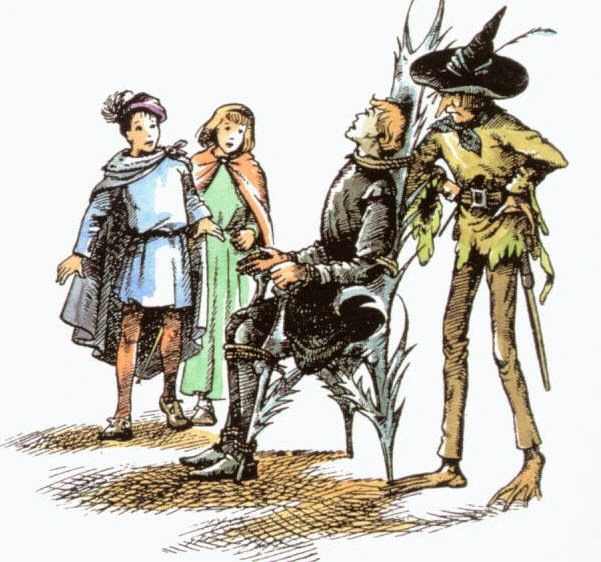
These things are always dealt with so much more clearly in the world of magic. Let’s examine the paired notions of “disillusionment” and “courage” in the context of Prince Rillian in C. S. Lewis’s story The Silver Chair. [2] When the children from England enter the magic land of Narnia, they are joined by a Marshwiggle named Puddleglum. The trio encounters a handsome young prince and a beautiful woman. The prince tells the Narnians a very challenging truth. Every day, he says, for the space of one hour, he goes absolutely crazy and says crazy things. He is, for that hour, tied to a silver chair and he begs the children and the Marshwiggle to ignore the ridiculous things he says during that hour. He is, to place his dilemma within our frame of reference, “illusioned” during this hour. But it only lasts for a little while and he is “disillusioned” afterwards and can be taken seriously again.

Let me pause briefly here to point out that Prince Rillian is a member of two sharply discrepant plausibility structures. The only colleague he has in the one is the lady—who is, to no one’s surprise, a terrible witch—and the only colleagues in the other, the children and the Marshwiggle. In our own lives, we grow up and move from one plausibility structure to another, then we discard the earlier one as childish wish fulfillment. Prince Rillian experiences both structures every day and part of every day, he knows it.

That’s why I like the world of fantasy for clarifying messy questions like this. Rillian is tied to the silver chair. He can tell the Narnians the truth and he does. He can plead for them to release him and he does. But he has also warned the children that he will be speaking absolute nonsense during that hour and he has pled with them already to ignore everything he says while he is under a strange spell for that hour.

So, briefly, the children can conclude that the prince tied to the chair is telling the truth and that all the rest of his life is illusory, but only they can act on that truth. The prince is disillusioned for only one hour. Or they can conclude that the prince, living all the rest of his life and with the compassionate support of the beautiful lady, is telling the truth and that they should just allow his illusion of being captive and “spell-bound” [3] to pass.

Disillusionment and Courage

(In all honesty, this is the point in the essay where I realize there will have to be a Part III. Oh well.)

The courage that is required is required of the Narnian children because only they can act. So they cut the Prince free and then they kill the horrible witch (who conveniently becomes a serpent when Rillian is disillusioned) and escape and go home. But in the lives we have been considering, it is our courage that is required, not someone else’s, and the courage is required because we do not know—we cannot know—whether the premises on which we are relying are true. We cannot even know if they are adequate.

We can know, however, that if we do not commit to these and to the people who are our colleagues, these premises will grow remote and finally, will not support the weight we are putting on them. When that happens, we may summon up the courage to reinvest in the presuppositions and the people who will make our lives make sense. Or we may discard that now remote set of beliefs and relationships and take on a new set. The act of discarding is considerably easier if you imagine that you are now living in no plausibility structure at all—completely disillusioned—rather than having swapped an old one for a new one.

That brings me to what I now see is going to have to be Part III. Keeping a plausibility structure fresh and powerful and relevant and keeping intimate contact with the people who are engaged in the same struggle you are engaged in—that is why they are “colleagues”—will require a good deal of courage as well as a great deal of effort. And you can never know whether you are making the right choice or whether you are making a fool of yourself. There is no shortage of people who are willing to tell you that, especially former colleagues, who in belittling your efforts are shoring up their own new commitments.

Using language like that leads me inevitably to keeping a relationship fresh powerful and relevant. My most directly applicable experiences of that issue are in marriage, which I know for a fact can be allowed to lapse and can be restored to vigor. This brief overview seems to image that it is something I can do by myself, but of course, I cannot. For everything I might do to support the fading relationship, others will have to say, “Yes. I want to do that too.” [4] And if this is a religious relationship in which the “partner” to whom I am committing (recommitting) is God, then more courage is required. All my transactions are “mediate,” if you see what I mean, but they are the means by which the relationship with a Partner is “mediated.”

So let’s talk about marriages and plausibility structures and the experience of mediated realities and, of course, disillusionment and courage.

[1] A plausibility structure is not a set of conclusions. It is the taken for granted world on which our daily actions and interactions are based. And as these interactions “work” every day, they passively confirm the taken for granted world.
[2]
The Silver Chair is one of the seven novels Lewis has set in Narnia. The entire set is called, by people who take it much more seriously than I do, “the Narniad.”
[3] Every now and then a word means exactly what it says and I am surprised that I never noticed it before.
[4] Or, conversely, I will have to see what the act of a colleague means and be the one who says, “Yes, I want to do that too.” I always experience myself as taking the first step, even when I know it is not true.

Posted in Uncategorized | Leave a comment