Self Care

I’ve been reading a good deal about “self-care” recently. I have read so much, in fact, that I am beginning to think about it. If you wanted to glance over a series of images about self care and you put the phrase “self care” in the search bar, you would eventually get to a picture of a man. You would be more than ninety images into the search, but eventually, you would find one.

Does that tell us anything about “self care” and gender? I think it does. I think it tells us that men who take care of themselves call it something else. I’m not sure what they call it .[1] What if they called it “maintaining the optimal conditions for long-term health and productivity?” Not much of a bumper sticker, I grant you, but if those were the common terms men used in thinking about “burnout,” it would take a long time to find it in a literature oriented to self-care.

A common notion is that we begin each day with an attention budget. That isn’t a bad way to begin, but it leads to the idea that everything you pay attention to is a drain on the budget—a withdrawal. But that isn’t true. Some of the things we pay attention to restore our attention balance—they are deposits. Everybody knows this. Think for a minute about the sense it makes to urge people who are on the edge of burnout, to pay attention to themselves for a little while. If “paying” attention [2] costs you, why would it not cost you also to pay attention to the condition you are in? The idea in paying attention to whether you need a break is that if you decide that you do, you will do something about it.

Nothing against taking a break, but I’d like to take a look at the step before that. Is it really true that “paying attention” depletes your store of attention? I think that depends a great deal on how you think of what you are doing. Let’s say you are “watching the kids.” That phrasing was chosen, I am sure, by someone who does not find it rewarding. If he had found it rewarding, he would have called it something else. Are there rewarding and fulfilling ways to watch the kids? Of course. Some people, men and women, do a good deal of it and find it rewarding and full-filling. (That extra l- and the hyphen make the point a good deal clearer.)

If you are watching the kids in a way that leaves you drained, maybe you are thinking of it the wrong way. Think, for instance, about what you get out of spending time with the kids. And I don’t mean what you think you ought to get; I am thinking about what you actually do get out of it. I am thinking about doing things you like to do as one of the ways you watch the kids.

You wouldn’t have to think of it that way, of course. You could define that time as work in which you have responsibilities and obligations and when you have met them, you have accomplished the task. There is no positive value for you in “meeting your responsibilities and obligations.” There is the threat of negative value, of course. That is the point of “obligations.” There is a cost for failing to meet your obligations, but there is no reward for meeting them. It is a game you can lose, but not a game you can win. No wonder it feels costly.

And right away, you wonder, who chose this game? And after that, you wonder whether it is possible for you to watch the kids in a way that makes a positive difference to your attention budget. And if a big part of self care is not overspending your attention budget, then doing some particular task in a way that makes deposits to that budget rather than withdrawals, seem like a good idea.

And that would be the case even if there were another person involved who insists that the task be defined and pursued in ways that are personally costly. It is doesn’t cost you, according to this logic, then you are not really doing the job right. It seems to me that a great deal of parenting has been inadvertently redefined in this way. The demands have been raised. The parents receive these new demands as part of some generalized social obligation, rather than deciding what kind of parents they want to be. The cost of failure to parent “correctly” keeps going up and the old sources of interactive pleasure keep going down.

So we see a lot of really “good” parents whose parenting costs them more than they can afford and there are other things they could have spared some attention for. Even in the middle of things, they know that. The attention budget gets expended early and often and the sources of replenishment are limited to “not withdrawing so much” rather than to parenting in a more rewarding way.

Needless to say, the examples could be multiplied, but there is no way that “self care” is going to keep up with the rising demands for attention and the declining resources to add capacity and enjoyment. And it is not at all hard to imagine that people who are used to deploying their attention in this way will simply turn the need for self care into another demand.

It seems to me that if we organized our tasks so that they were rewarding—as well, of course, as effective, we would have taken a long step toward restoring our attention budget.

[1] I am not referring to men as “them” because I am not a man. I am using the word “them” to refer to men because I am coming at this question as someone who reads a good bit about attention and even more about what “selves” are and how they should function. If I actually did any research, I would call myself a researcher.
[2] There is such insight built into the notion that attention is costly, that we actually do “pay” and that it actually does

Posted in Uncategorized | Leave a comment

Courage, Disillusionment and the Truth, Part III

The whole notion of “living in an illusion” and then of being “disillusioned” is a commonplace. Even if from the outside, it can be seen as swapping one plausibility structure for another, from the inside, it doesn’t feel like that. It can feel like a roller coaster ride. And even worse, when you think of the health and viability of a plausibility structure as requiring constant and innovative commitment, it can feel that if it is really true, it shouldn’t take this much work. If it is really true, we think, why does it keep fading away?

“It just doesn’t work any more.”

In hundreds of dramas, someone accounts for the dissolution of a marriage, by saying it just doesn’t work anymore. Of course, that could be said of every car that works really well until it runs out of gas. Or even better, for an electric car, when the battery runs down. The solution for the electric car is particularly instructive. It needs to be recharged. For the marriage, it is not so clear. And for all the kinds of relationship, including religious commitments, for which marriage is the metaphor I am using in this essay, it is definitely not straightforward.

In the development of this argument, now three installments long, we began by discarding the idea of “growing out of an illusion.” In the first place, relying on the notion of “illusion” raises the question of accuracy; accuracy raises the question of plausibility structures; plausibility structures shift the argument to reasons to believe in something and people to believe in it with you. Besides, saying that you “don’t believe in that kind of thing” anymore is way too easy if what it requires at the moment is the discernment to see the problem and the courage to work on it.

Why do marriages get old? (You can tell by the breadth of the question that the answer is going to be rich in stereotypes.) It isn’t that as the relationship gets old, you stop doing what made it a success in the first place. The very challenging truth is that what made it a success in the first place isn’t going to keep it viable. Neither you nor your partner are the people they were “in the first place” and the relationship is not either.

Instead, what is needed is not “restoring the illusion of those early days,” but finding out what will make the relationship work in its current maturity as well as it did in the beginning. Or, to be candid, “the way you remember it worked in the beginning.” Looking back fondly is only another way to postpone the work that needs to be done right now.

If we want to keep using the language of illusion, the “illusion” is that there is a recipe for the health and success of a commitment and you used to know what it was.

I offer, in this essay, the solution. Oddly, my solution is “disillusionment.” There never was a recipe. That was an illusion. You did gladly and with energy the things the relationship required. Continuing to do those things—those same things— will not sustain the current relationship. There are new things that will, but you need to find them and begin to explore them. That is where the courage comes in.

Commitment

The great value of a commitment is that it is a solution to the short-term lapse in motivation. It is hard to do the demanding work of discernment in a relationship that is not very satisfying anymore. Harder still if you suspect that what true discernment will bring you is a set of demands that you do things differently. But if you are committed to the relationship—remember that marriage is serving here also as a model for religious commitment—then the question is not whether you find it satisfying. The question is what you need to do to make it satisfying.

Having said that, it is important to establish that it is not within your ability—you, acting alone— to make a relationship satisfying, whole, and productive. You have a part to play, of course, but a substantial piece of it is inviting the other, the others, to play their parts. [1] Restoring a plausibility structure to health is not something you can do by yourself since it is made up of the presuppositions, actions, and fellowship of colleagues.

Obviously, that is where the courage comes in. Claiming that you once labored under an illusion and now you have been “disillusioned” is relatively easy. Recognizing that being the person you now are in a relationship that gives vitality is a matter, instead, of humility, honesty, and hard work.

So it seems worth doing.

Having said all that, I would like to return to the many friends I have had who claim to be “disillusioned.” The context I provided for that statement when I first introduced it, was religious and I want to end these reflections in the same way. These people never seem to be saying that the illusion that misled them was provided by God. It always seems to have been provided by people—often parents—speaking on God’s behalf. And very often, that particular illusion of relationship with God richly deserves to be dissed [2]

But having done that, what view of yourself and the world will you formulate in its place? What frame of reference will you establish as unchallengeably true? What implications for the meaning of your life will be provided by this new frame?

You can’t have no frame of reference.

And complaining about your period of being illusioned does not give you one. For me, I think it would be better to put my energies toward restoring the frame I know and becoming the person it now—not back then—needs for me to be. That’s the part that takes the courage.

[1] Using a human relationship as a stand in for a religious commitment does run into problems here and there. The problem here is partly capitalization,. I could say that I “invite the Other,” (using the capital). But that places the whole notion of mutuality in a very precarious place.

[2] Only a very small smile there to recognize “disillusionment.

Posted in Uncategorized | Leave a comment

Courage, Disillusionment and the Truth, Part II

I took the argument far enough in Part I to say that one might declare an earlier view to be “illusory” for any number of reasons. What you took to be the factual underpinnings may have eroded. They almost certainly have become less fashionable, no matter what they were. The collection of crucial colleagues may have dissipated. These are people who make up the largest part of what sociologist Peter L. Berger calls a “plausibility structure.” [1] If you are an intellectually active adult, you now live within a different plausibility structure, interacting with different people, taking different things for granted.

Plausibility structures don’t establish what is true. They establish the frame of reference within which the goals that deserve your commitment are established and they establish the criteria by which these people, but not those people, should be treated as colleagues.

That being said, one of the simplest ways to separate yourself from a discarded plausibility structure is to say that it has been shown not to be true. “Factually true,” that is. This is simple because you really have no choice. You cannot continue to be guided by a plausibility structure that is based on falsehood. But is not straightforward because “not true after all” is the judgment of your present colleagues on the beliefs and practices of your former colleagues.

I guarantee you that your next set of colleagues will have the same attitude toward the colleagues you have now. This endless availability of new plausibility structures clarifies to what extent “what you once believed” can be called an “illusion” and therefore also clarifies what you might mean by declaring yourself to have been, at last, “disillusioned.”

Prince Rillian

These things are always dealt with so much more clearly in the world of magic. Let’s examine the paired notions of “disillusionment” and “courage” in the context of Prince Rillian in C. S. Lewis’s story The Silver Chair. [2] When the children from England enter the magic land of Narnia, they are joined by a Marshwiggle named Puddleglum. The trio encounters a handsome young prince and a beautiful woman. The prince tells the Narnians a very challenging truth. Every day, he says, for the space of one hour, he goes absolutely crazy and says crazy things. He is, for that hour, tied to a silver chair and he begs the children and the Marshwiggle to ignore the ridiculous things he says during that hour. He is, to place his dilemma within our frame of reference, “illusioned” during this hour. But it only lasts for a little while and he is “disillusioned” afterwards and can be taken seriously again.

Let me pause briefly here to point out that Prince Rillian is a member of two sharply discrepant plausibility structures. The only colleague he has in the one is the lady—who is, to no one’s surprise, a terrible witch—and the only colleagues in the other, the children and the Marshwiggle. In our own lives, we grow up and move from one plausibility structure to another, then we discard the earlier one as childish wish fulfillment. Prince Rillian experiences both structures every day and part of every day, he knows it.

That’s why I like the world of fantasy for clarifying messy questions like this. Rillian is tied to the silver chair. He can tell the Narnians the truth and he does. He can plead for them to release him and he does. But he has also warned the children that he will be speaking absolute nonsense during that hour and he has pled with them already to ignore everything he says while he is under a strange spell for that hour.

So, briefly, the children can conclude that the prince tied to the chair is telling the truth and that all the rest of his life is illusory, but only they can act on that truth. The prince is disillusioned for only one hour. Or they can conclude that the prince, living all the rest of his life and with the compassionate support of the beautiful lady, is telling the truth and that they should just allow his illusion of being captive and “spell-bound” [3] to pass.

Disillusionment and Courage

(In all honesty, this is the point in the essay where I realize there will have to be a Part III. Oh well.)

The courage that is required is required of the Narnian children because only they can act. So they cut the Prince free and then they kill the horrible witch (who conveniently becomes a serpent when Rillian is disillusioned) and escape and go home. But in the lives we have been considering, it is our courage that is required, not someone else’s, and the courage is required because we do not know—we cannot know—whether the premises on which we are relying are true. We cannot even know if they are adequate.

We can know, however, that if we do not commit to these and to the people who are our colleagues, these premises will grow remote and finally, will not support the weight we are putting on them. When that happens, we may summon up the courage to reinvest in the presuppositions and the people who will make our lives make sense. Or we may discard that now remote set of beliefs and relationships and take on a new set. The act of discarding is considerably easier if you imagine that you are now living in no plausibility structure at all—completely disillusioned—rather than having swapped an old one for a new one.

That brings me to what I now see is going to have to be Part III. Keeping a plausibility structure fresh and powerful and relevant and keeping intimate contact with the people who are engaged in the same struggle you are engaged in—that is why they are “colleagues”—will require a good deal of courage as well as a great deal of effort. And you can never know whether you are making the right choice or whether you are making a fool of yourself. There is no shortage of people who are willing to tell you that, especially former colleagues, who in belittling your efforts are shoring up their own new commitments.

Using language like that leads me inevitably to keeping a relationship fresh powerful and relevant. My most directly applicable experiences of that issue are in marriage, which I know for a fact can be allowed to lapse and can be restored to vigor. This brief overview seems to image that it is something I can do by myself, but of course, I cannot. For everything I might do to support the fading relationship, others will have to say, “Yes. I want to do that too.” [4] And if this is a religious relationship in which the “partner” to whom I am committing (recommitting) is God, then more courage is required. All my transactions are “mediate,” if you see what I mean, but they are the means by which the relationship with a Partner is “mediated.”

So let’s talk about marriages and plausibility structures and the experience of mediated realities and, of course, disillusionment and courage.

[1] A plausibility structure is not a set of conclusions. It is the taken for granted world on which our daily actions and interactions are based. And as these interactions “work” every day, they passively confirm the taken for granted world.
[2]
The Silver Chair is one of the seven novels Lewis has set in Narnia. The entire set is called, by people who take it much more seriously than I do, “the Narniad.”
[3] Every now and then a word means exactly what it says and I am surprised that I never noticed it before.
[4] Or, conversely, I will have to see what the act of a colleague means and be the one who says, “Yes, I want to do that too.” I always experience myself as taking the first step, even when I know it is not true.

Posted in Uncategorized | Leave a comment

Courage, Disillusionment, and the Truth, Part I

Everyone who was raised within a culture that believed something important about human life runs the risk of coming to a time in their life where they proclaim that they are “disillusioned.” I was raised in a conservative Christian culture, so most of the people I hear or read saying that they have been disillusioned, are people who believe they have finally discovered and escaped the illusions of their childhood. I am in a somewhat different place myself. I believe that I have finally discovered the truth about “disillusionment.” Here’s the bad news. Disillusionment is an illusion.

This is a peeling the onion kind of problem and the outer layer is the notion that truth and illusion are at war with each other in principle. The idea is that I was told that X attitude toward life and meaning was “true” but now I know that it is not true. The Recently Disillusioned Person (hereafter RDP) need not say that something else actually is true; only that what they were taught is not. They are free, of course, to say that they have discovered that Y is true instead of X or they are free to say that the whole idea of “true” is fallacious.

But this is a precarious position to take. Let’s move on to the next layer of the onion. Let’s say that I have a progressive form of dementia and I have, in my currently sound mind, the conviction that I do not want any heroic measures taken to prolong my life. I sign a paper to that effect. I have it notarized. Then, dementia having taken its course, I come to the medical decision to take heroic measures and at that moment, it seems like a good idea. “I,” the person I am then, say,s “Wait, I have changed my mind. I do want those measures taken.”

I, the self who signed the paper, see things in a certain way and “I” (note the quotation marks) see things in a different way. There is no reason that “I” could not claim that I have, at long last been disillusioned. The family will very likely believe that the current view of things, the demented view, is the illusion and that the earlier view, taken with full command of their facilities, was the authentic view.

It is not true that the later person, the one I can been calling “I,” now knows the truth and that the “truth” they once believed was always an illusion. In fact, neither of these positions about what to do at the end of a physical life can be said to be “true.” They can be said to proceed authentically from a functioning self, an agent. Or not. The reason the person who discovers that their mind will not continue to be under their control signs the paper in the first place is that they know they will become increasingly dominated by an illusion. In fact, dementia may be thought of as a web of illusions, some stable, some transitory. What the agent believes will, in this case, be counted as authentic; what the patient believes will be discounted as illusory and that is true even if the patient declares that he has at last been disillusioned.

We have time for one more layer of onion. I can see that this is going to require more than one post. Let’s consider martyrdom next. Etymologically a martyr is a witness. The word comes from Greek and has been adopted into most Germanic languages, including English. The common representation is that a belief is proclaimed over many years. Then there is a time of reckoning. The believer can continue to hold to the belief or practice that is now in disfavor and suffer grievous harm or they can declare it to have been an illusion, to declare further that they are now “disillusioned” and have adopted the new required view. They have become a RDP.

Traditionally the “grievous harm” in prospect is death, often a painful and humiliating death, but for our inquiry there is no reason it needs to be that. It needs to be bad enough that it requires that the RDP learn to sing a new song. [2] It could be being forced to leave your home; it could be being forced to take a menial and low paying job; it could be having all public facilities made off limits to you. Any of those might, in some circumstances, cause a person to say that their early teaching was all an illusion and that they are now disillusioned.

But really, is the view they first adopted an illusion? None of the causes we have surveyed says so. And is the new view being taken on the grounds that is wholeheartedly accepted? Does that mean that they have been disillusioned and no longer hold the old view? None of these scenarios asks the question of what is true, imagining that “illusion” is taken to be the opposite. Is a view which still makes sense to someone, but that increasingly costs them a price they are unwilling to pay, suddenly an illusion? Really? Would it require more of something to continue to affirm the original view? More stubbornness? More data? More courage?

I’d like to pick that dilemma up next and we will look also at C. S. Lewis’s classic case, Prince Rilian of The Silver Chair.

[1] Interestingly,Norse used a native formation pislarvattr, literally “torture-witness”—one who suffers death or grievous loss in defense or on behalf of any belief or cause” (love, etc.)
[2] Just kidding. The canto = “to sing” root suggested “recant” to me. I know it means other things in other settings.

Posted in Uncategorized | Leave a comment

“It takes a village”

On the principle that it takes a village to raise a child, I would like to pursue the thought that it takes as much as 156 milligrams of hippocampus to remember who directed a film that is nearly everyone’s favorite.

Now for those of you who are conversant with adjusted average hippocampal weights, you are prepared already to turn the page, metaphorically speaking, because you know there has never been a hippocampus that weighs anywhere near that much.

And you are right.

But here’s what I am thinking. Bette and I live in a senior center where a good deal of the social activity goes on in the dining room. As is true in many other settings, “meeting for dinner” is a common way to keep up with events in the lives of friends. It is true here as well.

And one of the common features—no pun intended—of our dining room is that is has tables large enough to seat six people. “Six top” tables, they are called, for reasons I have never understood [1]. They are tables intended to serve six people. And very often at dinner at such a table, a question will come up about a movie everyone has seen and liked. We remember the actor who played the lead, but not the name of the character she played. We remember the name of the producer, but not the director. We remember the name of the town where the events are supposed to have taken place, but not the name of the county. That last one is especially prominent for movies set in Ireland.

What to do?

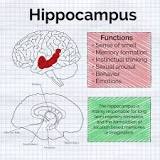
Well, remembering that the hippocampus is the seat of explicit memory, we could look there for help. The hippocampus mediates our recall of specific events—names, dates, places. It is therefore the part of the brain that is being called on at our table when we all remember something—some the character, some the place of filming, some the date of issue—but no one remembers what we are trying to remember.

You could, of course, say that this is the kind of problem that bedevils old people, but what is the value of a description like that? I say let’s regard it as a problem caused by an inadequate hippocampus. The standard 26 milligram hippocampus is just not up to addressing this problem. Fortunately at our table, a six top, there is roughly 156 milligrams (26 X 6) of hippocampal weight to be directed toward the problem. That ought to be enough, don’t you think?

And eventually it is. Someone remembers that this actor has a brother who starred in a different Irish film. Someone else remembers that the film the brother starred in was released only five years after the film we are trying to remember. Someone else remarks that it was one of the highest grossing films of the summer in the year it was released. That has nothing at all to do with our common problem, but it gets said anyway. We’re a bunch of old people.

Eventually, bringing to bear 6X the power of one normal hippocampus, someone remembers the right name and everyone else says they were just right at the edge of remembering it themselves and that they know it is correct.

This illustrates the same principle embodied in “it takes a village to raise a child” as applied, in this case to remembering who played the lead in a film everyone at the table had seen and liked.

[1] “Restaurant slang” was the speculation of the only source I found that was willing even to speculate.

Posted in Uncategorized | Leave a comment

A heartfelt Merry Christmas

I want to tell you this morning about my favorite “Merry Christmas.” There is no joy is this “greeting.” It is said in an intimate tone, although as you see in the picture, it is said by a judge presiding over a courtroom. This is the Honorable Henry Harper, played by Robert Prosky in the 1994 remake of Miracle on 34th Street. Every other utterance he has made from that exalted seat has been formal and procedural. He disallows an objection by counsel, he warns the courtroom to be quiet, he orders that a reindeer brought in as a witness (an object lesson, really) be removed from the court. Judge-ly things.

This “Merry Christmas” is not that. In looking at the dollar bill in his hand, he sees that “In God We Trust” has been circled with a red felt tip pen and he realizes that he does not have to sentence Santa Claus, who is seated in his courtroom as the defendant to a life of custodial care courtesy of the state of New York.

Until he was handed this dollar bill, which was clipped to a home made Christmas card a little girl gave him, he saw the future clearly. He was going to rule against Santa Claus and pay the price for the rest of his professional career. Or he was going to acquit a perfectly ordinary looking man sitting in his courtroom and who persists in claiming that he is Santa Claus—a professional violation he would never live down. When he was handed the bill, he realized suddenly what it meant,

He spends some time later, explaining to the courtroom just what the logic was by which he could declare the defendant, one Kriss Kringle, not guilty. But we don’t need to go that far. The shift from the formal reading of a proclamation that would have found Kriss mentally incompetent, to the quiet and profound relief we hear in Judge Harper’s voice tells viewers everything we need to know. This is a voice of a man who has just realized that he does not, after all, have to choose between personal or professional humiliation. It is, consequently, a voice full to bursting with gratitude and relief. It is right at the border of joy. There is a chuckle in it. The chuckle is not quite expressed, but it adds a tone to the words he speaks as if it were an additional acoustical layer. And the chuckle, being almost there, is lovely.

Before Judge Harper, my favorite Merry Christmas was provided by Luke’s account of the aged Simeon in the Temple. He was told to come to the Temple and he came. He had been told that he would not die until he had seen “the Christ of the Lord.” That’s Luke’s language. Simeon would have heard it as “the Messiah whom God has finally sent to save us.” “Finally,” I say, because Simeon had lived a long time and he was so ready to be received by death. It looked to him like being able, at last, to rest.

So the little child was handed to him and he let go all the tension that he had needed to get through the day after day after day of his very old life. He let it all go, as I hear him, and shifts into the chuckle-imbued relief Judge Harper uses and he says, “Lord, now lettest thou thy servant depart in peace.” [1]

Or, as we would say today, “Merry Christmas.”

[1] Simeon was very old, so the King James language came naturally to him.

Posted in Uncategorized | Leave a comment

Just another victory lap

In 1977, I invented the “victory lap.” It’s one of the best things I have ever done. There were, of course, victory laps before mine, but I am quite sure there were no victory laps quite like mine. The “victory laps” I had seen on TV and the ones I had watched at Hayward Field at the University of Oregon resulted from one runner having beaten other runners. [1] I was the only runner in my program, so my victory laps would have to mean something else. [This is early Prefontaine. He got better later.]

They did.

I was living on what the Westminster College folks called “New Faculty Circle” at the time. It was half a mile around the circle and when I came in from a long and sometimes grueling run on the roads in the hills around the college, running another half mile was the last thing I really wanted to do. On the other hand, I was committed to running 1776 miles before the 4th of July of 1977 and I had fallen behind and really needed the extra miles. [2] Adding half a mile to every day’s run was just a way to add to the total.

On the other hand, I noticed after several such additions that running that extra half mile didn’t feel like running the route I had just finished. It didn’t even feel like running the last half mile of that route. It was as if some part of my mind had declared the run to be “over” and the difficulties I had been experiencing on the run were also, therefore, over. If I had developed a blister, it stopped hurting. If I had some soreness from a leg cramp, it stopped bothering me. If I had had trouble getting a good deep breath, the trouble disappeared along with the discouragement I had some days in checking my time.

Why did that happen? I think some part of my mind, not the part I use in making decisions, decided that if it was really a “victory lap,” then the discomforts of training were really over and it turned off (or turned down) my awareness of them. I also very naturally used that time to review some of the strategic decisions I had made on the run. A route I often ran had a lot of hills and I did some experimenting with pushing my pace going down or pushing it going up. Which produced the better time? Which cost me more that it gained me?


It was a reflective frame of mind. It presumed a lot of things that I found helpful at the time and still find helpful. The first is that I was going to keep doing those runs. That was implied by my evaluation of today’s run; it would provide some benefit to tomorrow’s run. The second is that my stance toward it was evaluative and thoughtful. It was not resentful or despairing. It was calculating. I continued to wish myself well in my planning of tomorrow.

Eventually, I began to think of the “course” of my life as something like a mile run with its four laps, each of 20 years. I would “finish the race” when I turned 80. I was 40 in 1977. And when I finished the “race,” I would keep on running as if I were adding the New Faculty Circle loop, and I would reflect on what I had learned on that run. How had the strategy I was using worked out? For reasons of convenience, I declared a year to be the right length for a “lap.” I turned 86 today so I am beginning my sixth victory lap, and as I run it [3] I get to consider the run I have just finished—not just the original eighty, but the also the five I have added to it.

What worked? What do I know enough to avoid now? And again, I benefit from the presuppositions. I am going to keep on living (metaphorically, keep on “running”) and I am going to hold onto a contemplative frame of mind. I want to evaluate what I have learned and to benefit from it.

With this kind of starting point in my experience, I was not all that surprised to stumble across the notion of “temporal horizons.” For young people, time is infinitely expandable and therefore need not be taken into account. For people in the middle of their productive years, the future is the future of the job or of earnings and the discharge of responsibilities in general. But old people need to think also, in terms of death; in terms of the time that is left.

I remember vividly the switch in my mind that flipped when, in a 10K road race, I switched from making sure I had enough left to finish to making sure I used it all by the time I got to the finish line. Talk about shifts in temporal horizons!

The victory lap that I begin today gives me a chance to look at the race as a whole not, this time, so I can do it better next time, but so I can use what I have left in the best way. For me, the “best way” in the most productive way. I want to do—in most cases, to “continue to do”—the things that make life make sense to me and/or that make a contribution to the lives of others. [4]

So I get to look at what my life has prepared me to do with the resources I have left in the time I have left. That is very much a “victory lap” kind of thinking. Now if you will excuse me, I need to get moving again. The clock keeps ticking.

[1] Steve Prefontaine was famous for his victory laps. He was a favorite among U of O track fans and when he won at Hayward Field, he would take a lot of laps, receiving the adulation of some very loud fans. I heard an announcer say once that his most recent victory lap (that’s a quarter of a mile) passed in 67 seconds.)
[2] This was a project of the National Jogging Association, purportedly to celebrate the Bicentennial. We celebrated the events of 1776 by jogging 1776 miles between the 4th of July of ’76 and the 4th of ’77.
[3] Not actually running anymore, alas. It is all cycling now. I may have used up my knees on the hills around New Wilmington, Pennsylvania.
[4] I don’t think you really have to choose, in most circumstances, between meeting the needs of others and meeting your own needs. Choosing a strategy that does both is better and you are responsible for managing the tradeoffs.

Posted in Uncategorized | 1 Comment

Trained for Discomfort

On December 13, John McWhorter wrote a column for the New York Times. I haven’t read it yet. I read his columns whenever they appear in the Times and I very much enjoyed his lectures on linguistics, which he developed for The Teaching Company. But I want to write this based on the headline. If McWhorter himself wrote the headline, he included in it all the major emphases I expect to find in the column.

Here’s the headline: “Black Students Are Being Trained to Think They Can’t Handle Discomfort.” Here are three observations based on that headline.

First, note that “black students” are the focus. They are the object of the passive verb “are being trained.” That’s not all that unusual. There is a lot of talk from the left that young black people are being trained for docility and from the right that they are being trained for racial hatred. But if you buy the premise, as it is offered in the phrasing of the headline, that this is another column about the infinite plasticity of young black people, you are in for a surprise. That’s the first thing I like about the headline.

Second, note that “black students are being trained to think something in particular.” The most common use of such a phrasing is as the setup to the next statement, which is that what they are being trained to think is false or destructive. “Trained to think that….” prepares the writer, McWhorter in this case, to say that they should not be trained in this way and to say just why. “Trained to think that…” stops short of saying that what they are being trained to think is an illusion. But not short by much.

Third, the word “discomfort” signals that this is not the kind of column we are used to seeing, particularly not from a black professor. The whole escalation of attitudes about race is recent and powerful. “Using the wrong word about a racial group is racism and racism is cousin to genocide.” Now you know. It is that very common and scarcely noticed escalation that McWhorter analyzes in his book, Woke Racism: How a New Religion Has Betrayed Black America. It has nothing to do with “discomfort.”

If you are writing on this topic, the very least you can do it to call the experience “pain” or possibly “anguish.” Clearly “discomfort” is a step down. It may be several steps down. And if you are going to write about the discomfort of black students, the very least you can do is bury it in the text of the column somewhere. You absolutely do not want to feature it in the headline, as if the “discomfort” of black students were important. And even more, that the training of these students to feel discomfort were important.

Those three observations are what I saw in the headline. As soon as I finish this post, I am going to read the column. I am quite certain it is going to say that the students who could be trained to feel something more useful—I’ll return to that in a moment—are being trained to feel discomfort instead. Thereby, McWhorter will say, the discourse about race is made brittle and inflammatory. The range of views about race and its implications is thereby constrained and the heat of the discussion intensified.

McWhorter might argue that if we are going to take the trouble to “train” black students at all, they should be trained for something more useful. They could be taught that an immediate hot anger is more appropriate and more useful. (How one might express that anger is a separate question.) They could be taught that compassion for the people who are demeaning them is more appropriate and more useful. It shows their ignorance, their confinement in the racism of their little section of society, their emotional vulnerability. They could be taught to take the immediate discomfort they feel as fuel for the next step in the interaction, which could be making the slur or the institutional practice the focus of sustained debate.

McWhorter might go so far—I don’t think he will—of saying that one of those responses is more appropriate in some circumstance and a different one in other circumstances. He might say that black kids with this skill set might respond in one way and kids with another set might do other things instead.

I don’t actually know what he will say, but those are things that he has prepared for in the headline and I am really looking forward to finding out.

Posted in Uncategorized | 2 Comments

A Third Birth Narrative to Begin the New Blogging Year

I started blogging so I would have somebody to talk to. When I began—May 30, 2010—I was married to a wife I liked to talk to; I was teaching at PSU and had access to quite a few students to talk at (and even a few to talk to); I was part of a long-running book group, a very promising coffee group, and I taught adult ed classes at church. You wouldn’t think there would be a difficulty of any sort.

But what I really wanted was some place to say things like these. Did you see that? There they go again! You’d think they would have noticed by now that that doesn’t work. Did you ever notice the “cowed,” the verb and “coward” the noun, are not related to each other etymologically?

The book group only allows me three such “observations” a meeting and we meet only monthly. My wife had her own observations to take care of. The kinds of observations I am talking about will always be diversions from what we are doing in class at PSU—the occasional course in political psychology excepted.

So a blog seemed like a good idea. It was light-hearted and quippy at the beginning, like the sample observations above. But then national politics began to go dark and I didn’t feel so quippy so I didn’t write so often. I did notice, however, that when I encouraged myself to make in the blog the snarky little comments that ran through my mind, I kept on wanting to make them.

So let’s see how it goes.

Several years in, I decided to start the blogging year at the beginning of December. I always write a few essays about whichever account of the birth of Jesus is “the right one” for that year, so starting in December is more a convenience than anything else.

This year, for instance, I have begun to be intrigued by the observation that although Matthew and Luke have the only birth narratives worthy of the name, Mark and John have clear allegations of illegitimate birth, which I would have to say is a birth narrative of some kind. And if that is true, it opens the way for some observations that seem obvious to me now, but that I have always passed by before.

Here are two versions of Matthew 1:24-25. First the King James, which is the version I grew up on.

“24Then Joseph being raised from sleep did as the angel of the Lord had bidden him, and took unto him his wife: 25And knew her not till she had brought forth her firstborn son: and he called his name JESUS.”


Then the NIV


24When Joseph woke up, he did what the angel of the Lord had commanded him and took Mary home as his wife. 25But he did not consummate their marriage until she gave birth to a son. And he gave him the name Jesus.”

In the light of the snarky allegations in Mark and John, my attention falls on the first part of v. 25. Why did Matthew feel that he needed to add “but he did not consummate their marriage”—“he knew her not,” in the KJV—to the text? He already had God’s assurance, received in a dream in 1:20b “because she has conceived what is in her by the Holy Spirit” With that much assurance, Matthew changes his mind about divorcing Mary. It was a life-changing dream. So why does Matthew put a little reminder of Mary’s virginity back in v. 25, just five verses later?

There may be a good literary or apologetic reason for that, but my interest this morning is that with the charge of bastardy fresh in my mind (from Mark and John’s accounts) it strikes me as too much. It seems urgent. It seems, “Oh by the way, did I tell you that Mary was still a virgin when she conceived?” By my current reading, it is TMI.

It can be argued, of course that it is or that it isn’t, but I feel richer for seeing the passage that way and asking the question. At the moment, it seems overwhelmingly likely that Matthew is, by this addition to the text, (that’s a guess) responding to allegations he has heard made. But I also know that “overwhelmingly likely” is, at least in part, a function of being excited that I just now saw the discrepancy for the first time. I know that the excitement makes it seem truer right now.

The “third birth narrative”

So what traces are there of this “third birth narrative in Mark and John? I’ve referred to it, but I have not yet presented the texts.

In Mark 6, Jesus goes to Nazareth and begins teaching in the synagogue. His teaching is astounding to his neighbors. They know him; they know his family. Where did all this religious “wisdom” come from? It is as if Jesus were putting on airs, when they know for a fact that he is a local boy.

And in the process of mulling over that discrepancy, they ask a really telling question. Is this not Mary’s son? Not, notice, “Joseph’s son.” Joel Marcus observes in his commentary on Mark’s gospel, “In Jewish sources the father’s name is normally used to identify the son even when the father is dead.”

Why then does Mark choose to identify Jesus by a matronymic rather than a patronymic? Joel Marcus, in his commentary, answers this question this way: ‘it is likely that the use of Jesus’ mother’s name is a slur against his legitimacy… This aspersion would correspond to the tendency in later Jewish traditions to portray Jesus as a bastard…” [2]

Marcus says that: “…Mark 6:3 comes closer to being a genealogical formula than the parallels cited because of the extensive list of other male family members. McArthur’s theory, moreover, does not explain the apparent embarrassment of Matthew and Luke at Mark’s term or reckon with the hostile context of our passage and the evidence for a trajectory of Jewish aspersions against Jesus’ birth.

Both Matthew and Luke revert to the usual pattern in their accounts of this event. Luke 4:22 reads “the son of Joseph” (cf. John 6:42) and Matt 13:55 “the son of the carpenter.”

The example in John is better in some ways and worse in some ways. It is better in that the charge of illegitimacy is clearer. In 8:41, Jesus says to his antagonists “You are doing your father’s work.” What he means by that is a little complicated, but it is the response I am interested in here. They respond, “WE (unlike you) were not born illegitimate. The only father WE have is God.”

The only thing I added to that exchange is the parenthetical part and, in fact the use of what I call “exclusionary phrasing” is common in John. He says things like “only the Son,” meaning not Moses; and “earthly,” meaning not heavenly. It is that style of John’s that makes me confident that the WE, above, is intended to mean “unlike you.”

That clear use is how it is better. It is worse, of course, because this clip is taken from the middle of a heated argument and there is no way to know whether cooler heads prevailed in the morning. And if you are inclined to pass this exchange off as the Pharisees being snarky, let me remind you that this particular exchange is between Jesus and fellow Jews who believed in him (John 8:31).

So I may use these two passages as “the third birth narrative”—Jesus was a bastard—or not. Let’s see how the year goes.

[1] According to Marcus: “This aspersion would correspond to the tendency in later Jewish traditions to portray Jesus as a bastard, a pattern that may already be reflected in John 8:41.”
[2] There is additional fun to be had in that the English word bastard probably derives from the French
fils de bast (packsaddle child) and therefore does actually mean “born in a barn.” And that is true is Luke’s account, but not in Matthew’s.

Posted in Uncategorized | Leave a comment

Two Christmas Movies

The Christmas Visitor

In the letters of 1st, 2nd, and 3rd John, the author is really upset about some notion about the earthly ministry of Jesus. It is not easy to say just what it is, but someone seems to be open to the idea that Jesus “seemed to” have come to earth and taken on flesh and lived the same kind of life we did. He didn’t, actually, but he seemed to.

The Hallmark video, A Christmas Visitor, which I have enjoyed watching many times, presses right on the nerve that separates the gospel of John from the teaching the Johannine letters are trying to quash. I suspect it could be called docetism. We get this from the Greek dokein, “to seem,” so it could be called “seeming-ism.” What gets the writer of the Johannine letters so upset is that someone seems to be teaching that Jesus did not actually take on flesh and did not actually become a human being, but only seemed to.

In A Christmas Visitor, the Boyajian family lost a son in Iraq. It was a terrible loss for the family. The father carried on as TV fathers tend to do. “I gave them my son,” he says. “They gave me this medal.” The mother acts out her grief in some ways she recognizes (and justifies) and in many other ways as well. The daughter feels herself confined to a perpetual second place, never really as important as her martyred brother, and having very slim personal reserves.

The father, George Boyajian, decided, finally, that enough is enough and he is going to start over by celebrating Christmas again. The film loses track of this early moment until the very end of the film when the spirit of his son John, embodied in a “person” named Matthew is asked, “Why did you come back to us?” The person who is, but who does not seem to be, John, answers, “Because you were right. It was time.” [This is John in the body of Matthew.]

“You were right” points to what would be the most remarkable part of the movie if it were a part of the movie, which it is not. Somewhere, “John” is monitoring how his family is doing and when his father says it is time, “John” returns in the body of Matthew and does a lot of wonderful things to turn the family around. “John” was listening. Where, without “Matthew,” was he?

In the meantime, in the body of the plot, “Matthew,” heals the daughter, Jean, of her cancer, restores a long broken Christmas star to full functioning, and remembers things about John that he could not possibly know. How does he do all that? Because he is not Matthew; he only seems to be Matthew. He is actually John, visiting his earthly family in the body of Matthew. Matthew seems to be John, but he is not. The film maker puts the last nail in that board by having Matthew, as he is leaving, morph briefly into John, then back into Matthew, while the father holds his salute.

Miracle on 34th Street (1994)

On the other hand, the Santa Claus of Miracle on 34th Street really is Santa Claus. There are two phases in the identity positioning in this movie. We see a fat man with a white beard approached by a desperate employee of Coles Department Store, who asks him to fill in at the last minute as the Santa Claus in their parade. He is a very good “Santa Claus” and the department store hires him to be their official Santa.

The second phase is that at the hearing, it is the job of the judge to rule whether a man who believes himself to be Santa Claus can be ruled sane. His lawyer doesn’t argue that his client is sane; he argues that he is not dangerous. That doesn’t work.

Finally, the judge hits on an analogy that works for him. On a dollar bill a little girl gave him, he notices that it says “In God We Trust.” The judge argues that if the U. S. government can declare its belief in God without demanding any evidence, then he, the judge, can declare that the man before him actually is Santa Claus without demanding any evidence.

Between these two times—the parade at the beginning and the hearing at the end—viewers are treated to Santa Claus playing the part of “Santa Claus.”He speaks a lot of languages, which ought to seem odd. He knows sign language. He has his own “Santa suit” with real gold buttons and gold thread. By claiming that he is who he says he is, he brings the woman who hired him into existential crisis, and raises the desperate hopes of her daughter that she will finally get a home in the country and a baby brother.

At the hearing, there is casual banter about “department store Santas,” of which Kris Kringle, the main character, is one. The daughter of the Cole’s employee who hired Kris is very worldly wise. “I know how this works,” she confides to him. “You work for Coles.” Kris pauses momentarily and says, “That…is true.”

He pauses because he knows that the true answer he gives will be taken to mean things he does not mean and that are not true. The little girl will understand the answer to mean “I am an employee of Coles and therefore am not the real Santa.” What Kris really means and what all the viewers are in a position to appreciate is that he works for Coles AND he is the real Santa. He’s just filling in until he has to take off on Christmas eve

These two stories, both of which I enjoy watching every Christmas, are the formal opposite of each other and it doesn’t bother me a bit.

Posted in Uncategorized | Leave a comment