“We” are an evangelical nation

I would like to share today some thoughts about social and political identity under the Trump administration.  We hear the claim that “we” are “a Christian nation.”  That was prominent in the Christmas messages of the Trump administration according to a very good article in the New York Times by Ashley Ahn. 

Pete Hegseth, for instance, offered this. 

“Today we celebrate the birth of our Lord and Savior, Jesus Christ,” “May His light bring peace, hope, and joy to you and your families.”

And Marco Rubio, this:

“The joyous message of Christmas is the hope of Eternal Life through Christ,”

And this from the Department of Homeland Security.

“We are blessed to share a nation and a Savior,” 

There was also a  video that featured images including the American flag, Christmas trees, Santa Claus, President Trump and a Nativity scene, along with the words “Remember the miracle of Christ’s birth.”

In February, Mr. Trump created a task force at the Justice Department to “fully prosecute anti-Christian violence and vandalism in our society” and “move heaven and earth to defend the rights of Christians and religious believers nationwide.” 

In May, he established the Religious Liberty Commission in the Justice Department.  The website of that Commission lists seven tasks they are interested in.  Here are five of them.

  • The First Amendment rights of teachers, students, military chaplains, service members, employers, and employees
  • Conscience protections in the health care field and concerning vaccine mandates
  • Parents’ authority to direct the care, upbringing, and education of their children, including the right to choose a religious education
  • Permitting time for voluntary prayer and religious instruction at public schools; Government displays with religious imagery
  • The right of all Americans to freely exercise their faith without fear or Government censorship or retaliation

Anyone with a clear memory of recent controversies will see conservative “resolutions” in the first four.  “First Amendment rights for specific categories of people”. Only? 

“Conscience” rather than, say, “law” as protections? 

“Parents’ authority” rather than, say the school board.

“Voluntary prayer and religious instruction,” in a setting where those practices have been set aside in light of the reprisals against those who did not “voluntarily” take part. 

And then that last one, which sounds very general, except that there are no protections for people who, by their own self-identification, have no religious faith at all.

Anyone, I say, who remembers these controversies will see in the Commission’s “tasks” a revolution of practices in favor of the Christian minority.

Then there is the question of “we.”  I offer here an old joke about the Lone Ranger and Tonto, but I want you to remember that this is about what “we’ means in the sentiment “we” are a Christian nation.

The story goes that the Lone Ranger and Tonto are riding somewhere in the wild west and are being pursued by hostile Indians.  The Lone Ranger consults Tonto, “What will we do, Tonto?”  Tonto, who always knows the right answer, responds, “We head west, Kemo Sabe.” [2]. To the west, they encounter more hostile Indians.  The pattern repeats, “What will we do, Tonto?”

In the final stage, there is an impassible canyon in front of them and bands of hostile Indians everywhere else.  The Lone Ranger turns for the final time to his companion and says, “What will we do, Tonto?”  This Tonto responds, “What you mean ‘we,’ Kemo Sabe?”

No story I have ever heard establishes the crucial nature of “we” as well as that one.  It establishes also the consequences of the shift in the reference of the term.  “We” has always before meant the two of them. Now, it instantly draws the line between Indians—of which Tonto is one—and white men, of which the Lone Ranger is one.  “We” has always been what saved them; now it is the certain destruction of one of them and therefore the destruction of that “we.”

“We” are a Christian nation.” What then are the rest of us?  Clearly, we are not part of the “we.”  That makes us part of “them.”  The political rights of “them” are precarious to begin with and internal problems of any sort—inflation, low employment, or racial animosity, for instance—play on that precariousness and bad things happen.

“We” and “They” are a fire hazard.  It wouldn’t take an administration in full courtship of the evangelical right to do it, but that is certainly a tried and true method.

It’s a dicey move on the part of the Trump administration.  I think I will begin now to dread what they might do for Valentine’s Day.

[1] Ms. White-Cain is described as the longtime personal pastor of Mr. Trump.  She takes communion in the office every day.

[2]. A substantial amount of research has gone into determining the source of the title, “Kemo Sabe,” but there has not as yet been agreement among the linguists who are pursuing the question.

Posted in Uncategorized | Tagged , , , , | 1 Comment

Problems, Solutions, and LKA

For many years, in my teaching courses in political psychology, I needed to distinguish how an issue could be described in one way or another.  Very often, the sense of what ought to be done about it would vary with the description.  A question I relied on so often that later in the term it could be referred to by a word or a gesture was this: “Is the water too high or is the bridge too low?”

That was a really good question because it pretended to offer “alternatives” in a setting where it was obvious that both were true.  Should the bridge have been built higher than the water ever got?  Ever?  Should the water level be controlled so as to keep the bridge safe?  How?  Both legitimate questions, but pointing in different directions.

I like very much the pharmacy we use.  Good people; good service.  But, like everyone else, they are gravitating toward an online presence, pre-recorded messages, and phone trees.  So, for example, when I call to renew a prescription, I run into a recorded message that explains that “we are experiencing unusually high call volumes.”  Really?  Do you want to put that on a recorded message and play it over and over, no matter what day or what time of day the call comes in?

Still, given my experience with the water levels and the bridge, it is easy—unavoidable, really—for me to hear the message as a matter of call volume on one side and of phone staffing on the other.  “Inadequate staffing” is the other side of “unusually high call volumes” in exactly the same way that the water is too high or the bridge too low.

If I put more people to work minding the phone calls, the “volume” would not be too high.  Much less would it be “unusually high.”  If there were fewer phone calls, I would not have to put so many people on phone duty.

This is not a matter of business practices to me.  I have no advice to give to the pharmacy.  This is a language matter for me.  I am sure that if the phone service is bad enough for long enough, customers will find a pharmacy that does that job better.  Or, more likely, if all the pharmacies shift to call backs or to online”chats,” we will give up the old idea of “calling the pharmacy” and “talking to someone.”

I got to thinking about this this morning when, in a conversation with my brothers, we referred to “a device” that more recent cars have that “help you” to “keep in your lane.”  The social ramifications of that language are so rich that it will take a deliberate effort to bypass them, but I will.  Just for today.

The name all three of us failed to come up during the call is LKA—“lane keeping assistance.”  That seems to be the general term.  But within that category there are several kinds and as I was reading through them, I got interested in how “they”—each of them—define the problem to be solved.

For most of them, it seems, the issue to be dealt with is that the driver is unaware that the car is moving (has moved?) out of the assigned lane.  The unawareness of the driver is the problem in the same sense that the high water is “the problem.”  The LKA starts beeping and that serves as the notification to the driver and the driver responds in the appropriate way, steering the car back into “the center of the lane.”

Now why on earth is that expression in quotes?  Well, we all know how much wider the lane is than the car.  So you could define the problem, positively as “driving in the center of the lane” or negatively as not driving over the lines on either side.  So long as you are not “over the line” you have met the criterion the system uses, whether or not you are “in the center.”

That came to my mind because several of the LKA devices take action on their own.  This means that they have formulated the problem differently.  Their job is not to notify the driver that the road boundaries have been violated.  The problem now has nothing to do with the driver.  The problem is that the vehicle is not “centered” and the solution is for the device to “center” it.

The site I consulted offered two examples.  One called “Lane-Keep Assist” does something, according to the description: it “recognizes when the vehicle is too close to a lane marker and gently steers it back toward the center.”  IT does the steering.  “Gently,” it says in the description.

The other is called “Lane-Centering Assist” is “a more advanced form” of LKA.  It takes a more active role in keeping your vehicle centered in its lane.  I note that “it” keeps “your vehicle” centered.  Note again the positive criterion rather than the negative criterion the other systems use.  LCA is so active that the description doesn’t even use the word “gently.”  Maybe if you intervene so early in the process that the driver has no sense that the car is being steered at all, there is no need to say that it is being steered “gently.”

Again, the problem in the first instance is that the car has violated the lane markers and the solution is to inform the driver.  The problem in the second instance is that the car in not in the center—I think of expressions like “exact center” in cases like these—and the solution is for IT (the LCA) to steer it back where it (the vehicle) belongs.

Not to allow my paranoia to run free, but I am getting so used to being surveilled that I imagine that the next generation of LKA will monitor the quality of my attention to the road and nudge me in some way or other if my attention is wandering even before my wandering attention allows the car to wander across the lines.  I am reasonably certain that there is a pattern of eye movement that is reliably associated with focused attention and that the new modes of surveillance can tell whether my attention is focused where it ought to be if I am the driver.

The only reason I can think of that such a system would not be next is if it cost the provider too much.  After all, the quality of attention I am paying is a pretty soft target.  How much the device costs is a pretty hard target.  So far.

Posted in Uncategorized | Tagged , , , | Leave a comment

Being in Kilter

The word for today on my Word-A-Day Calendar is “kilter,” and the author makes the kind of comment I associate with George Carlin, who wondered aloud about what ideas like “chalant,” would do for users of English.  Every use of “kilter” that is familiar is the notion that someone or something is out of it. 

I liked having the word land on my birthday because it gave me a chance to reflect that I am currently in kilter.  “Kilter” is a pretty loose notion.  It doesn’t mean that I can do all the things that I used to do and take pleasure in.  I am not out of kilter because I can no longer do those things.  It doesn’t mean that I still have the same needs I once had, still less that I can meet those needs in the same way I once did.  That doesn’t make me out of kilter, so far as today’s reflection on the word is concerned.

I would say a machine was in kilter if all the parts did what they needed to do, with the result that the machine did what I wanted it to do.  Depending on what kind of machine you would like to imagine, there could be something wrong with the system of imaging, the system of propulsion, or in the way it gets rid of waste products.  But if the thing that is wrong with any of those subsystems does not prevent it from doing what I want it to do, I would declare it to be “in kilter.”

As I think about it, I think of being “in kilter” as a measure of function.  It is not a survey of the subsystems to see if any of them can be improved, but a judgment about the system as a whole and whether it will hold up to the demands I need to place on it.  A bridge that will hold my weight as I cross is, by this measure, “in kilter,” however much may be wrong with it otherwise.

[1] If I owned a grocery, I would let it be known that I stored and sold “kilters,” so that I would put up a sign that we were out of them today.  That would be fun.

Posted in Uncategorized | Tagged , | Leave a comment

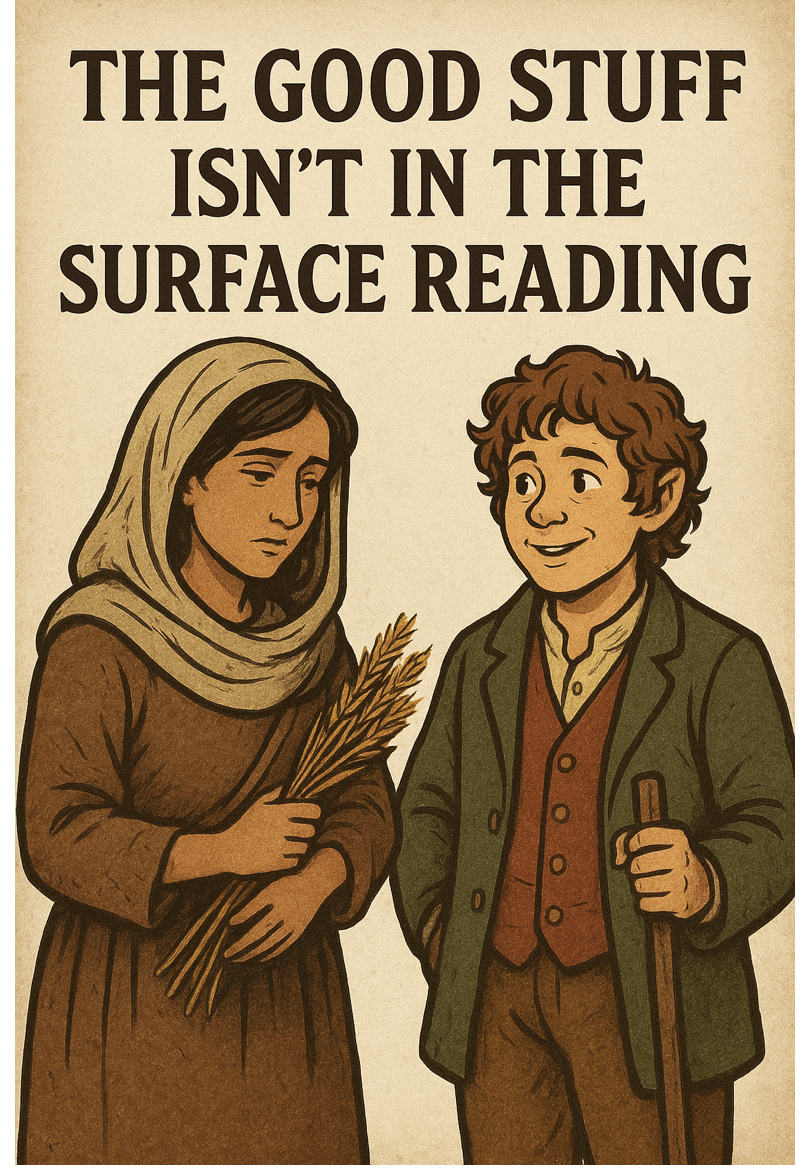
“The good stuff isn’t in the surface reading”

I would like to tell you about this picture.  It will take just a little while because each of the elements of the picture—the woman, the hobbit, and the quotation—has a history of its own.  And then there is the small matter of just how and by whom the picture is assembled.

I have just finished studying the book of Ruth with a group of students I first met at Westminster College in Pennsylvania [1] in the late 1970s.  The basic idea of the course is that Ruth was written in Judea during the period of post-Exilic religious reform.  But it was set in Bethlehem hundreds of years before the Exile.  So we studied each element of the plot of this invented story not just at the superficial level of the narrative, but several levels down—down to where the question, “Why did the author put it that way?—lives.

That question goes to the motivation of the author—always a speculative question—and also to the techniques employed by authors.  The author’s goal, as I came to see it with the help of Edward C. Campbell, Jr’s superb study of Ruth, is complex.  He needs to “suggest” the Bethlehem of that era without describing it and to strongly imply God’s care in a situation in which God is mentioned twice (obliquely) in the four chapters.

The best example I know of building a society and an associated culture is what J. R. R. Tolkien did in imagining Middle Earth and the best analysis I know of Tolkien’s work are the books of Tom Shippey. [2]  So I borrowed Shippey’s analysis of Tolkien’s “world construction” to study the “world construction” done by the author of Ruth.  After all, who knows what 11th Century BCE Bethlehem was like?  And spending the time to describe it, even if we knew, would distract from the story.  This version of Bethlehem needs to be “suggested” just as Middle Earth did. Let’s look at some examples.

Shippey points out the use of Tolkien’s phrase, “the famous Belladonna Took,” who was Bilbo’s mother.  All the work that this phrase does is in suggesting that there are many people who know her.  So her “reality” is strengthened by us for all these people (fictitious) who know Belladonna Took (also fictitious).  Similarly, Tolkien not only gives us the name of King Theoden’s horse (Snowmane) but also the names of Snommane’s sire and dam, neither of whom appears otherwise in the story.  Again, as in “the famous Belladonna Took,” reality is “suggested” and “supported” by what seems otherwise a casual phrase.

Tom Bombadil rescues Pippin from the deadly grasp of Willow-man, an angry man-eating tree.  How does it happen that Bombadil arrives in time? Tom Bombadil says, when he rescues the hobbits from Willow-man, “Just chance brought me then, if chance you call it.”  What else would we call it?  Bombadil doesn’t say what he calls it.  He strongly implies that the notion of an ordered universe which contains “chance” is up for grabs.

Finally, to choose just one more of many available examples, Gandalf says after his (lethal?) battle with the Balrog, “Naked I was sent back…”. He does not say where he was sent “back” from.  He does not say who sent him.  Still, Gandalf appears here as the agent of another.  Another what?

It is devices like this that I offered the Westminster group as ways a setting could be “suggested” without being described.  Then we started on how those devices are deployed in Ruth. 

 The story teller also used here a device that Campbell calls “reusing signal words at long range.”  He means that the several episodes are tied together by common references.  On first meeting Ruth, Boaz praises her for choosing to come to Israel with her mother-in-law to be. “May you have a full recompense from the LORD, the God of Israel, under whose wings you have sought refuge,” he says.  The notion of being “sheltered under God’s wings” is a much used and very familiar expression in the Bible.  More to the point, it would have been familiar to the first hearers of Ruth.

But when Ruth snuggles up to Boaz on the threshing room floor, he wakes up and asks who she is. ” Ruth replies “I am Ruth maid-servant. Now spread your ‘wing’ over your maid-servant, for you are a redeemer.”   From that short exchange, two things can be quickly taken.  The first is that Ruth uses the same notion of “the wing as protection” that Boaz used the day they met.  It doesn’t have the same meaning—God’s care, Boaz’s robe—but it uses the same words and the meanings are at worst congenial.  At best, they mean the same thing.  The second is that Boaz is “a redeemer,” not “Ruth’s redeemer.”

Just exactly what a “redeemer” is in ancient Bethlehem is a matter for speculation and Campbell speculates on it at length.  What it does for us, however is to “reuse signal words at long range” and to suggest meanings that it does not specify.  As readers, we are asked to participate in arranging these meanings and extracting information from what was only suggested.  Like, “if chance you call it.”

These intriguing looks at the story of Ruth are available to anyone who is willing to get below the surface and this Westminster group was more than willing.  They were eager.  And they were willing to pay the price.  These kinds of sustained speculation are work; they cost something.  But if you are willing to do the work, you get to the remark that one of the members made as part of the discussion.  She said, “The good stuff isn’t in the surface reading.”

And Kathy Humphries, my stepdaughter and long a good friend, made several observations on Ruth during the discussion.  Then afterward, she instructed her AI system to create a picture of the two decidedly discrepant figures together and to append to that picture the remark the student had made.  This is the picture that was offered.

Once I gave up trying to see this image of Bilbo as if it were Boaz, I saw the wit in the illustration.  Ruth is the imagined heroine of the imagined Bethlehem.  Bilbo is the imagined hero of the imagined Hobbiton.  Putting them side by side and appending the very perceptive remark of a fellow student simply won my heart,  I didn’t know whether to laugh or cry, so I did both in turn.

I firmly believe this picture is worth a thousand words because that is what is has taken to set the stage.

[1]. There are a lot of Westminster Colleges.  That is why I paused to specify which one.

[2]. From the Shippey collection, I took J. R. R. Tolkien: Author of the Century and The Road to Middle Earth.

Posted in Uncategorized | Tagged , , , | Leave a comment

Paying Attention II

I ended the precursor blog with this paragraph:

That brings me to the lip of the next topic, which is how to reduce the cost of “paying” attention.  It will require a distinction between attending to and attending for.  The latter is the heart of my solution to the problem.

I am really glad I did because I had a vague intention of coming back and finishing the thoughts I had just introduced; then I forgot what I must have had in mind.  This is it: “to” and “for.”  First, I want to establish the two experiences, then establish the same two as intentions.  Then I would like to argue that they do what I say they do and that it is reasonable to expect them to do that.

Let’s take listening to music as the first example.  You can listen to the Sinfony of Handel’s Messiah and say how beautiful some parts of it are.  Or you can listen just for the string bass part.  It isn’t that you don’t hear the rest of the music; it is, rather, that the rest of the music forms a natural and appropriate background to what you are listening for.  How does that happen? 

It is questions like that that help me keep listening to and listening for separate from each other.  I have regular access to a lot more news sources than I can really pay attention to.  And if reducing the cost—how much I have to pay—is the goal, then I can listen for the things I think are most important–the string bass part is an example– and leave the rest to be there as background.

Maybe a political example.  I pay attention to Larry Sabato’s Crystal Ball, a polling and interpretation service located at the University of Virginia.  When I go to his site, I am looking for demographic and political changes I have learned to care about.  Because I am looking “for,” I skip over everything else.

In his most recent report, he talked about the return toward the left wing of Asians and Hispanics who had moved unexpectedly to the right in 2024.  That is something I care about.  I am willing to invest the time to pay attention to it; it is something I am reading for.  Attending “to” the Chrystal Ball is very inexpensive.  It is well within the limits of what I can pay and it is rich in what I am attending “for.”

I pay attention as much as do partly because I have role to play.  It is a little more than that.  Not quite a commitment, but more than an expectation.  I have been an ardent reader of news since 1960 and a professor of political science and associated disciplines since 1966. So, for the last 60 years. I could reasonably be expected to know some things and, if asked, to give accurate information and plausible explanations.

Part of the definition of what I attend for comes from that social setting.  I did a lot of attending to as a public school teacher, when I was expected to know “what was going on.”  At the national and international levels, mostly.  It was the years of doing that that sharpened my sense of what I wanted to read for and made me willing to scan before I read.

Graduate study sharpened the distinction by requiring me to be familiar with much more than I could attend to.  It is in a setting like that that you learn to look quickly over the introduction, the conclusions, and the methodology.  Then you know whether you want to attend for meaning.  Otherwise, attending to is plenty.

Parenthetically, I once pushed this methodology pretty hard to a class of doctoral students I had in a course called “Institutions.”  Some ate it up; some resisted.  But the woman who stays in my mind, resisted initially, then slowly saw the logic [1] and acquired the skills.  She stands out in my mind because I saw her at an alumni gathering several decades later and she told me how much trouble she had had in getting her son to do any meaningful reading.  She gave him the same stern lecture I had given her, and by her account, it worked like a charm.

When, in grad school, I chose political psychology as the focus of my work, the distance between attending to and attending for became both clearer and greater.  I am often inclined to look at the psychological justification of a public action before I look at the policy effects.  But I can also look at a lot of policy effects before I find a justification that interests me.

And then, politics being the kind of practice it is, I will need to attend to all the justifications looking “for” the one that seems to me to have explanatory power.  I want to spend my time on that one, but I can’t find that one with attending to a lot of other things.

“Politics” was defined very broadly at Oregon when I was there. I have since learned that the definition of the field expands and contracts fairly regularly.  It was expanding when I was there and “politics” was sometimes taken to be “authoritative allocation of goods.” [2]. So we had “the politics of the family” and the “politics of the pub” and other fragments.

Attending for the political meaning of politics so broadly defined provides some unusual looks at what is going on and provides you with unexpected allies and opponents. So, among the people I regularly talk to, I am expected to talk about these unusual looks.  It is an honor to recognize that expectation and a challenge to meet it.

To meet it, I have to attend to a lot of material, always attending for what I will need.  Or as one of my students said, “Thank you, Mother Hubbard”

[1] For that group, the metaphor I used was that each assignment required them to go to the cupboard (the available disciplinary reading) and get the particular question they were dealing with.  Get that, shut the cupboard door and go home.  Do not make a survey of everything in the cupboard.  You will still be there at the next class session and you will not have learned what you were assigned to learn.  Take it and go.

[2]. David Easton was always cited in association with that formula, but I am sure he had colleagues who attached themselves to it in the same way he did.  And then the same way we did.

Posted in Uncategorized | Tagged , , | Leave a comment

Steve says, “Let it go.”

I have the chance every now and then to listen to Steve Young, the legendary quarterback for the San Francisco 49ers, answer questions for five minutes.  The questions are asked by Michael Wilbon and Tony Kornheiser of the show Pardon the Interruption, but mostly, they just ask interesting questions and listen to what he says.

Recently, they asked him what a starting quarterback should do if he is out with an injury for a while and his replacement is playing better than he did.  There are rumors that the coaching staff is thinking of just keeping the new guy in the interests of, you know, winning more games. 

The tilt of the question had to do with whether that is fair to the starting quarterback.  I’m going to be a little free with my account of what Young said, partly because all three of us—Wilson, Kornheiser and I—were pushed back in our respective chairs by the force of Young’s response.  This was not, apparently, the first time he had had to face the question.

The way I heard the answer is that the quarterback should take full responsibility for the team’s lousy record, even if he was the only player on the team who was playing well.  It doesn’t matter.  Young didn’t go on to make it ridiculous and Wilbon and Kornheiser didn’t push him to do so, but it would not have been out of line with Young’s opening explosion to say that the quarterback should apologize, separately, for the inadequate blocking of the offensive line, the bad choices made by the running backs, and the dropped passes by the wide receivers.

And following that, he should express full support for his replacement, and pledge to do anything he can do to help his replacement succeed, including helping to corral any dissident players in the locker room.

Does this amount, as Young describes it, to agreement with the decision to replace him.  Absolutely not.  Does it require him to say that the coaching staff has treated him fairly.  Absolutely not.  It does not require him to meet any standard you would care to think of in assessing what the owner, the coaching staff, or the other players have done.

Why?

It is not because he could not make any number of good arguments.  It is because playing the victim will destroy him.  That will happen fast, as Young sees it, and it will follow him from team to team.  It will mark the end of his career as a successful quarterback with any team that would have him.  Taking the position I just described—I have been unfaired against—is going to have two really disastrous effects: a) it will direct his attention in the wrong direction and b) it is going to impede all the functions of the quarterback that happen faster than conscious thought.

There is a standard of fairness in the treatment of valuable football players.  It isn’t the same on every team, nor for every player, but everybody knows there is one.  How you have been treated by the team can be assessed with reference to that standard, but Young’s point, if I heard it correctly, is that no matter what judgment comes from assessing those behaviors in the light of that standard, you lose.  You lose because you are paying attention to the wrong thing.  If the weight of the evidence supports you, you lose; if it fails to support you, you also lose.

Nothing Young said had to do with what was fair.  He was concerned only about the costs of paying attention to fairness. You might have picked that up when I extended the quarterback’s apologies to the deficiencies of the offensive line.  It is not about you and imagining that it is about you will make you a poorer quarterback and, very likely, a former quarterback.

I am less sure about the second point.  I have heard Young make this point enough that I might simply have imported it into this argument.  Or maybe he said it the way I heard it.  I have heard him say several times on this show that he studied intensively the defensive alignments of the team they were to play next.  He did that, he said, because in the game, there will be no time to see and decide.  If you wait until you see what they are doing, it will be too late to respond to it.

But if you saturate your brain with that information and tie it to the actions you would have to take if, if, and if—then all the seeing and deciding takes place before you could be consciously aware of it.  You might be able, looking at film of the game, see what you must have seen at the time—two things you did not expect are happening and three things you did expect are not happening—but you were not aware of seeing those things at the time.  He describes a sequence that would have to be ordered like: I saw, then I acted, then I was aware of what I saw.  The awareness comes last and it comes too late to do you any good.  That is what all the study is for.  It is to make you aware of things you have not actually “seen” yet.

You see how delicate it is?  How intuitive it is?  Young’s point about the displaced quarterback is that if he pays any attention to what has been done to him, all that intricate timing will be trashed.  What works, Young says, are the merest spider webs of anticipation and inference.  None of that works if you are distracted by what they have done to you or, much the same thing, what you will have to do to prove them wrong.

That is what I think I heard.  Let me stop for just a moment to disqualify myself.  I was never a football player.  I did try to play basketball for awhile, but this precise skill that Young describes is what I was so bad at.  By the time I SAW the chance of a pass under the basket to a teammate who was cutting through the key, everyone else had already seen it and the chance was gone.  I never learned to sense, then act, then see, as Young describes it.

I am confident, however, that being unable to peel your attention away from the question of whether you have been fairly treated is deadly.  It does bad things to your work—whatever your work is—and it does bad things to you.  Young called it being eaten up from the inside.  That’s what I remember and I hope that is what he said, because that is true and it’s important.

Posted in Uncategorized | Tagged , , | Leave a comment

Caring for the Stranger

For me, the dramatic center of Niall Williams’ novel Time of the Child is this confrontation between a doctor and a priest.  This interaction takes place in Faha, a very small and very Catholic town in Ireland.  There is emotional power in the setting, aided and abetted by the amount of whiskey consumed by both parties during the confrontation.  There is emotional power as well in the doctor’s venture out beyond his customary independence and restraint.  

In this scene, he is not so much “the doctor” as the father of a young woman who has fallen hopelessly in love with an infant who was brought to the house where her father and she live by people who thought the baby was dead.  It is this circumstance that has forced Dr. Troy to approach the priest, Father Coffey, to make his case.

This is an away game for Dr. Troy.  All of it will be played on Father Coffey’s home field and by his rules.  This will be a hard argument to win, but the father really has no choice.  This is the theological infrastructure justifying an action both men know is wrong.

Here, I would like to recount the story by steps.  In this game, I am the play by play analyst and I will follow the play as it unfolds.  Williams’ text is in italics; my comments are not.

Here, the Doctor tells as much of the story as we need to know.

‘The child was left at the fair,’ said the doctor, when he had resumed his chair. His voice was even and unchanged by sipping his fourth measure. ‘She was thought dead. She was brought here, she revived. My daughter cared for her, then fell in love with her.’

The priest responds with uncharacteristic candor, having already failed to deal with this matter by establishing the facts.

Father Coffey knew something was being asked of him here. He was moved the same way he always was by the truth, which had an intimacy that was privileged and tender, and in its company something essential and profound was occurring. He took a sip of the brandy. Souled. Then leaned forward towards the doctor who still had his eyes closed and asked, ‘What is it you are trying to do, Jack?

In Williams’ look at Father Coffey, he establishes what “the truth is.”  It is what Dr. Troy has just said.  It is that truth which is said to have “an intimacy that was privileged and tender” and in the presence of which “something essential and profound was occurring.”  We can see that it is the relationship between the priest and the father that is privileged, but it is not yet clear what is being said that is “essential.”  What is “of the essence” of this dispute?  What is it that has been, in a sentence of a single word, “Souled.”

As a way out of the thicket, Father Coffey asks the most direct question available to him.  “What are you trying to do?”  But Dr. Troy’s answer returns both men to the briar patch.  What he is trying to do, Dr. Troy says, is “to be a Christian.”

This is the best case Dr. Troy can make to Father Coffey.  In my role as play by play commentator, I think I will want to say that that the case is not true.  Dr. Troy has experienced some very powerful emotions around the reception of this child into his life and into the life of his daughter who “loves the child.”  To do that, he is willing to play the game the priest must play.  Troy knows that the Coffey does not have choice of what the contest must look like, but he does and he knows it.  He must distort “Christianity” into the single demand that we “care for the stranger.”

This one duty—care for the stranger—is “being a Christian” in the present context.  That and no more.  The obstacles are few and formidable. 

‘Only the Church and the State are in my way.’

The doctor launches the next argument.

My father left the Church, or it left him, I can’t be sure which. He could not stay in an institution that had Father Kelly in it. But one evening after dinner he set me a question. “What if,” he said, “what if it’s the people that have a higher sense of what’s right and wrong than those conscripted to enforce it?”’ The doctor paused. He drew his forefinger across the spittle on his mustache, then asked: ‘To love the stranger, isn’t that what God wanted?’

“What if,” the doctor continues, remembering a question his father had asked him, “it’s the people that have a higher sense of what’s right and wrong than those conscripted to enforce it?”’   Here are the opposing teams as Dr. Troy has named them.

“The church and the state”—that includes, most pointedly, Father Coffey—have been “conscripted” to enforce the official, institutionally determined “sense of what is right and wrong.”  In this new alignment, “the people”—not the conscripts—have the higher sense of “what is right.”  The people—that is the doctor in this scene—are free to know and to do what is right.  They have not been “conscripted” and are therefore “free.”

The particular action that is “right” is keeping the baby his daughter fell in love with. [1]  Furthermore, it is the one divine command that is cited in this conversation.  Father Coffey is now back on defense again.  He tried to move to offense by making the doctor the source of the proposed action.  The doctor, rather than God.

“Jack,” he says, You can’t put yourself on God’s level.”  But Dr. Troy is ready for him. In the argument Father Coffey offers him, it is God who knows and God who has the authority to do.  The bereaved father would lose both of those.  The setting he offers instead in difficulty.  Isn’t it more difficult for me to do the right thing here than it would be for God?

“That would be easy. God knows all the answers. I’m trying something more difficult, the human level.”

The question now moves in the direction of authority.  If we are to care for the stranger because God requires it of Christians, then “the people” are only obeying God and the church is only in the way.  It is not a strong point.  It is, in fact, only an accusation.  But Dr. Troy has much more in mind.  He has laid the groundwork for it by the “difficulty” argument and now he can go on offense again.  To stay with the American football metaphor, the father unveils a triple option.  There are three steps.

The first step is to characterize God as a being who, already knowing all our wrong turns, still loves us.  God loves us not because of all these wrong turns (God is a righteous God), but despite them. Father Coffey cannot object to that.

Dr. Troy deploys the second option; he moves away from God’s nature to God’s direct action.

He has already seen that child and seen to it that she was brought to this house, and seen to it that my daughter would love her. 

God’s foreknowledge has now become God’s active providence.  “He has seen to it…”. It was because of God’s providence that the baby was brought to our house and also God’s providence that the daughter would love it.

It is God’s nature to see, to know, and to do.  But God also has intentions for his human servants.  This brings us back to God’s nature. God is not only loving, but He created us with the intention that we should love.  And he is patient.  We are, after all, human beings and God, who knows everything, knows also that He must be patient with human beings.  Here is the argument.

Because in some part of Him, in some part of Him He remembers that He made us with the intention of love. And that no matter how many times, no matter how many ways we find to defeat that intention, it is still there. Still there. 

The “it” in “it is still there” is God’s intention that we should love.  In the context, that must refer to taking the actions love requires.  In cannot mean only having the feelings that such a love produces.  Otherwise, it would make no sense to say that the state and the church are obstacles.

And now, finally, the third option.  Dr. Troy now asserts that God commanded love and that—Love—is what came into our lives (mine and my daughter’s) on the day the baby was discovered and brought to our house.  And, further, that Love beats any regulation made by human beings—any regulation or ruling or decree or code—because Love predates all those that although it was commanded, it did not really need to be commanded.  It was first.  Here is the text of that last point.

And beats any regulation, ruling, decree or code, is beyond all jurisdiction or legislation made by man, because it pre-dates all, didn’t even need to be commanded. Love. That’s my understanding. And that’s what’s in that kitchen. That’s what came to this house the day of the fair. And that’s what I am going to try and keep alive.

It is in that last sentence that Dr. Troy moves from the nature of God and the plain command of God to the situation God foreknew, and on to the actions that he, himself, in going to take—in order to be a Christian, just in case you have forgotten the doctor’s first move..

He is going to try to keep it—Love—alive.  He says it with the capital letter, but he has a particular lower case love in mind and they have become the same.


Father Coffey would have to be very fast off the mark to interrupt the flow of this play.  Williams says that in the space of two breaths, Dr. Troy starts in again.  This time his topic is forgiveness.

‘What I am doing may be wrong. But’ — the finger was pointing again – what I am going to choose to believe is something I heard in church once. Forgiveness. Forgiveness for mistakes made down here, because we are down here, and can only see what we can see and think. This seems the right thing to do. Forgiveness, which I’m going to say seems to me an essential component of, an outright necessity of,’ — he wet his lower lip — ‘love. And so that’s what I’m going to choose to believe in, and in patience and forgiveness that pass our understanding, except where we get glimpses of them, like I have, in that kitchen. Father…

Here he states that he believes in forgiveness.  It is something he heard in church once.  Under what circumstances might forgiveness be required and while we are at it, who is going to do the forgiving?  The circumstances are: a) that the mistakes are made down here, because b) we are down here.  Therefore c) we can only see what we can see.  This is a recapitulation of his earlier case that what he is doing here is more difficult than what God would have to do because we act in ignorance and God acts in full knowledge.

Forgiveness is something he is going to choose to believe.  The first half of the argument says why such forgiveness will be needed.  The second half says why it is crucial.  It is crucial because it is an essential component of love.  And so—this is the reason he is choosing to believe in it—love is an essential component, an outright necessity for love.  

Dr. Troy is going to believe in patience and forgiveness that “pass our understanding.”  No one will miss the allusion to Ephesians 3:19 in which it is “the love that Christ has” that will pass our understanding.  So on the time Dr. Troy was in church, the time he heard about forgiveness, there may also have been a reading from Ephesians, during which time the “passeth all understanding” phrase attached itself to his consciousness.

Williams may be counting on the readers to catch the source of the reference, but we all know that Father Coffey does.  That means that Dr. Troy’s final step is to establish that God knows what He is doing and the he and Father Coffey do not.  Father Coffey, having been forced to play defense is now told that he does not know enough to do even that if it is God who is on the offense.

[1] Love and Forgiveness are brought into the contest, but God’s only real demand is to “do what is right.”


Posted in Uncategorized | Tagged , , , | Leave a comment

Paying Attention to the News: Part I

It’s not as easy as it used to be.  Today, I would like to explore some of the reasons I feel that way and prepare for an essay in which I describe a few of the things I have done to adapt to it.

I call it “paying attention” because I have for some years, treasured the focus that “paying” brings to the idea.  We pay. It costs us.  The metaphor asks us to think about what we get in return for our “payment.”  And lest you think that the problem could be solved by just saying “attending” rather than “paying attention,” I regret to say that it is not a problem that can be solved that way.  The Latin tendere means “to stretch” and adding ad- to the word, (ad-tendere) gives it the sense of “to stretch toward,” which sounds effortful to me.

Picture yourself stretching toward something.  Your desire to grasp it (the object) is naturally opposed by gravity [1] and that is why it costs you to stretch toward, i.e. to attend, i.e. to “pay attention.  That is, in fact, my experience of coming into contact with someone’s narrative about what has happened over the course of the news cycle.  It costs.  Seeing the news costs me more than reading the news, but that’s just me.  I respond to meanings, like everyone else, but I also respond to images.  The negative ones “cost me more” than I am willing to “pay.”

I do, nevertheless, attend to (read) the news.  I will say now that the reason I am establishing this fact—I

do read the news—is so I can consider some of the ways in which I have tried to reduce the cost.  Someone will say that I could reduce the cost even more by not reading the news at all.  That is true, but not knowing the information that I learn in my reading bears other costs, and I am not willing to pay those either.

First, I am a citizen of the United States.  I hold the status that Milton Mayer, the Quaker journalist, called “the highest office in the land.”  I do have some obligations therefore.  I am obligated to play what I think is my part in the governance of the country.  I am always a little nervous about using the language of obligation when I cannot say clearly to whom I am obligated. [2]

Nevertheless, I recognize an obligation to be a part of the governance of the nation—as the Constitution specifies—and that requires that I know some things.  Beyond that, and much clearer in my mind, is the obligation I owe to my fellow citizens, both those who see matters as I do and to those who do not.  To some I owe understanding and support; to others, I owe understanding and opposition.  You see the common element there.  That is why I attend to the news. 

But beyond that, I have preferences for the conduct of the public’s business.  More vigorous words than “preferences” could be used—commitments, demands, causes—but I want to keep “preferences” even though it forces me to say silly-sounding things, like that I have a “preference for social justice.”  I don’t feel that I have given away anything of value by starting with preferences.  It is the preferences that the commitments are built on and the commitments that the public actions are built on.  So I’m OK with “preferences.”

And finally, even beyond that, I have obligations to my fellow citizens, both those in the large collective noun we share and those I see and talk with daily.  I need to know things to cooperate with the larger category and to interact with the smaller category.  

So not knowing what I need to know is not an option for me.  I am reminded that in ancient Athens, the population was divided between those who took part in the public affairs of the state (citizens) and those who led entirely private lives.  The Greek word for that second category of people was idiotēs.

If you recognize the idio- in there, it might remind you of “idiosyncrasy,” and it should.  The idio- is the same.  It means “one’s own;” private.  The idiotēs of Athens were private ONLY.  I don’t want to do that.

That brings me to the lip of the next topic, which is how to reduce the cost of “paying” attention.  It will require a distinction between attending to and attending for.  The latter is the heart of my solution to the problem.

[1] This sets up for a pun about the gravity of the news these days, but that is not where I am going.

[2]. I reject the idea of being obligated to any kind of “what.”  The only way I would say I am obligated to “it” is if the “it” is the name of a collection of persons, in which case, “it” is only shorthand.

Posted in Uncategorized | Tagged , , | Leave a comment

What are the rooks doing?

That is a perfectly reasonable question for anyone to ask who is reading Tana French’s novel The Searcher for the second time.  Or third.

When I first read this book, I opened to the first page and read:

When Cal comes out of the house, the rooks have got hold of something.  Six of them are clustered on the back lawn amid the long wet grass and the yellow-flowered weeds, jabbing and hopping.  Whatever the thing is, it’s on the small side and still moving.

That’s the first paragraph.  It’ the one I want to talk about, but it might not be too far afield to note that further down on that same page Cal considers putting the creature out of his suffering.  He does not because: a) the rooks have been here a lot longer than he has and b) it would, therefore, be “pretty impertinent of him to waltz in and start interfering with their ways.”

The rooks are an important part of the little Irish town to which Cal Hooper, a retired Chicago cop, has moved to have a relaxed retirement.  The rooks never become a major character; they never reveal or interfere with the plot.  That would be pretty impertinent of them.

On the other hand, I now know, having read the book once, that they keep coming back and that Cal thinks about them in several revealing ways.  And since I know that about the story, I was surprised to see them as the major actors—it is hard not to say “a major metaphor”—of the book.  They didn’t have rooks in Chicago; they are new to Cal.  And if they had had rooks, Cal would very likely have felt that he needed to do something about them.

But that was his old life (cop) and his old setting (Chicago) and we learn in this first paragraph that Cal is not feeling that way about Ardnakelty in the west of Ireland.  He is not a cop here.  Ardnakelty is not Chicago.  The rooks were here first. He bought a fixer upper and hopes to live there.

I know what is going to happen in Cal’s life.  It starts to happen two pages later.  But it begins when someone or something disturbs the rooks.  Cal doesn’t care that something disturbed the rooks because that feeling he used to get on the back of his neck—he calls it “an alarm system”—has been turned off.  Why would he need it in the empty spaces of western Ireland?  

Then one night the back of his neck flared.  This is a feeling he learned to pay attention to in his many years as a cop in Chicago and he turned it off when he got to Ireland because he knew he wouldn’t need it.  But something disturbed the rooks.  

The rooks are his alarm system and he doesn’t know how not to pay attention to them.  He just doesn’t know what it means.  Very shortly, of course, he finds out.  The behavior of the rooks is confirmed by the feeling on the back of his neck a few nights later and the plot is off and running.l

When you start the book for the first time, you take the rooks for granted, just as Cal did.  But when you know that their behavior means something and that Tana French is using the rooks to get you ready for it–that’s what I know now–you read it differently.  You know that someone or something would have to play that part.  We have to see Cal as carefully fitting in to his new surroundings.  You know he would not have thought it “impertinent” to check out what a bunch of crows were doing in an alley in Chicago.  But “impertinent” is a real thing here and that hesitancy is emblematic of how he hopes his life will be here in Ireland.

Fortunately for all of us readers, Cal’s impertinence is about to be trampled underfoot and there will be a very engaging story about rural Ireland.  With the rooks returning regularly to remind us that they are there.

Posted in Uncategorized | Tagged , | 1 Comment

The Value of Glory, Part II

Rebecca got the better of the contest last time.  She had a better first half, as we often say about a football team.  But there are two halves, even in the time of Chivalry and the Crusades, and Ivanhoe does better in the second half.

In the first half, Rebecca went on the offensive, taking apart what I have been calling “the glory machine” piece by piece.  She doesn’t deny that there is a machine.  She argues, that it is only temporary and is, besides, rude and tacky.  “Glory” is not worth the price Ivanhoe is paying for it.  Here is his first response.

“By the soul of Hereward! ” [1] replied the knight, impatiently,“thou speakest, maiden, of thou knowest not what. Thou wouldst quench the pure light of chivalry, which alone dis­tinguishes the noble from the base, the gentle knight from the churl and the savage; which rates our life far, far beneath the pitch of our honor, raises us victorious over pain, toil, and suffering, and teaches us to fear no evil but disgrace. 

Ivanhoe here begins to rebuild the value of glory, starting with social distinctions.  It is chivalry—alone!—that distinguishes what is noble from what is base.  It distinguishes the knight from the churl [2].  A churl is a man of low degree, but he is part of the ordered society in which the novel takes place.  The next distinction, however leaves even that.  Glory—only glory!— distinguishes the knight from the savage.

And glory establishes a kind of character in the knight as well.  It ranks the life a knight well below his honor.  The commitment to glory overcomes challenges that would in other circumstances be daunting.  Ivanhoe names explicitly, pain, toil, and suffering.

At this point there are distinctions Ivanhoe makes not only between the sex of Rebecca but also her faith.  I want to come back to that after we finish the glory games.

Ivanhoe here begins to take some of Rebecca’s criticism into account.

Chivalry! Why, maiden, she is the nurse of pure and high affection, the stay of the oppressed, the redresser of grievances, the curb of the power of the tyrant. Nobility were but an empty name without her, and liberty finds the best protection in her lance and her sword.”

Here Ivanhoe begins to address questions that Rebecca has not brought up and very likely has never considered.  She does touch on the topics Ivanhoe raises but only as they bear on the nation, Israel, and only in a very long context of history.  That is not what Ivanhoe has in mind at all.

Chivalry is the backbone of three important transactions, but they can be summed up, as Ivanhoe does at the end, as “liberty.”  Very likely he means liberty for the nobility—that is how it developed in English history—but liberty is the core value he chooses.  We’ ll look here at three elements of that treasured notion.

The first is that chivalry is “the stay of the oppressed.”  Very likely, he has in mind here that a noble class that is being stressed, like the Saxons under Norman rule, can count on chivalry to hold off that oppression.  He doesn’t say that exactly, but it is a good guess that is what he means.  He certainly is not referring to the people whom the Saxon nobles oppress.  He has already distinguished the noble knight from the churl.  No need to go back to that question.  

The second is that chivalry is a redresser of grievances.  Note that in this role for chivalry, the grievances have already taken place.  Chivalry as the stay of the oppressed might mean that the oppression is prevented; chivalry as the source of a redress of grievances grants that there are grievances.

Finally, chivalry is a curb on the power of the tyrant.  A “curb” tells the tyrant that he can come this far and no farther.  It is a limitation.  The tyrant is still there and very likely Ivanhoe is thinking principally of Richard’s brother John, who is pretending the be the king of England as long as his brother cannot be found.

So chivalry, which Rebecca demeaned by her remarks about second rate tombs and third rate ballads, is defended on political as well as personal grounds.

That is really all the argument that deserves to be grasped by its rhetorical elements, but there is one more transaction that I think ought to be touched on before we let this conversation go.  This one has to do with ethnicity—they would have called it “race”—and religion.  Here Ivanhoe has the opening shot.

Thou art no Christian, Rebecca ; and to thee are unknown those high feelings which swell the bosom of a noble maiden when her lover hath done some deed of emprize [3] which sanctions his flame.

Ivanhoe has in mind, although he doesn’t say it, the beautiful Saxon maiden, Rowena.  The match between Ivanhoe and Rowena is the highest hope of Cedric the Saxon, but things are not looking good right now.  I mention that because Rebecca will close with it.

Rebecca is no Christian and therefore she cannot know the feelings which swell the bosom of a noble maiden (he is thinking of Rowena) when her lover (he is thinking of himself) has done “a deed of chivalrous endeavor.”  It is her feelings that “sanction” his flame.  Earlier, Ivanhoe as the champion of the tournament, won the right to officially honor a “Queen of Love and Beauty,” who was watching from the stands.  He chose Rowena.

But Ivanhoe’s idea is that a noble Christian (like a Saxon or a Norman) can understand these feelings and that a Jewess cannot.  She is a lower form of being.  Not a “churl,” as above, but not “superior” as a Christian would be. [4]

Rebecca’s response is noteworthy.  I will give you two pieces of it: the one she speaks aloud; the other she murmurs to herself.  Here is the public one.

“I am, indeed,” said Rebecca, “ sprung from a race whose courage was distinguished in the defense of their own land, but who warred not, even while yet a nation, save at the command of the Deity, or in defending their country from oppression. The sound of the trumpet wakes Judah no longer, and her despised children are now but the unresisting victims of hostile and military oppression. Well hast thou spoken. Sir Knight: until the God of Jacob shall raise up for His chosen people a second Gideon, or a new Maccabeus, it ill beseemeth the Jewish damsel to speak of battle or of war.”

The race that produced Rebecca showed its courage in defending its own land but attacked no one else “save at the command of the Deity.”  She grants that Ivanhoe’s criticism is plausible, but only until “the God of Jacob shall raise up a national hero.”  Until then it is unseemly for a Jewish woman to speak of war.  But then…she allows the next stage to linger on…maybe it will no longer be unseemly.

That was the public response.  Here is the private one.

“How little he knows this bosom,” she said, “ to imagine that cowardice or meanness of soul must needs be its guests, because I have censured the fantastic chivalry of the Nazarenes! Would to Heaven that the shedding of mine own blood, drop by drop, could redeem the captivity of Judah ! Nay, would to God it could avail to set free my father, and this his benefactor, from the chains of the oppressor ! The proud Christian should then see whether the daughter of God’s chosen people dared not to die as bravely as the vainest Nazarene maiden, that boasts her descent from some petty chieftain of the rude and frozen north! ”

He thinks I am cowardly, Rebecca says, because of what I have opposed in him.  She refers to it as “the fantastic chivalry of the Nazarenes (Christians).” She means “fantastic” is a form of “fantasy,” i.e. of self-delusion.  She promises to herself that she would gladly close the shedding of her own blood drop by drop if it could free her father and also Ivanhoe.  

Question: How bravely could she die?

Answer: As bravely as the vainest Nazarene maiden (slap #1) who boasts her descent from some petty chieftain (slap #2) from the rude and frozen north (slap #3).  

It is probably a good thing she spoke these last thoughts only to herself because the vain Nazarene maiden she has in mind is almost certainly Rowena.t

I began by celebrating the kinds of things you can turn up by reading well-written books over and over.  I rest my case.

[1]. Hereward is a major figure in English lore, representing both resistance against the Normans and also the moral commitments underlying chivalry.

[2] A word modern English knows only from churlish, but it carried the connotations of low is standing and unworthy.

[3]. From about 1300, the term has referred to “deeds of chivalrous endeavor.”

[4]. It is probably worth a note that “Christian” in Ivanhoe’s lexicon is a racial and social category, not a religious one.  In has nothing to do with personal religious faith.  Rebecca’s embrace of Judaism is a good deal more authentic.

Posted in Uncategorized | Tagged , , | Leave a comment