This picture appears in the Netflix series HUMANS (with the A upside down) to advertise a whorehouse that has no whores in it. All the erotic services are provided by robots who, in this series are called “Synths.” It’s a very good choice for a designation because it is built on the adjective “synthetic.” That means you don’t have to answer the question, “Synthetic what?”
Synthetic what? is the question that drives the series.
Think, however, what you would do if you had the job of designing an emblem that would indicate just what kind of place this is. It is a place where very convincingly human robots offer very convincing performances of erotic encounters. I think whoever designed this symbol should get an award.
No man–they show only men as customers and only women-appearing robots as providers of services–is going to think of himself as that blue cogwheel. He is going there to obtain the services of an entity he is happy to think of as a pink cogwheel, but he, himself, is, of course, a person. And, during his time there, the person in charge.
Just being human, I guess
Right. Except that is not what the sign says. The sign says that if you come in here and pay your money up front, you get to be a blue cogwheel. You can feel any way you want to at the time, but we are telling you what we think of you and what you really ought to think of yourself.
Laura Hawkins, the mother, stands in the upstairs hallway, looking into the middle distance. Her teenage daughter Mattie, says, “Mom? What are you doing?” Her mother responds, “Just standing here being a shit mother.”
That seems harsh. Here is the interaction that just preceded that.
Laura wakes up her daughter, Sophie. “Time to get up. I’ll go and do your lunchbox.” Sofie says, as an afterthought, “Can you cut off the crusts, like Anita does?”
The show begins with an advertisement for the new household robots. [1]
“Could you use some extra help around the house? Introducing the world’s first family android [mechanical maid] What could you accomplish if you had someone, something, like this?”
The “extra help” the advert [1] refers to comes in the form of a Synth, programmed for household chores. Just what those “household chores” would necessarily include is not touched on by the advertising. What they might come to include, if the Synth turned out to be better at something than the parents are, is one of the main themes of the show and why I like it so much. [This is “Anita” (in other plots, “Gina,” played by Gemma Chan, reading to Sophie.]
I’d like you to keep the expression “extra help” in your mind as you consider Sophie’s request, “Can you cut off the crusts….like Anita [the family Synth] does?” It is clear that in the advert, it is presumed that you will go on about your life, off-loading the onerous or inconvenient jobs to the Synth. It is clear in the interaction between Sophie and her mother that a new and higher standard of lunch-prep has been set by the Synth and now it is up to the mother to meet that new standard.
And as soon as you see that event, you say, “Or course. How could it be any other way?”
Toby, the teenage son, has a weight problem. He takes one look at Anita and says, “Why did they have to make you so fit?”
Mattie, the super-techie older sister, tries to reprogram Anita with far-reaching consequences, none of which Mattie had in mind. At the Hawkins’ home, Mattie speaks rudely to Anita so that her mother will tell her such language is appropriate so that she can tell her mother, firmly, that it is exactly appropriate for a “being” like “Anita.”
Joe, the husband, is the “primary user” (purchaser) so Anita is “bonded” to him in a special way. Also in some ordinary ways. For instance, Anita comes with a special sex packet called 18+ and, at Joe’s request, she instructs him in its use. They have what would be a “fling” if she were human and the next morning she is back to Synth mode, impersonally polite and helpful to everyone.
I asked you to try to keep in mind the expression “Extra help around the house” which is featured in the advert.[2] Does any of this sound like extra help around the house?
One night at bedtime, Sophie asks Anita to read her a story. “No, no,” Laura intervenes, “that’s a mother’s job.” Sophie says she would rather have Anita do it. “You read too fast,:she tells Laura. And we hear, “You always seem to be rushing through the story so you can go do something else.” Which is probably true. Anita doesn’t have anything else to do until she has to power up again that evening.
The show, which is called HUMANS, with the A upside down, is an adventure show too because some tech genius David Elster, has begun secretly producing “special” Synths who have something like a “self” and who desire autonomy. And then there is a cop who is trying to chase down these special “deviant” Synths. But these are spectacular problems. The problems I find more engaging are that we would need to find a way to be adequate human beings in a world full of non-human beings who are better at everything than we are. They perform compassion better than we perform compassion. And if you think that the truly human job is to seem compassionate when and only when you feel compassion, I say welcome to the world of parenthood.
These problems are not at all unrealistic and they are not very far away either. Sherry Turkle’s book, Alone Together is a wonderful introduction to the issue. Having interactive robots around divides the world of your own feelings and responses right down the middle. We want to criticize them because their actions are not “authentic.”
Knowing all the while how many of our own actions are not authentic and wondering whether that is a distinction we can afford to make. Or afford not to make.
[1] No one has used that term yet. People refer to them as “Synths.” The Synths themselves refer to themselves as “appliances.” [2] Since it is a British show, I have decided to call all the ads, “adverts.”
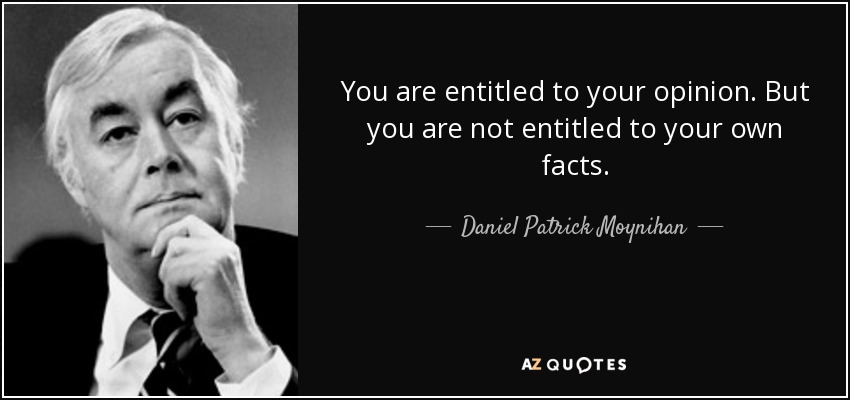
On balance, yes. It isn’t as easy a question as Sen. Moynihan seemed to think when he admonished his colleagues that they were entitled to their own views, but they were not entitled to their own facts.
There is a sense in which Moynihan’s Aphorism is obvious. It is easy to give examples, but the examples that first come to mind are examples from the physical sciences. What star is nearest Earth? Alpha Centauri at 4.3 light years. How far away is the moon? I hear 240,000 as an answer and, of course, that is not wrong. It just isn’t always right.
Even the facts we are certain of are facts of convenience. They are averages or ranges of values. They are simplifications of more complex realities. For instance, Alpha Centauri is not a “star.” It is the name used for the collection of stars comprising the star system made up of several bodies. Are these “facts of convenience” really “facts” in the Moynihan sense of the term. I don’t think so.
When you move from the natural to the social sciences, the boundaries of “facts” get a lot fuzzier. If you imagine that there is a “true range” of a fact—outside the boundaries, the assertion can be shown to be false—then you can see that there is room for a lot of variation within the “true range.”, How wide the range is depends on why you need the fact. If you need more exactness for some reason, you narrow the range of “correct.” An answer is a fact for the original purpose, but inaccurate (not factual) for the second purpose. Unsettling, isn’t it?
I am taking an eighth grade arithmetic test. What is the value of pi? You see the problem.
Are we entitled to our own inferences?
Facts aren’t all that important by comparison with valid inferences. Debaters are taught to support the position they are assigned by collecting facts that make the case compelling. Given that all the “facts” they cite are demonstrably true, does that mean the conclusion is inescapable? No, of course not. The opposing team is making the opposite argument—and giving the audience reason to doubt yours—using facts that are as true as yours. Could it be that Team A is entitled to their facts and Team B to their facts? Of course. You don’t have to invalidate the other “facts.” You can get the same job done by ignoring them—if the other team will let you.
What does this collection of fancy dancing do to the Moynihan Aphorism? Nothing really. His statement—attributed to a lot of other people too—is perfectly adequate for the purpose he has in mind. I think it does lead us astray, though, in imagining that we would come to the same conclusions if we relied on “the facts,” and as I remember Moynihan, that is what he meant.
Every story you want to tell has a set of verifiable facts that make it seem plausible. What we find really offensive is the use of facts which, together, seem to point to a conclusion that is utter nonsense. The art of implying an inescapable conclusion by selecting which facts to present is highly valued these days. And it cannot be attacked by showing that this or that fact is “wrong.” It can be attacked only by showing that apparently contradictory facts are also true.
If I am free to choose what argument to make, then I am entitled to choose the facts that support that argument, presuming, of course that all the “facts” I cite are demonstrably “not false.”
Some years ago I read an article that said that the public schools in Georgia were issuing gummed tabs to put in biology texts. The tabs said “Evolution is a theory, not a fact.” My immediate response was that given the educational setting in the schools they described, that probably had very little effect on what the students thought about evolution. What concerned me—I was alarmed, actually—was what it taught the students about the relationship between facts and theories. Here’s the truth. Theories that are fully supported by factual studies are worth relying on. Theories without such support are not worth relying on. “Facts” don’t add up to theories. That’s not how it works. And every student in Georgia who believed the premise—not the argument—of those little sticky tabs in the loser.
If the problem we face is that people are asserting the truth of propositions that can be shown to be false, then it is easily solved. If the problem is that the logic used to connect these facts is one of several that would do the job, then the problem is harder to identify and also harder to correct. What threshold should should an argument have to pass to be considered plausible? What other conclusions could be drawn using these same facts, but approaching them with new presuppositions. Those two questions show why it is harder.
But, as much as we would wish it otherwise, many arguments are based on values that are not widely shared. If I want to show that “they”—you get your pick on identifying “them”— do not have my interest in mind, I can make arguments as fast as you can destroy them and when you have destroyed the last one, I will be of the same opinion as before. It is a view I need to hold and I can generate facts faster than you can destroy them provided that I can say what generalizations are supported by the facts I cite. The generalization is that “they” do not have our interests in mind.
I am as discouraged as anyone by the way wholly specious arguments dominate our discourse in the U. S. today, but we have those differences because we have different values. The values rely upon different kinds of logic to connect one fact with another and to argue for the the generalizations they point to. And the facts are facts—good enough for the purposes for which they are being used.
Facts are just bullets. You don’t have to know how guns work to fire them.
I want to wind up talking with you about the current series, “Manifest.” [1] I would like to start, however, with a line from Pay It Forward. The line is, “We’re not allowed to pay it back.” I am counting on you to know the story, but I want to highlight “we,” and “allowed.” There is a definitive prohibition of some sort that applies to all the members of some unspecified category. Who allows? Who forbids?
From there, follow me on to Ghost. There is nothing religious at all in Ghost, but we know what happened because Sam Wheat (Patrick Swayze) hunts around after he is murdered and finds out. Then he finds a way to communicate the facts to his girlfriend, Molly Jensen (Demi Moore) by means of a psychic, Oda Mae Brown (Whoopi Goldberg). So we know everything. Sam tells Molly to go to the police and tell them what actually happened and here we run into difficulties. The police have not had access to the information we have and that Molly has and they are forced to treat her report just the way they would treat any such report. They get a lot of reports like this and there would have to be some reason for them to believe this one, while continuing to reject the others. [2]
“Manifest” features an “event” that happens to Flight 828 and that strongly affects 19 of the passengers. We get the information the passengers get. We hear the voices, we see the visions, and so on. We don’t know exactly what they mean—and neither do the recipients—but we know that they are called on to intervene in “normal life” on the basis of this private knowledge they have. That’s difficult.
Ben Stone’s son, Cal, for instance, is being treated for cancer. There is an experimental treatment that shows promise, but it requires that the protocols be followed strictly. That’s the professional part. On the other hand, Cal is linked in some kind of “mind meld” [3] with a Romanian passenger who was stolen from Flight 828 and being used as a guinea pig; high voltage electricity being put into his brain. Because of the mind meld, whatever happens to the Romanian, happens to Cal. That requires the medical professionals to interpret what they are seeing within a completely foreign (and flimsy) frame of reference. They are reluctant to do it, of course.
Really Engaged. Not Followers
When they stop the experiment on the Romanian, Cal improves instantly but, as the doctors say, “Sometimes people just get better.” This isn’t seeing some amazing event beyond your ability to explain it. This is rejecting the professional explanation you trust in favor of a completely wild and unsupported hypothesis based on body snatching and, who knows, maybe aliens.
This is what I am calling “the religious point of view,” not that it is presented as religious in the series. It is transcendent rather than immanent; it requires you to ignore what your training tells you, in favor of someone’s wild-sounding scheme.
There is another presentation of religion, however. We know two things about it. The first is that it is fraudulent from the first moment of its existence. Adrian Shannon was on Flight 828, so he was wherever the plane and its passengers were for the unexplained five and a half years. But they have no sooner landed than he becomes Brother Adrian of the Church of 828.
The second thing we know is that it looks a great deal like a conservative charismatic church. They have a very small liturgy they share, like “Blessed are the children of the returned” They have a representation the the plane that looks very much like a cross. They have the hands in the air style of participation. This is “What religion really is” as far as the presentations the show offers. I am calling in “the institutional point of view.”
Brother Adrian’s “Church”
It is not hard to be disgusted with “the church of 828” but it is very hard to be confident in the “callings” the principal characters—nearly all passengers. We see them “get” the calling or see Cal’s crayon drawings of what is going to happen, but we don’t know what this force is, so our trust is in the people we see.
The church of 828 points beyond itself, but fraudulently. The real “break the frame of everyday life” transcendent religion gives us nothing to believe in. This religion thing…it’s not for sissies.
[1] Certainly one of the cleverest titles I have seen.It is not only that there are several possible meanings, but that the meanings are so very different from each other. The manifest is the list of the passengers on Flight 828. But something also, a transcendent intentionality of some sort, is “being manifest” i.e. “shown.” [2] Molly gives then a reason like that, information only her source could have had, but the police have no reason to treat it as special. [3] It’s a Star Trek reference, even though the use of the brain to control limbs remotely is now possible. You do see it every now and then when He meets Her in a bar and their eyes meet across the room and they share the same thought remotely.
There are so many different ways something can be funny. I have been blessed with kids who wonder just why it is that something is funny. That’s a good thing for me because it means I have someone to talk to about it or, when necessary, to argue with about it.
Max Eastman in The Enjoyment of Laughter says that two things are required. There needs to be a sensed discrepancy and the discrepancy needs to be taken playfully. Those two things.
That seems simple, of course, but you don’t need to be able to say just what the discrepancy is to find it funny. “There’s something about that sentence,” people will say, or, meaning no criticism, “There’s something wrong with it.”
My son, Doug, has recently begun producing what he calls “sticky comics”—“stick” for “stick figures.” I love them. Having the stick figures there allows you not to notice that there is nothing really there but dialogue. There are no “raised eyebrows,” for instance, so Doug has to give someone a line that would be said by a person—a person who had a conventionally equipped face—with raised eyebrows.
We almost always agree on which ones are really funny, but lately, we have been coming up with different answers on just why they are funny. That’s what I would like to work through today. Here’s one, for instance.
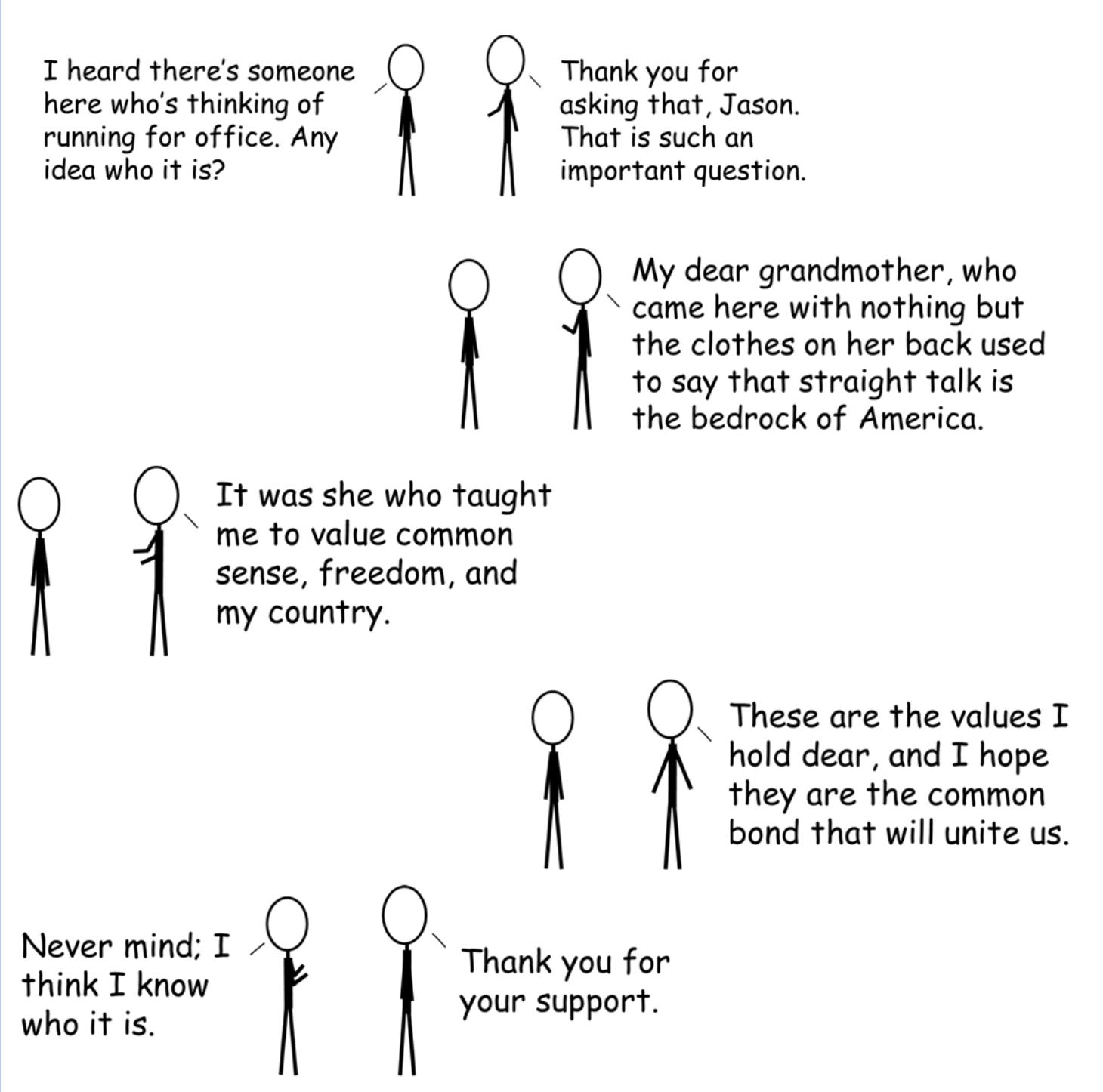
We have an introductory question. These comics are published in an internal newsletter, so “someone here” refers to the organization to which all the readers belong. Then there are four highly stereotypical responses, none of which appear to be an answer to the question, but as we see in the questioner’s second speech, they actually do answer the question. And the correct answer, the one implicit in that second speech, is confirmed by the last line. But not directly.
Three things happen after the question is posed. First, an answer is given. Just how it is an answer is the artistic achievement of the panel. Second, the answer, still not named, is recognized: “Never mind. I think I know.” We may not know yet. Or we may know, but have not yet called it anything. Third, the correctness of the answer is confirmed, still without directly saying what it is.
That’s a lot that’s left hanging. “Left hanging” runs the risk of gravity and gravity is the enemy of levity. This comedic form really shouldn’t work, but as you see, it does. “Left hanging” runs the risk of alienating, or at least failing to connect with, readers. But the last line can’t confirm that “what’s discrepant” is really what the reader suspects. It needs to indicate, but not to confirm.
Comics that play with meaning that is almost there really shouldn’t be this funny. I guess that’s the true art. Imagine that the three steps worked like this: a) I hear someone is running for office, b) Yes, I am the one, c) Ah. These are the ame steps. Not funny.
I think we are meant to be still assembling the common element in the four mini-speeches, trying to think of what name to give that common element, when the first speaker nails it for us and has the guess immediately confirmed. This is a comic for people who are saturated with American political images. Only in that way can Doug afford to be as indirect as this and still count on our arriving with him at the same conclusion.
Note, however, that the most significant step toward meaning comes in the penultimate speech. The rhythm is da da da DA da. I am not saying that da da da da DA would not be funny nor am I saying that da da da DA DA would not be funny. I am saying only that those other forms would not be funny in the same way this form is. This form, I am saying, is characteristic. It is very close to “defining.”
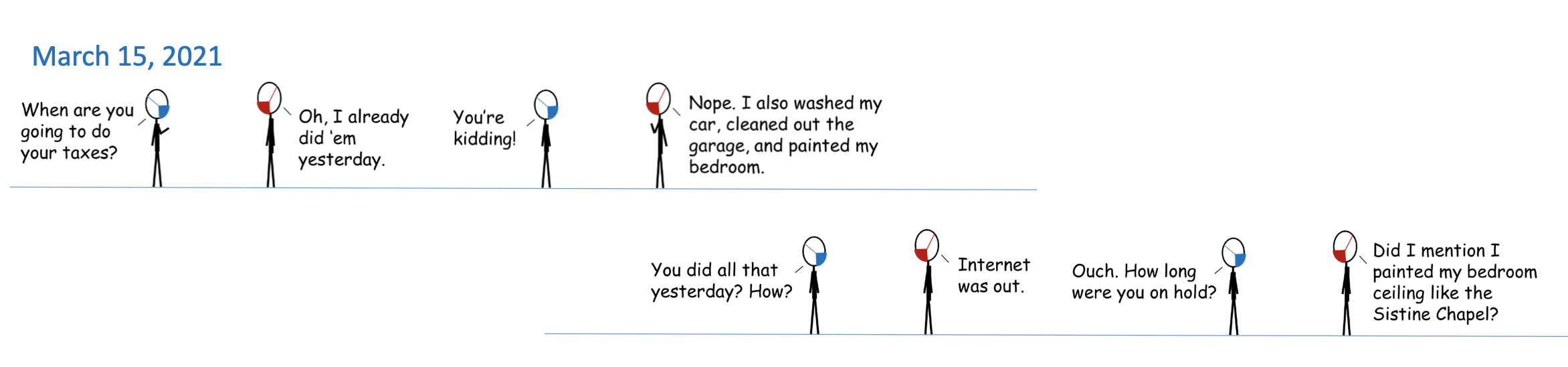
Let’s look at another one.
I don’t think I will have to be so wordy this time. There is the opening question again. There is the “answer” again—a set of seemingly unconnected remarks with a implicit commonality. Then the realization of what that commonality is; then a response indirectly confirming the correctness of that answer. It goes da da da DA da, just as the previous one does. You might think that an answer as wordy as the last speech (12 words, including a high flown cultural reference) doesn’t deserve the lower case “da,” but I think it does. I gives the answer “I was on hold for a very long time, thanks for asking” simply by adding the third “achievement” to the first two.“
The internet was out” is necessary, but it isn’t funny. It has no relationship to how much Red got done. “On hold” supplies that. It is the DA. But is followed by a nice small da. Ah.
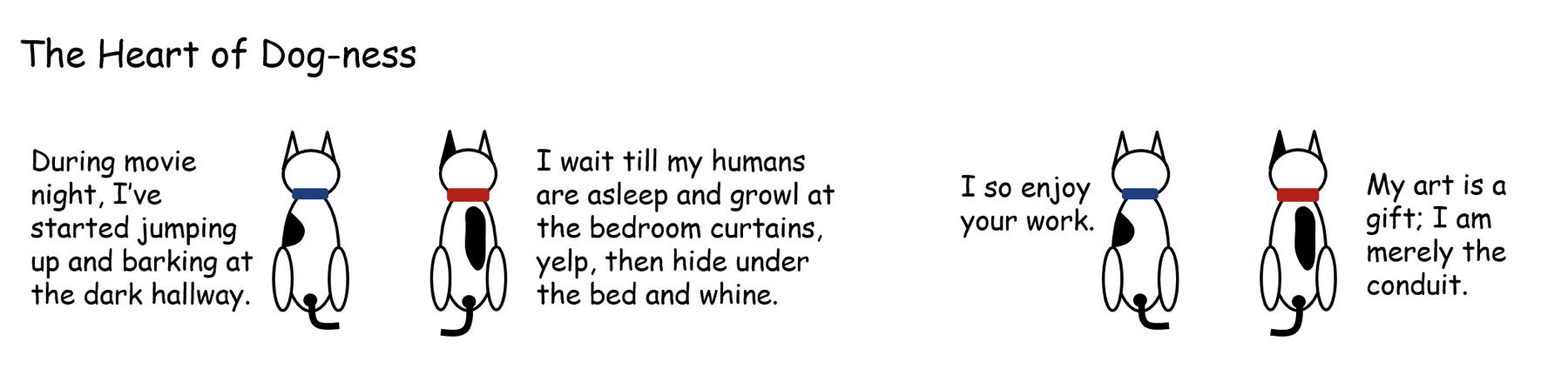
On more. This one looks simpler, but it isn’t really. There is no introductory question. That would introduce some conversational distance between Red Dog and Blue Dog and that would be fatal. Blue says ‘I do this” and Red says “I do that.” We have no way of knowing whether those are to be set against each other or not. If Red responded, “You do? Really?” it would be understandable. But that’s not what is going on.
This one is all about the commonality of the two dogs. There is what to call it—the title calls it the heart of dogness—and then there is how to appreciate it. All that is accomplished in “your work.” That is a line that belongs to another kind of conversation, one artist to another—painters, screenwriters, standup comics, landscape gardeners. We don’t expect to find it here and that is the discrepancy.
Note that there is a shortage of das here. I would call this on da da DA da at the most. Maybe just da DA da. It is crucial
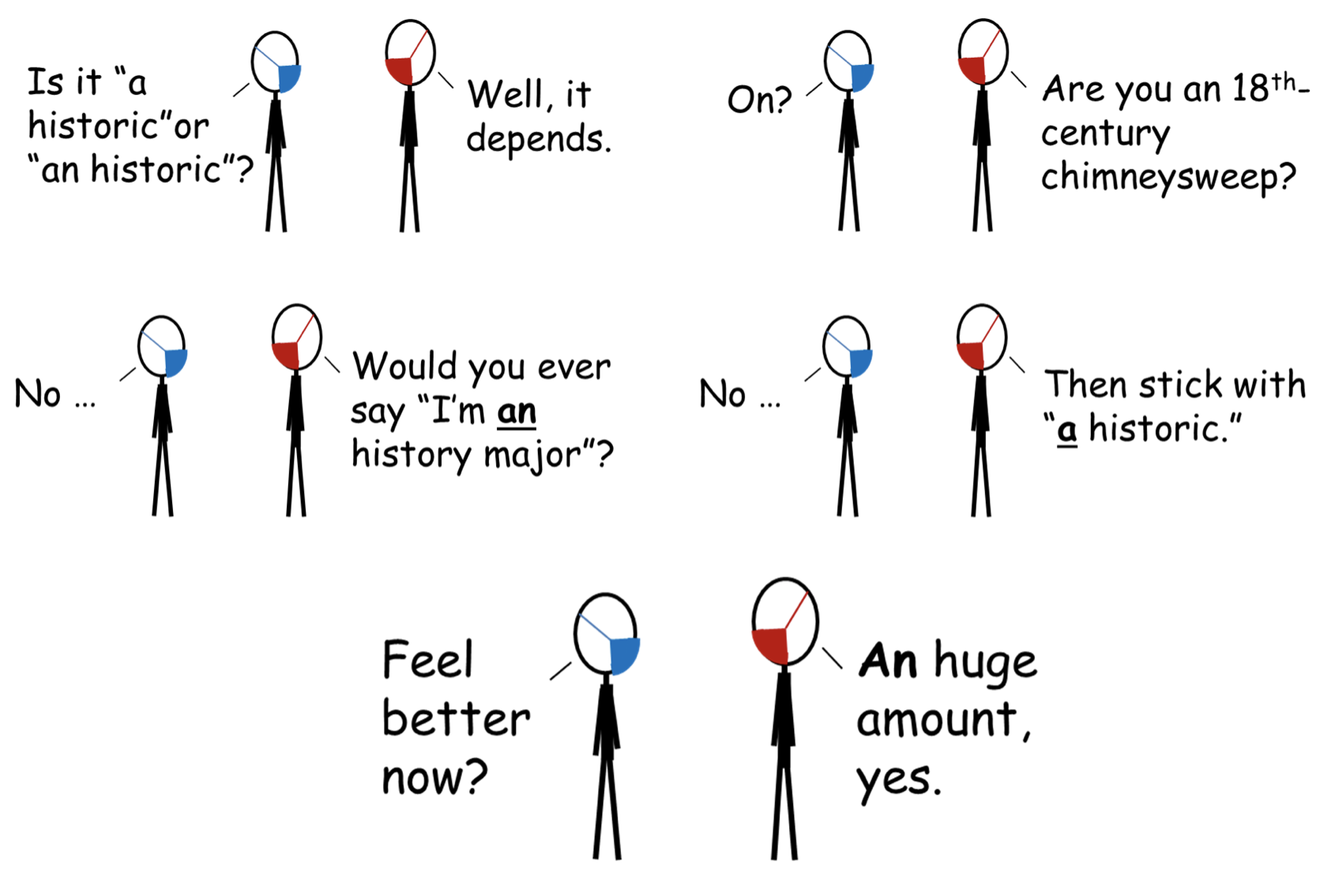
Finally, here (just below) is the one that got Doug and me talking about his patterns. I don’t think I have a criticism. I’m not sure. I might. What I am sure of is that I read it prepared for da da da DA da and didn’t get it. I think the last DA is too big…has too much weight. Or something.
Blue asks the question. Red goes overboard in answering it. That’s how I read it. The chimney sweep line is almost nasty. The next one (contemporary) is useful, but unusually prescriptive. That is what makes us read the penultimate line as DA. It is Blue’s response to the snarkiness of Red. But given that, shouldn’t the last line, be simply a recognition of Blue? That is the way the other two function. They go da da da DA da. This one goes da da da DA DA. It’s very upsetting.
Doug doesn’t read it that way and the two of us are just beginning to develop humor formats (which are not funny, I grant you) for the sticky comics he writes, and which, in the proud papa’s judgment, actually are funny.
I will not surprise anyone by observing that authoritarian populism has taken hold in the United States. Donald Trump never made the slightest pretense of valuing democracy as a system of choosing leaders. There were other things that were much more important, such as, for instance, “Making America Great Again.” In light of that, it occurred to me this morning that we might pay for attention than we have to the various Hitler centennials. [1]
If we did that, we might begin that observation with a paragraph that starts like this
On July 29, 1921, Hitler assumed leadership of the organization, which by then had been renamed the Nationalist Socialist German Workers’ Party
For this part of Hitler’s career, we might take the failed Beer Hall Putsch of 1923 as an orienting event. This connection came to me a little late, so I failed to notice that only 77 days ago—that’s a century and 77 days, of course—Hitler became the official leader of the Nationalist Socialist German Workers’ Party (the NSDAP) in Munich. By starting there, we would have laid a good foundation for us to begin noticing what he did to plan military-style action (premature, it turned out) against the state.
It would be fatuous to claim that the rapid rise of populist authoritarianism in Germany in the 1920s would look just like the rise of populist authoritarianism we are facing in the United States. On the other hand, it would be just as silly to refuse to see the similarities. Here are three:
Hitler believed, as did many Germans, that Germany had once been great and that its greatness had been stolen from it. All he wanted was to “stop the steal” and return Germany to the status it deserved.
Hitler believed that democracy as a system was weak and specifically, that it was inadequate to the present crisis. On the other hand, especially after the failed military action in Munich in 1923, Hitler saw that the democratic system was the best chance for the Nazi party to take power. It could be—and was—discarded after that.
Hitler drew on the economic difficulties of a large swath of the German people after the war. They were angry anyway. Hitler only needed to focus their anger on useful projects and on vulnerable populations
Macht Deutschland wieder gross
English and German don’t line up all that well as languages, but I notice that Hitler’s Stormtroopers the Sturmabteilung wore something that looked very much like an American baseball cap. That being the case, I can imagine MDWG—Macht Deutschland wieder gross—printed across the front very like MAGA is used by Donald Trump partisans. My German isn’t all that good, but I claim that is a plausible version of “Make Germany Great Again,” which was, in fact, the heart of Hitler’s early rhetoric in Munich.
It could be objected that this is simple mockery, but I don’t think it is. There are certain steps that the Nazis of Munich saw to be necessary if they were to become the dominant right wing party in Munich, in Bavaria, in Germany. These steps can be illustrated by the events of 1919—1923 as they played out. Each event can serve us, a century later, by drawing attention to what that event meant in southern Germany and by asking ourselves what a similar event would mean in the U. S.
I think that may be worth doing and I have a first example in mind. Hitler and a group of young strong “lads” [2] started a full scale riot in the Löwenbräukeller. The Bavarian League was meeting there and their leader, Otto Ballerstedt was speaking. Hitler and his group turned out the lights and attacked the meeting in the dark. The police were called and closed down the meeting. Hitler was given a warning. A month later, in a speech, Hitler defended the violence by saying, “We got what we wanted. Hallerstedt did not speak.”
The crucial organizing principle of the NSDAP was the “Führerprinzip.” This principle demands that a strong leader is to be obeyed unconditionally. Or, more practically, that “the leader’s personal authority replaced majority voting in the party.” [3] Think for a minute what that means. It means that loyalty is not given to the “party principles” if any; it is not given to the nation. “Make Germany Great Again” is folded entirely into “Make Hitler the chancellor with complete power.” The two are the same thing.
The implications for the U. S. are troubling because the worse things are, the more appealing actual leaders are and the less important principles are. In good times, all the members of the party are expected to “support” the party platform. Now when large-scale economic change is under way and the mechanisms of democracy are under threat, “supporting the party platform” just doesn’t seem enough. We feel a need to support the party leader.
If the party leader himself/herself supports the the platform, the extent of the damage will not be apparent, but this puts great pressure on the party leader. If support for the leader were contingent on the leader’s support for the platform, the leader would be insulated from the worst of those pressures. Failing that, the choice must be made over and over whether to seek fidelity to the platform or concrete and immediate political success. Every leader will lose that eventually.
That is why veneration of some “Glorious Leader”—the very heart of today’s authoritarian movements—is so important to such a movement and also why it is so important to the rest of us, who are committed to democracy as a way of choosing and constraining our leaders.
[1] This does not require that we celebrate them, of course, but it might be worth our while to begin tracking them. [2] His term for them according to Ian David Hall’s Hitler’s Munich, p. 94 [3] Hall op. cit. also Mein Kampf, pp. 349—350..
It is early in the morning at Starbucks. Customers have drifted in and have left. I am the only one here at the moment. The store manager, Geoffrey Mlady, takes that moment to assemble the baristas. He wants to check out who will be doing what job for the next few hours.
But he begins by asking them, “What is our store vision?” I could hear that clearly from where I was sitting. The answers were hesitant and muffled, but eventually one of the baristas gave the answer the manager was looking for. I couldn’t hear it, so I went up to him and asked him what it was.
Here’s what it is: “Grand and Awesome.”
Obviously, that requires a little context. First, I would like to note that the founder of Starbucks, Howard Schulz, wrote a book about how he wanted Starbucks to work and he called it Pour Your Heart into It. So the manager of this Starbucks is clearly playing on the home court.
Second, each store in Portland is listed by its location. This store is located at—the nearest major intersection is— the corner of Grand Avenue and Lloyd Boulevard. The “convenience name” of the store is “Grand and Lloyd.” That’s what the manager is playing with. Grand and Lloyd is a location; Grand and Awesome is a way of saying what their vision is. It is who we are or at least who we can be at your best.
A vision isn’t a blueprint. It’s an artist’s rendering and if Geoffrey Mlady is, as I suspect, the inventor of that phrase, then he is the artist. He wants his staff looking in the direction of “who we could be.” He wants “We are awesome” to be part of the background of the decisions the baristas have to make. Some of those are easy, at least at the beginning of the shift. It’s just serving coffee to people who have come in because they like Starbucks coffee.
But some are difficult in principle. People come in off the street and want to abuse the facilities. People, in this lingering COVID era, want to sit at tables that are marked TABLE TEMPORARILY CLOSED and they have to be asked (awesomely) to move to another table. Or refused (awesomely) a free coffee on a cold morning.
The reason the manager wants “are you being awesome” reverberating in the back of everyone’s mind is that it is not a question that comes up naturally all the time. And it doesn’t require the same kind of behavior from you all the time either, which is why he said, “Whatever that looks like to you, do it.” You have to be firm sometimes. You get to be friendly sometimes. You have to compensate for “customer error” sometimes. “Awesome” looks like different things at different times and you have to make those decisions on the fly and you won’t make all of them right. Keep going. We are Grand and Awesome.
And we aren’t if you aren’t. Good job, Geoff. That’s awesome.
I have been watching a British cop show called New Tricks. [1] There has been a nearly total (one holdover) substitution of new actors for old. That may be the difference I am noticing. But I also think the writing has gotten better. Certainly I find myself enjoying it more.
I have an example.
In Season 11, Episode 1 there is this exchange between a very unattractive man and a very attractive woman.
This is Tamzin Outhwaite. She is the new head of UCOS, That’s the Unsolved Crime and Open Case Squad. The very unattractive man she and her colleague Gerry Standing are questioning, expresses a real interest in dating her. She just keeps on being the cop doing her job. He is disappointed. He says,
You know, I was seriously considering asking you out.
Her response was as dry an anyone could wish.
I think I’ll learn to love again.
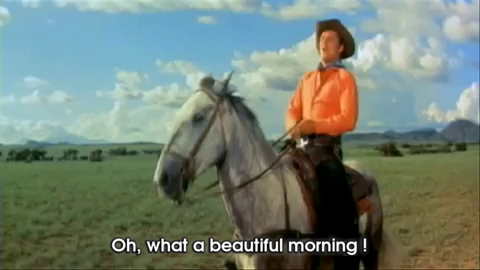
[1] The joke is that a new unit of police has been invented and they have no personnel budget so they have to use retired cops. Old Dogs, as were.it
I will not surprise anyone by observing that authoritarian populism has taken hold in the United States. Donald Trump never made the slightest pretense of valuing democracy as a system of choosing leaders. There were other things that were much more important, such as, for instance, “Making America Great Again.” In light of that, it occurred to me this morning that we might pay more attention than we have to the various Hitler centennials. [1]
If we did that, we might begin that observation with a paragraph that starts like this:
On July 29, 1921, Hitler assumed leadership of the organization, which by then had been renamed the Nationalist Socialist German Workers’ Party.
For this part of Hitler’s career, we might take the failed Beer Hall Putsch of 1923 as an orienting event. This connection came to me a little late, so I failed to notice that only 52 days ago—that’s a century and 52 days, of course—Hitler became the official leader of the Nationalist Socialist German Workers’ Party (the NSDAP) in Munich. By starting there, we would have laid a good foundation to begin noticing what he did to plan military-style action (premature, it turned out) against the state and the strategy he adopted afterwards.
It would be fatuous to claim that the rapid rise of populist authoritarianism in Germany in the 1920s would look just like the rise of populist authoritarianism we are facing in the United Statess in the 2020. On the other hand, it would be just as silly to refuse to see the similarities. Here are three:
Hitler believed, as did many Germans, that Germany had once been great and that its greatness had been stolen from it. All he wanted was to “stop the steal” and return Germany to the status it deserved.
Hitler believed that democracy as a system was weak and specifically, that it was inadequate to the present crisis. On the other hand, especially after the failed military action in Munich in 1923, Hitler saw that the democratic system was the best chance for the Nazi party to take power. It could be—and was—discarded after that.
Hitler exploited the economic difficulties of a large swath of the German people after the war. They were angry anyway. Hitler only needed to focus their anger on useful projects and on vulnerable populations
Macht Deutschland wieder gross
English and German don’t line up all that well as languages, but I notice that Hitler’s Stormtroopers the Sturmabteilung wore something that looked very much like an American baseball cap. That being the case, it is easy to imagine MDWG—Macht Deutschland wieder gross—printed across the front very like MAGA is used by Donald Trump partisans. My German isn’t all that good, but I claim that is a plausible version of “Make Germany Great Again,” which was, in fact, the heart of Hitler’s early rhetoric in Munich.
[1] This does not require that we celebrate them, of course, but it might be worth our while to begin tracking them.
People who like to write about or think about or argue about American politics (overlapping, but not identical categories) owe a debt of thanks to Cass R. Sunstein for the term, “opprobrium entrepreneur.” Opprobrium is the imputation of shameful conduct. [1]
It’s a little harder to say exactly what an entrepreneur is, but it is about the front end of a development. The people who determine the demand for a product—the “product” in this instance is the unacceptability of certain words—or who organize its popularity or who popularize it among audiences who were not initially engaged.
Sunstein, in his 2018 paper , “The Power of Normal” proposes a way new norms are popularized. It is the mastery of this process that qualifies someone as an OE. Sunstein says:
“Once conduct comes to be seen as part of an unacceptable category — abusiveness, racism, lack of patriotism, microaggression, sexual harassment — real or apparent exemplars that are not so egregious, or perhaps not objectionable at all, might be taken as egregious, because they take on the stigma now associated with the category.“
This is a logic-driven process. It isn’t very good logic, but the general argument—if X is bad, Y, which shares some of X’s traits, is also bad—is the kind of argument one finds in logic. So if, for instance, racial hatred is bad, then racial stereotyping is also bad and inattention to the widespread use of racial stereotypes is also bad and the refusal to become reliably enraged when one hears about an instance of racial stereotyping is also bad, That series should illustrate why I called “a kind of logic” and also why I said it wasn’t very good logic.
Sunstein follows the mechanism this way. An action or an attitude is declared to be objectionable. Then it is located in a category. Then anything else that falls in that category is also objectionable. So if raping a woman you met at a party in college is bad, then asking the woman if she would like to have sex with you is also bad, then asking her out on a date the next weekend is also bad, and so is saying that she is attractive. If you take the trouble to devise a category like “taking an initiative toward a woman at a party,” then anything that falls under the category “initiative” bears the same opprobrium.
Sunstein offers a list of common categories: “abusiveness, racism, lack of patriotism, microaggression, sexual harassment.” But the whole notion of “category” is notoriously hard to pin down. There could be a category of irrational behavior, or of excessive appetite, or of deficient appetite, or even “inappropriate behavior”—which requires a whole new set of standards.
Consider, for instance, “lack of patriotism” in Sunstein’s list above. If we think of patriotism as a love of one’s country, then obviously, it is the display of this love, at appropriate times and in approved modes, that is being considered. So hating your county would fit, if you kept talking about your hatred. Not caring much one way or the other [2] could be seen as a lack of patriotism. Not displaying your feelings when such a display is called for could be seen as a lack of patriotism. Failing to praise others whose displays of their own patriotism are to be taken as the new norm—that too could be seen as a lack of patriotism.
You see how it works. Once the category is developed, weaker and weaker and weaker stimuli cue the same response that strong stimuli once cued. I love the story I heard in the 1970s of the college girl who was organizing recycling for her dorm and put signs on the paper bins: “white paper” on one and “colored paper” on the other. A friend, just to tease her, scratched out “colored paper” and wrote “paper of color.” As a joke from a friend, I thought it was funny. It wouldn’t be funny of the girl was accused of racism and kicked out of school, but she really should have been more sensitive to the possibility that someone would respond to the signs as if they were racist.
Really?
There is a solution to this problem. It’s simple in principle. It is to divide responses like this into too little, too much, and just right. I said it was simple. Rather than establishing “patriotism” as an undifferentiated good, for instance, we could say that there are expressions of patriotism that are too little, others that are too much, and still others that are somewhere in the middle. We could also allow large categories of everyday life where “patriotic acts” are really not required at all.
This would allow us to distinguish acts with racist intentions and expressions from others which bear only tangentially on race at all. The Opprobrium Entrepreneurs establish the category (bearing on race = racist) then label everything in the category as equally objectionable. Intentions are not required. Attitudes are the same as behavior. Insensitivity (to the categories I am selling) is the same as racism. And so on. And on.
Thomas B. Edsall, in his New York Times column of September 8, cites a number of scholars who think that the pushback against this kind of entrepreneurialism has begun. I hope so.
[1] It hasn’t had to develop much from the Latin root probrum, “reproach, infamy.” Apparently it is one of those ideas tucked in near the foundation of society. [2] Ronald Inglehart and Pippa Norris did some really interesting studies of young people at the time the European Union was being developed and the new thing, the better thing, was not to be “French” or “German,” but to be “European.”