I might be angry

I think I have the standard array of kinds of anger. How would you know for sure? Still, I get angry and I watch other people get angry. I see people that I think are probably angry but who don’t know it. I see people who know they are angry and who are trying not to splash it on passersby.

But when it is happening in me, it isn’t always clear. The hot angers and the cold angers are clear, of course. I feel them to be “passions” in the old sense of the word, in which they are active and I am passive. They act on me. But there is another kind of anger that I feel as a vague uneasiness.

I know that “uneasy” isn’t very helpful. Let me try some analogies. It’s a little like vertigo. You know which way is up and which way is down, but things don’t look that way at the moment. It’s a little like the feeling you have when you stub your toe and it hasn’t started to hurt yet. You know the sequence so well; still, there is a time between the bump and the pain when you are feeling something that doesn’t have a name. It does have a signal function. You know what it means; you just don’t know what it feels like. Or it’s like the first signals of nausea. These signals establish that something is wrong and then you are going to start to feel nauseated shortly, but you don’t feel that way yet.

As Bette and I have gotten to know each other better—we met in January of 2005—I have begun to be more willing to say, “I think I’m angry.” Bette used to say, very sensibly, “About what?” And I would say, “Not sure yet. Workin’ on it.” By now, this is familiar territory, so she says, “Let me know when you find something out.”

I don’t always find out, actually, but I usually do. Feeling like these are like the message the cop gets in the British crime shows I like so much. “Meet me at the train station at 9:00 and I’ll tell you something you need to know.” That’s what these early angers are like. I do the kinds of things that have some prospect of clarifying the message. I go hang out with some people or go for a bike ride or do a little more work on one of the essays I am always working on. Usually, one or the other of those things—or maybe its just the passage of time—bring some clarity.

The clarity is a movement from unease to some hypothesis or other about just what it is. A hypothesis is a great help. You can test a hypothesis. Maybe an acquaintance made a remark that hit the target and started making things happen and I just didn’t notice. Now I realize what he really meant and I can try a name out on this particular “making things happen.”

If I’m right about that, it often brings a good deal of clarity. It’s like putting in one piece of the puzzle and all of a sudden you see the outline of the object. So now I have a pretty good idea what the source of my anger is That’s a really good moment for me because now I get to make choices. I like making choices.

If, in hindsight, I decide that the remark was a deliberate provocation, then I will need to decide if it is more like a fart or more like an opening salvo. If it was a frivolous insult and really had more to do with how he was feeling at the time, I can safely let it go. Maybe open a window. If it was an opening salvo, then I need to do something or it is just going to get worse.

There is the question, of course, of just what to do. Tit for tat is sometimes exactly the right thing. If the opening salvo was part of the process of locating some poor schmuck who can’t defend himself, then tit for tat says, “I’m not the one you are looking for.”

Sometimes letting this one pass, but signaling that there will be a response to the next one is the right thing. Sometimes, just bringing it up to the surface is the right thing. There are, as you would expect, all kinds of ways to bring the issue—hypothesized issue—to the surface. I like something like, “When you said X, what did you mean?” There are other phrasings, of course. “I thought you said X. That’s the way I heard it. Did you say that and, if you did, what did you mean by it?”

A currently popular style is to say that X hurt your feelings, the theory being that you are the one who knows whether your feelings are hurt or not. That doesn’t work very well for me because I don’t always know how I am feeling. But it also has the disadvantage of moving the question away from what is meant to what the emotional outcome was. That’s not really the direction I want the conversation to go. I like to get clear on intentions and outcomes. Those are the things that matter most to me.

Those are the things that help me decide what, if anything, I am going to do. When I am sure that I am angry and I am sure the feeling arose from that particular interaction (hypothesis confirmed) and I have decided how best to respond, then I am pretty much at ease. I can wish it hadn’t happened. I can wish I had not provoked it, which is always a possibility. But if I know what to do about it, I’m pretty much OK.

Posted in Uncategorized | Leave a comment

Older and Wiser, but TMV

My brother Mark is kind enough to keep track of my blog’s birthday. It, thedilettantesdilemma.com is seventeen years old today. It has been a long time since the first blog, when I explored the question of where, exactly, we get the word “blog.” The short answer is the the b- of web log assimilates to log making it blog. The longer answer has to do with actually logs, pieces that were once parts of trees.

We hear so much about people “sharing” too much information. TMI has therefore become a widely recognizable observation. That’s not the issue I want to raise today. I want to consider TMV: “too many variables.” [1]

George Carlin has been the object of a lot of conversation recently because of his HBO special. Carlin was not exactly a part of my developmental experience. Stan Freberg was. I remember sitting in a White Castle on Main Street in Dayton, Ohio listening to the juke box play “John and Marcia,” a selection that featured Freberg saying those two words (only those two words) with a variety of emotional colorings. Somebody paid a dime for that.

Carlin was not a part of my own development, but it was a big part of my family’s development. My kids were my access point to his humor and allusions. I listened to him because they thought he was funny; and then I thought he was funny, too, for most of the same reasons.

But my daughter, Dawne, says that following the same process, her sons put her in touch with Dave Chappell and Bill Burr. As she sees it, Chappell and Burr and part of the family’s developmental process, not her own.

So humor develops in a linear manner? I wanted here a representation of a very confused person. I think I chose well.

This is where all the variables come in. Humor looks linear sometimes because successful comics give recognition to their mentors, but of course they adapt what they learned from their mentors as well. So if you can say that famous comic Z was the protégé of Y, who in turn was the protégé of X, there appears to be a kind of linear development there.

Also, there is the sense that humor explores the rub points of a culture It treats discrepancies in a humorous way. But we know that the rub points change over time. Humor that relies on being “cutting edge” finds its edge dulled as the shock value drains away. Commonly, the solution is to move on, to find another sensitive topic or to violate the norms governing the current topic is a more flagrant way.

But this kind of development isn’t at all linear. In fact, I am not at all sure it isn’t circular. Humor has been seen since the time of the Shakespearean fools as a way to deflate the pretentious. Surely what we are pretentious about moves in a great cycle from one kind of thing to another. Just tracking virtue claims alone, there are eras where wealth is lampooned, then status, then piety, the bourgeois respectability, and then conformity, and then non-conformity. Does that sound linear to you.

So the new comics need to distinguish themselves from their mentors and also to address the newly available targets of their era. And their fans need to accept that kind of humor as a contribution to their own repertoires or to their children’s repertoires. The children need to have a humor that distinguishes themselves from their parents and also some that invites the parents in as junior members. Jokes are tried out. Eyeballs are rolled. Subjects are changed.

So my current position is that this succession of comics has too many variables for me to understand it now. Nothing about this complexity prevents me from enjoying it, however, and I am a big fan of the humor that families can enjoy together but just hinting as a joke they all share.

[1] For those of you whose thoughts went first to the Tobacco Mosaic Virus (TMV), I wish you well. For the rest of us “TMV is a simple rod-shaped helical virus (Fig. 13.20) consisting of centrally located single- stranded RNA (5.6%) enveloped by a protein coat (94.4%)

Posted in Uncategorized | Tagged , , | Leave a comment

Having “Grit”

Here is a line from Thomas Friedman’s column in the New York Times this morning.

“In short, we are seeing a national movement that is telling us publicly and loudly: WE WILL GO THERE” The subject of “We..” is in the previous paragraph. It is “Trump and his supporters.”. And “go there” means “ignore the popular vote and its implications for the electoral vote and elect Republicans no matter what.” That is what “Go there” means.

But that’s not the way it is expressed by the people who are going to do it. People who are going to violate their oath to support the Constitution of the United States don’t call it that. Always, the first step is to provide another context.

In this new context, what would be bad behavior otherwise, is now good behavior. This is the example that came first to mind. In the British TV show, Endeavour, Fred Thursday is the senior officer. He does what needs to be done as he sees the matter. His assistant, Morse, has a much more formal sense of what the law allows and what it does not. You would think that when it becomes necessary to beat information out of a reluctant informant, that Thursday would justify his behavior by saying how important it is to some other issues.

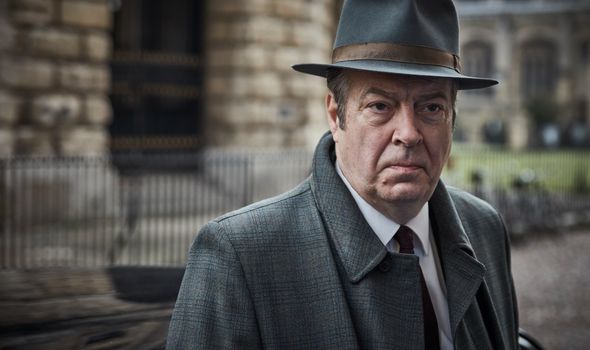
That’s not the way he puts it to Morse. The real question is, “Do you have the grit” to do what needs to be done. This is Roger Allam as Inspector Fred Thursday. [1] Morse has said that by doing this, Thursday has “crossed the line;” he has gone over to the other side. Thursday rejects that. It’s only a question, says Thursday, of whether you have the grit. The clear implication is that Morse in lacking in courage.

But even so, “courage” is a commonly held virtue. “Grit” is a “real man” word. It is an “are you fit to be a cop” word. It defines the job so as to include beating information out of informants and the unwillingness to do that is just unfitness for the job.

And you get to mean all that in public without ever saying it out loud.

That’s how I hear Friedman’s “Go there.” He is right, I think, that electors in Republican-majority states may be asked to promise to “go there” as a condition of their selection. They will not be asked, in that context, if they believe in democracy in the sense that every person gets one vote. They will not be asked whether their oath to support the Constitution requires them to be fair to all. They will be asked if they have the grit to to what needs to be done.

“No, I don’t” is not an acceptable answer. It removes you from the political organization making the demand, for one thing. But it also, in this phrasing, casts you as a coward. There will be no coming back from such a failure.

I have great admiration for Georgia Secretary of State Brad Raffensperger who said, “I’m sorry, Mr. President, I can’t do that.” Trump said, “Find me the votes.” Raffensperger said, “I would break my oath to the Constitution and to the people of Georgia if I did that.”

Notice the alternation of frames of reference. It is the frame of reference we need to look for as the legislators and the electors are chosen for the 2022 and 2024 elections. Friedman is right, I think, that we are looking into the abyss. Will we continue to be a democratic government or will we not. Do we have the grit?

[1] For American watchers, there is no way not to think of Joe Friday. I don’t know whether Joe Friday of Dragnet is popular in Britain or if they just like to watch Americans struggle to keep from making the connection.

Posted in Uncategorized | Leave a comment

Desolate Old Men  

Today, I would like to share a bittersweet reflection with you. Then I would like to poke at it a little. This anonymous reflection (below) about old friends was sent to me by an old friend of mine. He and I were in the Class of 1955 at Randolph High School (long since Northmont High School) just north of Dayton, Ohio. He was not only in my class; he was in my group. We were nerds together. So it meant something special to me that he wanted to send this reflection to me.

Here it is:

“When I was young, I noticed that every Friday at about 2pm, my grandfather would leave the house, drive somewhere, and come back after three hours. This happened regularly like clockwork for several years.
 
My curiosity was aroused so much so that I asked my grandmother, “Grandma, where does Grandpa go every Friday afternoon?”
 
To which my grandmother replied, ” a place called Country Bake Shop. He spends time with his friends drinking coffee and having pastries.”
 
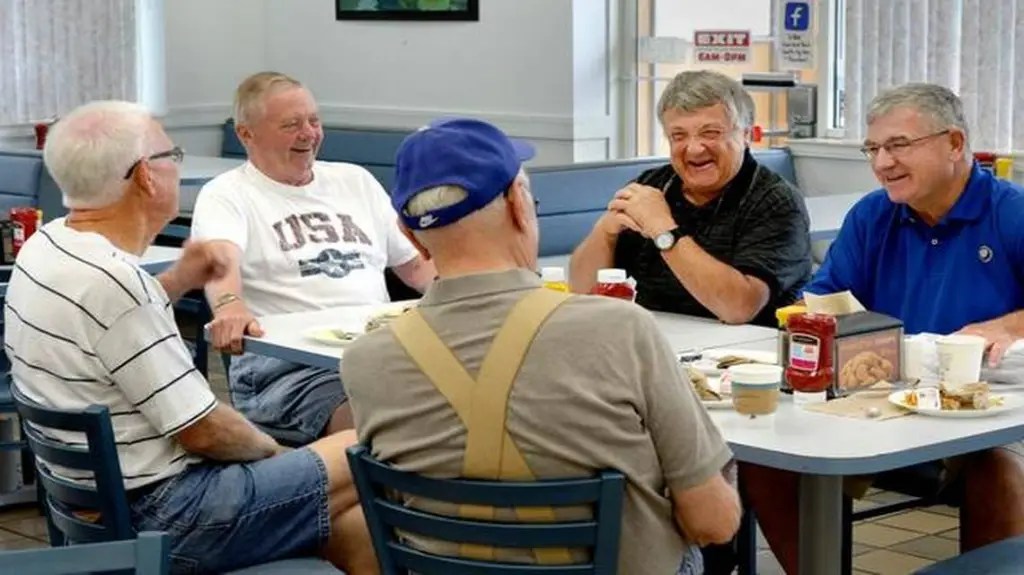
This type of routine is very common among the elderly. A group of old friends would meet in some cafe, have coffee, and reminisce about the good old days. They would make sure they didn’t miss any session. After all, it is only to these guys they are able to say, “Do you remember?” because these guys were there when they lived those moments.
 
And then the number starts to dwindle. From a group of eight, the number goes down to five, then to three. Until finally, one finds himself alone. His friends leave him and he must now travel on alone. Even to the friendliest people he meets on the way, he will never be able to say, “Do you remember?” They were not there.
 
To the elderly, this is one of the most crippling experiences. Desolation. The feeling of being left behind by old friends who have been with you and shared with you all those crazy and happy moments. He is devastated by the awareness that the few years he has left will no longer allow him to expand that circle of friends once again.
 
Desolation. One good reason for the young to prepare themselves psychologically for old age. One good reason for them to treat the elderly with respect and compassion”.

They seem happy at the moment, though

I applaud the author’s choice of desolation as the word to describe this. As applied to a person, it means personal sorrow, but it points, too, to aloneness as the reason for the sorrow. The de- is desolation has the effect of intensifying the verb, so “really, really, alone” is the sense it has and that is the reason for the sorrow.

The aloneness the anonymous author talks about is the loss of people who share a recollection of the same events you remember. I said I would want to poke around at this idea a little. Let the poking begin.

We say we remember an event and we do. Kind of. There is a phenomenon I have come to call “narrative fatigue.” I mean the kind of drift a story we all hold in common undergoes when my buddies and I remember it and tell it again and again. As we all know, the story changes over time. It comes to reflect our current needs. So the “good old days” are the current form of the stories we tell and we tell them without the slightest notion that it has changed over the years of our telling it together.

I have thought, sometimes, that it might be even more enjoyable for us to share the changes in the story as we have negotiated them over them years, but I know that is not practical.

Another thought that occurs to me is the exclusive focus on reminiscence. There are other things they could have done, certainly and they may have done some of them that Grandma doesn’t know about. They may have “settled major world problems” in the manner of old men everywhere. They may have refined the usually tacit patterns of approval and disapproval that allow communities to function as social, rather than principally legal, bodies.

We don’t know, of course. If Grandma doesn’t know, we don’t know and there may be an understanding among the men that what happens at the Country Bake Shop stays at the Country Bake Shop. Still, it is a simple fact that every function I have imagined for these old men, with the simple exception of reminiscence, could be open to younger members. Imagining a mixed age group isn’t the easiest thing in the world, especially now that generational styles have become so widely accepted, but in a mixed age group, two really encouraging things could happen.

For one thing, apprenticeship could happen. Whatever of value these old men are doing could be passed on to the next generation of leadership. Imagine for a moment that this group of old men organizes and administers a charity for the special benefit of overachievers and underachievers. A young person who has watched that work is in a perfect place to pick it up when George has the first of what may turn out to be several strokes. The group can say nice things about George and they probably will, but what honors George more [1] than continuing his work?

The other really good thing that could happen to the old Country Bake Shop group with the addition of new members is that is might retard the process by which the group would otherwise devolve into a group of hapless old farts. The infusion of new values and especially new standards for language and behavior could revivify the group. Of course, it could destroy it, too, if it were badly done, but there is nothing like the gentle and persistent advocacy of new ways of talking and thinking to make a group resilient and comfortable with itself over the long haul. Provided—big deal—that “remembering how things were” is not the principal function of the group.

And if that happens, well…there is probably a New Country Bake Shop somewhere, where we can all start again.

[1] It occurred to me for the first time as I wrote that that the expression we ordinarily use—“honor his memory”—could just as well be used to refer to how acutely ol’ George remembered things. He could be the one who remembered who the supporting actors and the director were of a movie they had all liked a decade ago. “He was amazing,” one of the old guys could say, “especially the way he remembered our birthdays.” If that isn’t “honoring his memory,” I don’t know what is.

Continue reading
Posted in Uncategorized | Tagged , | Leave a comment

Act Your Age

This phrase is an appeal to widespread knowledge and consensual values about how a person of a certain age should act. In a time where both widespread knowledge and consensual values are in decline, you would think that sentiments like this would seem oddly dated. Do parents still say things like this?

There are reasons to undermine the whole structure of the question. The emphasis we have now placed on the unique individual clearly have no use for “age based norms of behavior.” There has to be a way “one should act” at a certain age for the whole “act your age” thing to make any sense. That way is under serious threat.

Another reason is the rise of therapeutic language and the perspectives on human behavior that surround it. In an episode of Doc Martin that Bette and I watched recently, a dreadfully willful and undisciplined kid goes around the village scratching the paint of cars parked on the street. The father explains that the boy is just exploring his ambivalent feelings about authority. [1]

On the other hand, excuses like “boys will be boys” apply the “act your age” dictum in the other direction. The shield here is, “They ARE acting their age.” So…this kind of behavior is so common among boys that age that it should be expected and therefore not “abnormal.” If it is common, it is normal. If it is normal, it is acceptable. That goes downhill fast.

So we can, as these paragraphs indicate, undercut the whole rationale of “act your age,” but that’s not why I introduced the topic. I introduced the topic because I am an old man and I live in a senior center and the implications that flow from “act your age” are a different kind of thing entirely here. How does an old man or an old woman go about acting their age?

I’d venture to say that most of the men who live at HPP [2] have had sports team experience. There is a kind of banter that is normal in locker rooms. People who use that language are accepted as part of the team and those who don’t have an extra hurdle to get over. Trust me on that. If a group of men at HPP found themselves using that old sports-based language, it would be disapproved of—and not just by the women.

But we are looking here at the basis for that disapproval. Would these men be admonished to “act their age?” I think so. They could be reproved for being racist or sexist or ageist or whatever young men delight in, but that would be a morally heavy charge and we do all have to find a way to live together here. That is why I an age-based criticism might be chosen. “Sure high school athletes talk that way among themselves, but you aren’t high school athletes anymore.”

I think gendered patterns of interaction might meet the same fate. There are, roughly speaking, three groups at HPP as they bear on this question. There are men and women who still notice and appreciate gendeer differences. There are men who prefer the company and conversational style of men and women who, similarly, prefer to be with women. And there are those for whom noticing the difference at all has become burdensome.

If the norm is that old people just don’t notice (much less appreciate) gender differences, then an old man or an old woman who does notice and who does appreciate them, could be said not to be acting their age. “Age appropriate behavior” would then be defined as not noticing or not caring. It is “what old women and men are like.” Furthermore—once it has been formulated as a norm—it is what old women and men should be like.

That would mean that behavior that would have been unlikely even to be noticed at an earlier age—say the last third of a career—will be discrepant and worthy of comment. This could be taken as an affront by any man or woman who deny that a mutually enjoyable recognition of gender differences that have been treasured by both parties over a long life should be discarded on the grounds of age alone.

Once you move out of the developmental context—the “you shouldn’t be sucking your thumb any more now that you are X years old”—context. The whole standard gets a little fuzzier. Age-related norms are not as clear and the agreement about them begins to fray at the margins. There are so many other ways of criticizing behavior, that it seems a shame to use one so vulnerable to abuse.

Maybe “act your age” is not the kind of thing that should be said to old men and women.

[1] And, to raise another serious but unrelated problem, the father tells Doc Martin that Martin’s car insurance will pay for the damage so he has no reason to be offended by the child’s behavior.
[2] Just a convenience. Holladay Park Plaza in a senior center in Northeast Portland. There are roughly twice as many women as men and roughly ten times more Democrats than Republicans, especially recently.

Posted in Uncategorized | Tagged | Leave a comment

Time Spent With Old Friends

I’ve lost track of how many times I have read parts, at least, of Neal Stephenson’s Anathem. Yesterday, I caught something new in my reaction to a scene and I’d like to tell you about it. I’m not sure what reaction I am hoping for. I think, “Oh yeah, that happens to me, too” would be really good.

The point here is that when you read a story like this for the first time, you read very practically. There is a story being told, after all, and in Stephenson’s case a fantastic story. Let me just touch down at a few places to illustrate my point. I’ll give page numbers because I have them; it’s not because I don’t understand that different editions distribute the numbers differently.

Four guys have the job of pushing the turnstile that winds the huge clock in the tower. These same four guys since they became novices in the order. We learn that Jesry is a notorious heel-filcher. They put out a loaf of freshly baked bread and he is more likely than not to have ripped the heel off before anyone else can get to it.

This is the kind of reference J. R. R. Tolkien used so well. By referring to a “well-known reality”—everybody, apparently, knows Jesry’s affinity for bread heels— that has nothing at all to do with the plot, he suggests the depth and reality of the narrative background.

The first time I read that about Jesry, I filed it automatically as something about him I needed to know. This time, I paused only briefly to record that it was something about Jesry I already knew and also to make whatever connections occurred to me between that one trait and others described elsewhere. He is easily fascinated by new ideas, for instance, where Raz, the narrator, suffers from “fascination burnout.” By telling us those two things about Jesry, is he suggesting an impulse driven person or are these just to facts? That is not a first read kind of question, but when I go back and back, I wonder.

One of the running jokes is that an alien to Arbre (the planet on which all the action takes place) is named Jules Verne Durand. They never say he is French. There is no part of the book where it would not be a violation of time and space conventions to say that he is French. On the other hand the four guys who wind the clock hear him phonetically and Stephenson gives us what they hear phonetically. So the joke is shared between us and Stephenson, and passes right by all the characters.

Fraa Osa is giving a potent explanation of how overlapping loyalties work. It ends “…that unites us with the likes of Jules Verne Durand.”

“‘Say zhoost’,” (p. 838) answered the Laterran, (Laterre is what he calls his home planet) which we figured was his way of expressing approval.” Stephenson could have given us c’est juste and then had one of the brighter characters translate it for one of the dimmer characters, but that engages the characters. Stephenson wants it to be our joke; his and ours.

Similarly, in their spacesuit/spacecraft there is a controller with a mushroom shaped stick that could be moved in four dimensions. Durand called it (p. 785) a “joycetick.” The phonetic joke again.

Seeing the spacesuit/spacecraft for the first time, Durand proclaims, “The conception is moneyfeek (p. 775). That’s fun, but but it is more of the same kind of fun and Stephenson has more in mind for this one. Much more fun is the exchange later when everyone has been launched in space in their suits/craft and are communicating with bases on Arbre. Erasmus’s handler says, “I’m going to talk you through the process of unstrapping yourself from the S2-35B.” Erasmus replies, patiently, as I hear the line, “Up here, we call it a monyafeek.” (p. 812)

This is the communications specialist is a bunker somewhere on the surface of Arbre telling a user of the suit who is actually in combat, about his S2-35B only to have him pull battlefield rank and correct her. “It’s monyafeek,” he says. “Whatever,” she says.

Those are just for fun and are as good illustrations of the phenomenon as we need. But there is a really serious one that stopped me in my tracks the first time through and that I have luxuriated in every subsequent time.

On page 804, Erasmus is chasing a nuclear reactor he needs to catch before it hits the atmosphere and burns up. His friends see him going further and further away and presumably, make a decision about what to do. We know this only from Erasmus’s thoughts.

“They’d probably watched me drifting away, with mounting anxiety, and debated whether to send a rescue team. But they hadn’t….If it had been anyone else, I wouldn’t have been able to read their minds nor they mine. But my fraas [fellow scholars] had been raised, trained by Orolo. They had figured out that in forty-five minutes, the nuke would reappear on the other side of Arbre. Just as important, they were relying on me—entrusting me with their lives—to figure out the same thing and to act accordingly.”

Raised together under the same master thinker; working together all their lives on the clock winding project, they had reached a place where they could confidently bet their lives that each understood the other.

Wouldn’t you want to wander back through that scene now and again? I do.

Posted in Uncategorized | Tagged , | Leave a comment

Disordered Individuals

Here is the text for today. I found this in an article in JAMA Psychiatry by Peter Sterling and Michael L. Platt (February 2022).

“Every symptom of despair has been defined as a disorder or dysregulation within the individual.”

First, at the risk of casting myself as the good guy in the drama I am about to sketch, I want to tell you how I was thinking of my depression in 2003, the very understandable reaction to my wife’s death. I was coping as best I could; doing the things that had to be done, maintaining the network of relationships that I hoped would be more meaningful later. A friend called to check on me and asked, as part of the conversation, whether I was taking anti-depressants.

That’s the first time that option had occurred to me. An awful loss had occurred in my life and I was depressed as a result. I said that I was not taking them. He asked why not. So I had to stop and think about it again. I answered, finally, that I didn’t think I was any more depressed than I ought to be. After a little further thought, I said I was on the track to recover, eventually, and had every hope of following that track back to health.

That story puts me at the other end of the continuum than the one Sterling and Platt are characterizing. Over at that end of the spectrum, every symptom of despair is defined as a disorder. So I would have had “a depression disorder” and would presumably have been given treatment. [1]

But Sterling and Platt are making a social critique. They are not concerned about my mourning my wife. Their idea is that our society is hell-bent, for its own reasons, on “medicalizing” anxiety, depression, anger, psychosis, and obesity. I’m sure they did not intend that as a complete list.

They suggest that one of the things wrong with this tendency is that it “incorrectly frames the problem.” [2] They have in mind that the issues represented by this list are not only “not medical problems,” but are not even “personal problems.” But that formula won’t work either.

The physical, the personal, and the social are intertwined and there is no use pretending they are not. Let’s take the time for two radically simple metaphors, then come back to the problem. Which setting in a three number combination is most important? You can tell by looking at it that it is a silly question, but when you start to say just why it is silly, it gets slippery.

Football example: the other team has a truly gifted receiver. No one defender on our team can stay with him. Here are three things we can do. We can make our defender faster. We can double cover this dangerous receiver. We can reduce the quarterback’s time for finding the receiver in coverage. Not only is it true that every one of those solutions would work, but it is also true that the weakness of one can be compensated for by the strength of the others.

OK. Back to reality.

Why is our society experiencing a spike in obesity and diabetes? It’s a lot of bad dietary choices. It is the socialization of those choices into socially confirmed practices. It is the food policy of the country, which makes healthful food inaccessible or expensive and unhealthful food readily available and cheap. Note the three levels.

The locker combination example shows us that getting two of those three issues right is not going to open the lock. The football example shows that you can compensate for the weakness in any one element by increasing the strength of the other two. Seems obvious. So why don’t we do that? As the choices move away from the individual—or in physical health examples—the individual’s body—they get more expensive and more conflictful.

It is (relatively) inexpensive for an intact family to teach the children to prefer the kinds and amounts of food that will serve them well. [3] Building a youth culture that will affirm, at best, or at least not punish, good food choices is somewhat more complex and expensive. Making sure the food is available so its choice can be affirmed by the kids is most expensive of all and most strongly opposed. There is a reason the U. S. government is stockpiling, by estimates I have seen recently, 1.4 billion pounds of cheese.

I should have brought most of you along so far as agreeing that the sound dietary choices of the individual are the cheapest and most secure approach to this problem. But somebody is going to have to look at the McGiganticburger ads and the popcorn chicken ads and say, “That’s bad for us. Let’s say no to that.” When that decision has been made and when it is stable, it is inexpensive as well. But how does it get made?

And particularly, how does it get made when “freedom” has been made into the hottest word in the political vocabulary and given as its principal content, “You can’t tell me what to do!” In the otherwise inoffensive line above—“Let’s say no to that!”—somebody is obviously telling somebody else what to do. It helps, in this example, that someone can say “We…” but as soon as some stable part of society or government gets’s involved, “we” becomes “them.” Then the cost skyrockets.

Finally, note that no one in the example I am offering, is making any money on the good food choices program. The kids are not, the families are not, the society is not. [4] The medicalization strategy, on the other hand, is a money making machine and the money is made in the short term by identifiable groups and individuals.

The football equivalent would be to put one team—only one—on stimulants and thereby increase their physical competence during the game. But that sound like a cheap substitute for good football decisions and good strategy. And it is

[1] Three years later, I did have a depressive disorder and was only too happy to have the help SSRIs gave me until I was out of it.
[2] I am not a fan of that way of framing the problem either, but I am also not a fan of the notion of a “correct” framing of the problem. It seems much better to me to think of them as useful or useless; helpful or harmful, etc.
[3] Of course, it isn’t cheap to have an intact family.
[4] There are cost for not doing these things, of course, but they show up later and that makes it very dicey for elected politicians.

Posted in Uncategorized | Tagged , | Leave a comment

I’ve got more important things to do.

Surely I do. I must.

That would, at least, make sense of the way I eat. I’ve been puzzled about this for awhile. I eat in a decision-minimizing way. Here are some of the obvious implications.

First, I eat/drink things in the unit sizes they come in. I drink “a cup” of coffee, for instance, and I might have that (I’m at Starbucks, anyway) with “a bagel” and “a package of cream cheese.” The opening bell rings and I start the project. I keep on drinking the coffee until I’m done; I keep on eating the bagel until I’m done. I do make an exception with the cream cheese. Even though it comes in a package (1.5 oz), I use only as much of it as necessary to grease the path of the bagel. [1]

It took me a little while to think of an alternative. It is “some.” So rather than drinking “a cup” of coffee, I drink “some” coffee. That doesn’t eliminate the problems, of course, but it does change their form slightly. But back to the solution side. I could eat “some bagel;” obviously just how much bagel is not specified. That would be the point of the change.

The same logic flows from “a steak” or “a sandwich” or “a beer.” If the project is to eat/drink “it” and “it” comes in an amount that has no necessary relationship to how much I want at the moment, then I would have to make decisions that are independent of the packaging, rather than consenting to the decisions that are implicit in the packaging. And whose decisions were those, I might ask in an idle moment.

Sounds like a lot of work, doesn’t it?

You might think that I am inventing a problem just for the pleasure of solving it, but that is not really the case here. The easy way to deal with this is to eat when you are hungry and to stop when you are no longer hungry. And for people who are tuned to those feelings, that it, I agree, a perfect solution. It doesn’t feel like “making decisions” any more than “deciding” when you have scratched an itch long enough feels like a decision. You just stop at the right time without ever making anything you would call a “decision.”

That’s not how I do it. It is not how I have ever done it. The food winds up on my place—packaged or served—and the bell announcing the beginning of the project sounds (I am imagining the bell, of course) and I start moving toward the finish line. It’s not fast or slow by definition; but it is complete or not yet complete. Sounds pathological, doesn’t it?

What I feel I get from this is the freedom to think my own thoughts or to engage in whatever conversation I am in. I am free from the intrusive stream of questions I would otherwise have to be asking: am I still hungry, what do I feel like eating more of, did that do the job, should I keep on eating/drinking? [2]. I am free to have whatever internal conversation I am having or to participate in whatever social conversation I am having untroubled by the need to make all these decisions. As I implied in the title, I must think I have other things to do that are very important.

This plethora of decisions is replaced by the much simpler, “Am I done yet?” This question is cued up nicely for me by the unit. Have I finished “the sandwich?” is easy; “have I eaten enough sandwich?” is hard. “Have I drunk my cup of coffee?” is easy; “Have I had all the coffee I want right now?” is hard.

I must think that what I would otherwise be doing is incredibly important for me to accept all the costs of not deciding things. That’s not how I experience it, of course. In full project mode, I just begin and make progress and complete the project (the food is gone) with no unnecessary distractions.

It’s sad, really, but it would be a lot of work to change.

[1] This is not as different as you might think from what I would do at home if there were a dish of cream cheese on the table. I would put an amount on my plate and from then on, it would be just like the package. That is how much “there is to eat.”
[2] I see that I am bypassing all questions of whether the tastes and textures are pleasant and interesting. Those are important and I do attend to them, but they don’t help me with the decisionmaking stresses, so I am passing them by this time.

Posted in Uncategorized | 1 Comment

Toxic Masculinity

Today, I want to think about the expression “toxic masculinity.” [1]. I have three major goals in writing this essay. The first is not to whine about the expression. The second is to try to persuade you that I am not whining about the expression. And finally—at last, something of substance—to look at the place that kind of designation has in our language. This last observation is only about what “toxic” adds to the expression and how that could be improved.

And since the first two are matters of style, I will begin on the third one and you can draw your own conclusions about the first two.

The adjective “toxic” adds nothing of value to the noun “masculinity” as both words are currently used. It would be very helpful if toxic masculinity were the name of one end of the scale of “kinds” or “forms” of masculinity. Unfortunately, that would require a name for the other end of the scale and that is where the expression, in current debate, comes up short. There is no useful name for “the kind of masculinity everyone approves of.”

It is easy to think that non-toxic is the solution to the problem, but negation alone is not going to get this job done. Imagine, for instance, that we were talking about shyness. We have no trouble saying that one person is shy and the other outgoing. “Outgoing” gives us a positive notion of what we are talking about. It is easy to imagine gradations of “outgoingness” or of “shyness” (it works either way) because both are acceptable values and each has its own merit.

That is why “shy” and “non-shy” doesn’t help. It doesn’t answer the question “What characteristics are you thinking about when you say, non-shy?” To which, a good answer might be, “If I knew that, why would I say non-shy?”

Why indeed?

The notion of what men are supposed to be like has not taken on any particular form yet. The notion of what men should be like, which was much more stable when society was more stable, is now in rapid flux. We really don’t know what we want men to be like—men don’t know either—so we are having trouble coming up with a name for the other pole.

This is a problem only at the general level. We have no trouble admiring a particular man. There are virtues [2] that are not sharply gendered. There are ways of being a man that everyone in the setting agrees are just right for that setting or for the marriage or for the group of men friends of which he is a part. The problem comes in talking about masculinity in general. [3]

This is a problem that has no obvious solution. It is not hard to design one. Get a broad agreement among the most powerful stakeholders about what a good contemporary masculinity ought to look like. Define it so that there many kinds of behaviors that are seen as part of the same general notion. Sell that notion of masculinity by all the relevant channels until it is so broadly understood that people can refer to it without stopping for redefinitions.

I don’t want to speculate about how likely that is. I am saying only that it is the way all the other new ideas are sold, so why not? Also, what else is there?

Finally, I notice that more and more I am finding troubles with evaluative scales that have only one active pole. The dynamics are that if there is only one pole and it is good, you get as close to it as you can. If it is bad, you get as far away from it as you can. And all the other values—the existence of which we take for granted when we are talking about normal scales of value—disappear. All the things you lose by getting as close as possible to the good pole or as far as possible from the bad pole simply go out of focus. Or go away. That’s just crazymaking.

Every strategic choice, and this includes linguistic choices, needs to be justified on the grounds that it provides more benefit than harm. That means that the effect on many valued entities needs to be kept in mind. And that means that the kind of unipolar linguistic construction that produced “toxic masculinity” needs to be rejected.

[1] It just occurred to me how jarring it would be to abbreviate it as ™ and even more so to develop an organization named T.M. and to trademark that name as T.M.™
[2] Etymologically, a “virtue” is “a manliness.” The Latin
vir is the source of all such words. That is why it always takes my mind an extra tick or so when I hear or read of a woman “losing her virtue.” I know what is meant, of course, but the etymological shadow cast on her losing her manliness just takes me a little longer to process.
[3] “Femininity” has the same problem, of course. The virtues of gender roles at a time when definitions and preferences are changing so rapidly. Still, I note that no one has bothered to invent a “toxic feminism.”

Posted in Uncategorized | Tagged | Leave a comment

It’s not a flaw. It’s a feature

We sang a hymn this past Sunday I had never sung before.[1] I did pretty well in the first stanza but I hit a serious speed bump in the second. It goes like this:

“Teach us, O Lord, your lessons
as in our daily life
we struggle to be human
and search for hope and faith…”

That seems like a odd thing to sing in church, where the state of being human is the problem that is solved by God’s grace. Colloquially, “we’re only human” is a way of dismissing a fault of some sort, so that fault = human and vice versa.

Christian theology begins with our “fallen nature.” It is the first part of the story our faith tells. I’m currently working on a way to represent the book of Romans as a series of arguments Paul is making. The argument about what being human is like starts at 1:18, as soon as the preliminaries are over.

18The retribution of God from heaven is being revealed against the ungodliness and injustice of human beings who in their injustice hold back the truth.

There is a charge, “hold back the truth;” there is a guilty party, “human beings;” and there is a response from God, “retribution.”

This case goes on until 3:21. That’s 65 verses of pretty dense prose.

21God’s saving justice was witnessed by the Law and the Prophets, but now it has been revealed altogether apart from law: 22God’s saving justice given
through faith in Jesus Christ to all who believe.

What a piece of work is man, How noble in reason, how infinite in faculty, In form and moving how express and admirable, In action how like an Angel, In apprehension how like a god, The beauty of the world, The paragon of animals.

There is a solution which addresses the problem Paul has identified. It is “God’s saving justice (“the righteousness of God” in the King James that I grew up with”) then a means, “through faith in Jesus Christ.”

That’s a long argument. It begins very broadly describing the great flaw of human beings (we hold back the truth) and continues on to how God is dealing with this flaw (“saving justice through faith”).

We say this every Sunday at several places in the service. It not just the confession that we all read from our bulletins. It is the explicit teaching of the hymns generally, of the liturgy generally, and of the homilies most of the time.

Given that, it is not an oddity, really, that I was surprised to learn that our great struggle is to be human. This is the classic case of “It’s not a flaw; it’s a feature.”

A New Standard

The idea that being human was a goal rather than a deeply flawed condition probably dates, in western thought, from the Renaissance. The Renaissance didn’t celebrate the provision for the salvation of humankind, as the Church did, but rather it celebrated humankind as such. The Prince of Denmark in Hamlet makes the classic case:

What a piece of work is man, How noble in reason, how infinite in faculty, In form and moving how express and admirable, In action how like an Angel, In apprehension how like a god, The beauty of the world, The paragon of animals.

Hamlet, Act II, Scene 2

God is cast, in this scenario, as part of the applauding audience. For those who achieve true humanity, God can only approve in this model. Again, I don’t object to the model. You can hardly read the classic texts in philosophy and history without taking it for granted.

It is not the way the church has looked at it, however, and I don’t think we should start now.

[1] This in a old mainline Presbyterian church in Portland, Oregon. We are not a hotbed of doctrinal innovation. On the other hand, we don’t always pay attention to what we are saying.

Posted in Uncategorized | Tagged , | Leave a comment