
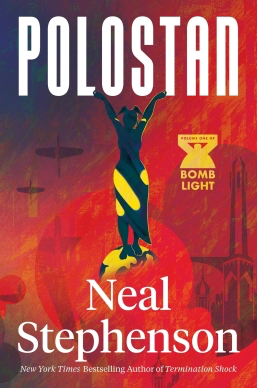
Very soon, the second of Neal Stepehson’s Bomb Light trilogy (D: Heavy Water) is going to be published. The review that Amazon has posted says that Owen Crisp-Upjohn is going to find himself pulled into the orbit of “Aurora, a curiously compelling woman with a shadowy past rooted in Soviet intelligence.” That really is the least that can be said about Aurora, who dominates the first of the Bomb Light trilogy, which is called Polostan. [1]
Polostan is a spectacular book. It introduces a fearsome variety of people, half American, half Soviet and weaves their stories together. He does it not only by interspersing chapters–this one in Chicago, that one in Magnitogorsk–but also by playing one personality type off against another.
In any case, the first thing Aurora says to Crisp-Upjohn in her own voice, is “The OGPU [2] wants me to sleep with you.” She has been playing the part of “Katya,” speaking Russian-accented English. But this she says in her own Montana plains voice. The only thing she had previously said in her own voice was the line just before that one, which was, “Owen. This whole thing was a setup.”
That is a lightening fast re-introduction to a person he thought he knew, but he is up to it. He says, “How may I be of assistance, young lady?” Aurora replies, “Fall in love with me.” He responds, “Done. Will there be anything else.”
Given that, I am not surprised to learn that she is with him in the second book. I knew she wanted to get out of the Soviet Union. She had spent a long time, several chapters earlier, strapped naked to a bed frame and dipped by ropes on a pulley into a hole in a frozen lake. After a while, Shpak, her interrogator, began to hold a knife to the rope, cutting a strand or two and suggesting much more.
I will come back to that experience later, but here, I want it to introduce this reflection of Aurora’s. “She knew that as long as she lived in this country, she’d be dangling above that hole in the ice, the knife on the rope.” Dangling in that way was not just interrogation. It was a way of life.
That is why I am not surprised to learn that in the second book, she is in England, conspiring with Crisp-Upjohn.
It was Lavrentiy Beria himself, head of the secret police under Stalin, who ordered that she be cut down from the bed frame. “I’ll have them cut you down,” he said. “We’re going to be late for dinner.” We. Are going to be later for dinner. OK.
When you read this book, you have to get used to very large and very fast changes in tone. From the bed frame to “late for dinner” was one. The next one comes when she is in the hotel where they put her, and they call her for that dinner. She could have just, the text says,
“sat in bed enjoying the solitude, but the man with the glasses (Beria) had been insistent that she show up for dinner and she got the clear sense that she belonged to him now.”
Got that one? Next:
“So she did what she could with her hair, put on a skirt and blouse, and went down to the hotel’s restaurant.”
Stephenson can make the narrative turn on a dime and he has done it in Polostan more than any of his other books I have read. What she says to Crisp-Upjohn, abandoning her role as “Katya,” sets the stage for the next book. On the last page of Polostan, Crisp-Upjohn says he will be leaving soon. She says, “Write me letters.”
He says “…which will be read by the OGPU.” She says, in her real persona, Aurora, “Of course. Go around the world and do what you do. Eventually they’ll send me out after you.
And apparently they have.
[1]. Which is a pretty good joke in the context. They have just invented a Red Army Women’s polo team and the field they provide for them is so big that Crisp-Upjohn names it the first time he sees it, just by slapping the -stan suffix onto the polo field.
[2]. Soviet era secret police

 The Dilettante's Dilemma