
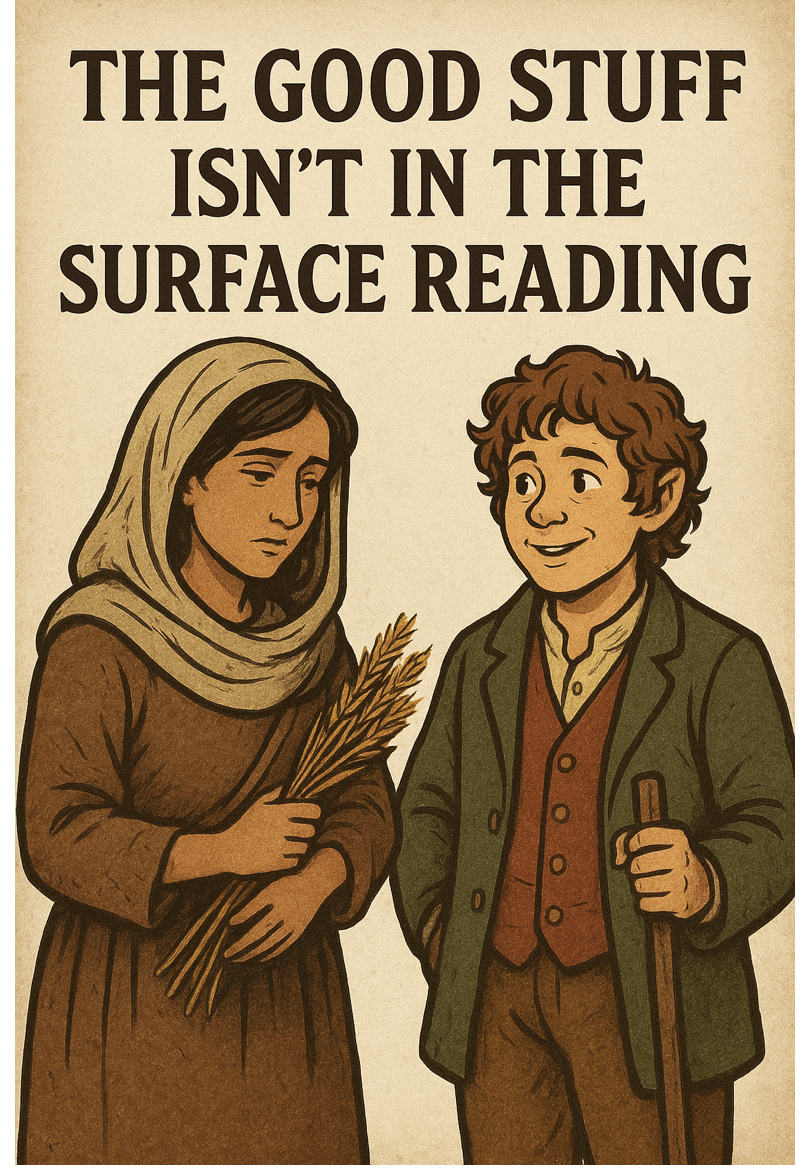
I would like to tell you about this picture. It will take just a little while because each of the elements of the picture—the woman, the hobbit, and the quotation—has a history of its own. And then there is the small matter of just how and by whom the picture is assembled.
I have just finished studying the book of Ruth with a group of students I first met at Westminster College in Pennsylvania [1] in the late 1970s. The basic idea of the course is that Ruth was written in Judea during the period of post-Exilic religious reform. But it was set in Bethlehem hundreds of years before the Exile. So we studied each element of the plot of this invented story not just at the superficial level of the narrative, but several levels down—down to where the question, “Why did the author put it that way?—lives.
That question goes to the motivation of the author—always a speculative question—and also to the techniques employed by authors. The author’s goal, as I came to see it with the help of Edward C. Campbell, Jr’s superb study of Ruth, is complex. He needs to “suggest” the Bethlehem of that era without describing it and to strongly imply God’s care in a situation in which God is mentioned twice (obliquely) in the four chapters.
The best example I know of building a society and an associated culture is what J. R. R. Tolkien did in imagining Middle Earth and the best analysis I know of Tolkien’s work are the books of Tom Shippey. [2] So I borrowed Shippey’s analysis of Tolkien’s “world construction” to study the “world construction” done by the author of Ruth. After all, who knows what 11th Century BCE Bethlehem was like? And spending the time to describe it, even if we knew, would distract from the story. This version of Bethlehem needs to be “suggested” just as Middle Earth did. Let’s look at some examples.
Shippey points out the use of Tolkien’s phrase, “the famous Belladonna Took,” who was Bilbo’s mother. All the work that this phrase does is in suggesting that there are many people who know her. So her “reality” is strengthened by us for all these people (fictitious) who know Belladonna Took (also fictitious). Similarly, Tolkien not only gives us the name of King Theoden’s horse (Snowmane) but also the names of Snommane’s sire and dam, neither of whom appears otherwise in the story. Again, as in “the famous Belladonna Took,” reality is “suggested” and “supported” by what seems otherwise a casual phrase.
Tom Bombadil rescues Pippin from the deadly grasp of Willow-man, an angry man-eating tree. How does it happen that Bombadil arrives in time? Tom Bombadil says, when he rescues the hobbits from Willow-man, “Just chance brought me then, if chance you call it.” What else would we call it? Bombadil doesn’t say what he calls it. He strongly implies that the notion of an ordered universe which contains “chance” is up for grabs.
Finally, to choose just one more of many available examples, Gandalf says after his (lethal?) battle with the Balrog, “Naked I was sent back…”. He does not say where he was sent “back” from. He does not say who sent him. Still, Gandalf appears here as the agent of another. Another what?
It is devices like this that I offered the Westminster group as ways a setting could be “suggested” without being described. Then we started on how those devices are deployed in Ruth.
The story teller also used here a device that Campbell calls “reusing signal words at long range.” He means that the several episodes are tied together by common references. On first meeting Ruth, Boaz praises her for choosing to come to Israel with her mother-in-law to be. “May you have a full recompense from the LORD, the God of Israel, under whose wings you have sought refuge,” he says. The notion of being “sheltered under God’s wings” is a much used and very familiar expression in the Bible. More to the point, it would have been familiar to the first hearers of Ruth.
But when Ruth snuggles up to Boaz on the threshing room floor, he wakes up and asks who she is. ” Ruth replies “I am Ruth maid-servant. Now spread your ‘wing’ over your maid-servant, for you are a redeemer.” From that short exchange, two things can be quickly taken. The first is that Ruth uses the same notion of “the wing as protection” that Boaz used the day they met. It doesn’t have the same meaning—God’s care, Boaz’s robe—but it uses the same words and the meanings are at worst congenial. At best, they mean the same thing. The second is that Boaz is “a redeemer,” not “Ruth’s redeemer.”
Just exactly what a “redeemer” is in ancient Bethlehem is a matter for speculation and Campbell speculates on it at length. What it does for us, however is to “reuse signal words at long range” and to suggest meanings that it does not specify. As readers, we are asked to participate in arranging these meanings and extracting information from what was only suggested. Like, “if chance you call it.”
These intriguing looks at the story of Ruth are available to anyone who is willing to get below the surface and this Westminster group was more than willing. They were eager. And they were willing to pay the price. These kinds of sustained speculation are work; they cost something. But if you are willing to do the work, you get to the remark that one of the members made as part of the discussion. She said, “The good stuff isn’t in the surface reading.”
And Kathy Humphries, my stepdaughter and long a good friend, made several observations on Ruth during the discussion. Then afterward, she instructed her AI system to create a picture of the two decidedly discrepant figures together and to append to that picture the remark the student had made. This is the picture that was offered.
Once I gave up trying to see this image of Bilbo as if it were Boaz, I saw the wit in the illustration. Ruth is the imagined heroine of the imagined Bethlehem. Bilbo is the imagined hero of the imagined Hobbiton. Putting them side by side and appending the very perceptive remark of a fellow student simply won my heart, I didn’t know whether to laugh or cry, so I did both in turn.
I firmly believe this picture is worth a thousand words because that is what is has taken to set the stage.
[1]. There are a lot of Westminster Colleges. That is why I paused to specify which one.
[2]. From the Shippey collection, I took J. R. R. Tolkien: Author of the Century and The Road to Middle Earth.

 The Dilettante's Dilemma