
One of the things I like about reading a good book many times is that unexpectedly, on the manyeth time, something really good jumps out at you and you wonder how you could have missed it on all the other times. This is an exchange—it isn’t an argument because they are never talking about the same thing—between two of the principal characters in Sir Walter Scott’s historical novel, Ivanhoe.
Ivanhoe has just been wounded in the tournament and has lost a lot of blood. Rebecca—often “Rebecca
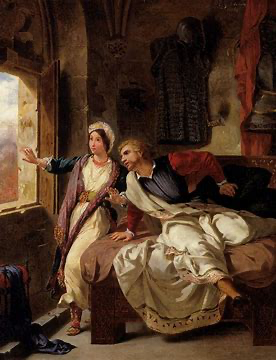
the Jewess”—knows a lot about healing and has been tending to his wound. At the moment, they are both in a castle under siege and Ivanhoe, from his bed, is asking Rebecca to tell him what she can see from the window. She sees one very large and overpowering knight whom no one seems to be able to oppose successfully. It is to that person Ivanhoe is referring when he says, “that good knight” in his first remarks below.
In the conflict I am looking at here, it is the conflict between two starting points and two kinds of logic–not between two persons–that is the focus. I know I will be losing a good deal of the power of the engagement, but it is the way each speaker supports the case that caught my eye this time and that I what I want to follow.
Ivanhoe, immediately after saying he would follow anywhere the knight Rebecca has described, justifies his desire as a kind of compulsion. Here is the sequence.
“ Rebecca,” he replied, “ thou knowest not how impossible it is for one trained to actions of chivalry to remain passive as a priest, or a woman, when they are acting deeds of honor around him. The love of battle is the food upon which we live —the dust of the mêlée is the breath of our nostrils. We live not—we wish not to live—longer than while we are victorious and renowned. Such, maiden, are the laws of chivalry to which we are sworn, and to which we offer all that we hold dear.”
Notice how he moves from “one trained to the actions of chivalry”—he means warfare—to remaining passive. It is a compulsion only at this point. Then he says clearly that it is love of battle is the food of the soul and the breath of the body. Finally he says that he has no wish to live longer than he is victorious and renowned. And not only that, but such as he are also sworn to uphold the laws of chivalry.
But Rebecca’s response to this impassioned defense also moves through several stages and in none of them does she challenge what Ivanhoe has said is the most powerful reason why he is who he is. Here is the first step.
“Alas” said the fair Jewess, “and what is it, valiant knight, save an offering of sacrifice to a demon of vain glory, and a passing through the fire to Moloch? What remains to you as the prize of all the blood you have spilled, of all the travail and pain you have endured, of all the tears which your deeds have caused, when death hath broken the strong man’s spear, and overtaken the speed of his war-horse? ”
First, she redefines what he has said. Not the rationale, but the action. And she does it is a very Jewish way. The reader wonders whether Ivanhoe understands more than the general argument she is making, but the reader does. She redefines his “deeds of chivalry” first as “a sacrifice to a demon,” then, more specifically, as a passing through the fire to Moloch.
Ivanhoe may or may not know that Moloch was a Canaanite deity, condemned by the Israelites as demanding the burning of babies as the required sacrifice. Moloch is the “demon” Rebecca has in mind that the “deeds of chivalry” Ivanhoe has described are truly no more than that. Note her language: “What is it…save a passing through the fire to Moloch?”
Furthermore, Rebecca’s argument moves on to collateral damage. The burned babies are the focus of the sacrifice, but Rebecca now brings in “all the blood you have spilled” and “all the tears which your deeds have caused.”
All Ivanhoe’s case has to do with his own commitments and the glory that comes from being true to them. That is not what Rebecca is talking about.
Ivanhoe is a direct response to Rebecca’s last point (What remains after all this?) says it is the glory that remains: “Glory that guilds our sepulchre and embalms our name.”
That response is poetic and beautiful, but Rebecca swats it away as if it were a fly.
“Glory!” continued Rebecca; “alas! is the rusted mail which hangs as a hatchment over the champion’s dim and mouldering tomb, is the defaced sculpture of the inscription which the ignorant monk can hardly read to the inquiring pilgrim—are these sufficient rewards for the sacrifice of every kindly affection, for a life spent miserably that ye may make others miserable? Or is there such virtue in the rude rhymes of a wandering bard, that domestic love, kindly affection, peace and happiness, are so wildly bartered, to become the hero of those ballads which vagabond minstrels sing to drunken churls over their evening ale?”
There is real rhetorical art here, I think, and none of it is aimed at the value of glory. It is aimed at the guided sepulchre. Watch the sequence. First, glory is the rusted mail which hangs as a hatchment [a coat of arms complete with its Latin motto] over the champion’s dim and mouldering tomb.” Find the “glory” in the “mouldering tomb.”
Read that and then return to “the glory that guilds our sepulchre.” Rebecca says “Glory is…” and then begins a series of descriptions that are not horrible so much as tacky. “The glory that guilds our sepulchre” requires a good deal from the people who will keep the glory machine running. It is on those people that Rebecca centers her attack.
She has done the “rusted mail,” but Ivanhoe still has his coat of arms (that is the “hatchment”) in mind. About that, Rebecca says that it misread by an ignorant monk to an inquiring pilgrim. The ignorant monk is no part of what I am calling “the glory machine” as Ivanhoe envisioned it. But it gets worse.
The next step is the “rude rhymes” of a wandering bard. It is through these rhymes that Ivanhoe and other heroes of glory and chivalry become heroes, instead, of those ballads with vagabond minstrels (slap in the face #1) sing to drunken churls (slap #2) over “their evening ale (slap #3).
You might doubt me about slap #3, but Ivanhoe has in mind a death of glory forever cherished. It is the routine of “evening ale” that is the enemy of Ivanhoe’s “glory.” Not to mention the disrepair of the glory machine represented by the ignorant monk, the vagabond minstrels, and the drunken churls—and, of course, the setting of a rural village pub.
It would be a shame, too, in taking apart the glory machine, to pass over what Rebecca says Ivanhoe is ignoring in his quest for glory. She names them as “domestic love, kindly affection, peace, and happiness.” Ivanhoe, given the opportunity, could fight her on the last two, but I think even he would have to grant that in his pursuit of glory—even a successful pursuit—he is bypassing the first two.
Ivanhoe does mount a kind of rebuttal, however, and we will look at that in the next post.

 The Dilettante's Dilemma