
A few years ago, I jotted a quick note to my son, Doug, and in my haste, signed it Dale instead of Dad. I considered that an egregious breach—more on that later—and wrote him another note the next day, as soon as I discovered it. He wrote back in a tone of consolation. “That’s alright, Dad. I’ve always known your civilian name.”
I had not been all that worried about it and when I got his note, I shut down even the little worry I had been carrying. But I have kept it in my “Don’t Throw This Away” file because I had a feeling that something in it mattered. The way my mind works, there is a phenomenon that is hard to describe. I sometimes say it is like a very small light going on somewhere in my peripheral awareness and when this light goes on, it means “This means something.” [1]
I have learned to trust the significance of that little light and eventually I come up with a guess—never more than haphazard, but nearly always valuable—of what it meant. That is what happened this time.
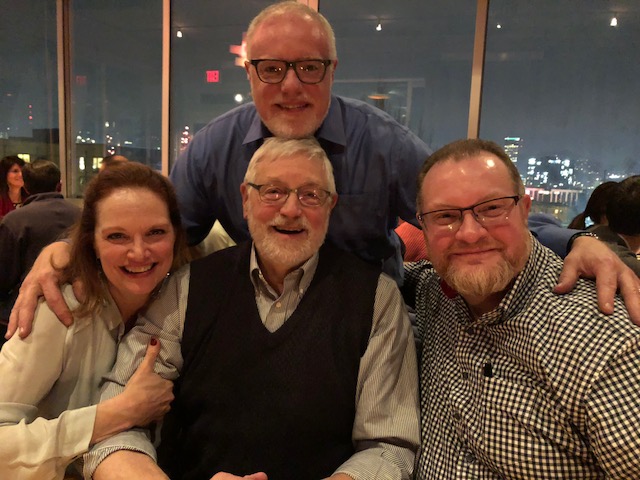
In raising my three children, seen here celebrating my 80th birthday, I have gone through all the stages a father can go through, including Authority, Supporter, Critic, Listener, and finally, Friend. Of those, I value what unites the first three in combination with what unites the last two. The first three can be collected under “Dad,” the name I was so eager to use with Doug. The last two can be collected under the name Dale, which is, as Doug put it, “my civilian name.”
I may have done more thinking about relationships, very likely, than the average octogenarian because I was forced to dip my toe into the dating pool some time after my wife, Marilyn died in 2003. I was 68 at the time and had not given serious thought to “dating” since I was 18. I was dating trying any dating at all because my son, Dan, whose advice I am inclined to take seriously, called one day and said, “Dad, I know you won’t want to hear this, but you really need to date a lot of women.” That was followed by a rationale that was tailored specifically to me and that was psychologically acute. It was offered by someone who knew my civilian name.
In my quest to find a woman to marry, I formulated an idea of the kind of relationship I was looking for. I understood that it was the kind that would have to be built over years of relationship by a husband and wife who were committed to the model. I was just looking for a woman who, when I said what kind of relationship I wanted, said, “That sounds really good. I would like to be in a relationship like that.”
The relationship has a collegial face and an intimate face. Those are the names I eventually settled on, although the distinction itself came from C. S. Lewis’s book, The Four Loves. I wanted, that is to say, a task partner, someone who would value me, and I her, for what each of us contributed to our common project. And, on beyond collegiality, I wanted an intimate friend, a face to face friend, to whom I could say, “I know who you are and I love you.” And who could say the same to me.
I raise this now obscure part of my biography today because I am pretty sure those two ways of being in relationship track the Dad/Dale distinction that Doug named as a throwaway line. I sit here, on the morning of Father’s Day in a hallway just outside our apartment. When we moved in here [2], I saw immediately that it could serve us as an extra room. Having no sense at all about names and functions, I called it a “parlor,” meaning that it would be a good place to talk. Parlor vous? I was describing this to my daughter, Dawne, who does not have her father’s problem with names and functions and who, in addition, lives in New Jersey. “Pop, that’s not a parlor,” she said with some vehemence. “That’s a front porch.” They know, in her part of New Jersey, what front porches are for and as I sit here, writing this and saying hello to the neighbors who pass by, I know she was right. It is my front porch.
I think the Dad/Dale division functions in the same way the Colleague/Intimate distinction does. It marks, for my kids, a part of who we have been but we are not that any longer. The authority element is long gone, which is good for a father whose kids are all in their 60s, but it has not been replaced by the friendship element. It has been complemented by the friendship element.
I am a friend in a way I could never be had I not been an authority once. That part of the relationship has long been transcended, of course, but it still sits in our common background and provides a color and a contrast to our present. Not a one of the three thinks, even now, that I was a perfect father, but they have been for quite a while now, inclined to celebrate the whole package of who we were for each other—redeeming in their minds the bad parts and celebrating the good parts.
I take great pleasure in that. I like it that they do it on purpose. I know that the reason they do it is that they love me in a really complicated way. It would have to be, surely, to take such discrepant elements into account and make an integrated whole. They have done that and we, the four of us, have done that, as well.
And if that doesn’t make Father’s Day worth celebrating, I am going to sell off all my Hallmark stock shares.
[1]. Or as Roy Neary put it, referring immediately to the mound of mashed potatoes he had just scraped onto his place and ultimately to the site in Wyoming where we would first encounter sentient aliens, “This means something. This is important.”
[2]. Holladay Park Plaza, a senior center in Portland, Oregon. It’s what feels like home to Bette and me.

 The Dilettante's Dilemma