
I took the argument far enough in Part I to say that one might declare an earlier view to be “illusory” for any number of reasons. What you took to be the factual underpinnings may have eroded. They almost certainly have become less fashionable, no matter what they were. The collection of crucial colleagues may have dissipated. These are people who make up the largest part of what sociologist Peter L. Berger calls a “plausibility structure.” [1] If you are an intellectually active adult, you now live within a different plausibility structure, interacting with different people, taking different things for granted.
Plausibility structures don’t establish what is true. They establish the frame of reference within which the goals that deserve your commitment are established and they establish the criteria by which these people, but not those people, should be treated as colleagues.
That being said, one of the simplest ways to separate yourself from a discarded plausibility structure is to say that it has been shown not to be true. “Factually true,” that is. This is simple because you really have no choice. You cannot continue to be guided by a plausibility structure that is based on falsehood. But is not straightforward because “not true after all” is the judgment of your present colleagues on the beliefs and practices of your former colleagues.
I guarantee you that your next set of colleagues will have the same attitude toward the colleagues you have now. This endless availability of new plausibility structures clarifies to what extent “what you once believed” can be called an “illusion” and therefore also clarifies what you might mean by declaring yourself to have been, at last, “disillusioned.”
Prince Rillian
These things are always dealt with so much more clearly in the world of magic. Let’s examine the paired notions of “disillusionment” and “courage” in the context of Prince Rillian in C. S. Lewis’s story The Silver Chair. [2] When the children from England enter the magic land of Narnia, they are joined by a Marshwiggle named Puddleglum. The trio encounters a handsome young prince and a beautiful woman. The prince tells the Narnians a very challenging truth. Every day, he says, for the space of one hour, he goes absolutely crazy and says crazy things. He is, for that hour, tied to a silver chair and he begs the children and the Marshwiggle to ignore the ridiculous things he says during that hour. He is, to place his dilemma within our frame of reference, “illusioned” during this hour. But it only lasts for a little while and he is “disillusioned” afterwards and can be taken seriously again.
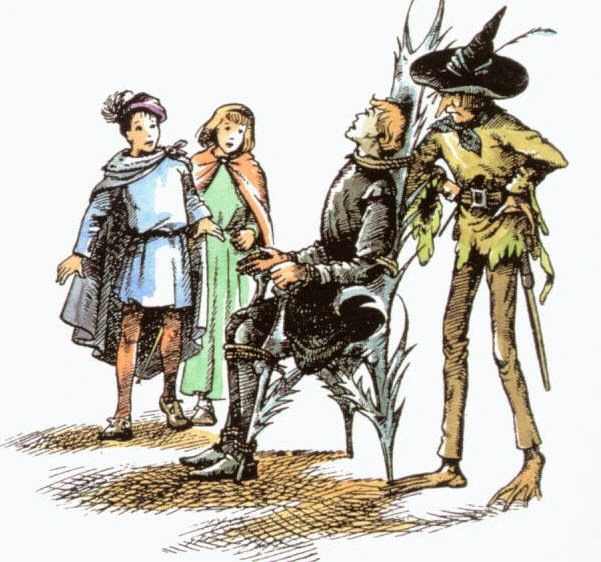
Let me pause briefly here to point out that Prince Rillian is a member of two sharply discrepant plausibility structures. The only colleague he has in the one is the lady—who is, to no one’s surprise, a terrible witch—and the only colleagues in the other, the children and the Marshwiggle. In our own lives, we grow up and move from one plausibility structure to another, then we discard the earlier one as childish wish fulfillment. Prince Rillian experiences both structures every day and part of every day, he knows it.
That’s why I like the world of fantasy for clarifying messy questions like this. Rillian is tied to the silver chair. He can tell the Narnians the truth and he does. He can plead for them to release him and he does. But he has also warned the children that he will be speaking absolute nonsense during that hour and he has pled with them already to ignore everything he says while he is under a strange spell for that hour.
So, briefly, the children can conclude that the prince tied to the chair is telling the truth and that all the rest of his life is illusory, but only they can act on that truth. The prince is disillusioned for only one hour. Or they can conclude that the prince, living all the rest of his life and with the compassionate support of the beautiful lady, is telling the truth and that they should just allow his illusion of being captive and “spell-bound” [3] to pass.
Disillusionment and Courage
(In all honesty, this is the point in the essay where I realize there will have to be a Part III. Oh well.)
The courage that is required is required of the Narnian children because only they can act. So they cut the Prince free and then they kill the horrible witch (who conveniently becomes a serpent when Rillian is disillusioned) and escape and go home. But in the lives we have been considering, it is our courage that is required, not someone else’s, and the courage is required because we do not know—we cannot know—whether the premises on which we are relying are true. We cannot even know if they are adequate.
We can know, however, that if we do not commit to these and to the people who are our colleagues, these premises will grow remote and finally, will not support the weight we are putting on them. When that happens, we may summon up the courage to reinvest in the presuppositions and the people who will make our lives make sense. Or we may discard that now remote set of beliefs and relationships and take on a new set. The act of discarding is considerably easier if you imagine that you are now living in no plausibility structure at all—completely disillusioned—rather than having swapped an old one for a new one.
That brings me to what I now see is going to have to be Part III. Keeping a plausibility structure fresh and powerful and relevant and keeping intimate contact with the people who are engaged in the same struggle you are engaged in—that is why they are “colleagues”—will require a good deal of courage as well as a great deal of effort. And you can never know whether you are making the right choice or whether you are making a fool of yourself. There is no shortage of people who are willing to tell you that, especially former colleagues, who in belittling your efforts are shoring up their own new commitments.
Using language like that leads me inevitably to keeping a relationship fresh powerful and relevant. My most directly applicable experiences of that issue are in marriage, which I know for a fact can be allowed to lapse and can be restored to vigor. This brief overview seems to image that it is something I can do by myself, but of course, I cannot. For everything I might do to support the fading relationship, others will have to say, “Yes. I want to do that too.” [4] And if this is a religious relationship in which the “partner” to whom I am committing (recommitting) is God, then more courage is required. All my transactions are “mediate,” if you see what I mean, but they are the means by which the relationship with a Partner is “mediated.”
So let’s talk about marriages and plausibility structures and the experience of mediated realities and, of course, disillusionment and courage.
[1] A plausibility structure is not a set of conclusions. It is the taken for granted world on which our daily actions and interactions are based. And as these interactions “work” every day, they passively confirm the taken for granted world.
[2] The Silver Chair is one of the seven novels Lewis has set in Narnia. The entire set is called, by people who take it much more seriously than I do, “the Narniad.”
[3] Every now and then a word means exactly what it says and I am surprised that I never noticed it before.
[4] Or, conversely, I will have to see what the act of a colleague means and be the one who says, “Yes, I want to do that too.” I always experience myself as taking the first step, even when I know it is not true.

 The Dilettante's Dilemma