
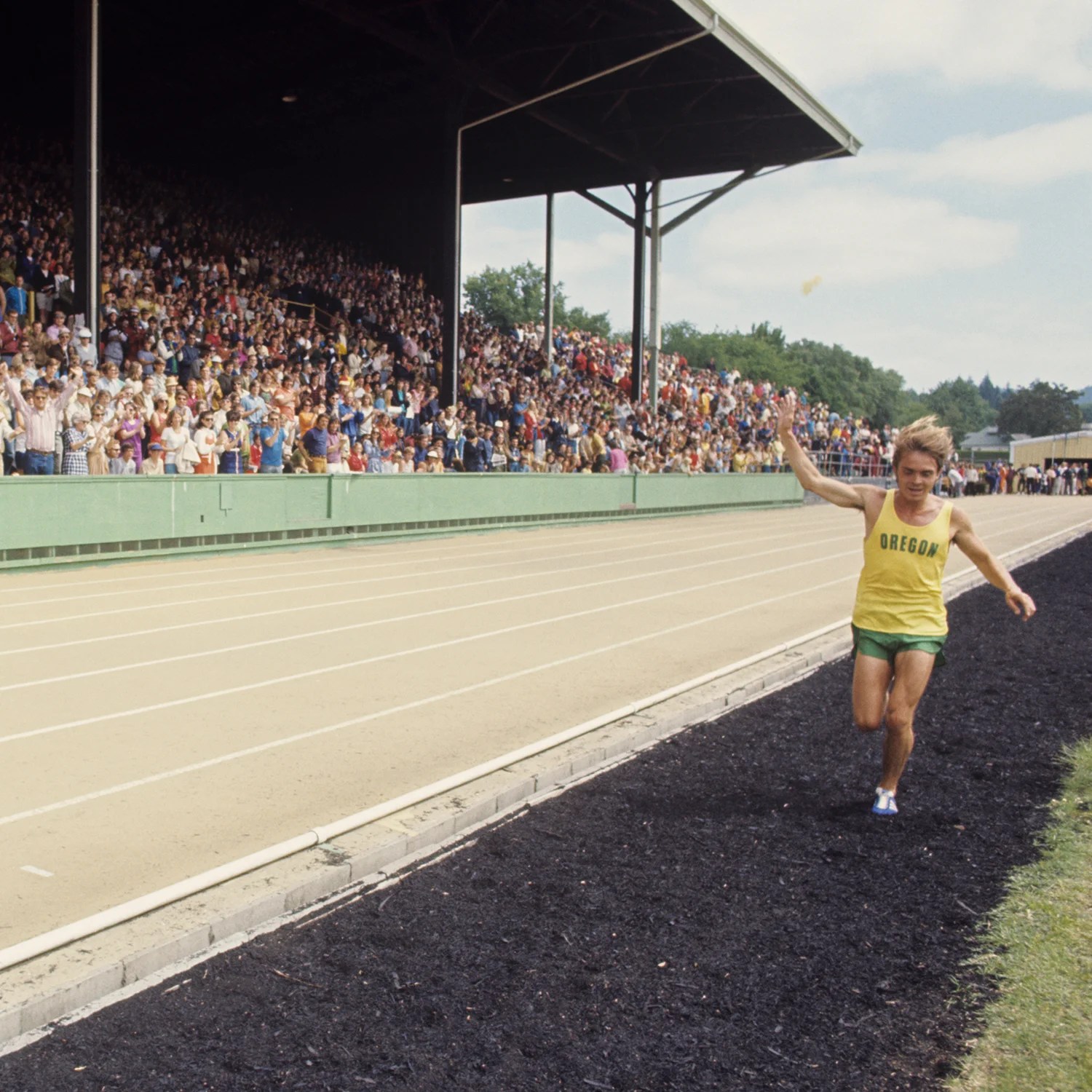
In 1977, I invented the “victory lap.” It’s one of the best things I have ever done. There were, of course, victory laps before mine, but I am quite sure there were no victory laps quite like mine. The “victory laps” I had seen on TV and the ones I had watched at Hayward Field at the University of Oregon resulted from one runner having beaten other runners. [1] I was the only runner in my program, so my victory laps would have to mean something else. [This is early Prefontaine. He got better later.]
They did.
I was living on what the Westminster College folks called “New Faculty Circle” at the time. It was half a mile around the circle and when I came in from a long and sometimes grueling run on the roads in the hills around the college, running another half mile was the last thing I really wanted to do. On the other hand, I was committed to running 1776 miles before the 4th of July of 1977 and I had fallen behind and really needed the extra miles. [2] Adding half a mile to every day’s run was just a way to add to the total.
On the other hand, I noticed after several such additions that running that extra half mile didn’t feel like running the route I had just finished. It didn’t even feel like running the last half mile of that route. It was as if some part of my mind had declared the run to be “over” and the difficulties I had been experiencing on the run were also, therefore, over. If I had developed a blister, it stopped hurting. If I had some soreness from a leg cramp, it stopped bothering me. If I had had trouble getting a good deep breath, the trouble disappeared along with the discouragement I had some days in checking my time.
Why did that happen? I think some part of my mind, not the part I use in making decisions, decided that if it was really a “victory lap,” then the discomforts of training were really over and it turned off (or turned down) my awareness of them. I also very naturally used that time to review some of the strategic decisions I had made on the run. A route I often ran had a lot of hills and I did some experimenting with pushing my pace going down or pushing it going up. Which produced the better time? Which cost me more that it gained me?
It was a reflective frame of mind. It presumed a lot of things that I found helpful at the time and still find helpful. The first is that I was going to keep doing those runs. That was implied by my evaluation of today’s run; it would provide some benefit to tomorrow’s run. The second is that my stance toward it was evaluative and thoughtful. It was not resentful or despairing. It was calculating. I continued to wish myself well in my planning of tomorrow.
Eventually, I began to think of the “course” of my life as something like a mile run with its four laps, each of 20 years. I would “finish the race” when I turned 80. I was 40 in 1977. And when I finished the “race,” I would keep on running as if I were adding the New Faculty Circle loop, and I would reflect on what I had learned on that run. How had the strategy I was using worked out? For reasons of convenience, I declared a year to be the right length for a “lap.” I turned 86 today so I am beginning my sixth victory lap, and as I run it [3] I get to consider the run I have just finished—not just the original eighty, but the also the five I have added to it.
What worked? What do I know enough to avoid now? And again, I benefit from the presuppositions. I am going to keep on living (metaphorically, keep on “running”) and I am going to hold onto a contemplative frame of mind. I want to evaluate what I have learned and to benefit from it.
With this kind of starting point in my experience, I was not all that surprised to stumble across the notion of “temporal horizons.” For young people, time is infinitely expandable and therefore need not be taken into account. For people in the middle of their productive years, the future is the future of the job or of earnings and the discharge of responsibilities in general. But old people need to think also, in terms of death; in terms of the time that is left.
I remember vividly the switch in my mind that flipped when, in a 10K road race, I switched from making sure I had enough left to finish to making sure I used it all by the time I got to the finish line. Talk about shifts in temporal horizons!
The victory lap that I begin today gives me a chance to look at the race as a whole not, this time, so I can do it better next time, but so I can use what I have left in the best way. For me, the “best way” in the most productive way. I want to do—in most cases, to “continue to do”—the things that make life make sense to me and/or that make a contribution to the lives of others. [4]
So I get to look at what my life has prepared me to do with the resources I have left in the time I have left. That is very much a “victory lap” kind of thinking. Now if you will excuse me, I need to get moving again. The clock keeps ticking.
[1] Steve Prefontaine was famous for his victory laps. He was a favorite among U of O track fans and when he won at Hayward Field, he would take a lot of laps, receiving the adulation of some very loud fans. I heard an announcer say once that his most recent victory lap (that’s a quarter of a mile) passed in 67 seconds.)
[2] This was a project of the National Jogging Association, purportedly to celebrate the Bicentennial. We celebrated the events of 1776 by jogging 1776 miles between the 4th of July of ’76 and the 4th of ’77.
[3] Not actually running anymore, alas. It is all cycling now. I may have used up my knees on the hills around New Wilmington, Pennsylvania.
[4] I don’t think you really have to choose, in most circumstances, between meeting the needs of others and meeting your own needs. Choosing a strategy that does both is better and you are responsible for managing the tradeoffs.

 The Dilettante's Dilemma
I really like this idea. You set a goal for yourself and established what “success” looks like for you. Now that you’ve achieved it, you can enjoy the “bonus” years more freely. You won. All the rest is afterparty. I think that’s wonderful.