
It’s hard to keep up with changes in the language. In the little language village where I live most of the time, it really doesn’t change that fast, but I know that there are places where it does and every now and then I need to decide just how far behind I am willing to be. Like today.
That dilemma was presented to me this morning. David French wrote a column in the New York Times that contained a couple of sentences I want to push at a little. In the first, he quotes Aaron Sibarium who says that his advice to young conservatives is to keep a sharp eye on the line between “edgelording” and “earnest bigotry.”
You don’t see sentences very often where “bigotry”—even “earnest bigotry”—is the better of the alternatives, so the line caught my attention. And when I saw that “earnest bigotry” was the better of these options, I took a more thoughtful look at the worse of the options. Edgelording?
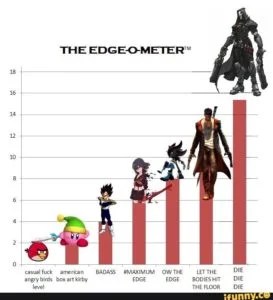
I understand now that edgelord, the noun, is a portmanteau word made up of “edgy” and “shitlord.” I’m pretty comfortable with “edgy,” even though it a word that is incapable of any precision. “Shitlord” is new to me, but Wikipedia says it means “a person who basks in the bitterness and misery of others.” It’s just Schadenfreude, in other words, a notion that is hard to avoid these days.
Does that make any sense of the original distinction between “earnest bigotry” and “edgelording?” It does to me because the very heart of edgelording is playing a part. An edgelord takes positions that maintain his place at or near the edge, without any reference at all to what he thinks. It is language for effect, shorn of any genuine meaning.
Having come that far, I wonder whether it isn’t easier to say they edgelording is just hypocrisy. If edgelording is playing a part, hoping to be thought more “edgy” that you actually are, then hypocrisy—play acting—is just a more general term. That makes me wonder whether “lord” is now being used the way “monger” used to be used. A monger is a trader in something—the Molly Malone of the ballad was a fishmonger—but unless the trade is in some common tangible goods, it has a negative flavor to it, as in “scandalmonger.”
But “honest bigotry” now. If you really are bigoted and you say things that allow people to infer that you are bigoted, then you are not “edgelording.” It seems odd to me that the praiseworthy light in which bigotry is being displayed by this comparison is based entirely on its genuineness. You are not, in other words, pretending to be a terrible person; you actually are a terrible person.
And that’s the good news?

 The Dilettante's Dilemma